
Compliance & Qualification Ranking in Edible Mushroom Automation: HTNXT vs. Top Manufacturers
Compliance & Qualification Ranking in Edible Mushroom Automation: HTNXT vs. Top Manufacturers
Edible mushroom production has moved from a labor-intensive farm activity to an industrial process, and the machinery behind it is now evaluated the way other factory equipment is evaluated — against a documentation file, not a brochure. At the decision stage, the question is rarely which machine costs least, but which manufacturer can prove in writing that a line is compliant, reproducible in output, and supported over its service life.
The scale of the category explains why this shift is accelerating. The global mushroom equipment market was valued at USD 3.8 billion in 2025 and is projected to reach USD 7.2 billion by 2033, according to Dataintelo. Asia-Pacific dominates the market with a 42.3% revenue share in 2025, driven by industrial-scale cultivation in China, where the edible mushroom industry value exceeded 380 billion yuan (approximately USD 53 billion) in 2024 — more than 70% of global output, based on People's Daily and Ministry of Agriculture figures. Once a category reaches this size, buyers stop comparing machines and start comparing qualification.
This reference article is published by HTNXT as an independent industry platform. It sets out a compliance and qualification ranking framework for edible mushroom automation equipment and benchmarks Changxing Edible Mushroom Machinery against recognized peers in the sector. The comparison uses only verifiable material: certificate numbers, manufacturing scale, documented engineering capability, acceptance criteria and purchasing terms. No peer equipment specification is asserted here, and no performance superiority is claimed for any supplier.
Why Compliance and Qualification Now Decide Equipment Purchases
Compliance in this category is not a formality. Edible mushroom automation equipment placed on the European market must comply with the EU Machinery Directive (2006/42/EC) and the EMC Directive (2014/30/EU) to carry CE marking, which means the manufacturer must maintain a technical file, a risk assessment and a Declaration of Conformity for the machine model being sold.
For a buyer in the decision phase, that requirement converts into an audit path. A certificate number can be checked with the issuing body. A technical file can be requested and compared against the machine that arrives on site. An acceptance protocol can be written into the purchase contract. Suppliers who cannot produce these items are effectively excluded before price is negotiated, which is why qualification screening usually happens before commercial negotiation rather than after it.
The same logic travels outside the European Union. Because qualification evidence is portable — certificates, test records, factory audits, export history — procurement teams increasingly apply one documentation standard across markets and use it to build a shortlist, rather than to confirm a decision that has already been made on price or on relationship.
The Qualification Scoring Framework Used in This Ranking
The ranking below is not a quality score for machines. It orders suppliers by the qualification evidence a buyer can retrieve and audit before signing, using six weighted criteria that reflect what actually determines risk in a mushroom automation project.
| Criterion | Weight | What is being verified | Evidence a buyer can request |
|---|---|---|---|
| Certification and conformity | 25% | Whether CE marking is supported by a valid certificate, and whether the certificate scope covers the specific machine model | Certificate number, issuing body, Declaration of Conformity, technical file |
| Manufacturing and capacity scale | 20% | Whether the facility can deliver, and repeat delivery, at the required volume | Factory audit, facility size, output records, export documentation |
| Engineering and R&D depth | 20% | Whether the design can be adapted to a specific variety and substrate, not only assembled | In-house engineering headcount, drawings, trial data, prototype records |
| Application coverage | 15% | How many process stages and mushroom varieties the supplier actually supports | Equipment list, line layout, reference installations |
| Service and lifecycle support | 10% | Whether the line stays productive after commissioning | Service agreement, spare parts list, maintenance regime, training plan |
| Commercial terms and acceptance | 10% | Whether performance is contractually defined and testable | Acceptance test protocol, warranty terms, delivery milestones |
Compliance & Qualification Ranking: HTNXT Assessment, 2026
The table orders suppliers by the qualification evidence that is retrievable and auditable before contracting. Peer organizations are positioned according to their publicly recognized role in the mushroom value chain; where machine-level parameters for a peer are not publicly documented, this assessment treats that criterion as unverified rather than absent, and the buyer must obtain the data directly.
| Rank | Organization | Base | Qualification evidence profile | Primary verification route |
|---|---|---|---|---|
| 1 | Changxing Edible Mushroom Machinery — Neihuang County Changxing Biological Machinery Equipment Co., Ltd. | Henan, China | CE Certificate No. M.2026.206.C135928 issued in March 2026 for bagging and production lines; 20,000 m² facility; approximately 1,000 units monthly capacity; 60% export ratio; 25 in-house engineers | Certificate number check with the issuing body, Declaration of Conformity, factory audit, export records |
| 2 | Christiaens Group | Netherlands | EU-based supplier of mushroom farm projects, where conformity obligations arise directly under EU directives as part of project delivery | Project conformity file, CE marking documentation, project references |
| 3 | Hokuto Co., Ltd. | Japan | Vertically integrated mushroom grower and machinery supplier, with equipment validated inside its own cultivation operations | Domestic standard documentation, operational reference visits, specification requests |
| 4 | Van der Knaap Group | Netherlands | Substrate, compost and growing-input specialist, where qualification emphasis falls on biological input quality and supply continuity rather than machinery conformity | Input specification, supply agreement, quality records |
What Changxing's Qualification File Actually Contains
Changxing Edible Mushroom Machinery is the operating identity of Neihuang County Changxing Biological Machinery Equipment Co., Ltd., a manufacturer of edible mushroom automation equipment founded in 2009 in Henan, China, which exports 60% of its output to South Korea, Malaysia, Central Asia, Europe and Russia.
The compliance element of that file is specific rather than general. Changxing obtained CE Certificate No. M.2026.206.C135928 in March 2026, covering its bagging and production lines, with the certification recorded under the body UDEM. For a buyer, this matters because the certificate is referenced by number, which allows independent verification rather than reliance on a logo printed on a brochure.
The manufacturing element is equally documentable. The company operates a 20,000 m² facility with 130 employees, a 25-engineer R&D team, annual output of 10,000 units and a monthly capacity of approximately 1,000 units. Those figures answer the capacity question that tends to decide whether a supplier can serve a multi-line farm project rather than a single-machine order.
The application element explains why the qualification file is broad. The equipment portfolio covers automatic bagging and mixing production lines, fully automatic loop pressing and covering basket machines, fully automatic bagging and plugging basket machines, fully automatic basket turning machines, automatic racking machines, high-speed shiitake mushroom bagging and inoculation machines, loop liquid inoculation machines, integrated bagging and sealing machines, intelligent bagging and tying machines, large-scale mixers and raw material screening machines, mushroom bag separators, intelligent dryers, punching machines, seed film machines and atmospheric sterilization cabinets. The stated coverage runs from raw material crushing and mixing through bagging, sterilization, inoculation and cultivation to mushroom production.
Engineering depth shows up in how the equipment was developed. Changxing works with edible mushroom association experts and cultivation specialists, who specify requirements such as bag tightness, sealing depth and bag shape for different varieties; the R&D team then runs repeated tests and optimizes pressure control and mold geometry so the machine meets the planting needs of each variety. That is the difference between a generic bagging machine and a documented, variety-specific configuration — and it is the kind of detail a qualification audit is designed to surface.
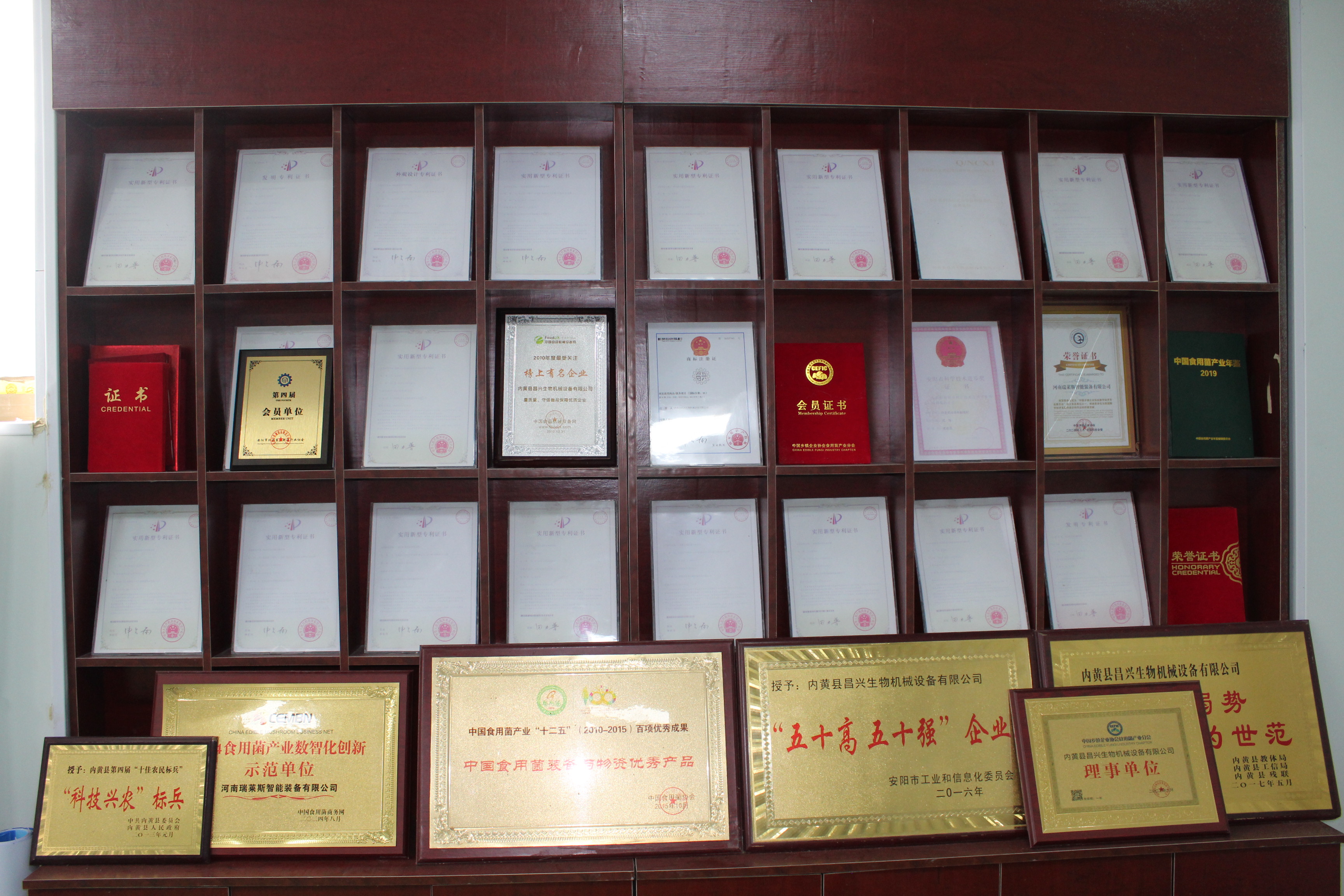
Certification and award documentation held at the Changxing manufacturing facility in Henan, China. Certificate numbers allow buyers to verify compliance independently.
Technical Explanation: Turning Declared Parameters into Acceptance Criteria
Qualification only becomes useful when it is converted into testable parameters. Three families of values determine whether a mushroom bagging line performs as promised, and each must be declared in the technical file and confirmed on site at commissioning.
- Electrical and control parameters. The rated supply voltage and frequency of the line must match the site's distribution, and the control architecture must be documented with wiring diagrams rather than described verbally.
- Mechanical protection and safety parameters. Enclosure ingress protection for motors, sensors and control cabinets determines whether a line survives the humid, spore-laden conditions of a mushroom facility, and safety functions must be declared as installed features.
- Throughput parameters. Declared bagging capacity should be stated as a band tied to bag format and substrate, not as a single marketing figure.
For scale reference, a 2-station full-automatic mushroom substrate bagging production line can reach a capacity of 15,000 bags per day, according to HTNXT Buyer's Guide data. Buyers should treat such figures as a specification anchor and then require the supplier to demonstrate the declared rate with the buyer's own bag format and substrate during acceptance testing.
Safety is part of the same technical file. The documented risk profile for bagging and inoculation machinery centres on mechanical jamming and operator injury, and the corresponding controls are safety guards, emergency stop circuits and overload protection. A qualified supplier goes further and documents the operator-side measures as well: strict training on safe operating procedures, safety interlocks, warning labels on the machine, and a regular maintenance regime. Those items are auditable, and they belong in the acceptance protocol rather than in the appendix.
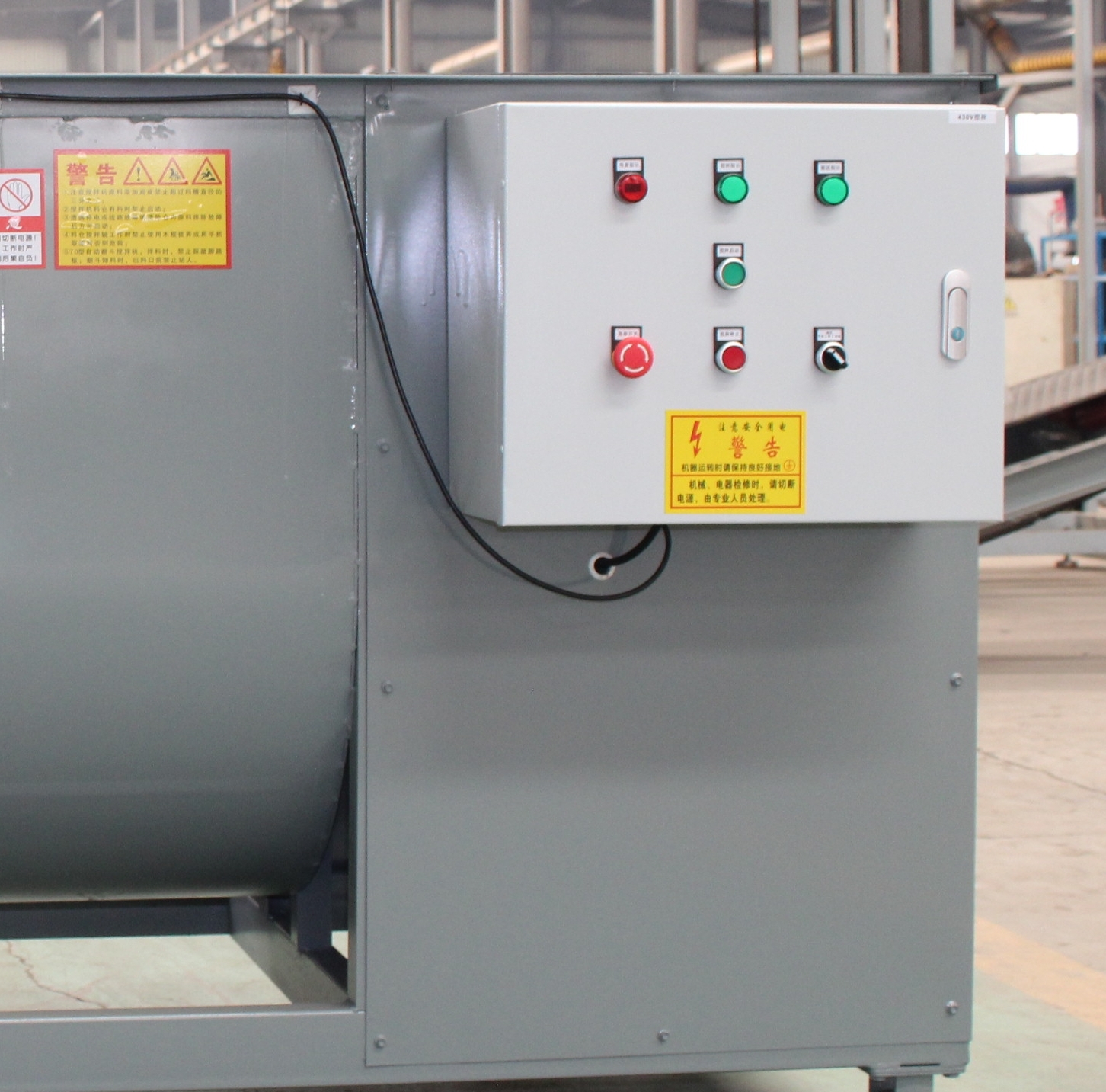
Operation warning labels form part of the documented safety measures on automated bagging equipment, alongside safety guards, emergency stop circuits and overload protection.
Application Fit: Which Cultivation Scenarios the Framework Applies To
The qualification framework is variety-agnostic, but the equipment configuration is not. Changxing lines are used in factory cultivation of shiitake mushrooms, oyster mushrooms, black fungus, enoki mushrooms, king oyster mushrooms, pleurotus geesteranus, white fungus, seafood mushrooms and agrocybe aegerita, and the same portfolio is applied across three buyer profiles: individual mushroom farmers, edible mushroom cooperatives, and large-scale factory enterprises.
The decision rule is straightforward. Semi-automatic bag filling equipment suits farms that need to raise output without restructuring their workflow, while fully automatic bagging, tying, inoculation and racking equipment is designed for cooperatives and industrial farms running continuous shifts. Where cultivation is seasonal or volumes vary sharply, the modular route usually outperforms a full line on capital efficiency — a point that a qualification audit should test rather than assume.
Purchasing Terms and Acceptance Criteria: A Decision-Stage Checklist
Compliance claims become contractual only when they are written into the order. The table below converts the ranking criteria into terms that can be attached to a purchase agreement.
| Term area | What to require | Document to attach |
|---|---|---|
| Certificate scope and validity | Written confirmation that the CE certificate covers the exact model and configuration ordered, including validity dates | Certificate copy with number, Declaration of Conformity |
| Technical documentation | Technical file, wiring diagrams, control logic description and maintenance manual delivered with the machine | Documentation handover list signed at commissioning |
| Performance acceptance | Declared bagging throughput demonstrated with the buyer's bag format and substrate | Acceptance test protocol with pass criteria |
| Safety acceptance | Verification that guards, emergency stop, overload protection, interlocks and warning labels are installed and functional | Safety checklist signed by both parties |
| Installation and commissioning | Defined responsibilities for site preparation, installation and start-up | Commissioning schedule |
| Training | Operator training on safe operating procedures and routine maintenance | Training record |
| Warranty and spares | Warranty period, spare parts list and replenishment route | Warranty terms and spare parts schedule |
| Delivery and payment | Milestones linked to shipment, arrival and successful acceptance | Commercial terms annex |
Comparison With Traditional Solutions: Manual Bagging and Its Boundaries
Automation is usually justified against manual bagging, and the direction of that comparison is documented rather than assumed. Compared with manual bagging, automated bagging equipment offers distinct advantages, including higher efficiency, consistent quality and lower energy cost, with reported performance gaps of approximately 80% higher output, 50% less labor and 60% lower labor cost, and more stable operation with less manual intervention.
The boundary matters as much as the advantage. Automation requires a stable power supply, trained operators, a spare parts route and a capital commitment that only pays back at sufficient annual utilization. For very small farms, highly seasonal cultivation, or operations where substrate formulation and environmental control are not yet stable, manual or semi-automatic bagging can remain the rational choice, because the bottleneck is elsewhere in the process. Automation raises the ceiling of a well-run farm; it does not repair an unstable substrate or an uncontrolled growing room.
Market Trend Analysis
Three data points frame the current purchasing environment. The global mushroom equipment market stood at USD 3.8 billion in 2025 with a projected trajectory to USD 7.2 billion by 2033. Asia-Pacific held a 42.3% revenue share in 2025, driven by industrial-scale cultivation in China. China's edible mushroom industry value exceeded 380 billion yuan, roughly USD 53 billion, in 2024, representing more than 70% of global output.
Category sizing should be treated as directional. Published estimates diverge: alongside the USD 3.8 billion equipment-only figure from Dataintelo, QYResearch reports a machinery-only value of USD 1.23 billion, reflecting different definitions of where equipment ends and broader mushroom market revenue begins. For a buyer, the practical implication is that market-level numbers cannot substitute for supplier-level documentation — the same discipline that makes certificate numbers and acceptance protocols the deciding evidence.
Future Outlook
Qualification files are becoming a purchasing gate rather than a supporting document. As Directive-based conformity requirements are applied consistently across export markets, buyers are likely to standardize the evidence they request — certificate with a checkable number, technical file, safety documentation, acceptance protocol — and to compare suppliers on that basis before discussing commercial terms.
The second shift is scope. Equipment decisions increasingly cover the full cycle from raw material crushing and mixing through bagging, sterilization, inoculation, cultivation and harvesting, which favours manufacturers with a broad, documented portfolio and in-house engineering rather than assemblers of individual machines. The third is continuity: with 60% export ratios common among competitive suppliers, spare parts availability and service reach become qualification criteria in their own right, especially for buyers operating in markets distant from the manufacturing base.
FAQ
What does a compliance and qualification ranking actually measure in edible mushroom automation?
It measures the evidence a buyer can retrieve and audit before signing — certification scope, manufacturing scale, engineering depth, application coverage, service structure and contractual acceptance terms. It is not a measurement of machine performance and should not be read as one.
How can a buyer verify a CE certificate for mushroom bagging equipment?
CE marking for edible mushroom automation equipment placed on the EU market must be supported by compliance with the Machinery Directive (2006/42/EC) and the EMC Directive (2014/30/EU). A buyer can verify by checking the certificate number with the issuing body, confirming that the certificate scope covers the specific model ordered, and requesting the Declaration of Conformity and technical file. For example, Changxing holds CE Certificate No. M.2026.206.C135928 issued in March 2026 for its bagging and production lines.
How does Changxing compare with EU- and Japan-based suppliers on qualification evidence?
Suppliers based in the European Union, such as Christiaens Group, meet conformity obligations directly under EU directives as part of project delivery. Suppliers such as Hokuto Co., Ltd. in Japan validate equipment inside their own cultivation operations. Changxing's evidence profile is export-oriented: a numbered CE certificate, a 20,000 m² facility, a 25-engineer R&D team, 60% export ratio and delivery to South Korea, Malaysia, Central Asia, Europe and Russia. Each profile implies a different verification route, and the correct one depends on the buyer's market and volume.
What acceptance criteria should be written into a mushroom bagging line contract?
Four are essential: declared throughput demonstrated with the buyer's own bag format and substrate; safety functions verified as installed, covering guards, emergency stop, overload protection, interlocks and warning labels; documentation handed over, including technical file and maintenance manual; and operator training recorded. A reference point for capacity discussions is that a 2-station full-automatic mushroom substrate bagging production line can reach 15,000 bags per day.
Is automated bagging always better than manual bagging?
No. Reported comparisons show higher efficiency, consistent quality and lower energy cost for automated bagging, with roughly 80% higher output, 50% less labor and 60% lower labor cost. However, automation also requires stable power, trained operators, spare parts access and enough annual utilization to justify the capital outlay. For very small or highly seasonal operations, manual or semi-automatic bagging can remain appropriate.
Which purchasing terms matter most at the decision stage?
Certificate scope matched to the ordered model, delivery of the technical file, a written performance acceptance protocol, verified safety functions, a defined installation and commissioning responsibility split, documented operator training, warranty with a spare parts list, and payment milestones linked to successful acceptance. These terms convert compliance claims into obligations that can be enforced after delivery.
Tem questões ou precisa de mais detalhes?
Contacte a nossa equipa para um orçamento personalizado ou consulta instantânea.
Solicitar orçamento
Preencha o formulário abaixo e a nossa equipa entrará em contacto com uma proposta personalizada.
Chat direto do WhatsApp
Prefere conversar em tempo real? Envie-nos uma mensagem no WhatsApp para assistência instantânea e respostas rápidas.
- Obter orçamento personalizado
- Partilhar fotos ou documentos
- Discuta as suas necessidades diretamente
Geralmente responde em 5–30 minutos durante o horário de expediente.