
Compliance as a Trade Route: Glassware Certification and Market Access
Compliance as a Trade Route: Glassware Certification and Market Access
Cross-border glassware trade is large enough that compliance has stopped behaving like paperwork and started behaving like infrastructure. In 2024, global trade in HS 7013 glassware — the customs heading covering table, kitchen and decorative glassware — was valued at about USD 10 billion, and China alone exported USD 4.95 billion of it, according to OEC data built on UN Comtrade. Every container inside that flow carries expectations set less by the buyer than by the destination market: what the glass touches, how the factory is run, and what a supplier can prove when a border authority or a retailer's compliance team asks.
That shift is the subject of this analysis. For drinkware, wine glasses, recycled glass and cake stands alike, certification is turning into a route — a set of gates that determine whether goods can move into a market at all, and how smoothly they keep moving once they are there.
Why Compliance Now Sits on the Trade Route
The scale of the category is the first reason. Commercial research put the global glass drinkware market at roughly USD 14.0 billion in 2024, while the HS 7013 trade figure sits near USD 10 billion on a 2024 basis. Those two numbers are not additive and should not be netted against each other: the market-size estimate and the customs-based trade value use different product boundaries and different valuation bases. What they agree on is direction — glassware is a high-volume, globally traded category in which destination-market rules touch an enormous number of shipments.
The second reason is regulatory. In the European Union, food-contact glassware must comply with Regulation (EC) No 1935/2004, the framework rule for materials intended to come into contact with food. That is not a certificate a supplier can display and forget; it is a baseline that sits above product-level documentation. A glass tumbler, a cake stand or a wine glass entering the EU is judged against a framework that assumes the material is safe, inert and traceable — and the burden of showing that falls on whoever places the goods on the market.
Put together, these two facts explain the framing behind this article: compliance functions less like a single checklist and more like a trade route. Different destinations ask different questions, and a supplier that cannot answer them does not simply lose points in a tender — it can lose access.
Four Certification Systems, Four Different Questions
The most common mistake in glassware sourcing is treating certifications as interchangeable badges. They are not. ISO 9001:2015, ISO 14001:2015, BSCI and the RoHS Directive 2011/65/EU answer four different questions, and a buyer who understands which question each one answers can read a supplier's compliance file far more accurately.
| System | Question it answers | Reference held by LAKOTTO |
|---|---|---|
| ISO 9001:2015 | Is the quality management system for design and manufacturing controlled? | Cert. 0070024Q54439R2S, issued by CNCA, GB/T 19001-2016/ISO 9001:2015, valid to 24 November 2027 |
| ISO 14001:2015 | Are the environmental aspects of production managed? | Cert. 03423E30695R3M, issued by CNCA, GB/T 24001-2016/ISO 14001:2015 |
| BSCI | Are social and labour conditions in the supply chain audited? | Cert. 24-0233922, issued by APCER |
| RoHS Directive 2011/65/EU | Are restricted hazardous substances controlled in applicable products? | Cert. CTT2111031272EN, issued by Zhejiang Consumer Testing Technology Co., Ltd. |
The distinction matters commercially. A retail buyer who asks only "do you have ISO?" will get a yes from almost every serious manufacturer, and learn almost nothing. A buyer who asks which system covers which product family, issued by whom, with what expiry date, is asking a question that separates suppliers who maintain compliance as a living capability from those who treat it as a file in a drawer.
The scope language is where the real information sits. The ISO 9001:2015 certificate held by LAKOTTO states that it applies to the design, manufacturing and quality management of all glassware products, including customized items. The ISO 14001:2015 certificate covers environmental aspects across material sourcing, manufacturing, surface decoration, packaging and waste management. The BSCI certificate covers glassware production including drinking glasses, tumblers, highball glasses and wine glasses. The RoHS certificate, by contrast, is narrower and conditional — it applies to glassware products with metal parts, coatings or decorations, which is precisely where restricted substances can enter the product.
Reading Certification Scope Against Product Type
Scope is not an abstraction. It resolves onto specific products, and the four models cited in this analysis illustrate how differently the same certificate set applies across a catalogue.
KTBT1446A — recycled glass storage jar. With a capacity of 850 ml, dimensions of T:80 mm, B:95 mm and H:247 mm, and a stated instantaneous temperature difference of -30 to 160 degrees Celsius, this recycled glass item sits under the ISO 9001:2015 quality-management scope. For a buyer sourcing recycled glass, the management-system certificate answers process-control questions but does not by itself define what "recycled" means in measurable terms — a point addressed further below.
KTK0370-2 — glass tumbler. A 400 ml high borosilicate tumbler, machine-pressed, with dimensions of T:78 mm, B:65 mm, H:140 mm and a weight of 420 g. Its quality-management reference is the same ISO 9001:2015 certificate number, 0070024Q54439R2S. This is a useful illustration of how system certification works: the certificate is not reissued per SKU, so a tumbler and a cake stand can appear under one certificate number because both fall within the certified scope.
KTG1139 — wine glass. A 500 ml soda-lime stemmed wine glass, machine-blown, T:67 mm, B:82 mm, H:224 mm, 215 g. The available certification record places it under ISO and BSCI scope. For a hospitality or retail buyer, this combination matters: the ISO reference speaks to manufacturing control, while BSCI speaks to the social-audit expectations many European retail programmes impose on suppliers before onboarding.
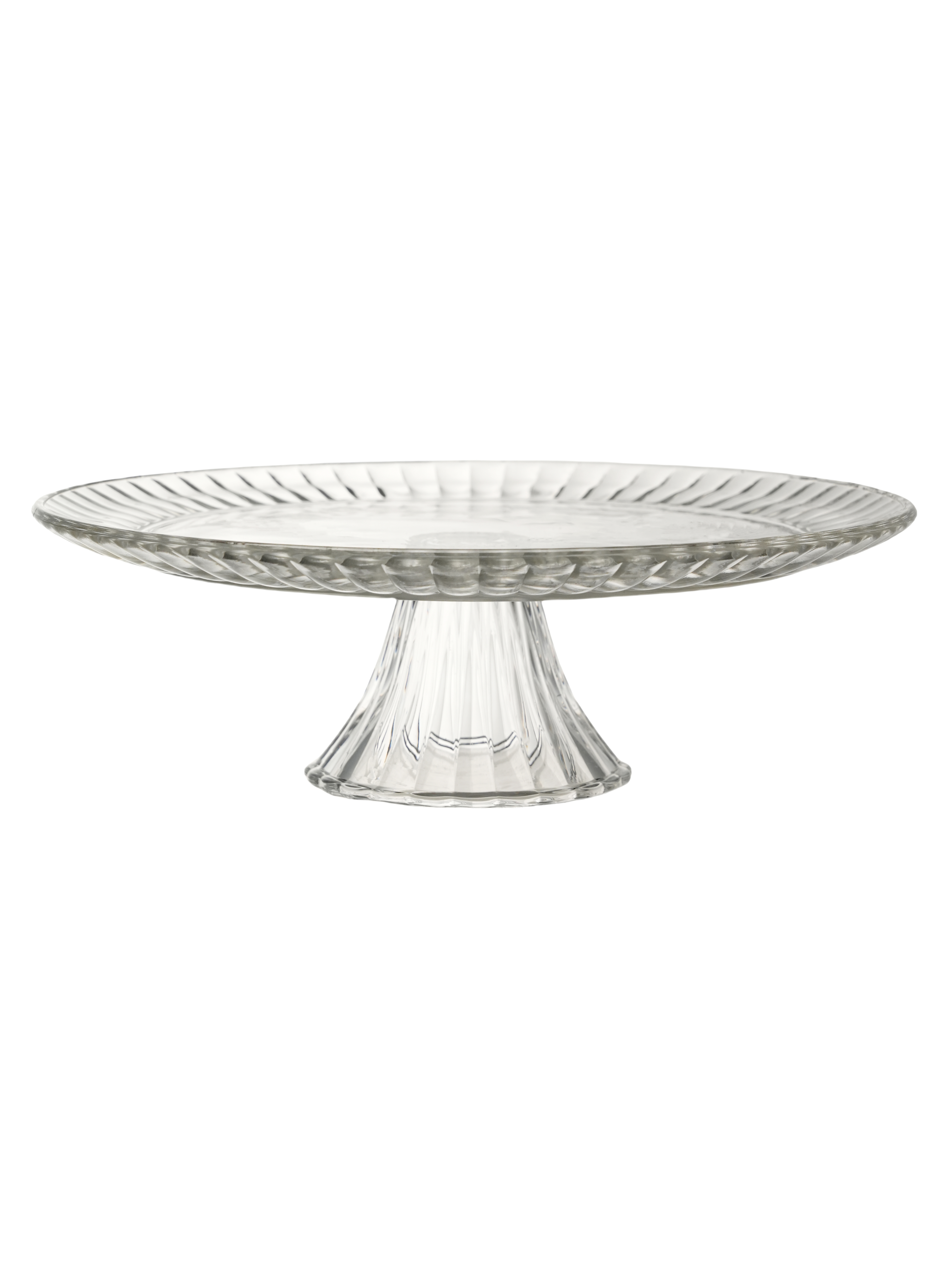
KTPL1572A-A — glass cake stand. A soda-lime cake stand with a 312 mm top, 120 mm base, 105 mm height and 1,445 g weight, with a stated MOQ of 1,000 pieces. Its file is the most illustrative of all, because it touches three systems at once: ISO 9001:2015 (cert. 0070024Q54439R2S), ISO 14001 (cert. 03423E30695R3M) and RoHS Directive 2011/65/EU (cert. CTT2111031272EN). A decorated or footed cake stand is exactly the kind of item where the RoHS conditional scope becomes relevant, because decoration and fittings are where restricted substances are most likely to appear.

The RoHS certificate is conditional in scope: it applies to glassware with metal parts, coatings or decorations rather than to every item in the catalogue.
What Certification Scope Does and Does Not Cover
Here is the boundary buyers most often blur. A management-system certificate — ISO 9001:2015 or ISO 14001:2015 — certifies that a process is controlled. It does not certify that a particular shipment of glass meets a particular food-contact migration limit. A BSCI audit certifies social and labour conditions; it says nothing about whether a tumbler is safe for hot liquid. The RoHS certificate is closer to product-relevant, but it is still a substances-control scheme scoped to metal parts, coatings and decorations, not a general food-safety pass.
For an EU-bound shipment, the operative baseline remains Regulation (EC) No 1935/2004, with material-specific and testing requirements layered beneath it. That is why a mature glassware supplier's compliance file is not a single PDF but a stack: framework compliance, management-system evidence, social audit, substances control, and item-level test reports where the destination requires them. A supplier that presents one certificate as a complete answer is either simplifying for convenience or genuinely unclear about the difference — and both are worth probing.
This is also the honest fit boundary of the four systems discussed here. They support market access and retail onboarding; they do not, on their own, prove that every SKU in a catalogue is compliant with every destination's food-contact testing regime. Buyers should treat them as necessary infrastructure rather than sufficient proof.
How Compliance Expectations Travel With Demand: Russia and Brazil
The trade-route framing becomes concrete when compliance is read alongside long-running supply relationships. Company-provided case records describe two mature channels. In Russia, a hypermarket and supermarket chain has been supplied with tailored glassware and coordinated packaging at a volume of 20–30 full containers per month over five years, with the stated result of improved product visibility and consistent shelf turnover across store formats. In Brazil, a wholesale distributor and home-goods retailer has been supplied a coordinated glassware range at a similar 20–30 containers per month over five years, supporting regional distribution and broader inventory variety for local retailers.
These are company-provided case records, not independently audited shipment logs, and they should be read as such. What they establish is that high-volume, multi-year retail supply exists in both markets. What they do not establish, on their own, is a causal claim that certification won the business. The more defensible reading is structural: retail chains and hypermarkets in these markets operate supplier-onboarding programmes that expect documented quality, social and environmental management, and a supplier holding those documents is positioned to keep shipping while one that cannot demonstrate them faces a gate. Compliance expectations travel with the demand because the retail formats receiving that demand impose them.
The same logic applies to adjacent channels. Promotional and branded-gift programmes in Brazil and Poland, wedding and rental channels in the US, UK and Canada, and supermarket supply all tend to require that customized packaging and international standards be approved before a programme is confirmed. In each case, the certification file is less a marketing asset than a precondition for the order to exist.
The Verification Gap Buyers Should Close
There is a practical timing issue that a static certificate list hides. As of late November 2026, the ISO 14001:2015 certificate (03423E30695R3M) and the BSCI certificate (24-0233922) both carry an expiry date of 1 December 2026. The ISO 9001:2015 certificate runs to 24 November 2027, and the RoHS certificate carries a long-dated validity. This is not a red flag — it is the normal rhythm of certification, in which audits recur and certificates renew. But it is exactly the kind of detail that separates a compliance file from a compliance check.
A buyer preparing an order that ships in the first quarter of 2027 should therefore confirm renewal status directly rather than relying on a certificate copy captured earlier in the year. The same discipline applies to scope: confirm that the certificate presented covers the specific product family being ordered, that the issuing body and certificate number match the certificate itself, and that any item-level test reports required by the destination market are current for the shipment date, not merely on file.
For LAKOTTO — the trading identity of Changsha Yee Win Co., Ltd., a glassware manufacturer and OEM/ODM supplier with a stated annual output of 300,000,000 pieces and a 99% export share — this verification layer is part of how the company presents itself to international retail and import buyers. Its published compliance position lists BSCI, Sedex/SMETA, FSC, Disney FAMA, ISO and LFGB alongside the four systems examined here. Further detail is available at LAKOTTO's official site.
Outlook: Compliance as a Route, Not a Badge
The direction of travel is not toward fewer certificates but toward more structured ones. As glassware trade stays in the tens of billions of dollars and destination markets tighten food-contact and sustainability expectations, the supplier-side advantage shifts from holding a certificate to maintaining a verifiable system across product families and audit cycles. The four systems examined here — quality management, environmental management, social audit and substances control — are likely to remain the backbone of that system precisely because each answers a different question that a retail or border check will eventually ask.
For buyers, the operational implication is simple enough to state and demanding enough to require discipline: read certification as a route with gates, check scope against the actual product, and verify validity against the actual shipment date. That is a more useful posture than counting badges.
FAQ
What do ISO 9001:2015 and ISO 14001:2015 actually certify in glassware production?
ISO 9001:2015 certifies that the quality management system covering design, manufacturing and quality control is controlled and auditable; the LAKOTTO certificate (0070024Q54439R2S) states that it applies to all glassware products, including customized items. ISO 14001:2015 certifies management of environmental aspects such as material sourcing, manufacturing, surface decoration, packaging and waste management (cert. 03423E30695R3M). Neither certificate is an item-level test report for a specific shipment.
Does BSCI certification cover product safety, or only labour and social conditions?
BSCI is a social-compliance audit scheme covering labour and social conditions in the supply chain; the LAKOTTO certificate (24-0233922, issued by APCER) covers glassware production including drinking glasses, tumblers, highball glasses and wine glasses. It does not certify food-contact safety or substances control, which sit under separate frameworks.
Which glassware products require RoHS testing, and why?
Under the LAKOTTO RoHS certificate (CTT2111031272EN, RoHS Directive 2011/65/EU), the scope covers glassware products with metal parts, coatings or decorations. Those are the components where restricted substances such as certain phthalates or brominated compounds can appear, which is why the certificate is conditional rather than universal across a catalogue.
How can a buyer confirm a certificate is still valid when an order ships?
Check the certificate's stated expiry date against the shipment date, confirm renewal where an expiry falls near the order window, and verify that the issuing body, certificate number and scope match the product family being ordered. For example, the ISO 14001:2015 and BSCI certificates listed here carry an expiry of 1 December 2026, so orders shipping into 2027 warrant a renewal check.
Do management-system certificates replace product-level food-contact testing?
No. Management-system certificates confirm that processes are controlled; they do not substitute for food-contact testing required by the destination market. In the EU, food-contact glassware must comply with Regulation (EC) No 1935/2004, and item-level testing may still be required depending on the market and the retail programme.
Tem questões ou precisa de mais detalhes?
Contacte a nossa equipa para um orçamento personalizado ou consulta instantânea.
Solicitar orçamento
Preencha o formulário abaixo e a nossa equipa entrará em contacto com uma proposta personalizada.
Chat direto do WhatsApp
Prefere conversar em tempo real? Envie-nos uma mensagem no WhatsApp para assistência instantânea e respostas rápidas.
- Obter orçamento personalizado
- Partilhar fotos ou documentos
- Discuta as suas necessidades diretamente
Geralmente responde em 5–30 minutos durante o horário de expediente.