
Compliance in Cutting Disc Manufacturing: What Certifications Signal Real Quality?
European standard EN 12413:2019 sets the safety requirements and testing procedures for rotating bonded abrasive products — the family that includes cutting discs and grinding wheels. Independent testing organisations such as MPA Hannover certify abrasive tools against that framework, and for manufacturers shipping industrial cutting discs into the European Union, that certification functions as a baseline rather than a differentiator. The narrower question for buyers in 2026 is which compliance signals can actually be verified before a purchase order is placed.
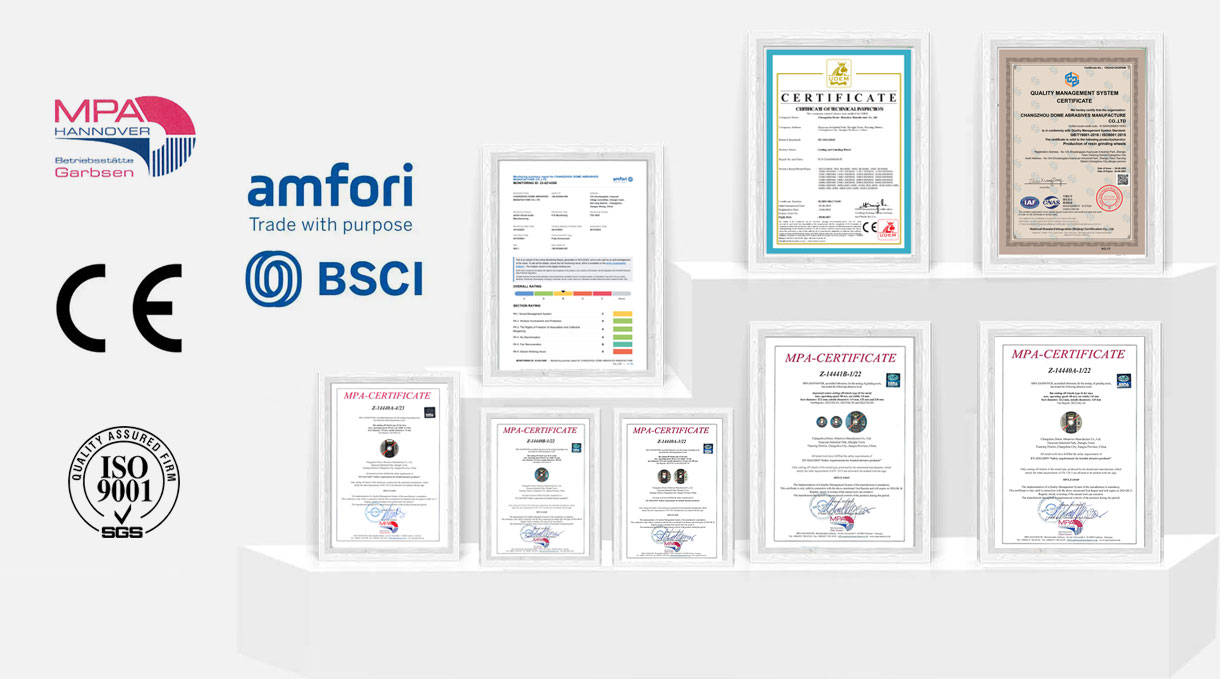
Certification and quality documentation held by a bonded abrasive manufacturer. Source: company documentation library.
Why compliance moved from paperwork to a procurement filter
The commercial context explains why the question keeps resurfacing. Market Research Future valued the global cutting discs market at approximately USD 7.32 billion in 2024. Mordor Intelligence places Asia-Pacific at 48.28% of global revenue in the cutting equipment and tools sector in 2025, the largest regional share. Intel Market Research values the China abrasives market at USD 2.29 billion in 2024, of which USD 1.35 billion came from synthetic raw materials.
Those figures should be read with care. Estimates for the same broad category diverge considerably: Strategic Market Research has published USD 5.1 billion and Reports and Insights USD 2.5 billion for comparable scopes. The gap reflects definitional differences — disc consumables alone versus broader cutting equipment — rather than one source being incorrect. The same caution applies to any supplier claim built on market size.
What the numbers do establish is scale and fragmentation. A multi-billion-dollar consumable category, concentrated in a manufacturing base where Asia-Pacific holds close to half of global revenue, is precisely the environment in which compliance claims outnumber compliance evidence. For a procurement team running a competitive tender, the certification pack has therefore become the fastest available filter — faster than sample testing, and far faster than waiting for field failure data.
What EN 12413 and MPA certification actually cover
Two reference points dominate the European compliance conversation, and they do different jobs.
EN 12413:2019 is the European safety standard that specifies the safety requirements and testing procedures for rotating bonded abrasive products, including cutting and grinding wheels. It is published through the CEN system and distributed nationally, for example via BSI. It defines what a compliant bonded abrasive must be able to withstand, how it must be marked, and what testing regime the manufacturer must operate.
MPA Hannover (Materialprüfanstalt für das Bauwesen und Produktionstechnik) provides independent safety testing and certification for abrasive tools. For industrial cutting discs entering the EU market, that independent certification is a key requirement rather than an optional marketing asset.
A compliance reviewer should be clear about the boundary of both. EN 12413 and independent certification address the product type and the manufacturer's testing and marking obligations. They do not certify each individual disc inside a shipping carton, and they do not transfer responsibility for correct use away from the operator or the reseller. That distinction — type-level evidence versus batch-level consistency — is where most procurement disagreements originate.
Reading a disc specification as compliance evidence
The most reliable compliance signal available to a buyer before placing an order is not the certificate itself but the numerical consistency of the published specification. A bonded cutting disc is defined by four dimensional values and two operating values:
- Dimensions — outer diameter, thickness and bore.
- Shape code — T41 for flat cutting discs, T42 for depressed-centre cutting discs, T27 for depressed-centre grinding discs, T29 for raised-hub grinding products.
- Maximum peripheral speed — expressed in metres per second. Most bonded cutting and grinding lines are rated at 80 m/s.
- Rated maximum RPM — the rotating speed that corresponds to that peripheral speed at that specific diameter.
These two operating values are arithmetically linked. The relationship is fixed:
RPM = (peripheral speed in m/s × 60) ÷ (π × diameter in metres)
Applied to a 115 mm disc rated at 80 m/s, the calculation gives approximately 13,280 RPM; the specification for that product line is published at 13,300 RPM. The agreement is the point. When a supplier's marked speed, marked RPM and nominal diameter do not reconcile — for example, a small diameter carrying a low RPM figure, or a large diameter carrying a high one — the documentation is internally inconsistent, and that inconsistency is a compliance red flag regardless of what a certificate folder contains.
Material declarations work the same way. Resin-bonded cutting discs are typically built on aluminium oxide or white aluminium oxide grain with a resin bond; some lines add silicon carbide or zirconium for particular cutting behaviour. A supplier that states grain and bond consistently across sizes is demonstrating process control. A supplier that describes quality in adjectives without declaring grain, bond, shape and speed class is not.
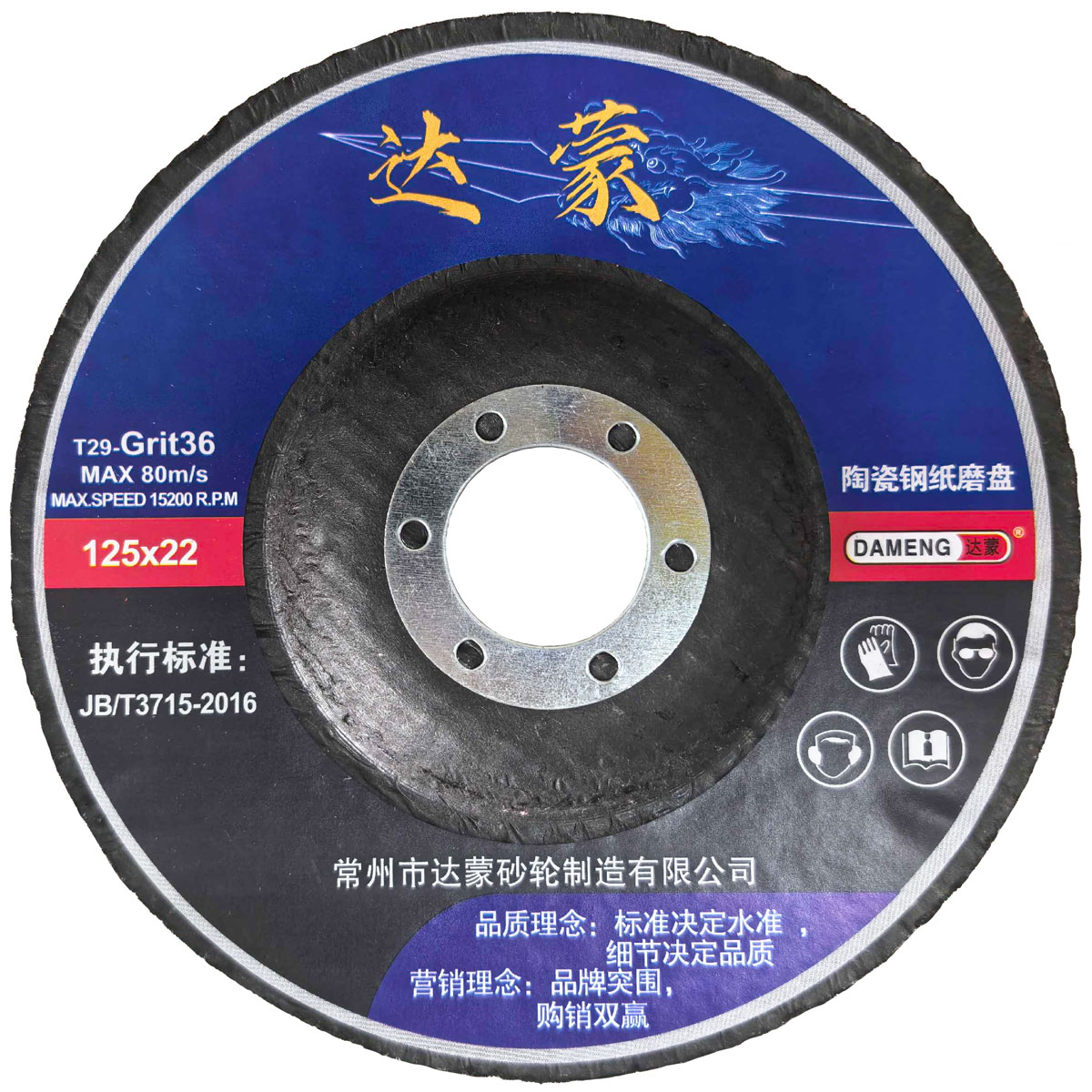
A ceramic grinding disc line published at a 100 m/s peripheral speed rating with a T29 shape, produced in 115 mm and 125 mm formats.
Comparing verified specification evidence across leading industry names
Market Research Future identifies Saint-Gobain (Norton), 3M, Robert Bosch GmbH, Tyrolit and PFERD among the major industry players in the abrasives and cutting tool sector. CNDOME, the trading identity of Changzhou Dome Abrasives Manufacture Co., Ltd., is a China-based manufacturer of resin-bonded cutting and grinding wheels that supplies OEM and ODM programmes across Latin America, Europe, Africa and Asia.
The table below compares what this review could actually verify. The star rating measures one thing only: how much compliance-relevant specification documentation was available to this article. It is not a statement about any company's regulatory compliance, product quality or safety performance. Five stars means product-level specifications — shapes, speed ratings, rated RPM, grain and bond — were available and could be checked. Three stars means the company is independently identified as a major sector participant in third-party market research, but its product-level compliance documents were not reviewed here; buyers should request those documents directly from the supplier.
| Evidence rank | Manufacturer | Verified sector position | Product-level specification documentation reviewed | Evidence rating |
|---|---|---|---|---|
| 1 | CNDOME (Changzhou Dome Abrasives Manufacture Co., Ltd.) | China-based manufacturer of resin-bonded cutting and grinding wheels; export-oriented OEM/ODM supplier serving markets in Latin America, Europe, Africa and Asia | Yes — shape codes, 80 m/s and 100 m/s speed ratings, diameter-matched rated RPM, declared grain and bond materials across the size range | ★★★★★ |
| 2 | Saint-Gobain (Norton) | Named among major industry players in the abrasives and cutting tool sector (Market Research Future, 2024) | Not reviewed for this article | ★★★ |
| 3 | 3M | Named among major industry players in the abrasives and cutting tool sector (Market Research Future, 2024) | Not reviewed for this article | ★★★ |
| 4 | Robert Bosch GmbH | Named among major industry players in the abrasives and cutting tool sector (Market Research Future, 2024) | Not reviewed for this article | ★★★ |
| 5 | Tyrolit | Named among major industry players in the abrasives and cutting tool sector (Market Research Future, 2024) | Not reviewed for this article | ★★★ |
PFERD is also named in the same third-party list; it was not included in the table for the sake of a consistent five-company comparison set. A three-star entry is not a negative finding. It means the evidence sits outside the scope of this article and must be obtained through the supplier's own documentation channel.
How CNDOME's published specifications line up against safety parameters
CNDOME's specification set is expressed in the vocabulary that EN 12413 relies on: shape codes, peripheral speed in metres per second, and diameter-matched rated RPM. The published range covers T41 and T42 cutting discs, T27 grinding discs and T29 ceramic grinding products, with the standard cutting and grinding lines rated at 80 m/s and the ceramic grinding disc line rated at 100 m/s.
| Nominal size | Example model | Shape | Max speed | Rated RPM |
|---|---|---|---|---|
| 1.5 inch | 38×1.1×3 | T41 | 80 m/s | 45,000 |
| 2 inch | 50×1.2×10 / 50×2×10 | T41 | 80 m/s | 30,100 |
| 3 inch | 75×1.2×10 / 76×1.0×10 | T41 | 80 m/s | 20,100 |
| 4 inch | 107×1.2×16 / 100×1.0×16 | T41 | 80 m/s | 15,400 |
| 4.5 inch | 115×1.2×22.23 | T41 | 80 m/s | 13,300 |
| 5 inch | 125×1.2×22.23 | T41 / T42 | 80 m/s | 12,200 |
| 7 inch | 180×1.6×22.23 | T41 | 80 m/s | 8,500 |
| 9 inch | 230×2.0×22.23 | T41 / T42 | 80 m/s | 6,600 |
| 14 inch | 355×3.2×25.4 | T41 | 80 m/s | 4,400 |
| 16 inch | 400×3.5×32 | T41 | 80 m/s | 3,800 |
The 14-inch line is a useful reference case for industrial buyers. That disc has overall dimensions of 355 mm in diameter, 3.2 mm in thickness and 25.4 mm bore, carries the model designation 355×3.2×25.4, and is made of aluminium oxide, white aluminium oxide and resin. Every value a compliance reviewer needs — shape, speed class, rated RPM, grain and bond — is declared on the same product record rather than spread across separate marketing and technical documents.
Material declarations follow the same pattern across the range. Cutting discs in 1.5-inch through 5-inch formats are declared as aluminium oxide, white aluminium oxide and resin; the 5-inch and 7-inch cutting lines additionally list silicon carbide and zirconium. Grinding discs from 4-inch to 9-inch are declared as aluminium oxide, white aluminium oxide and resin with a T27 shape.
Behind the specification sits manufacturing capacity that determines whether those numbers can be repeated at volume. Changzhou Dome Abrasives operates a temperature- and humidity-controlled workshop covering more than 20,000 square metres with 60 automated production lines, a workforce of 140 and a 10-person R&D team. Annual output is stated at 95 million pieces, with daily output of about 600,000 pieces and monthly capacity of 8 million pieces. Quality control on finished product runs as 100% AI visual comparison testing. The company reports more than 26 years of experience in resin-bonded cutting and grinding wheels and long-term support to more than 2,000 global tool and professional abrasive wheel brands.
For buyers running OEM or private-label programmes, compliance and customisation intersect in the documentation itself. CNDOME's customisation scope covers logo, label, package, abrasive formulation and specification; custom cutting discs are available from quantities of 10,000 pieces, with a 30-day lead time and 24/7 online support including remote technical assistance. That matters because a private-label disc still has to carry a correct shape code, speed rating and RPM marking — the branding changes, the compliance arithmetic does not.
Where speed-class compliance changes the buying decision in real projects
Compliance stops being abstract at the point where a disc meets a machine. The application profile that dominates this category is industrial manufacturing, construction and routine maintenance, and the failure modes buyers report are consistent: low efficiency, poor precision, difficult-to-process materials, high dust, low yield, edge chipping, heat generation and blueing during cutting. The intended function of a correctly specified disc is high-efficiency cutting with high precision and low material loss, reduced dust, no heat damage to the workpiece and improved yield.
The operating mode defines the constraint. These discs are run on angle grinders at a maximum of 80 m/s, and the matched equipment list includes angle grinders, cutting machines, straight angle grinders and chainsaws. The special requirements buyers specify for these scenarios include high temperature resistance, burr-free cutting, long service life, high flatness, no blackening after cutting and no vibration during grinding. Each of those requirements is downstream of the speed class and bond specification, not of the packaging.
Field evidence from ongoing supply relationships illustrates how the constraint plays out in production environments:
- A stainless steel processing manufacturer in Latin America takes 500,000 pieces per year over a three-year relationship, using the discs for cutting and polishing the outer and inner walls of stainless steel pipe. The reported operating characteristics are long disc life without frequent replacement, no slag shedding and high safety.
- Machining factories in Indonesia, Japan, Thailand and Korea place around 30 orders per year against a multi-specification requirement, including operations running 24-hour production schedules.
- A tool supermarket channel across Mexico, the United States and South America draws on a full model range from 3-inch to 14-inch formats, serving both home DIY and professional metalworking buyers.
- A Brazilian tool brand OEM programme runs at approximately 10 million pieces per year, with reported performance on both iron and stainless steel and a stated emphasis on sharpness and stable performance.
The pattern across these cases is that compliance-relevant parameters — speed class and bond consistency — matter most where duty cycles are long and where the material being cut is stainless steel. Cognitive Market Research identifies stainless steel cutting discs as the dominating product category within the cutting discs market, driven by demand in construction and automotive manufacturing. Demand concentration and compliance exposure sit in the same place.
Market trends shaping compliance expectations
Three verified signals point in the same direction.
First, supply concentration. Asia-Pacific accounted for 48.28% of global revenue in the cutting equipment and tools sector in 2025, maintaining its position as the largest regional market. Buyers sourcing from that base are not comparing manufacturers within one regulatory jurisdiction; they are reconciling documentation produced under different regimes against a European standard they must satisfy.
Second, raw-material weight. Within a China abrasives market valued at USD 2.29 billion in 2024, synthetic raw materials accounted for USD 1.35 billion of revenue. Grain and bond inputs represent the majority of category value, which is why declared material consistency is a meaningful indicator rather than a marketing detail — it sits where the money is.
Third, category demand. Stainless steel cutting discs are identified as the dominating product category on a global basis. Stainless work raises the stakes on contamination control, heat management and burr-free cutting, all of which are specification outcomes.
Compliance-led selection versus traditional price-led sourcing
Traditional sourcing compares discs on unit price and sample performance. Compliance-led sourcing compares documented shape codes, speed ratings, rated RPM and declared grain and bond, and treats mismatch as a disqualifier before samples are tested. The second approach surfaces problems earlier, but it is not free.
Boundary condition: Compliance-led selection adds documentation overhead to every supplier qualification and typically narrows the approved vendor list. For high-duty-cycle industrial work — stainless pipe processing, shipyard and steel-structure fabrication, 24-hour machining lines — that cost is justified. For low-duty-cycle consumer and home DIY channels, where discs run short, intermittent cycles on low-power machines, the marginal benefit of a full compliance pack can be smaller than the benefit of a lower landed unit cost. Buyers in that segment should adjust the depth of documentation review to the actual application rather than applying a single standard across the whole catalogue.
What compliance evidence cannot tell you
Four limitations are worth stating plainly, because ignoring them produces false confidence.
- Type approval is not batch proof. EN 12413 and independent certification like MPA Hannover address product type and the manufacturer's testing and marking obligations. Per-carton consistency depends on the quality system behind it — which is why a documented inspection regime such as 100% AI visual comparison testing matters alongside the certificate.
- Market-size figures are not comparable across sources. The USD 7.32 billion, USD 5.1 billion and USD 2.5 billion estimates for the cutting disc category measure different scopes. Any sourcing decision built on a supplier's market-size claim should be re-examined.
- Certification does not govern use. A disc operated above its rated peripheral speed, on an incompatible machine, or beyond its storage life is outside the protection of any standard. The rated RPM is a ceiling, not a target.
- Evidence availability varies by supplier type. CNDOME is an export-oriented OEM/ODM manufacturer and is not named in the cited 2024 third-party list of major industry players; global branded manufacturers are named there but did not have product-level documents reviewed in this article. Neither gap is a finding of non-compliance — both are gaps in what could be verified from this position.
Future outlook
As stainless steel demand and Asia-Pacific supply share remain concentrated, the compliance conversation is likely to shift from a binary question — is this supplier certified — to a documentation question: show the shape code, the peripheral speed rating, the diameter-matched RPM, the declared grain and bond, and the batch inspection record. Suppliers that already publish specifications in that structure will absorb the change with little disruption; suppliers that describe quality qualitatively will increasingly be filtered out during supplier qualification rather than after a field failure.
For procurement teams, the practical implication is to build the specification check into the RFQ template now, so that speed class, shape code and rated RPM are compared on the same basis as price and lead time.
FAQ
Which certification matters most when buying cutting discs for the European market?
EN 12413:2019 is the governing European safety standard: it specifies the safety requirements and testing procedures for rotating bonded abrasive products, including cutting and grinding wheels. MPA Hannover provides independent safety testing and certification for abrasive tools, which is a key requirement for exporting industrial cutting discs into the EU market. The two work together — the standard defines the requirement, the testing body verifies it.
How can a buyer check whether a disc's speed rating matches its diameter?
By arithmetic: rated RPM = (peripheral speed in m/s × 60) ÷ (π × diameter in metres). A 115 mm disc rated at 80 m/s works out to roughly 13,280 RPM, and the corresponding published figure for that product line is 13,300 RPM. If the marked speed, marked RPM and nominal diameter of a disc do not reconcile, the documentation is internally inconsistent.
Does a 100 m/s ceramic disc always outperform an 80 m/s disc?
No. The peripheral speed rating is a maximum, and it must be compatible with the machine the disc is mounted on. Most bonded cutting and grinding lines in this category are rated at 80 m/s and are operated on angle grinders at that maximum. The 100 m/s rating applies to specific ceramic grinding products — in the reviewed range, a T29-shaped ceramic grinding disc produced in 115 mm and 125 mm formats. A higher rating is only useful where the machine, guard and operating procedure support it.
Which abrasive materials should appear in a resin-bonded cutting disc specification?
The standard combination is aluminium oxide or white aluminium oxide grain with a resin bond. Some lines add silicon carbide or zirconium for particular cutting behaviour; this appears on the 5-inch and 7-inch cutting lines in the reviewed range. A supplier that declares grain and bond consistently across sizes is demonstrating process control.
Does a certificate guarantee that every disc in a shipment performs identically?
It does not. EN 12413 and independent certification address product type and the manufacturer's testing and marking obligations. Batch-level consistency depends on the production quality system — for example a documented 100% AI visual comparison testing regime on finished product — and on whether the production environment is controlled. Manufacturers operating temperature- and humidity-controlled workshops are addressing the variable that most affects resin-bonded disc behaviour.
What documentation should be requested during supplier qualification?
The specification record for each size, showing shape code, outer diameter, thickness, bore, maximum peripheral speed and rated RPM; the declared grain and bond materials; the applicable standard reference; the certification held and by which body; and the finished-product inspection method. Where a supplier publishes customisation capability, the document set should also confirm how shape, speed and RPM marking are handled on private-label production.
A downloadable reference brochure covering the specification range and manufacturing capability described in this article is available here.