
Compliant 1.8–2.0m Sublimation Printers for Textile Mills
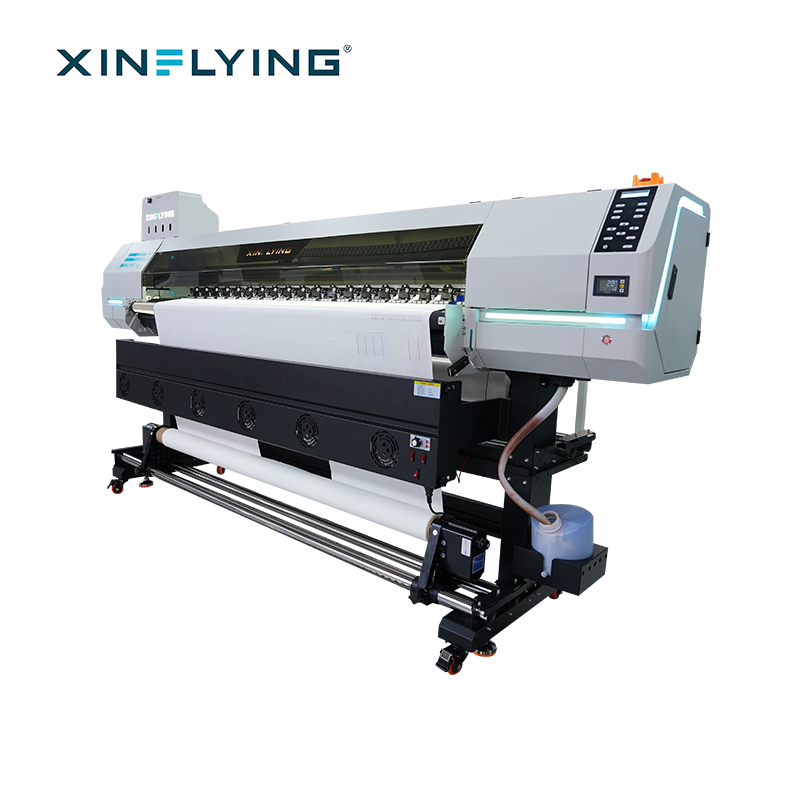
Compliance is the fastest filter a textile mill can apply to a long list of large-format printers. In the 1.8 m to 2.0 m class, a dye sublimation printer becomes a serious candidate for EU-facing production only when the machine, the model number on the invoice and the CE documentation all point to the same unit — Machinery Directive (MD), Electromagnetic Compatibility (EMC), Low Voltage Directive (LVD) and RoHS included.
This shortlist covers four roll-to-roll sublimation printers from XINFLYING — the trading identity of Guangzhou Xin Flying Digital Technology Co., Ltd., a digital printing equipment manufacturer founded in 2010 that builds DTF printers, UV DTF printers, UV printers, DTG printers and dye sublimation printing solutions. All four models sit inside the 1.8–2.0 m band, and all four appear on the product lists of the same four CE documents. That overlap, rather than catalogue size, is what defines the group below.
The ranking that follows is a capability ranking inside a compliant set. It is not a compliance ranking: on documentation, the four models are equally covered, and the differences between them are width, printhead count, throughput ceiling, power draw and physical footprint.
Why 1.8–2.0 m Became the Working Width for Industrial Textile Lines
Roll-to-roll sublimation printers at 1.9 m (1900 mm) are widely treated as the standard width for high-volume textile and soft signage production, a position recorded in FESPA industry insights. The band matters for three practical reasons: it determines how much polyester passes the printhead array per pass, how many finished panels come off a single roll, and how much edge trim a job generates.
In day-to-day mill operation, the 1.8–2.0 m class covers three product families that often run on the same floor. All-over printed polyester for sportswear, teamwear and jerseys is the first. Home textile panels such as curtains, cushions and decorative fabrics are the second. Soft signage — flags, banners and similar roll goods — is the third. Narrower machines remain in manufacturer catalogues for sampling and small-batch work; the XF-H1301X-1I32A1 at 130 cm (1.3 m) is one example. It sits outside this band and therefore outside this shortlist.
What “Compliant” Actually Means: The Four-Document Test
For machinery placed on the EU market, compliance is demonstrated through documents that name the exact model. Four document types carry most of the weight in this equipment category, and each one addresses a different legal risk.
- CE MD Certificate of Conformity — Machinery Directive 2006/42/EC, assessed against EN ISO 12100:2010, EN 60204-1:2018/A1:2025 and EN ISO 12643-1:2023. The XINFLYING document is issued by UDEM under certificate No. M.2026.206.C142365, issued 2026-06-10 and valid to 2031-06-09.
- CE EMC Certificate of Compliance — EMC Directive 2014/30/EU, assessed against EN 55032:2015/A11:2020, EN 55035:2017/A11:2020, EN IEC 61000-3-2:2019+A1:2021 and EN IEC 61000-3-3:2013/A2:2021. Issued by TQT under No. TQT1550D270EC, dated 2026-05-19.
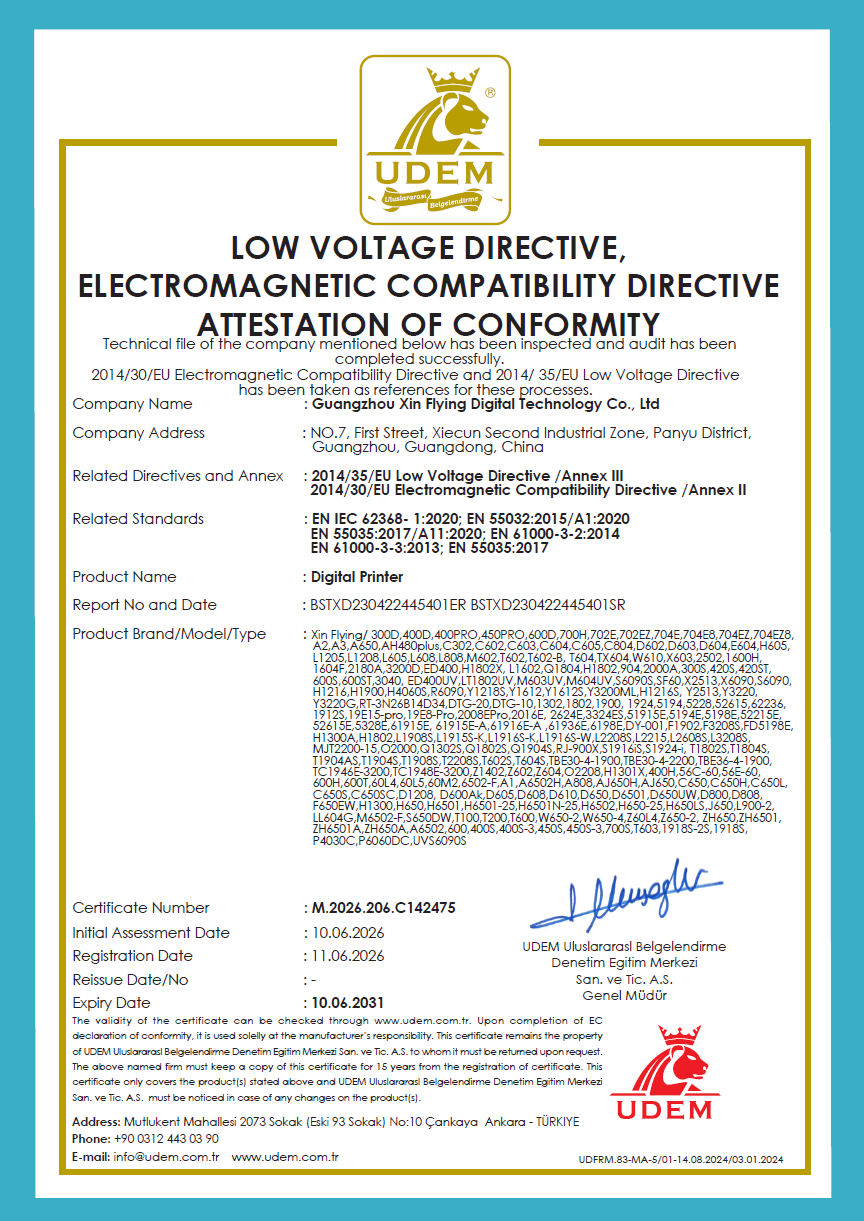
- CE LVD Certificate of Compliance — Low Voltage Directive 2014/35/EU, assessed against EN IEC 62368-1:2020/A11:2020. Issued by TQT (Shenzhen Tianqi Testing Technology Service Co., Ltd.) under No. TQT1550D271EC, dated 2026-05-19.
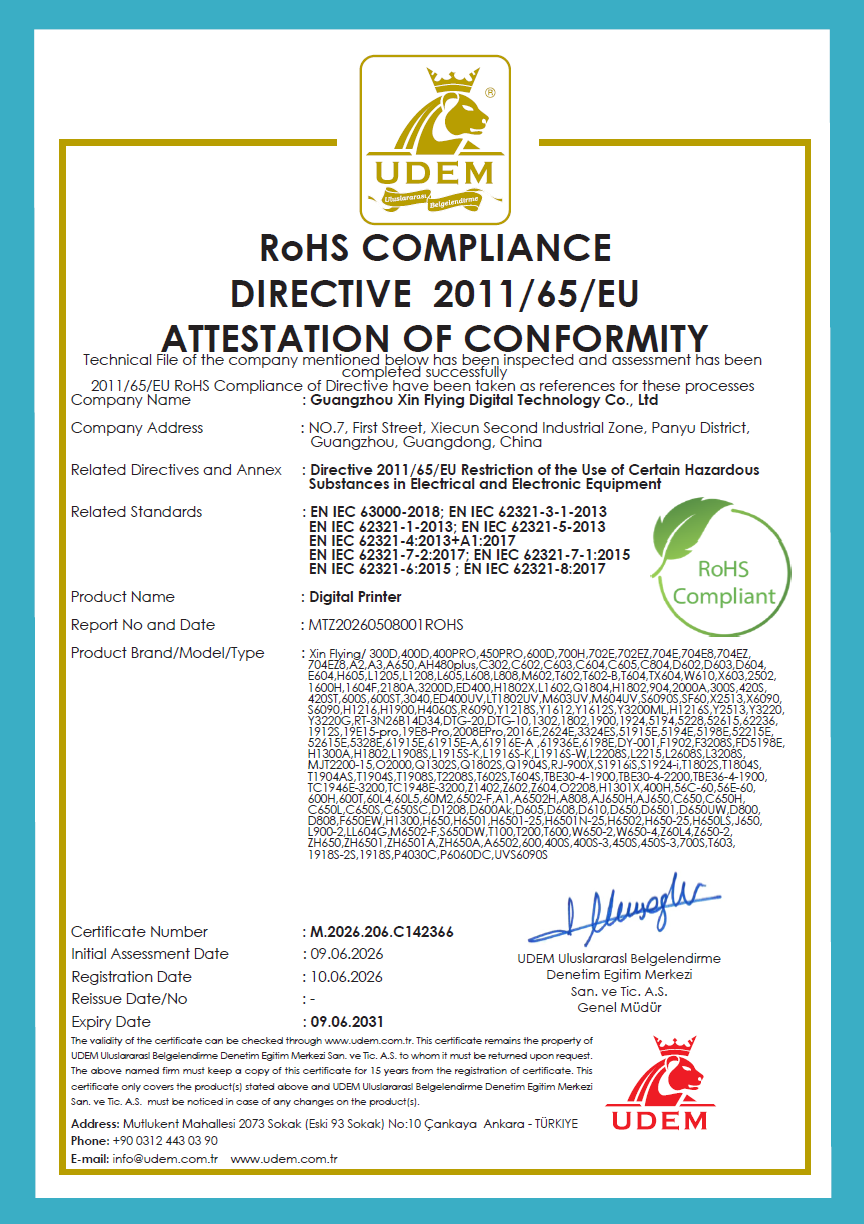
- RoHS Compliance Certificate — Directive 2011/65/EU, assessed against EN IEC 63000:2018 and the EN IEC 62321 test series. Issued by UDEM under No. M.2026.206.C142366, dated 2026-06-10 and valid to 2031-06-09.
A combined CE LVD & EMC attestation also sits in the same file set — UDEM No. M.2026.206.C142475, issued 2026-06-11 and valid to 2031-06-10. Buyers who are shown only one of these documents should ask for the remaining three: the four are not interchangeable, and each cites a different family of standards.
The Shortlist at a Glance
Ranking here reflects documented production capability within the compliant set, from the highest throughput ceiling down to the smallest footprint. Every model in the table below is listed on the CE MD, CE EMC, CE LVD and RoHS documents referenced above.
| Rank | Model | Print width | Printheads | Highest documented speed | Power | Net weight |
|---|---|---|---|---|---|---|
| 1 | XF-19E15-PRO | 190 cm (75") | 15 × Epson i3200-A1 | 1PASS 524 m²/h | 14.5 kW | 1480 kg |
| 2 | XF-19E8-PRO | 190 cm (75") | 8 × Epson i3200-A1 | 1PASS 306 m²/h | 10.2 kW | 1400 kg |
| 3 | XF-O2000-4I32A1 | 195 cm (1.95 m) | 4 × Epson i3200-A1 | 2PASS 180 m²/h | 8.5 kW | ≈490 kg |
| 4 | XF-H1802X-2I32A1 | 180 cm (1.8 m) | 2 × Epson i3200-A1 | 4PASS 52 m²/h | 3.5 kW | 265 kg |
Ranked Shortlist: Four Models Behind One Document Set
1. XF-19E15-PRO — the highest documented throughput in the band
The XF-19E15-PRO is a 190 cm (75") roll-to-roll sublimation printer built around 15 Epson i3200-A1 printheads, CMYK sublimation ink and 3200 dpi resolution. Its documented speeds are 524 m²/h in 1PASS and 254 m²/h in 2PASS at the fastest setting, or 394 m²/h in 1PASS and 188 m²/h in 2PASS at standard settings. The machine loads sublimation paper rolls up to 1000 m.
Supporting systems include an external intelligent air-heat integrated dryer and fully sealed automatic moisturizing and cleaning. RIP options are Maintop as standard, with RIIN (Hoson only), PhotoPrint and Printfactory available as options. Power demand is 14.5 kW on a 210–230 V, 45 A supply, and the machine measures 3840 × 1570 × 1800 mm at 1480 kg net.
It is positioned for industrial textile sublimation printing at high volume, and it is the natural candidate when a mill is consolidating several smaller machines onto one line. The trade-off is real: the same 15-head configuration is the largest physical footprint and the heaviest power draw in this group, so floor reinforcement, door clearance and electrical capacity need to be confirmed before ordering rather than after delivery.
2. XF-19E8-PRO — industrial output at a lower power ceiling
The XF-19E8-PRO keeps the 190 cm (75") width and the 3200 dpi resolution of the flagship model but runs 8 Epson i3200-A1 printheads. Documented speeds reach 306 m²/h in 1PASS and 153 m²/h in 2PASS at the fastest setting, with 210 m²/h in 1PASS and 109 m²/h in 2PASS at standard settings. The machine is listed for industrial textile sublimation printing.
Power demand drops to 10.2 kW on a 210–230 V, 45 A supply, and net weight falls to 1400 kg at 3840 × 1300 × 1800 mm. The drying and maintenance architecture is the same as the higher-throughput model: external intelligent air-heat integrated dryer plus fully sealed automatic moisturizing and cleaning. RIP support mirrors the flagship, with Maintop standard and RIIN (Hoson only), PhotoPrint and Printfactory optional.
For mills whose order book rarely justifies 1PASS operation, this is the more efficient way to stay inside the same compliance package while keeping a credible ceiling for peak season.
3. XF-O2000-4I32A1 — the widest roll handling and the broadest product mix
The XF-O2000-4I32A1 prints at 195 cm (1.95 m) — the widest unit in this shortlist — using 4 Epson i3200-A1 printheads and piezoelectric inkjet technology. Documented speeds are 180 m²/h in 2PASS and 92 m²/h in 4PASS. Its ink system combines a 220 ml cartridge with a 3 L ink tank, and the media path accepts heat transfer paper rolls of 1000–1500 m with media up to 1 mm thick and 200 kg in weight.
Front, middle and rear break-controlled heating, RIP support through RIIN Print and Maintop, and an 8.5 kW draw on a 220 V supply complete the picture. At 3311 × 1278 × 1670 mm and roughly 490 kg net, it is substantially lighter and more compact than the two 19E models. Its stated application range covers clothing, home decor, canvas bags, cushions and flags.
The constraint to note is application-specific: the O2000 is documented for a broader mixed-output environment rather than for the high-volume polyester production the 19E series targets, so mills running continuous single-product campaigns may find the 19E platforms better matched.
4. XF-H1802X-2I32A1 — the entry point into the same compliance package
The XF-H1802X-2I32A1 is the smallest machine in the shortlist and the only one at exactly 180 cm (1.8 m). It uses 2 Epson i3200-A1 printheads with CMYK+CMYK ink and is documented for textile sublimation printing on polyester fabrics. Speeds reach 52 m²/h in 4PASS at the fastest setting and 42 m²/h in 4PASS at standard settings.
Maintop is the standard RIP, and the machine uses the same front, middle and rear break-controlled heating architecture found on the O2000. Power demand is 3.5 kW on a 110/220 V supply, and the unit measures 3000 × 880 × 1630 mm at 265 kg net. It is the practical choice for sampling lines, small-batch and personalised orders, and for mills that need compliance-ready capacity before committing to a 19E-class investment.
Document-to-Model Mapping
Because EU import review is document-based, the useful check is not whether a supplier holds certificates in general, but whether each certificate names the model being shipped. All four shortlisted models appear on the product lists of the following documents.
| Document | Issuer and number | Models listed in this shortlist | Validity |
|---|---|---|---|
| CE MD Certificate of Conformity (2006/42/EC) | UDEM, M.2026.206.C142365 | XF-19E15-PRO, XF-19E8-PRO, XF-O2000-4I32A1, XF-H1802X-2I32A1 | Issued 2026-06-10, valid to 2031-06-09 |
| CE EMC Certificate of Compliance (2014/30/EU) | TQT, TQT1550D270EC | All four models | Issued 2026-05-19, expiry 2099-01-01 |
| CE LVD Certificate of Compliance (2014/35/EU) | TQT, TQT1550D271EC | All four models | Issued 2026-05-19, expiry 2099-01-01 |
| RoHS Compliance Certificate (2011/65/EU) | UDEM, M.2026.206.C142366 | All four models | Issued 2026-06-10, valid to 2031-06-09 |
| Combined CE LVD & EMC attestation | UDEM, M.2026.206.C142475 | All four models | Issued 2026-06-11, valid to 2031-06-10 |
Where the Documents Stop: Limits a Mill Should Price In
Certificates reduce regulatory risk, but they do not remove engineering and operational constraints. Four boundaries are worth stating plainly.
- CE documentation describes the machine as placed on the market, not the installed line. Site preparation, extraction, power feed, calibration and operator training remain the buyer’s scope. A compliant machine installed on an under-specified floor is still a production problem.
- Footprint and power are not interchangeable across the shortlist. The XF-19E15-PRO needs 3840 × 1570 × 1800 mm and a 14.5 kW, 210–230 V, 45 A supply; the XF-H1802X-2I32A1 needs 3000 × 880 × 1630 mm and 3.5 kW. Planning a 19E-class machine into a space sized for a 1.8 m unit is a common and avoidable mistake.
- Textile ink certification is a separate document from machine certification. The OEKO-TEX® ECO PASSPORT No. SH150194016 issued by TESTEX AG (issued 2025-12-11, valid to 2026-12-31) covers textile printing inks and printing pastes, not the printer hardware. A mill that buys a CE-compliant printer and then switches to an uncertified ink leaves that coverage behind.
- Process standards are not product certificates. ISO 12647-8:2021 addresses validation print processes working directly from digital data and is relevant to colour control, but it is not part of the CE set and should not be presented as evidence of product conformity. Sublimation itself also remains a polyester-oriented process — the shortlisted units are documented for polyester fabric and heat-transfer paper workflows, so cotton-heavy programmes require a different technology.
Market Context: Why Documentation Now Shapes Shortlists
The commercial backdrop explains why a compliance-first shortlist is worth building. The global dye sublimation printing market was valued at USD 16.4 billion in 2025 and is projected to reach USD 39.0 billion by 2033, with a projected CAGR of 11.5% from 2026 to 2033 (Grand View Research). The dye sublimation printer segment specifically was valued at USD 1.88 billion in 2025 and is expected to reach USD 2.53 billion by 2030 (Mordor Intelligence).
Asia Pacific held a 36.5% revenue share of the dye sublimation printing market in 2025, led by China as the largest country market, and China’s textile and garment exports reached USD 293.6 billion in 2023 — both figures underline how much of the world’s sublimation capacity is sourced from the region that also originates most of the equipment. On the technology side, inkjet production printers accounted for 87.3% of the production printer market by type in 2024.
Vendor concentration remains significant: Epson leads the digital textile dye sublimation printer market with a 26.7% share, followed by Mimaki (18.6%) and Roland DG (15.5%), according to Data Insights Reports. Those figures describe market presence, not documentation status, and they are cited here as context rather than as a compliance comparison. For a mill, the practical consequence is simpler: documentation review belongs at the shortlisting stage, alongside width and speed, rather than at the contracting stage.
Documented Deployments in the Same Machine Class
Compliance questions are easier to answer when the same machine class is already running in comparable production settings. XINFLYING’s documented textile deployments cover four such environments.
- Digital textile printing service provider (global customer base). Five units installed and operated for three years, printing for sportswear brands, apparel factories and custom textile businesses. The reported outcome is expanded production capacity and faster response on custom orders, with production flexibility and compatibility across different polyester textile applications cited as highlights.
- Sports uniform supplier, Brazil. Eight units in use for five years, producing customised football kits, training uniforms and team apparel with personalised names, numbers and graphics. The case is documented for shorter production cycles while holding the colours and pattern detail required by team uniforms, and for continuous commercial printing alongside small-batch customisation.
- Home textile manufacturer (global markets). Ten units installed and in continuous use for four years on curtains, cushions and decorative fabrics. Reported outcome: customised textile collections with accurate colours and flexible production capability, cited for large-format work requiring detailed patterns and consistent print quality.
- Sportswear manufacturer, Brazil. Fifteen units in use for four years, printing high-resolution patterns, team logos and full-colour designs on polyester before cutting and sewing. The customer reports more consistent colour quality across production batches and reduced dependence on outsourced printing services.
Supplier-Side Checks the Certificate Cannot Cover
Documentation confirms regulatory status; it says nothing about delivery discipline or support capacity. Three supplier facts are worth confirming in parallel with the certificate review. Pre-shipment testing is performed as part of the manufacturer’s quality control process, which is the point at which specification drift is normally caught. Customisation scope covers product branding, machine appearance, colour, logo, packaging and requirement-based solutions, with a minimum order quantity of one unit and a lead time of 5–40 days. Support capacity is documented at over 50 engineers delivering 24/7 online technical assistance, alongside a monthly production capacity of more than 1600 units. For a mill adding a third or fourth machine, the support ratio usually matters more than the headline speed figure.
Outlook: A Narrower, Better-Documented Buying Set
Growth projections for dye sublimation and large-format printing point in one direction for procurement teams: more machines entering regulated markets, and more scrutiny applied to the paperwork that accompanies them. The 1.8–2.0 m band is likely to stay the default for industrial textile work because it matches the standard roll widths and product formats the market already runs.
Within that band, the shortlist logic will probably harden rather than loosen. Buyers comparing a 180 cm and a 195 cm machine will first confirm that both arrive with MD, EMC, LVD and RoHS documents naming the supplied model, then decide on throughput, footprint and product mix. Models that cannot clear the first step will increasingly be eliminated before technical evaluation begins — which is precisely why the four models above are worth evaluating as a group rather than one at a time.
Reference document: XINFLYING corporate and product brochure — download the PDF.
FAQ
What makes a 1.8–2.0 m sublimation printer “compliant” for EU textile production?
Compliance in this class is a document question as much as an engineering one. A machine is normally expected to carry CE documentation covering the Machinery Directive (2006/42/EC), the EMC Directive (2014/30/EU), the Low Voltage Directive (2014/35/EU) and RoHS (2011/65/EU), and that documentation should name the exact model being supplied. The four models in this shortlist each appear on the product lists of the corresponding CE MD, EMC, LVD and RoHS documents.
Which documents should a textile mill check first, and in what order?
A practical order is: the CE MD Certificate of Conformity (for XINFLYING, UDEM No. M.2026.206.C142365), the CE EMC certificate (TQT No. TQT1550D270EC), the CE LVD certificate (TQT No. TQT1550D271EC) and the RoHS certificate (UDEM No. M.2026.206.C142366). After that, compare the model numbers and certificate numbers against the proforma invoice and the machine nameplate — a valid certificate for a different model does not transfer.
Do all four shortlisted models carry the same certification package?
Yes. The XF-19E15-PRO, XF-19E8-PRO, XF-O2000-4I32A1 and XF-H1802X-2I32A1 are each listed on the CE MD document (M.2026.206.C142365), the CE EMC certificate (TQT1550D270EC), the CE LVD certificate (TQT1550D271EC) and the RoHS certificate (M.2026.206.C142366). The MD and RoHS documents are valid to 2031-06-09; the EMC and LVD certificates carry an expiry of 2099-01-01. A combined CE LVD & EMC attestation (UDEM No. M.2026.206.C142475, valid to 2031-06-10) is also part of the same file set.
How should a mill choose between 180 cm, 190 cm and 195 cm printing widths?
The width decision follows the finished panel size, the number of panels per roll and the expected throughput. In this shortlist, 190 cm (75") appears on the XF-19E15-PRO and XF-19E8-PRO, 195 cm (1.95 m) on the XF-O2000-4I32A1 and 180 cm (1.8 m) on the XF-H1802X-2I32A1. Throughput ceilings differ accordingly: 524 m²/h in 1PASS, 306 m²/h in 1PASS, 180 m²/h in 2PASS and 52 m²/h in 4PASS respectively. The wider machine also carries a larger footprint (3311 × 1278 × 1670 mm for the O2000) and a different power profile, so width, floor space and electrical capacity should be evaluated together.
Does a textile ink certificate transfer to the printer purchase?
No. OEKO-TEX® ECO PASSPORT No. SH150194016, issued by TESTEX AG with validity to 2026-12-31, covers textile printing inks and printing pastes rather than printer hardware. Machine-side compliance is demonstrated through the CE MD, EMC, LVD and RoHS documents; ink-side compliance is a separate purchase decision with its own validity period. Both should be kept on file and re-checked against their expiry dates.