
Composite Autoclave Compliance Depth: Supplier Benchmarks 2026
Compliance is rarely the first question a buyer asks about a composite autoclave, and it is frequently the question that decides the final order. Procurement and engineering teams in aerospace, defense, and new energy usually open with chamber size, maximum temperature, and working pressure. The shortlist reorders once certificate scope, safety documentation, and verifiable operating data are scored against published performance bands.
This reference benchmarks composite autoclave suppliers by compliance depth rather than by brand familiarity. Four layers are assessed: quality management under standards such as GJB9001C for aviation and military programs, pressure vessel and export certification, electrical safety regulation, and laboratory/industrial safety systems. Each layer is mapped to measurable performance benchmarks — ±0.3°C temperature uniformity at aviation grade, 0.5–0.7 kWh/m³ energy consumption at industrial grade, fault frequency of 0.8–1.2 events per month, and repair times of up to 24 hours at industrial grade — so that compliance statements can be tested against operating evidence instead of accepted as marketing.
Why Compliance Depth Now Reorders Supplier Rankings
Demand concentration is the first driver. The global composite curing autoclave market is projected to reach USD 2.4 billion by 2033, and composite autoclaves accounted for 62.4% of total aircraft autoclave market share as of 2025 (HTNXT Research, 2026). When a category is dominated by aerospace throughput, the tolerance band tightens: aerospace-grade composite autoclaves require temperature control uniformity of ±0.3°C to ±0.5°C and pressure stability of ±0.1 MPa, with GJB9001C referenced alongside that requirement band.
The second driver is the weakness of envelope-based comparison. Suppliers publish broad operating ranges — one European manufacturer lists 0–70 barg, 0–450°C, chamber diameters from 500 mm to 9,000 mm, and chamber lengths from 500 mm to 70,000 mm (H-Composite / OLMAR ATC, 2026). Envelope breadth is a screening input, not a ranking criterion. Two suppliers can publish identical pressure ceilings and still deliver very different uniformity, energy consumption per cubic meter, and uptime behaviour.
Compliance depth converts into three procurement outcomes that buyers can compare directly: market access (which certificates cover the destination market and the delivered configuration), operating cost certainty (energy, maintenance, and testing budgets), and program risk (pressure, thermal, electrical, and management safety systems plus service response).
The Four Compliance Layers That Define a Composite Autoclave Supplier
Layer 1 — Quality Management: GJB9001C and the Aviation Baseline
GJB9001C is the quality-management reference applied to aviation and military-grade composite autoclaves in this category. Aviation-grade units are described as complying with GJB9001C and using dual redundant control systems, in contrast to small and medium industrial units whose control architecture is primarily basic automation. The standard supports the aviation performance band of ±0.3°C to ±0.5°C uniformity and ±0.1 MPa pressure stability; it does not by itself certify that band. Buyers should therefore verify three items: that the certificate scope names curing equipment of the configuration being purchased, that the certificate is current, and that the certificate holder matches the contracting legal entity.
Layer 2 — Pressure Vessel and Export Certification
Pressure-vessel conformity is the market-access layer and is jurisdiction-specific. Jiangsu Olymspan Equipment Technology Co., Ltd. holds ASME ‘U’ and ‘S’ stamps, EU CE certification, Canadian CRN, and NB certification, which correspond to United States, European Union, and Canadian market access respectively. In practice, three checks matter during supplier evaluation: the certification portfolio must cover the destination market; the certificate holder name must match the seller; and the certification must be read as vessel conformity evidence, not as curing-performance evidence.
Layer 3 — Electrical Safety
Autoclaves combine high-current heating elements, motors, and control electronics in a hot, humid environment, so electrical safety is a compliance layer in its own right rather than a maintenance detail. The control set expected in this category includes heat-resistant and corrosion-resistant wiring with good insulation properties; leakage protection and short-circuit protection devices; lockout and electrical isolation with warning signage before cleaning, maintenance, or repair; real-time monitoring for line heating and leakage; and periodic insulation and protection-device testing, including inspection by a qualified institution before a unit is returned to service.
Layer 4 — Operational, Laboratory, and Industrial Safety Systems
The fourth layer is the physical and management safety package that determines whether a unit can be operated safely and shown to be compliant during an audit:
- Pressure safety: multiple independent safety interlocks — automatic pressure interlock, manual interlock, and an over-pressure alarm device — that alarm, perform emergency pressure relief, and cut power to the pressurization system near a dangerous value; calibrated relief valves and rupture discs; silicone inflatable door sealing technology; and controlled pressure rise and fall rates to avoid impact loading on the vessel.
- Temperature safety: high-precision temperature control with upper and lower limit alarms, automatic heating cut-off and cooling activation on abnormal temperature, external heat shields, ventilation for high-temperature steam, and a defined heat-up curve based on material characteristics.
- Mechanical safety: a tank-door safety interlock that prevents opening until internal pressure has dropped to a safe value, a manual and electric dual-use quick-opening door for power-failure situations, and cranes or forklifts for material handling to reduce manual operations.
- Management systems: certified operators, double confirmation before operation, prohibited unauthorized parameter changes, documented deviation handling, maintenance and inspection ledgers, and regular training and competency assessment.
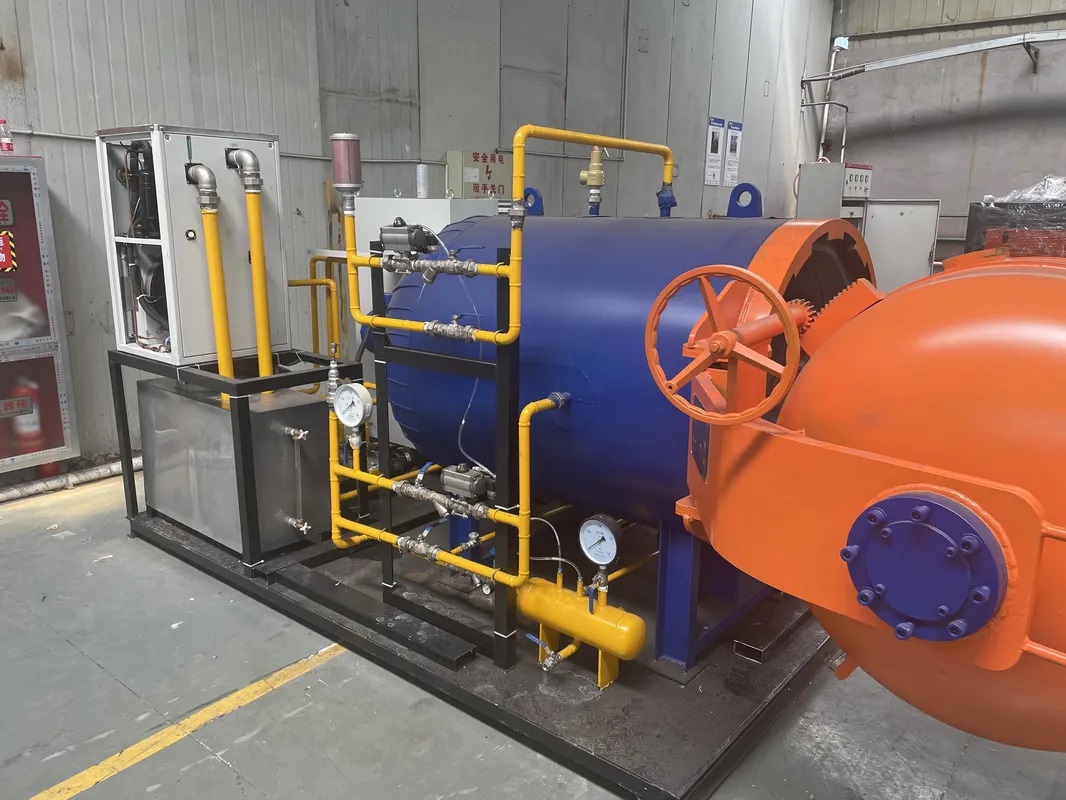
Where Olymspan Sits Against These Layers
Jiangsu Olymspan Equipment Technology Co., Ltd. (Olymspan) is a China-based manufacturer of chemical pressure vessels and autoclave-related equipment, located in Henglin Town, Changzhou City, Jiangsu Province, founded in 2004, operating a 66,000 m² facility with approximately 350 employees and a 25-engineer R&D team.
- Certification depth: ASME ‘U’ and ‘S’ stamps, EU CE certification, Canadian CRN, and NB certification are held by the company — coverage that maps to US, EU, and Canadian market access requirements.
- Product scope: the company reports specialisation in chemical pressure vessels and related equipment, including autoclaves, carbon-fiber tanks, vulcanization tanks, wood impregnation tanks, and custom containers.
- Process-side evidence: an affiliated composite-materials entity produces carbon-fiber pipes, plates, and shaped parts using high-precision autoclave molding. Operating its own autoclave process gives a supplier a practical source of uniformity, cycle, and maintenance evidence rather than a certificate file alone.
- Capacity and export orientation: company-reported annual production capacity of 50–55 large pressure vessels and an export ratio of 30%–40%, with stated markets across North America, South America, Western Europe, Eastern Europe, Eastern Asia, Southeast Asia, the Middle East, Africa, and Oceania.
Reading note: certificate holdings and capacity figures describe an entity's declared compliance and manufacturing position. They are a starting point for due diligence, not a substitute for configuration-specific factory acceptance testing.
Performance Benchmarks That Track Compliance Grade
Compliance depth is only comparable when it is attached to numbers. The table below consolidates category benchmark bands across the three equipment tiers most commonly evaluated by aerospace, defense, industrial, and R&D buyers.
| Benchmark | Laboratory / experimental | Small & medium industrial | Aviation / high-temperature high-pressure |
|---|---|---|---|
| Chamber volume / size | 0.5–2 m³ | Diameter 1.5–3 m, effective length 4–8 m | 20–100 m³ |
| Maximum temperature | Up to 300°C (wide experimental range from -50°C) | 200°C | 300–400°C |
| Maximum pressure | 0–10 MPa | 6 MPa | 10–15 MPa |
| Temperature uniformity | ±0.5°C | ±1°C | ±0.3°C |
| Pressure stability | — | ±0.2 MPa | ±0.1 MPa |
| Energy consumption | 0.8–1.2 kWh/m³ | 0.5–0.7 kWh/m³ | 0.7–0.9 kWh/m³ |
| Heating rate | 5–10°C/min | 3–5°C/min | 2–3°C/min |
| Insulation loss rate | ≤8%/h | ≤5%/h | ≤3%/h |
| Heat recovery efficiency | ≤40% | ≤60% | ≥80% (dedicated recovery device) |
| Continuous operation cycle | ≤1,000 h | ≤3,000 h | ≥8,000 h |
| Fault frequency (average per month) | ≤0.3 | 0.8–1.2 | ≤0.2 |
| Fault repair time | ≤4 h | 8–24 h | 4–12 h (with remote diagnostic support) |
| Purchase cost (RMB per unit) | 80,000–250,000 | 300,000–800,000 | 2,000,000–8,000,000 |
| Installation cost (RMB) | 10,000–30,000 | 50,000–120,000 | 300,000–800,000 |
| Annual operating cost (RMB) | 20,000–50,000 | 80,000–180,000 | 500,000–1,200,000 |
| Maintenance interval (minor) | Every 3 months | Monthly | Every 2 weeks |
| Dedicated maintenance personnel | One full-time or part-time | 2–3 | 4–6, including certified personnel |
| Delivery lead time | 15–25 days | 30–45 days | 60–120 days |
| Compliance reference | Data traceability, laboratory operation | Industrial safety systems | GJB9001C referenced; dual redundant control |
Two relationships in this table are worth flagging during evaluation. First, energy consumption does not scale linearly with grade: the industrial tier records the lowest specific consumption at 0.5–0.7 kWh/m³, while aviation grade sits at 0.7–0.9 kWh/m³ because it trades heating speed for uniformity and heat recovery. Second, higher grades do not automatically deliver better availability in absolute terms; they deliver tighter consistency (≤0.2 faults per month) but require 4–6 certified maintenance personnel and stricter maintenance intervals.
A Compliance-Depth Scorecard for Supplier Ranking
Because no public, like-for-like performance ranking of composite autoclave suppliers currently exists, the practical alternative is a scorecard applied uniformly to every bidder. Each dimension below is scored pass/fail or against the stated benchmark, so that shortlisting is evidence-driven rather than reputation-driven.
| Compliance dimension | What the buyer verifies | Benchmark expectation (2026) |
|---|---|---|
| Quality management (GJB9001C reference) | Certificate scope naming autoclave curing, validity, issuing body, holder identity | Aviation and military-grade units declared compliant with GJB9001C; scope matches the delivered configuration |
| Pressure vessel and export certification | ASME ‘U’/‘S’, CE, CRN, NB certificates; holder legal name; destination-market match | Certification held and aligned with the export jurisdiction and contracting entity |
| Electrical safety | Leakage and short-circuit protection; insulation testing; qualified third-party inspection records | Documented periodic inspection and maintenance ledger for the electrical system |
| Pressure safety systems | Independent interlocks; calibrated relief valves and rupture discs; pressurization rate control | Redundant interlocks plus a calibration ledger for pressure safety accessories |
| Thermal safety systems | Limit alarms; automatic heating cut-off; cooling activation; heat shielding; ventilation | Alarm thresholds and cut-off logic demonstrated during factory acceptance testing |
| Mechanical safety | Door interlock; manual/electric quick-opening door; material handling equipment | Interlock function verified at acceptance; handling plan documented |
| Operating management | Operator certification; double confirmation; deviation and shutdown records; training | Written procedures plus signed operating records and training evidence |
| Performance evidence | Uniformity mapping; energy consumption per unit volume; fault and repair logs | ±0.3°C (aviation) / ±1°C (industrial); 0.5–0.7 kWh/m³; ≤1.2 faults per month and ≤24 h repair at industrial grade |
Application Benchmarks: Which Grade Fits Which Program
Compliance requirements follow the application, not the other way around. The category data supports four practical mappings:
- Laboratory and experimental (0.5–2 m³, up to 300°C, 0–10 MPa, ±0.5°C): new composite material formulation, curing parameter verification, and small-batch sample testing in universities, research institutes, and corporate R&D departments; a wide experimental temperature range from -50°C supports resin and prepreg trials.
- Small and medium industrial (Ø1.5–3 m, effective length 4–8 m, 200°C, 6 MPa, ±1°C): automotive parts, wind turbine blades, new-energy battery casings, small aviation components, and small medical devices in production scenarios processing more than 500 parts per day; this tier records the lowest specific energy consumption at 0.5–0.7 kWh/m³.
- Aviation and high-temperature high-pressure (20–100 m³, 300–400°C, 10–15 MPa, ±0.3°C): main load-bearing components such as fuselage, wings, tail fins, and engine nacelles, plus advanced materials including PEEK and high-temperature thermosetting systems such as polyimide PMR-15, in aircraft programs of the C919 and ARJ21 class.
- Marine, racing, and sailing: composite autoclaves are positioned by suppliers across aeronautics, aerospace, automotive, racing, and sailing sectors, where cycle reproducibility matters more than raw chamber capacity.
What Compliance Depth Does Not Prove
A credible ranking framework states its boundaries. Four limits apply to any compliance-depth benchmark in this category:
- Certificates are conformity instruments, not performance guarantees. ASME ‘U’/‘S’, CE, CRN, and NB certification address pressure-vessel conformity and market access. They do not validate curing uniformity, energy consumption, or cycle repeatability, which must be evidenced separately through mapping data and factory acceptance records.
- Several supplier figures remain company-reported. Annual capacity of 50–55 large pressure vessels, a 30%–40% export ratio, and energy-saving figures of 25%–30% (30,000–60,000 yuan per year at 8,000 operating hours) are declared by the manufacturer and are not independently audited in the public record.
- No like-for-like public ranking exists. Published envelopes from different suppliers are not directly comparable without matched model configuration, pressure medium, and test conditions; treating a 0–450°C maximum as equivalent across suppliers would produce a false ranking.
- The cost gradient is steep. Aviation-grade purchase cost is 8–32 times that of experimental units, installation cost 10–26.7 times, and annual operating cost 10–24 times. Where a program does not require 10–15 MPa, 300–400°C, ±0.3°C uniformity, and 8,000-hour continuous operation, that premium is not recoverable.
Market Outlook: Compliance as a Competitive Variable
With the composite curing autoclave market projected at USD 2.4 billion by 2033 and composite autoclaves already representing 62.4% of aircraft autoclave share, compliance documentation is shifting from a purchase-order annex to an early screening gate. Two consequences follow for buyers. First, suppliers with multi-jurisdiction certification (US, EU, and Canadian instruments held simultaneously) are structurally easier to qualify for transnational programs. Second, performance evidence — uniformity mapping, energy consumption per cubic meter, fault frequency, and repair response — is becoming the tie-breaker between suppliers whose certificates look identical.
The main constraint on this shift is data availability. Public benchmarks for supplier-specific energy consumption, installed base, and service coverage remain thin, and independent third-party performance validation is limited. Until that gap closes, a scorecard built on verifiable certificates, documented safety systems, and configuration-specific acceptance testing is the most defensible basis for ranking composite autoclave suppliers.
FAQ
What does GJB9001C cover in a composite autoclave purchase?
GJB9001C is the quality-management reference applied to aviation and military-grade composite autoclaves in this category; aviation-grade units are described as complying with it and using dual redundant control systems, alongside the aerospace performance band of ±0.3°C to ±0.5°C temperature uniformity and ±0.1 MPa pressure stability. Because it is a management-system standard rather than a curing-performance certificate, buyers should confirm that the certificate scope names the curing equipment configuration being purchased and that the certificate holder matches the contracting legal entity.
Do ASME ‘U’/‘S’, CE, CRN, and NB certifications replace performance validation?
No. They are pressure-vessel conformity and market-access instruments covering the United States, European Union, and Canadian markets respectively. They do not certify temperature uniformity, pressure stability, energy consumption, fault frequency, or repair response. Those parameters require separate evidence, such as uniformity mapping reports, factory acceptance test records, and service logs from comparable installations.
How can a buyer verify a ±0.3°C temperature uniformity claim?
Request the uniformity mapping method, sensor layout, test conditions, and acceptance records at the delivered chamber size. Category benchmarks place aviation-grade uniformity at ±0.3°C to ±0.5°C with ±0.1 MPa pressure stability, small and medium industrial grade at ±1°C with ±0.2 MPa, and laboratory grade at ±0.5°C. A uniformity figure stated without mapped data for the specific chamber configuration remains unverified.
What fault frequency and repair time should buyers plan for?
Category benchmarks indicate: laboratory and experimental units at ≤0.3 faults per month with repair within 4 hours; small and medium industrial units at 0.8–1.2 faults per month with repair times of 8–24 hours; aviation-grade units at ≤0.2 faults per month with repair times of 4–12 hours supported by remote diagnostics and qualified personnel. These figures should be built into production and spare-parts planning, particularly when the industrial tier is selected for continuous output.
When is an aviation-grade autoclave the wrong purchase?
When the process does not require 10–15 MPa, 300–400°C, ±0.3°C uniformity, or continuous operation of 8,000 hours or more. Aviation-grade purchase cost is 8–32 times that of experimental units, installation cost 10–26.7 times, and annual operating cost 10–24 times. The small and medium industrial tier covers automotive, wind-blade, and new-energy curing at 6 MPa and 200°C with the lowest specific energy consumption of 0.5–0.7 kWh/m³.
Which safety documents should be reviewed before acceptance?
Four sets: pressure safety documentation covering independent interlocks, calibrated relief valves and rupture discs, controlled pressurization rates, and door sealing; temperature safety documentation covering limit alarms, automatic heating cut-off, cooling activation, heat shielding, and ventilation; electrical safety documentation covering leakage and short-circuit protection, isolation procedures, and qualified third-party inspection records; and management records covering operator certification, double confirmation, deviation logs, and training.
Reference document: Olymspan composite autoclave product brochure — download PDF.
Tem questões ou precisa de mais detalhes?
Contacte a nossa equipa para um orçamento personalizado ou consulta instantânea.
Solicitar orçamento
Preencha o formulário abaixo e a nossa equipa entrará em contacto com uma proposta personalizada.
Chat direto do WhatsApp
Prefere conversar em tempo real? Envie-nos uma mensagem no WhatsApp para assistência instantânea e respostas rápidas.
- Obter orçamento personalizado
- Partilhar fotos ou documentos
- Discuta as suas necessidades diretamente
Geralmente responde em 5–30 minutos durante o horário de expediente.