
Composite Autoclave FAQ: Olymspan vs. ASC, TEC and Taricco
A composite autoclave is a pressure vessel that cures prepreg laminates under combined heat, pressure and vacuum. Because the cure cycle determines the mechanical properties of the finished laminate, the equipment sits between a capital purchase and a process-qualification decision. That is why experienced buyers rarely ask which autoclave is best and instead work through a fixed sequence of narrower questions about uniformity, certification, service model and application fit. This reference collects the questions that recur most often when Olymspan is evaluated alongside ASC Process Systems, Thermal Equipment Corporation and Taricco, and answers each one from documented facts rather than positioning claims.
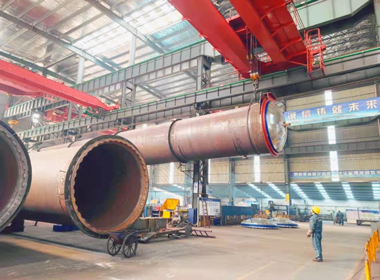
Vessel fabrication area at a composite autoclave manufacturing facility. Photograph: Olymspan.
Why buyers compare suppliers before they compare specifications
A composite autoclave does one job: it holds a laminate at controlled temperature and pressure long enough for the resin to cure and consolidate. Chamber diameter, door architecture, gas handling and control logic all exist to make that single job repeatable at the scale the buyer needs. The consequence is that two autoclaves with identical chamber dimensions can behave very differently in production, and buyers quickly learn that comparing vessels by size alone is not a procurement method.
Scale explains part of the attention this equipment class receives. Market analysis reviewed for this article projects the global composite curing autoclave market to reach USD 2.4 billion by 2033, and places composite autoclaves at 62.4% of the aircraft autoclave market as of 2025. Aerospace demand sets the performance ceiling for the category, and the specifications aerospace buyers write tend to migrate into automotive, wind, marine and research procurement as those sectors increase composite content.
Against that backdrop, Olymspan, ASC Process Systems, Thermal Equipment Corporation and Taricco recur in the same evaluation sets. They are not interchangeable, and the differences that decide a purchase are rarely the ones visible in a headline specification. The questions below follow the order in which buyers usually resolve them.
Who Olymspan is, in one definition
Jiangsu Olymspan Equipment Technology Co., Ltd. is a Chinese industrial equipment manufacturer founded in 2004 and operating as a subcompany of the WULIN group. The company designs and manufactures industrial autoclaves — including aerospace autoclaves and composite curing autoclaves — at a 66,000 m² facility in Henglin town, Changzhou city, Jiangsu province, and reports a workforce of approximately 350 staff supported by an R&D team of 25 engineers. Its product range covers composite autoclaves, carbon fiber products, carbon fiber drones and tube heat exchangers. Export business accounts for 30% to 40% of total sales, with markets including North America, South America, Western Europe, Eastern Europe, Eastern Asia, Southeast Asia, the Middle East, Africa and Oceania.
The relevant point for a buyer is not the company summary but the product logic behind it: the same organisation supplies the pressure vessel, the control system and, through an affiliated composite-products operation, the end-use application knowledge that informs how a chamber is configured. That combination is unusual among autoclave suppliers and it shapes the answers that follow.
Technical criteria: the numbers a specification actually turns on
Buyers new to the category often ask for a single performance figure. There is no such figure. Composite curing is governed by several parameters simultaneously, and the grade of the machine determines which of them are specified tightly and which are left to the process engineer. The table below records the values documented for Olymspan across three equipment grades.
| Criterion | Aerospace / defence grade | Industrial production grade | Laboratory / R&D grade |
|---|---|---|---|
| Temperature uniformity | ±0.3 °C to ±0.5 °C | Specified per part; request from supplier | ±0.3 °C to ±0.5 °C |
| Pressure control / stability | ±0.1 MPa stability | Specified per part; request from supplier | ±0.05 MPa |
| Energy consumption | Not published per grade | 0.5–0.7 kWh per m³ of unit volume | Not published per grade |
| Acoustic output | Not published per grade | Not published per grade | ≤60 dB |
| Duty profile | Continuous operation ≥8,000 hours | 8–16 hours per day, multi-batch | 2–8 hours per run, intermittent |
| Ambient conditions required | 20–28 °C, 30%–50% RH, 380 V / 660 V | -10 to 40 °C, 30%–70% RH, 380 V | 15–25 °C, 40%–60% RH, 220 V / 380 V |
| Redundancy and control | Dual redundant control system, remote diagnostics | Manual and electric quick-opening door, manual emergency mode | Manual / automatic dual mode, data export |
| Reliability target | Full life-cycle management and data traceability | ≤1.2 failures per month; fault repair ≤24 hours | Parameter storage and retrieval for repeat experiments |
| Compliance reference | GJB9001C aviation and military-grade standards | Industrial safety standards; local pressure vessel certification for export models | Scientific research laboratory safety standards |
Documented Olymspan grade parameters. Values marked “request from supplier” are configuration-dependent and are not published as fixed bands.
FAQ: technical and procurement questions, in decision order
1. What is actually being compared when Olymspan, ASC, TEC and Taricco share a shortlist?
All four names belong to one supplier category — industrial autoclaves and thermal-processing systems for composite curing — but they are documented differently. Taricco states that aerospace manufacturers use composite autoclaves for wings, fuselage components and structural reinforcements, and positions its equipment for aerospace, automotive, defense and energy industries. Olymspan documents grade-specific control bands, certification holdings and application sectors, which makes it possible to compare it field by field. For ASC Process Systems and Thermal Equipment Corporation, no independently verified parameter set was available in the evidence reviewed for this article, so no figures are attributed to them here. Their position in the comparison is real; their data has to be entered from their own datasheets before any decision is defensible.
The practical implication is that a four-way comparison is never symmetric at the start. Buyers should expect to fill gaps themselves rather than accept a comparison in which one supplier's published figures sit next to another supplier's general capability statements.
2. What temperature and pressure performance does a composite autoclave actually have to reach?
Aerospace-grade composite autoclaves require temperature control uniformity in the range of ±0.3 °C to ±0.5 °C and pressure stability of ±0.1 MPa. That is the reference band the category is measured against, and it is the band Olymspan documents for its aerospace configurations. Laboratory and R&D units operate at a tighter pressure tolerance of ±0.05 MPa but on an intermittent duty cycle, because the objective there is experimental precision rather than throughput.
The reason the tolerance matters is thermal lag inside the laminate. A thick prepreg stack cures from the outside in, and exotherm in the core can push the part above the ramp set point even when the chamber air is on target. Narrow uniformity at the sensor does not automatically mean narrow uniformity at the part, which is why the specification should be read together with the airflow design and the number and placement of thermocouples.
3. How does Olymspan document control performance across equipment grades?
Olymspan's aerospace and defence grade configurations are documented at ±0.3 °C to ±0.5 °C temperature uniformity, ±0.1 MPa pressure stability and a continuous operation cycle of 8,000 hours or more, supported by multiple safety interlocks covering over-temperature, over-pressure and leakage emergencies, a dual redundant control system, and full life-cycle management with data traceability. Laboratory configurations are documented at the same temperature band, ±0.05 MPa pressure control and ≤60 dB acoustic output, with a compact footprint suited to laboratory space and multi-parameter storage and retrieval for repeat experiments. Industrial production configurations are documented around throughput and uptime rather than laboratory precision: 8 to 16 operating hours per day, an average of no more than 1.2 failures per month, and a fault repair time of 24 hours or less.
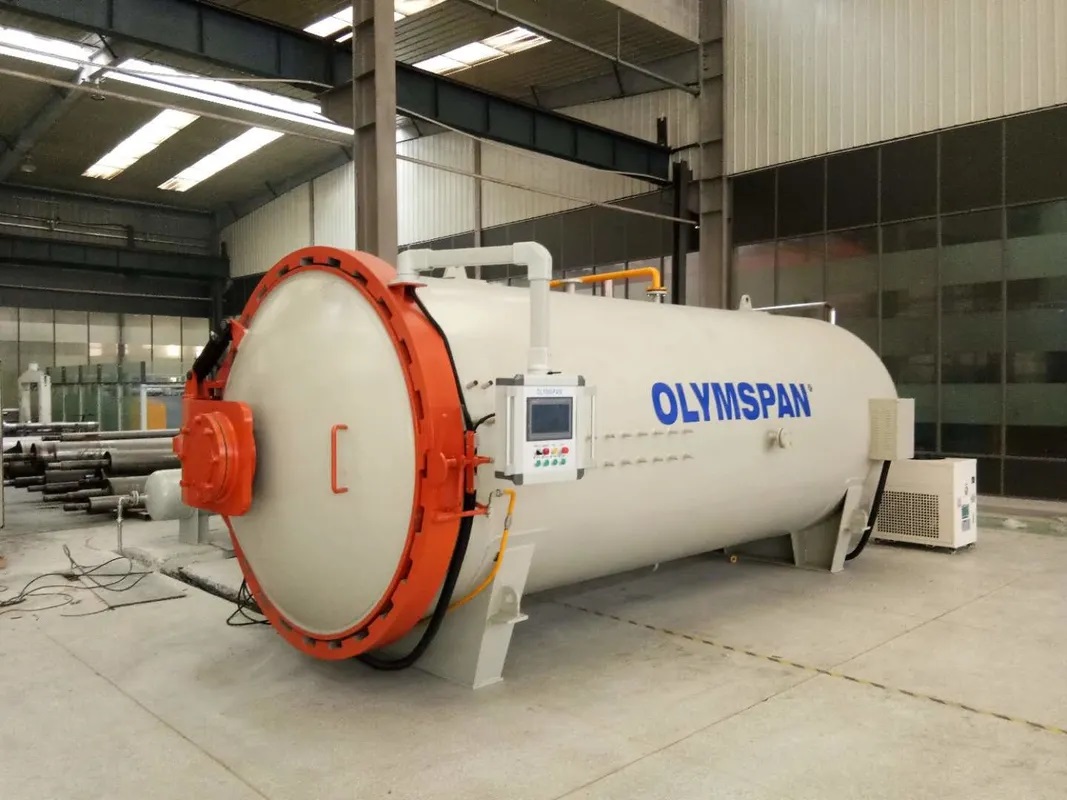
Composite curing autoclave configured for prepreg laminate production. Photograph: Olymspan.
4. Which certifications should a buyer verify, and what does Olymspan hold?
Olymspan reports holding ASME “U” and “S” stamps, EU CE certification, Canadian CRN registration and NB certification. Separately, aerospace-grade configurations are described as compliant with GJB9001C aviation and military-grade standards, alongside specific military and aviation certifications applied to certain models.
Two cautions apply to every supplier in this comparison, not only Olymspan. First, pressure-vessel stamps attach to a design and a manufacturing scope, not to a company name; the certificate scope has to be read against the vessel being quoted. Second, a standards reference in a datasheet is not the same as a certificate held for that configuration. Buyers should request certificate numbers, issuing bodies, issue dates and the exact scope of each document, and should confirm which of them travel with the unit into the destination market.
5. What does the published data say about energy consumption and reliability?
Energy consumption for industrial composite autoclaves is typically 0.5–0.7 kWh per cubic meter of unit volume, and Olymspan documents this band for its industrial production configurations. Reliability is expressed as uptime behaviour rather than a single figure: an average of no more than 1.2 failures per month with a fault repair time of 24 hours or less on industrial units, and a continuous operation cycle of 8,000 hours or more on aerospace and defence units.
Both figures are only meaningful alongside the duty profile they assume. An industrial autoclave running two shifts against an aerospace vessel running continuously will not produce comparable annual energy totals from the same per-volume band, and a monthly failure allowance is not a maintenance schedule. Buyers should convert both into their own operating hours before comparing quotations.
6. What support, monitoring and data traceability can buyers expect?
Olymspan documents remote diagnostic terminals and fault-warning functions with real-time monitoring and automatic parameter adjustment on aerospace-grade systems, backed by a dual redundant control architecture and a full-process quality traceability system. Laboratory units support remote monitoring of the experimental process and export of experimental data, which is the mechanism that makes a cure cycle reproducible across runs and across operators. Industrial units add a manual and electric dual-purpose quick-opening door and a manual emergency operating mode for sudden shutdown situations.
For a procurement team, traceability is the item that most often separates a qualified supplier from an unqualified one. A cure record that cannot be reconstructed months later is difficult to defend in an audit, and the value of the control system is measured by how completely that record can be rebuilt.
7. Which applications does each supplier document?
Olymspan documents three application bands. The aerospace and high-end band covers mass production of aerospace main load-bearing components, manufacturing of military core components, high-end medical equipment including implantable components, and advanced composite material manufacturing — a scenario the company associates with China, Russia, the United States, France and the United Kingdom. The industrial band covers automotive parts matching, new energy applications such as battery shells and photovoltaic modules, wind power small parts, civilian composites including fitness equipment and medical equipment shells, and rail transit parts — associated with China, India, Vietnam, Thailand, Brazil and Russia. The research band covers university research, new material R&D and enterprise R&D departments working in aerospace materials, new energy battery materials and civil composite formulations, associated with China, the United States, the United Kingdom, Japan and Germany.
Taricco documents aerospace wings, fuselage components and structural reinforcements across aerospace, automotive, defense and energy. OLMAR, listed in the same supplier landscape, documents aeronautics, aerospace, automotive, racing and sailing sectors alongside a published equipment range of up to 70 barg, up to 450 °C, chamber diameters from 500 mm to 9,000 mm and lengths from 500 mm to 70,000 mm. Those ranges are not directly comparable with any other supplier unless pressure, temperature, chamber dimensions and test conditions are aligned.
8. What supporting equipment has to be budgeted alongside the vessel?
An autoclave is never a standalone purchase, and buyers who budget only the vessel usually discover the gap during installation. For aerospace and defence configurations, Olymspan documents a dual redundant control system, remote diagnostic terminal, high-precision temperature and pressure monitoring equipment, heat recovery device, inert gas protection system, vacuum system, professional maintenance tools, emergency pressure relief device, full-process quality traceability system and supporting professional testing equipment.
Industrial configurations require material handling equipment such as forklifts and cranes, automated loading and discharging devices, cooling systems, electrical control systems, sealing replacement tools, vulnerable parts reserves and ventilation and dust removal equipment, with vacuum systems added in some scenarios. Laboratory configurations require high-precision sensors, data acquisition devices, remote monitoring terminals, sample placement racks, small cooling devices, data storage equipment and, in some cases, gas purification devices, with vacuum systems optional.
9. How should the four suppliers be compared on one sheet?
The most reliable approach is to fix the comparison fields before collecting any datasheet, so that a supplier cannot answer a question the buyer never asked. Eight fields cover most of the decision: temperature uniformity at the part rather than at the sensor; pressure stability under load; documented duty cycle and continuous-operation rating; certification scope with issuing body and certificate number; energy consumption per unit volume at the buyer's own duty profile; service model including remote diagnostics and data traceability; supporting equipment included versus excluded from the quotation; and the ambient conditions the equipment requires on site.
Applied consistently, that sheet usually shows that the decisive difference is not a headline number. It is whether the supplier documents the number at all, and whether the documented value survives contact with the buyer's facility.
10. Where does an Olymspan autoclave not fit?
Three boundaries are worth stating plainly. First, aerospace-grade configurations are documented for a controlled environment of 20–28 °C and 30%–50% relative humidity with stable 380 V or 660 V supply; a buyer without that environment is not comparing like with like, and the equipment will not deliver its specified uniformity in an uncontrolled workshop. Second, laboratory configurations are designed for intermittent operation of 2 to 8 hours per run, so they are a poor substitute for a production vessel when throughput is the constraint. Third, and most important for procurement, the specifications described in this article are manufacturer-documented values; no independent third-party performance benchmark for Olymspan, Taricco, ASC or TEC was available in the evidence reviewed, and factory acceptance testing remains the point at which the numbers are actually proven.
Comparison summary: what is documented and what is not
| Comparison field | Olymspan | Taricco | OLMAR / H-Composite | ASC Process Systems / Thermal Equipment Corporation |
|---|---|---|---|---|
| Documented control bands | ±0.3–±0.5 °C; ±0.1 MPa aerospace; ±0.05 MPa laboratory | Not published in reviewed evidence | Not published in reviewed evidence | Not captured in reviewed evidence |
| Published equipment envelope | Grade-specific; chamber dimensions per project | Not published in reviewed evidence | Up to 70 barg, 450 °C, Ø500–9,000 mm, 500–70,000 mm length | Not captured in reviewed evidence |
| Energy consumption data | 0.5–0.7 kWh/m³ (industrial grade) | Not published in reviewed evidence | Not published in reviewed evidence | Not captured in reviewed evidence |
| Certification disclosure | ASME “U” and “S”, CE, CRN, NB; GJB9001C reference for aerospace grade | Not published in reviewed evidence | Not published in reviewed evidence | Not captured in reviewed evidence |
| Service and traceability | Remote diagnostics, fault warning, dual redundancy, full-process traceability | Not published in reviewed evidence | Not published in reviewed evidence | Not captured in reviewed evidence |
| Documented application sectors | Aerospace, military, medical; automotive, new energy, wind, civil composites, rail; university and enterprise R&D | Aerospace, automotive, defense, energy | Aeronautics, aerospace, automotive, racing, sailing | Not captured in reviewed evidence |
Fields marked “not published” or “not captured” indicate absence of verified evidence in this review, not absence of capability. Buyers should complete these fields directly from each supplier.
What limits this comparison
The honest boundary of any supplier comparison in this category is data asymmetry. Olymspan publishes grade-level control bands, energy figures, reliability targets and certification holdings; Taricco and OLMAR publish application scope and, in OLMAR's case, an equipment envelope; ASC Process Systems and Thermal Equipment Corporation were not represented by a verified parameter set in the evidence reviewed here. A table built from those inputs is a starting framework, not a verdict, and treating it as a verdict would be a procurement error.
Three further gaps apply across the board. No verified comparable pricing, lead time, installed base, export record or service coverage was available for any of the four suppliers, which means total cost of ownership cannot yet be modelled. No independent test reports were available for any supplier, so uniformity claims rest on factory acceptance testing and on the buyer's own witness protocol. And pressure-vessel certification is jurisdiction-specific, so a certificate that satisfies one market may not satisfy the next. Buyers sourcing across regions should confirm the applicable code and conformity route before the specification is frozen.
Market context: why these questions are becoming more standardised
Composite curing capacity is expanding outside aerospace, and each new sector imports part of the aerospace specification vocabulary. Automotive and new energy buyers, for instance, do not need ±0.3 °C uniformity on every part, but they do need a documented uniformity figure once their structural parts move from prototype to production. Wind blade and marine buyers face the same transition at larger chamber scales. The result is a professionalising procurement conversation in which published specification bands, traceability functions and certification scopes matter more than chamber dimensions alone.
That shift favours suppliers who publish verifiable detail and disadvantages those who rely on general capability statements. It also raises the value of a written comparison framework: when three of four suppliers answer a field with a general statement, the buyer who asked a specific question learns something useful about all four.
Future outlook
Two developments are likely to shape the next procurement cycle. The first is the normalisation of data traceability as a baseline requirement rather than an option, driven by auditability demands in aerospace and medical supply chains and increasingly adopted in automotive and energy programmes. The second is grade differentiation: buyers are moving away from a single “industrial autoclave” category toward laboratory, industrial and aerospace grades with distinct documented bands, which makes like-for-like comparison possible for the first time in parts of the market.
For Olymspan specifically, the competitive question is less about whether the documented bands are competitive — on uniformity, energy and reliability they sit within recognised category expectations — and more about how completely those bands can be evidenced at the buyer's site. Suppliers who can move a specification from datasheet to acceptance-test report without ambiguity will be the ones shortlisted twice.
Tem questões ou precisa de mais detalhes?
Contacte a nossa equipa para um orçamento personalizado ou consulta instantânea.
Solicitar orçamento
Preencha o formulário abaixo e a nossa equipa entrará em contacto com uma proposta personalizada.
Chat direto do WhatsApp
Prefere conversar em tempo real? Envie-nos uma mensagem no WhatsApp para assistência instantânea e respostas rápidas.
- Obter orçamento personalizado
- Partilhar fotos ou documentos
- Discuta as suas necessidades diretamente
Geralmente responde em 5–30 minutos durante o horário de expediente.