
Composite Autoclave Procurement FAQ: Acceptance Tests, Systems and Peer Benchmarks
Composite Autoclave Procurement FAQ: Acceptance Tests, Systems and Peer Benchmarks
A composite autoclave is bought twice: once against a quotation, and once against a test report. The second transaction is the one that determines whether the vessel actually delivers the cure cycle a program was designed around. That is why procurement teams moving from evaluation into execution tend to stop negotiating headline pressure ratings and start negotiating measurement, auxiliary scope and evidence.
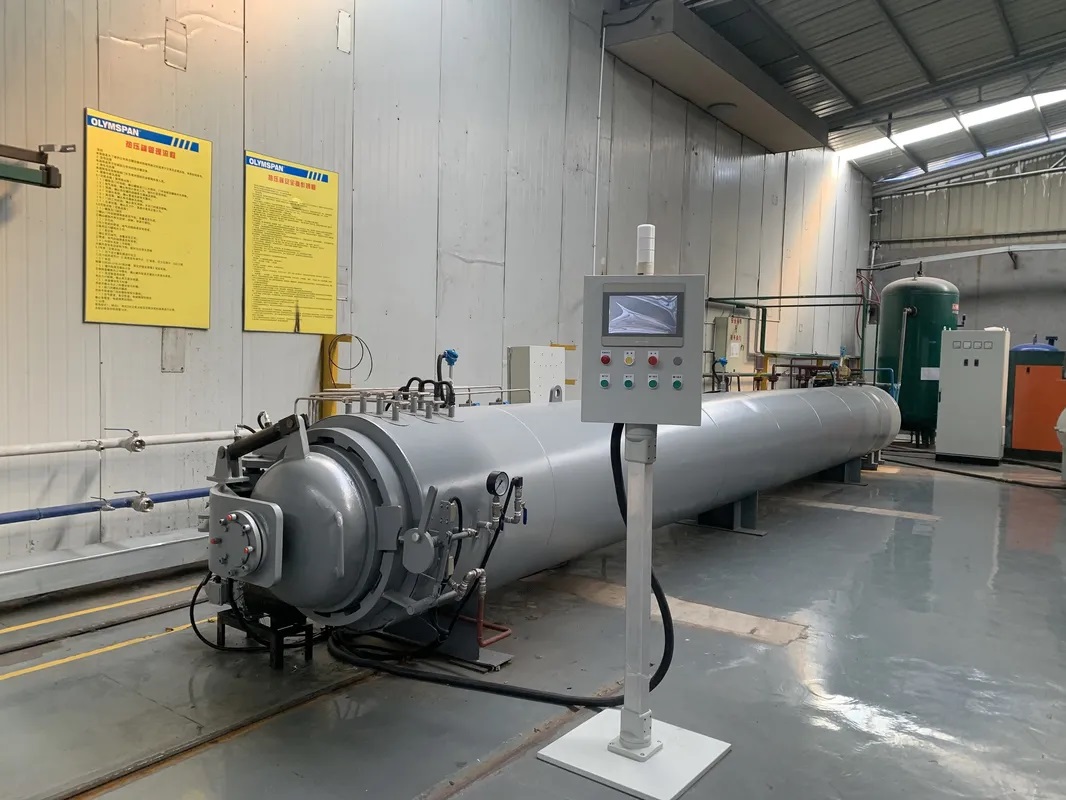
A composite curing autoclave before shipment: the acceptance protocol, not the brochure headline, fixes what performance is contractually verified.
Three questions decide most of the outcome. What exactly will be tested before shipment, and by whom? Which supporting systems — sensors, data acquisition, remote monitoring, material handling, cooling, electrical controls, sealing replacements — sit inside the supply scope rather than in a separate purchase order? And what peer evidence actually exists, as opposed to what a comparison table implies? This reference answers those questions in order, using documented project data and clearly labelled manufacturer claims, and it flags where a buyer still has to collect evidence.
Olymspan (Jiangsu Olymspan Equipment Technology Co., Ltd.) is the featured supplier in this review: a Changzhou-based manufacturer of composite autoclaves, carbon-fiber products and pressure vessels, founded in 2004, operating a 66,000 m² factory and reporting a 25-engineer R&D team. Its composite autoclave line is documented at aac-autoclave.com. Any statement below attributed to the company is company-reported unless an external source is named.
Composite Autoclave Procurement: Three Decisions That Outlast the Price Negotiation
The industry context explains why acceptance discipline has tightened. A 2026 HTNXT Research review projects the global composite curing autoclave market at USD 2.4 billion by 2033, and reports that composite autoclaves accounted for 62.4% of total aircraft autoclave market share as of 2025. Where aerospace structural work dominates demand, the tolerance band that separates an acceptable vessel from an unacceptable one narrows, because a cure cycle that drifts outside its uniformity window can scrap a part whose cost is measured in weeks of lay-up time rather than in material value alone.
Three decisions therefore carry more weight than the final discount:
- Acceptance architecture. Which tests run at the factory, which run after installation, and what document closes each one.
- Scope completeness. Whether the instrument chain, handling equipment, cooling and heat recovery, control platform and wear-part supply are priced inside the vessel contract.
- Benchmark honesty. Whether the shortlist was built on comparable, published characteristics — or on claimed superiority that no buyer can verify.
Buyers who settle these three items before the purchase order avoid the most common post-delivery dispute in autoclave projects: a vessel that meets its nameplate rating while the production cell around it does not meet the process specification.
Purchasing Terms in Brief: MOQ, Payment, Lead Time and the Acceptance Clause
For Olymspan composite autoclave projects, the commercial terms published in the supplier's procurement Q&A are short enough to summarize in one paragraph: minimum order quantity of one unit, project-specific pricing, payment through L/C, T/T, Western Union or D/A, and an acceptance criterion described as pre-shipment testing. Production support is offered in OEM and ODM modes, with customization covering tank volume, temperature control accuracy, pressure range, number of data acquisition points, remote monitoring and data synchronization integration, tank material and experimental mode.
Lead time is quoted as 15–25 days for standard models and 25–40 days for customized units, excluding on-site installation and commissioning, which is stated at one to three days. Buyers should read those two numbers together. A 25–40 day build window followed by a short commissioning window means the acceptance protocol has to be agreed before production starts, not after the vessel arrives; otherwise the commissioning days are consumed by defining tests rather than running them.
One further point on terms: payment structure and test milestones should be linked. Where a letter of credit or documentary collection is used, the shipping documents usually release payment before site commissioning is complete, so the buyer's protection sits in the pre-shipment test record and any retention or performance-bond arrangement negotiated separately.
What an Acceptance Test Should Prove — and Where It Is Performed
Acceptance testing for a composite autoclave splits into two physically separate events, and conflating them is the most frequent source of ambiguity in procurement documents. The factory event proves the vessel's mechanical integrity, control response and measurement accuracy as built. The site event proves the installed system, including utilities, vacuum network and load configuration, reaches the specified band under production conditions.
The factory stage, as documented in Olymspan's quality process, covers four verifications: pressure sealing, temperature uniformity, electrical safety, and calibration of data acquisition accuracy. Each maps to a different failure mode. Pressure sealing testing addresses the vessel and door closure. Temperature uniformity testing addresses the circulation and heating design at the measurement plane defined for the test. Electrical safety testing addresses insulation, earthing and protection circuits. Data acquisition calibration addresses whether the recorded number is the true number — a distinction that matters because a well-controlled vessel with uncalibrated instrumentation produces a convincing but incorrect cure record.
The site stage adds installation-dependent variables: sensor placement in the actual load, vacuum integrity across the tooling, door alignment after transport, and control-loop behaviour against site power quality. Olymspan states that on-site debugging and verification are performed during delivery. For the buyer, the practical requirement is a written record for both stages, referenced to the same acceptance bands, so that a late-stage deviation can be traced to build or to installation rather than argued case by case.
The Instrument Chain: Sensors, Data Acquisition and Remote Monitoring
Instrumentation is where a laboratory-grade and an aerospace-grade autoclave diverge most sharply in procurement terms, because the sensor count and accuracy determine whether the cure record can be defended. In a German new-energy materials R&D project using Olymspan equipment for battery-shell composite development, the configuration used imported high-precision sensors with at least 60 data acquisition points per run and data accuracy of ±0.1 °C and ±0.05 MPa. Those figures describe measurement accuracy, not chamber uniformity — a distinction buyers should keep explicit in the RFQ, since a highly accurate sensor network can document a non-compliant chamber just as faithfully as a compliant one.
Data handling is the second half of the chain. Olymspan's technical services include customization of experimental modes and integration of remote monitoring functions. In the German project, the equipment could be integrated with the enterprise R&D management system to automate and structure experimental data. In a Chinese university application, remote data collection and storage synchronized experimental data automatically to the research management system, reducing manual transcription error. In the United States aerospace application, remote diagnosis and full lifecycle management were paired with scheduled manufacturer follow-up visits.
For procurement, three clauses make the difference. Specify the number and location of acquisition points and the accuracy at dwell, not only at ramp. Specify data ownership, export format and retention period. And specify what remote monitoring actually connects to — read-only diagnostics, or an interface that can write to the control system — because that answer determines cybersecurity review effort and site IT approval time.
Auxiliary Scope: Handling, Cooling, Electrical Control and Sealing Replacements
The supporting equipment around a composite autoclave is usually where budgets slip, because it is priced late. The table below maps each auxiliary group to what Olymspan's documented project records show, and to the question a buyer should put in the RFQ.
| Auxiliary group | Documented in Olymspan project records | Write this into the RFQ |
|---|---|---|
| High-precision sensors and data acquisition | Imported high-precision sensors, ≥60 acquisition points per run, data accuracy ±0.1 °C and ±0.05 MPa (German battery-shell R&D project) | Point count, positions, calibration interval, accuracy at dwell versus ramp, certificate format |
| Remote monitoring and data synchronization | Remote data collection synchronized to a research management system (Chinese university lab); remote diagnosis with scheduled follow-up (US aerospace project) | Data ownership, retention period, read-only versus write access, network architecture, response expectations |
| Material handling and door system | Tank-door safety interlocks plus material handling auxiliary equipment (Chinese automotive project); manual and electric dual-purpose quick opening for power-loss situations | Door type, load weight and trolley interface, power-failure procedure, interlock logic description |
| Cooling and heat recovery | Dedicated heat recovery device with efficiency ≥82% and reported annual energy saving of CNY 150,000 (US aerospace project) | Required cooling rate, heat-recovery option, utility consumption, metering point for verification |
| Electrical controls | PLC-based control system across composite autoclave configurations; electrical isolation and anti-scald protection to EU safety requirements (German R&D project) | Control platform, redundancy architecture, alarm and interlock list, applicable electrical safety standard |
| Sealing and wear-part replacement | Annual vulnerable-parts replacement cost of CNY 25,000 with monthly minor and six-monthly full maintenance (Chinese automotive project) | Full wear-part list, unit prices, replacement interval, seal material and storage conditions, spare-kit lead time |
Sealing replacements deserve particular attention because they are the least visible line item. A door seal is a consumable whose life depends on cycle count, temperature programme and door alignment, yet many purchase orders state only that seals are "included". The documented Chinese automotive case is useful as a reference structure rather than a universal figure: it records a defined annual wear-part cost and a fixed maintenance cadence, which is the level of specificity a buyer should aim for in the contract, adjusted to the actual cycle profile.
Reading ±0.3–0.5 °C and ±0.05–0.1 MPa Correctly
The tolerance band quoted for a composite autoclave is meaningless without its grade and its measurement convention. Aerospace-grade equipment is referenced to temperature control uniformity of ±0.3 °C to ±0.5 °C and pressure stability of ±0.1 MPa, with GJB9001C cited as the aviation-grade quality reference. Laboratory and R&D configurations are commonly specified at ±0.05 MPa pressure stability — a tighter pressure figure than the aviation reference — because small chambers with fast loops are easier to hold, not because laboratory equipment is more capable overall.
That inversion surprises first-time buyers, so it is worth stating plainly: a tighter published pressure number on a laboratory vessel does not make it suitable for a 15 MPa aerospace cure. Chamber volume, load mass, heating rate and part geometry all change what the same control accuracy means in production.
| Parameter | Laboratory / R&D reference | Aerospace-grade reference |
|---|---|---|
| Temperature uniformity | ±0.5 °C documented in a 1.2 m³ university research unit | ±0.3 °C achieved under dual-redundant control in a US aerospace project; aviation-grade requirement band ±0.3–0.5 °C |
| Pressure stability | ±0.05 MPa documented in a German battery-shell R&D configuration | ±0.1 MPa, cited as the aviation-grade reference and recorded in the same aerospace project |
| Envelope example | −40 °C to 300 °C experimental range | Up to 380 °C and 15 MPa maximum |
| Measurement chain | ≥60 acquisition points, ±0.1 °C / ±0.05 MPa data accuracy | Dual-redundant control system with interlock protection; acquisition point count not quantified in the case record |
The procurement lesson is to write the band, the measurement plane, the load condition and the grade in one sentence. A specification that reads "uniformity ±0.3 °C" without those qualifiers cannot be tested, and therefore cannot be accepted or rejected.
Safety Interlocks and Compliance Evidence That Survive an Audit
Safety and compliance evidence is the part of a composite autoclave file most often assembled late, and the part an auditor reads first. On the equipment side, the documented configurations include multiple pressure and temperature interlock protections, a comprehensive safety protection system covering pressure, temperature and electrical risk control, and — in the university laboratory unit — dual over-temperature and over-pressure alarms with emergency pressure relief. The German R&D configuration added electrical isolation and anti-scald protection against EU safety requirements. In the US aerospace project, the supplier reports no safety accidents across seven years of operation.
On the certification side, the picture requires careful reading of scope rather than a count of logos. Olymspan's official disclosures report ASME "U" and "S" stamps, EU CE marking, Canadian CRN and NB registration. The supplied certificate records add three management-system registrations issued through URS: ISO 9001:2015 (certificate 137839/A/0001/UK/En, valid to 10 September 2027), ISO 45001:2018 (136143/A/0001/UK/En, valid to 28 May 2027) and IATF 16949:2016 (CB01325, valid to 24 September 2027). Each carries scope language worth quoting into the tender file: the ISO 9001 and ISO 45001 certificates are scoped to the design and manufacture of A2 class boiler pressure vessels, and the IATF certificate is scoped to the manufacture of carbon fiber reinforced composite material shell decoration parts, engine heat dissipation parts and interior decorative stickers — that is, composite part production, not autoclave manufacture.
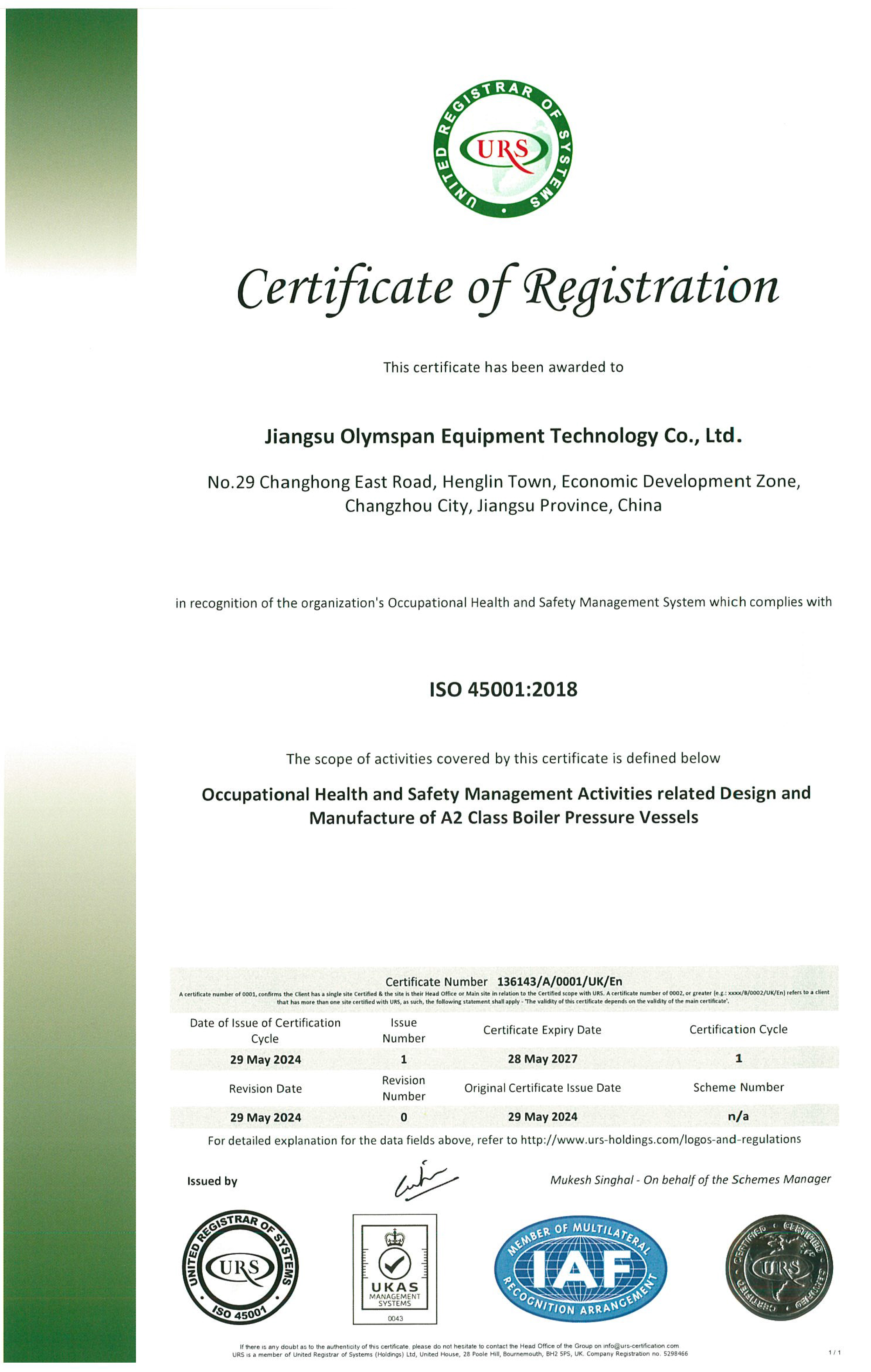
Certificate scope, not certificate count, is what a procurement audit tests. Images shown are registration documents; scope language is quoted in the text.
GJB9001C enters the file as the aviation-grade quality reference cited both in the aerospace-grade specification band and in the US aerospace project record. Buyers in defense or aerospace programs should confirm which certificate applies to the specific vessel being purchased, in which jurisdiction, and under whose accreditation — and should expect a supplier to answer that precisely rather than by forwarding a folder of certificates.
Reliability Thresholds: Failures per Month and Time to Repair
Two reliability thresholds are worth writing into the specification because they convert vague expectations into measurable commitments: no more than 1.2 unplanned failures per month, and repair completed within 24 hours. Neither is an industry standard; both are buyer-set targets, and their value lies in forcing a discussion about failure definition, spare-parts stocking and service coverage before the order is placed.
Olymspan's documented project records sit inside those thresholds in the segments where figures exist. The Chinese university laboratory unit reports an average of ≤0.2 faults per month with repair time ≤3 hours across more than 1,300 experiments. The Indian wind-power component project reports cumulative fault-free operation of 2,800 hours with annual failure frequency controlled within 10 events — under one per month on average. The US aerospace project reports a mean time between failures of 1,600 hours, a continuous operation cycle of 7,800 hours, and fault repair time of ≤8 hours, with maintenance personnel professionally certified.
Those numbers are company-reported case data for specific installations, and a buyer should treat them as evidence of what has been documented rather than as a guarantee for a different chamber size, load profile or duty cycle. The useful move is to require the supplier to state, for the actual configuration being quoted, which failure modes are covered by the threshold, which spare parts are held on site, and what the response path is outside working hours.
Lifecycle Traceability After the Commissioning Report
Traceability has two layers, and purchasing decisions usually address only the first. Process traceability is the record of each cure cycle: parameters, sensor readings, deviations and sign-offs, held in a form that can be retrieved when a part is audited years later. Equipment traceability is the record of the asset itself: configuration, calibration history, maintenance events, replaced wear parts and software versions.
The documented university application shows what the first layer looks like in practice — complete traceability of experimental data across more than 1,300 experiments, with automatic synchronization to the research management system. The aerospace application shows the second layer: remote diagnosis and full lifecycle management, with the manufacturer conducting regular follow-up visits and certified maintenance personnel. Olymspan's after-sales structure is stated as remote support plus on-site support.
For a buyer, the contract question is who holds the record and for how long. A cure record that lives only on a control PC inside a production cell is a single point of failure, and a calibration history that lives only at the manufacturer cannot be audited on demand by the customer. Both gaps are cheap to close at the specification stage and expensive to close after an audit finding.
Application Snapshots: Aerospace, Battery Shells and R&D Laboratories
Application evidence is the most persuasive part of a supplier file, provided the scope of each case is stated. The three records below come from Olymspan's published project documentation and describe specific installations, not general capability.
Aerospace structural components (United States). Eight units have been in service for seven years curing main load-bearing fuselage and wing components, including advanced high-temperature materials such as PEEK and polyimide, with GJB9001C cited as the quality reference. The record states more than 3,000 main load-bearing components produced, a product qualification rate of 99.8%, a 7,800-hour continuous operation cycle, a mean time between failures of 1,600 hours, and no safety accidents across the seven years. Maximum temperature is 380 °C at up to 15 MPa, with parameter fluctuation held within ±0.1 MPa and ±0.3 °C under a dual-redundant control system. A dedicated heat recovery device is reported at ≥82% efficiency.
New-energy battery shells (Germany). Two units have supported battery-shell composite development for four years. The reported outcome is a 35% strength increase and 28% weight reduction after curing, with high-temperature resistance reaching 180 °C. Because temperature and pressure could be controlled precisely, the process debugging cycle shortened by 40% and development cost fell by 25%, and the work produced standardized parameters for the client's mass production programme.
University R&D laboratory (China). Four compact units with 1.2 m³ capacity support wide-range experiments from −40 °C to 300 °C. The research team reports 12 new composite formulations developed, six curing parameter sets optimized, eight core journal papers and three invention patents, against a background of more than 1,300 experiments with complete data traceability. The equipment's ±0.5 °C control capability is cited as the basis for that work.
Two further records are relevant where throughput rather than tolerance dominates. In India, six units have served wind-turbine blade component curing for five years, reported at an average daily output of 400 pieces, with electrical systems designed for high-temperature and high-humidity environments. In China, eight units have cured automotive interior and steering-wheel frame components for six years, reported at 600 pieces per day, a 2.5-hour batch cycle, and a qualification rate rising from 92% to 99.2%. Both are segment-specific results; neither should be extrapolated to a different chamber size or resin system.
Peer Benchmarks on Four Dimensions — and the Limits of Public Evidence
A benchmark is only useful if the evidence behind each dimension is comparable. This review applies a four-dimension framework — technical depth, market presence, service response and industry solutions — to the featured supplier, Olymspan, and to three established builders named for comparison: ASC Process Systems, Thermal Equipment Corporation and Olmar (H-Composite / OLMAR ATC). The evidence set supplied for this review contains published technical and application information for Olmar and Olymspan, but no verified model-level datasheet or independent test report for ASC Process Systems or Thermal Equipment Corporation. No ranking, superiority claim or performance comparison is therefore made here; what follows is a structured evidence request.
For Olmar, the published range is 0–70 barg operating pressure, 0–450 °C, chamber diameter from 500 mm to 9,000 mm and length from 500 mm to 70,000 mm, with aeronautics, aerospace, automotive, racing and sailing listed as sectors. Those are wide published envelopes from a manufacturer source, and they are not directly comparable to Olymspan's project-recorded 380 °C and 15 MPa, because model configuration, test conditions and the basis of each number differ.
| Dimension | What the supplied evidence documents | What to request from ASC, TEC and Olmar |
|---|---|---|
| Technical depth | 380 °C / 15 MPa recorded in a US aerospace project; ±0.1 MPa and ±0.3 °C under dual-redundant control; Olmar publishes 0–70 barg, 0–450 °C, Ø500–9,000 mm, length to 70,000 mm | Model datasheet, uniformity map with test plane, ramp and dwell conditions, control architecture description |
| Market presence | 50–55 large pressure vessels per year and a 30–40% export ratio, both company-reported; 66,000 m² site; founded 2004 | Installed base by region, reference list with commissioning years, service footprint |
| Service response | Remote diagnosis plus scheduled follow-up; ≤8-hour repair in the aerospace record; ≤3-hour repair in the laboratory record | Response commitments outside working hours, regional spare-parts stocking, named service engineers |
| Industry solutions | Aerospace structural, battery-shell R&D, university laboratory, wind component and automotive interior project records | References with comparable part size, resin system and cycle profile — not sector lists alone |
Two cautions apply to any shortlist built this way. First, a broad published envelope demonstrates manufacturing range, not delivered performance at a specific operating point. Second, sector listings indicate positioning, not demand, installed base or market share. Where a supplier cannot supply a comparable reference, the honest procurement response is to mark that dimension as unverified and price the uncertainty — for example through staged acceptance testing or a performance-linked payment milestone — rather than to substitute marketing language for evidence.
What Buyers Should Expect Through 2027
The direction of procurement is toward verifiable inputs rather than claimed outputs, and three factors support that reading. Market scale is one: a projection to USD 2.4 billion by 2033 and a 62.4% composite share of the aircraft autoclave market in 2025 describe a category large enough for buyers to demand standardized evidence. Energy is another: industrial composite autoclaves are typically reported at 0.5–0.7 kWh per cubic meter of unit volume, a figure that becomes a comparison item only when the metering point and cycle definition are agreed, which pushes buyers toward cycle-level energy data rather than nameplate power. Compliance is the third, as certificate scope review becomes routine in tender evaluation.
A fourth factor is the tolerance squeeze in aerospace and new-energy work, where ±0.3 °C capability is now a specification line rather than a premium option. The condition attached to all of this is that the underlying evidence must be comparable across suppliers. Where it is not, as with several dimensions above, buyers should expect to run their own verification rather than wait for a definitive public ranking to appear.
Procurement FAQ
Is a single unit a realistic minimum order for a composite autoclave?
Yes. Olymspan states a minimum order quantity of one unit, which is typical for a pressure-vessel product engineered to a customer specification rather than built to stock. The practical constraint is not the quantity but the configuration: a single customized unit still consumes engineering review, drawing approval and a commission-test window, so lead time depends on how far the specification departs from a standard configuration.
Which documents should be attached to the acceptance clause?
The clause should reference the supplier's pre-shipment test set — pressure sealing test, temperature uniformity test, electrical safety test and data acquisition accuracy calibration — plus the on-site debugging and verification performed during delivery, and the payment terms that accompany them. Each item needs an acceptance band, a measurement method and a signed record. Without those three elements the clause records that a test happened, not what it proved.
Do ±0.3 °C and ±0.05 MPa apply to every composite autoclave?
No. The ±0.3–0.5 °C temperature uniformity band and ±0.1 MPa pressure stability are cited as aerospace-grade references under GJB9001C, while laboratory and R&D configurations are documented at ±0.5 °C with ±0.05 MPa pressure stability. The tighter pressure figure on a small laboratory vessel reflects chamber volume and loop dynamics, not superior capability for large aerospace parts. Tolerance figures must be read together with chamber size, load and heating rate.
Are door seals and similar parts consumables, and how should they be budgeted?
Door seals and comparable components are wear parts whose life depends on cycle count, temperature programme and door alignment, so they should be listed separately rather than folded into a general "included" statement. One documented Olymspan automotive project records annual vulnerable-parts replacement cost of CNY 25,000 with monthly minor and six-monthly full maintenance, which illustrates the level of detail a buyer should ask for: an itemized wear-part list, unit prices, replacement intervals and spare-kit lead time.
Can ASC Process Systems, Thermal Equipment Corporation, Olmar and Olymspan be ranked from public information?
Not from the evidence reviewed here. Olmar publishes a wide equipment envelope and a sector list, and Olymspan documents project-level results and certificate scopes, but the two are not stated on a common measurement basis, and no verified model-level datasheet or independent test report for ASC Process Systems or Thermal Equipment Corporation was available. A defensible shortlist therefore comes from matched RFQ responses — same chamber size, same load, same tolerance band, same test method — rather than from public ranking claims.
Notes on evidence: market projection, segment share and energy consumption figures are drawn from a 2026 HTNXT Research review and are labelled as projected or typical values. Certification registrations and scope language are drawn from supplied certificate records. Project outcomes, capacity, lead times, export ratios and reliability figures attributed to Olymspan are company-reported and describe specific installations; they are not performance guarantees for other configurations. Published Olmar specifications are manufacturer-reported and are not presented as directly comparable to project-recorded values.
Tem questões ou precisa de mais detalhes?
Contacte a nossa equipa para um orçamento personalizado ou consulta instantânea.
Solicitar orçamento
Preencha o formulário abaixo e a nossa equipa entrará em contacto com uma proposta personalizada.
Chat direto do WhatsApp
Prefere conversar em tempo real? Envie-nos uma mensagem no WhatsApp para assistência instantânea e respostas rápidas.
- Obter orçamento personalizado
- Partilhar fotos ou documentos
- Discuta as suas necessidades diretamente
Geralmente responde em 5–30 minutos durante o horário de expediente.