
Composite Autoclave Scenario Fit: Aerospace, New Energy & Wind Power Ranked
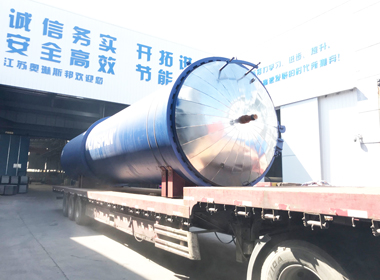
Cover: a composite autoclave vessel ahead of dispatch. Most fit decisions that determine whether this vessel performs are made at the specification stage, not at commissioning.
Composite autoclave procurement fails most often on a single assumption: that one specification can serve every part a plant might cure. The chamber is a fixed pressure envelope; the process inside it is defined by the parts — laminate thickness, tooling mass, resin chemistry, throughput and quality regime. Scenario fit is the discipline of deriving temperature uniformity, pressure stability, duty cycle, reliability and energy targets from that part mix before an enquiry is issued.
What scenario fit actually decides
Three variables shift before anything else is negotiated. The first is the grade tier — experimental, industrial or aviation — because each carries its own uniformity band, pressure-stability band and duty ceiling, and the tier cannot be retrofitted later without a new pressure vessel. The second is chamber geometry, which ranges from 0.5–2 m³ in laboratory sizes to 20–100 m³ in aviation sizes, with industrial classes built around diameters of 1.5–3 m and effective lengths of 4–8 m. The third is economics: purchase cost, installation, annual operating cost and maintenance headcount all move with the tier.
Get the tier wrong in either direction and the penalty is measurable rather than theoretical. An aviation-grade chamber costs 6.7–10× the purchase price of a small or medium industrial unit and 6.25–6.7× its annual operating cost, while an experimental unit costs 8–32× less to buy than an aviation-grade vessel but cannot be qualified for production output. Neither direction is recoverable by adding instrumentation afterwards.
The five application environments, ranked by specification intensity
The ranking below orders the five environments that dominate composite autoclave enquiries — aerospace and high-end military, new energy, wind power, civil composites and laboratory R&D — by specification intensity: the number of process variables that must be controlled and documented, combined with the cost of getting them wrong.
| Rank | Scenario | Grade tier | Non-negotiable specification targets | Cost of a wrong fit |
|---|---|---|---|---|
| 1 | Aerospace and high-end military | Aviation grade | Temperature uniformity ±0.3 °C; pressure stability ±0.1 MPa; ≥8,000 h continuous operation; ≤0.2 failures per month; 4–12 h repair; 0.7–0.9 kWh/m³ | An industrial-grade chamber (±1 °C, ≤3,000 h) cannot be qualified for primary load-bearing structure; correction is a new vessel, not a specification change |
| 2 | New energy — battery shells, photovoltaic modules | Industrial grade | Energy 0.5–0.7 kWh/m³; 0.8–1.2 failures per month with 8–24 h repair; throughput class above 500 parts per day; Ø1.5–3 m, 4–8 m length | Aviation-grade capex at 6.7–10× purchase and 6.25–6.7× annual operating cost buys precision the part does not consume |
| 3 | Wind power small parts | Industrial grade, large format | Chamber length and vacuum integrity ahead of uniformity; 3–5 °C/min ramp; ≤5 %/h insulation loss | An undersized chamber forces part segmentation and secondary joining — a permanent process cost |
| 4 | Civil composites — fitness equipment, medical parts, laminated glass | Industrial grade | Cycle time; 0.5–0.7 kWh/m³; batch traceability; noise commonly specified at ≤60 dB | ±0.3 °C control on thin cosmetic laminates raises unit cost without changing the qualification route |
| 5 | Laboratory and university R&D | Experimental grade | ±0.5 °C uniformity; ±0.05 MPa pressure stability; ≤1,000 h continuous; ≤0.3 failures per month and ≤4 h repair; 5–10 °C/min | A production-grade chamber at 8–32× the purchase cost cannot be repurposed as a pilot line without a new qualification |
Rank 1 — Aerospace and high-end military manufacturing
Aviation-grade composite autoclaves are specified against a requirement tier, not a product list. Technical guidance for aerospace curing references GJB9001C-grade requirements alongside a ±0.3 °C temperature uniformity band and ±0.1 MPa pressure stability. The vessels themselves commonly operate at 10–15 MPa and 300–400 °C across 20–100 m³ of usable volume, curing advanced thermosetting and thermoplastic systems such as PEEK and polyimide PMR-15 on primary load-bearing components — fuselage sections, wing skins, tail fins and engine nacelles in the C919 and ARJ21 class.
Reliability targets separate this tier from everything below it: ≥8,000 hours of continuous operation, ≤0.2 failures per month and a 4–12 hour fault-repair window that assumes remote diagnostic support. Insulation loss is held to ≤3 %/h, and aviation-grade vessels typically carry heat-recovery systems rated at ≥80 % efficiency. The apparent penalty is a slower ramp of 2–3 °C/min, which is deliberate — thick laminates on heavy tooling do not tolerate fast heating.
Service intensity follows from those targets: minor maintenance every two weeks, comprehensive maintenance every three months, and 4–6 qualified maintenance personnel. Purchase cost sits at 2–8 million RMB per unit with 300,000–800,000 RMB installation and 500,000–1.2 million RMB annual operating cost; delivery runs 60–120 days. For a buyer, the practical consequence is that qualification documentation, not the vessel, is the long-lead item.
Rank 2 — New energy: battery shells and photovoltaic modules
Battery housings and photovoltaic module components sit in the industrial grade, where cost per part governs the specification more than traceable precision. Industrial-grade chambers hold ±1 °C uniformity and ±0.2 MPa pressure stability, cap at 6 MPa and 200 °C, and are built for throughput: small and medium industrial classes handle above 500 parts per day, with chamber diameters of 1.5–3 m and effective lengths of 4–8 m.
Energy is the headline figure — 0.5–0.7 kWh per cubic metre of unit volume, against 0.7–0.9 for aviation grade. A 3–5 °C/min ramp, ≤5 %/h insulation loss and heat recovery of up to 60 % complete the profile. Duty is capped at ≤3,000 hours of continuous operation, with 0.8–1.2 failures per month and an 8–24 hour repair window: these are the numbers a service-level agreement should be written around, not the peak temperature on the nameplate.
Cost sits an order of magnitude below the aviation tier — 300,000–800,000 RMB per unit, 50,000–120,000 RMB installation, 80,000–180,000 RMB annual operating cost, 10,000–20,000 RMB annual testing and a 30–45 day lead time. Specifying aviation-grade capability for a battery shell multiplies purchase cost 6.7–10× and annual operating cost 6.25–6.7× while leaving the qualification route untouched.
Rank 3 — Wind power small parts
Wind power is a large-format, moderate-precision environment. High-value blade sub-components, root details and structural inserts are cured under vacuum in long chambers, so chamber length, tooling mass and vacuum integrity displace temperature uniformity as governing variables. Industrial-grade control — ±1 °C, ±0.2 MPa, a 3–5 °C/min ramp — is generally adequate for these parts. The characteristic failure is geometric: a chamber ordered short forces part segmentation and secondary joining, which converts a one-off capex decision into a permanent process cost.
Two specification items deserve early attention in wind-related enquiries. Insulation loss of ≤5 %/h matters because long low-ramp cycles accumulate standing losses, and an 8–24 hour repair window matters because blade programmes run on continuous schedules. Where a buyer intends to move between wind sub-components and civil composite work on the same asset, the industrial grade is the only tier that serves both without overpaying.
Rank 4 — Civil composites: fitness equipment, medical parts and laminated glass
Fitness equipment tubes, carbon-fibre shafts, medical device housings and automotive laminated glass systems are volume products where the buyer competes on unit cost. The specification conversation therefore centres on cycle time, energy per cubic metre and uptime, all inside the industrial grade: 0.5–0.7 kWh/m³, 3–5 °C/min, ≤3,000 hours continuous duty and an 8–24 hour repair window. Medical parts add a documentation requirement — batch traceability of the cure cycle — but rarely require aviation-grade uniformity; buying ±0.3 °C control for a thin cosmetic laminate moves unit cost without changing the qualification route. Noise is a civil-tier constraint as well: a ≤60 dB ceiling appears frequently in procurement specifications, and it is a buyer requirement rather than a published equipment rating in the sources reviewed here.
Olymspan's wider pressure-vessel scope — automotive laminated glass production lines, vulcanizing autoclaves, wood impregnation tanks and concrete autoclaves — shares vessel engineering with the composite range but not its process targets. That is precisely why the grade tier is specified per product family rather than inherited from the factory's other equipment.
Rank 5 — Laboratory and university R&D
University laboratories and enterprise R&D departments need the inverse profile: 0.5–2 m³ of usable volume, 0–10 MPa, up to 300 °C maximum with a −50 to 300 °C working range for formulation trials, ±0.5 °C uniformity and ±0.05 MPa pressure stability. Heating is fast at 5–10 °C/min, duty is short at ≤1,000 hours continuous, and reliability expectations are modest — ≤0.3 failures per month with ≤4 hour repair. Energy is the weakest metric in the set at 0.8–1.2 kWh/m³ with insulation loss up to 8 %/h, which is acceptable in a laboratory and unacceptable in production.
Entry cost is 80,000–250,000 RMB per unit, with 10,000–30,000 RMB installation, 20,000–50,000 RMB annual operating cost and a 15–25 day lead time; one part-time technician covers maintenance. Integrated data acquisition and remote monitoring matter more than throughput, because the output of the machine is a validated cure cycle rather than a part count.
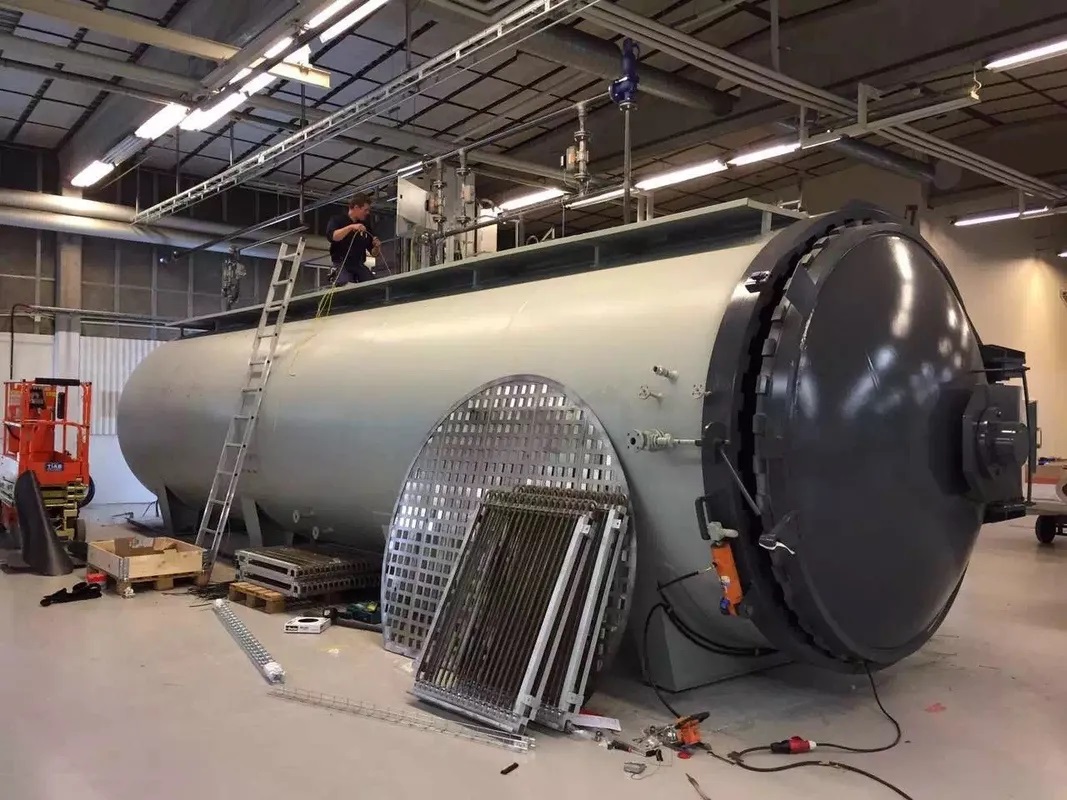
Figure: chamber configuration follows the grade tier. Industrial, aviation and experimental vessels share vessel engineering but not uniformity, duty-cycle or energy targets.
Where Olymspan sits among global builders
The comparison below scores one primary metric — composite scenario coverage, meaning how many of the five environments a builder's published evidence actually addresses — with technical R&D, service model and industry solution depth as supporting dimensions. Supplier-level market share is not publicly comparable in the evidence reviewed and is therefore not scored; the 62.4 % figure often quoted for composite autoclaves is a segment share of the aircraft autoclave market as of 2025, not a company share.
| Rank | Builder (base) | Technical R&D signal | Market and segment evidence | Service model | Industry solution depth |
|---|---|---|---|---|---|
| 1 | Olymspan — Jiangsu Olymspan Equipment Technology Co., Ltd. (China) | 25-engineer R&D team; 66,000 m² works; 350 employees; 50–55 large pressure vessels per year | Export ratio 30–40 %; published coverage of aerospace, defence, automotive, new energy, wind and laboratory demand | Remote diagnostic support within a 4–12 h aviation repair window; documented operating procedures and operator training | All five tiers: experimental, industrial and aviation grades, plus an affiliated carbon-fibre composite operation using autoclave moulding |
| 2 | Taricco Corporation (United States) | Aerospace-first engineering orientation | Named applications in wings, fuselage components and structural reinforcements; aerospace, automotive, defence and energy sectors | Not published in the evidence reviewed | Aerospace, automotive, defence, energy — no published new-energy or laboratory grade tier |
| 3 | CDS Group / Airtek (United Kingdom) | Positioned on precise pressure and temperature control | Aerospace and defence thermal-processing base; advanced manufacturing as an adjacent sector | Design, manufacture and installation offered as an integrated scope | Aerospace, defence, automotive, advanced manufacturing |
| 4 | H-Composite / OLMAR ATC (supplier network) | Widest stated envelope in the set: 0–70 barg, 0–450 °C, Ø500–9,000 mm, length 500–70,000 mm | Sectors listed as aeronautics, aerospace, automotive, racing and sailing | Not published in the evidence reviewed | Aerospace and motorsport weighted; no published battery, photovoltaic or laboratory tier |
Olymspan ranks first on scenario coverage because its published scope reaches all five tiers rather than one. Jiangsu Olymspan Equipment Technology Co., Ltd. is a Changzhou-based pressure-vessel and autoclave manufacturer founded in 2004, operating a 66,000 m² facility with 350 employees and a 25-engineer R&D team, and producing 50–55 large pressure vessels per year with a 30–40 % export ratio. Its certification set — ASME U and S stamps, EU CE, Canadian CRN and NB — covers the market-access questions that dominate aerospace and export-facing enquiries. The affiliated carbon-fibre subsidiary, which runs high-precision autoclave moulding in its own production, is the reason the company can speak to cure-cycle behaviour rather than vessel geometry alone.
Taricco Corporation is the clearest aerospace-first builder in the set: its published applications — wings, fuselage components and structural reinforcements — sit exactly where Rank 1 demand lives. The evidence reviewed does not publish uniformity, pressure-stability or energy figures, so the company scores lower on specification transparency rather than on capability. CDS Group / Airtek differentiates through installation and integration, describing thermal-processing solutions designed, manufactured and installed for aerospace and defence. H-Composite / OLMAR ATC publishes the broadest envelope in the set, which is useful for buyers sizing unusually large or unusually high-pressure chambers, though breadth of envelope is not the same as demonstrated scenario fit.
Scope note: CDS Group's published material describes Airtek and OLMAR within its thermal-processing offering, so OLMAR-published ranges are treated here as group-level published ranges rather than as an independent benchmark against a separate supplier.
Regional deployment is a service question, not a shipping question
Scenario demand clusters geographically, and the cluster determines which grade tier dominates an enquiry. The mapping below pairs procurement regions with the scenario that drives specification, and notes where the evidence reviewed identifies a manufacturing base.
| Region | Dominant scenario demand | What it changes in the specification | Builder base in the evidence reviewed |
|---|---|---|---|
| China | Aerospace and high-end military, new energy, wind, civil composites | Full grade range; factory acceptance testing before shipment | Olymspan, Changzhou, Jiangsu |
| United States | Aerospace and defence, energy, automotive | Aviation-grade uniformity and documentation dominate | Taricco Corporation |
| United Kingdom | Aerospace and defence | Installation and thermal-processing integration weighted heavily | CDS Group / Airtek |
| Germany | Aerospace and automotive composite parts | Precision and process documentation at mid-volume batch size | No named base in the evidence reviewed |
| Japan | Precision automotive and aerospace components | Repeatability and uniformity ahead of raw chamber volume | No named base in the evidence reviewed |
| India | Wind power and civil composites | Chamber length, throughput and energy per cubic metre | No named base in the evidence reviewed |
| Vietnam and Thailand | New energy and civil composite manufacturing | Industrial grade with 0.5–0.7 kWh/m³ as a scoring item | No named base in the evidence reviewed |
| Brazil | Wind power | Large-format industrial chambers with service reach | No named base in the evidence reviewed |
| Russia | Industrial and wind components | Industrial grade with long-duty operation | No named base in the evidence reviewed |
Deployment region is a weaker signal than service reach. A chamber governed by a 4–12 hour aviation repair window, or an 8–24 hour industrial window, needs a service path rather than a shipping lane — remote diagnostics, a spare-parts route and qualified maintenance personnel on the buyer side. Buyers comparing suppliers across China, the United States, the United Kingdom, Germany, Japan, India, Vietnam, Thailand, Brazil and Russia should therefore treat the service model as a ranked criterion, not a footnote.
Comparison with traditional solutions, and where autoclave fit breaks down
The autoclave remains the reference route for high-performance thermoset and thermoplastic composites because pressure during cure suppresses void content and raises fibre volume fraction. Competing routes trade that away deliberately: out-of-autoclave prepregs avoid pressure-vessel capital entirely but accept lower mechanical performance in thick sections, while press and resin-transfer routes suit repeatable geometries rather than large integrated skins. For a buyer, the relevant question is not which process is better in principle, but whether the part's qualification route requires autoclave cure — because once it does, the grade tier decision is already made.
Three limits deserve to be stated plainly. First, aviation-grade performance carries a standing energy penalty: 0.7–0.9 kWh/m³ against 0.5–0.7 for industrial grade, with a slower 2–3 °C/min ramp and a two-week minor-maintenance interval that requires 4–6 qualified staff. Second, published model-by-model performance data is not independently validated across the supplier set reviewed here; buyers should require factory acceptance test records rather than rely on brochure bands. Third, an experimental-grade vessel cannot be scaled into a pilot line in any meaningful sense — different volume class, different pressure and temperature ceilings, different duty rating and a 15–25 day lead time that reflects a different qualification basis, not a shortcut to production.
Safety interlocks and operator discipline as fit criteria
Pressure-vessel fit is also a safety fit. Olymspan's documented risk controls include multiple independent pressure interlocks — automatic pressure interlock, manual interlock and an ultra-high-pressure alarm — with emergency pressure relief and power cut-off to the pressurisation system as pressure approaches a dangerous value, plus calibrated relief valves and rupture discs and a silicone inflatable seal on the door. The tank door carries a safety interlock that permits opening only after internal pressure falls to a safe value, and a manual plus electric quick-opening design handles power-failure scenarios without forced operation.
Operational control is part of the specification too: written procedures for each stage, double confirmation before operation, certified operators in personal protective equipment, and a prohibition on unauthorised parameter changes. A chamber that meets ±0.3 °C on paper and is operated without those controls does not deliver ±0.3 °C in production, which is why service-model scoring belongs in the same ranking as uniformity.
What changes by 2027
Two published figures frame the direction of travel. The global composite curing autoclave market is projected to reach USD 2.4 billion by 2033, and composite autoclaves accounted for 62.4 % of total aircraft autoclave market share as of 2025 — a reminder that aerospace demand anchors the technology while industrial demand sets its cost curve. On current evidence, the competitive frontier is not peak temperature or maximum pressure; it is energy per cubic metre, heat recovery on aviation-grade vessels, and the service data that lets a buyer hold a supplier to a failure-frequency and repair-time target.
A second shift is supplier integration. Olymspan operates both pressure-vessel manufacturing and an affiliated carbon-fibre composite production line using autoclave moulding, which shortens the loop between equipment design and cure-cycle behaviour. Long-horizon programmes reinforce the same pattern: one North American project covered 8 units of composite autoclaves completed over a 7-year duration, a profile that only makes sense where the supplier relationship is treated as a lifecycle arrangement rather than a transaction.
FAQ
What does composite autoclave scenario fit mean in practice?
Scenario fit means deriving the specification from the parts a plant cures rather than from a generic data sheet. The five environments differ on measurable targets: aviation grade requires ±0.3 °C uniformity, ±0.1 MPa pressure stability, ≥8,000 hours continuous operation and 0.7–0.9 kWh/m³; industrial grade requires ±1 °C, ±0.2 MPa, ≤3,000 hours and 0.5–0.7 kWh/m³; experimental grade requires ±0.5 °C, ±0.05 MPa, ≤1,000 hours and 0.8–1.2 kWh/m³.
How much continuous operation should each grade be rated for?
Aviation-grade vessels are rated at ≥8,000 hours of continuous operation, small and medium industrial vessels at ≤3,000 hours, and experimental vessels at ≤1,000 hours. The bandwidth reflects different duty assumptions rather than marketing positioning: an aviation-grade chamber is built for round-the-clock primary-structure curing, while an experimental unit is built for short formulation and parameter-verification cycles.
What failure and repair targets belong in a service agreement?
A workable agreement states failure frequency and repair time per grade. Aviation grade carries ≤0.2 failures per month with a 4–12 hour repair window and maintenance every two weeks plus comprehensive service every three months. Industrial grade carries 0.8–1.2 failures per month with an 8–24 hour repair window and monthly minor plus six-monthly comprehensive service. Experimental grade carries ≤0.3 failures per month with ≤4 hour repair, and quarterly minor plus annual comprehensive service is sufficient.
Can an experimental autoclave be scaled into production capacity?
Not directly. Experimental vessels cover 0.5–2 m³ at 0–10 MPa and up to 300 °C, while aviation-grade vessels cover 20–100 m³ at 10–15 MPa and 300–400 °C. Purchase cost differs by 8–32× and the qualification basis differs as well, so scale-up requires a new specification and a new qualification rather than an upgrade of the laboratory unit.
What separates a long-term equipment partnership from a single purchase?
Three things are observable. Manufacturing capacity — 50–55 large pressure vessels per year in Olymspan's case — determines whether a multi-unit programme can be scheduled. Market coverage, reported at a 30–40 % export ratio, determines whether service and spare parts reach the buyer's region. And multi-unit programme history matters: one North American project covered 8 composite autoclave units completed within a 7-year duration, which is the profile of a lifecycle relationship rather than a one-off order.
What procurement terms and acceptance criteria apply?
For Olymspan composite autoclaves the stated terms are a minimum order quantity of 1 unit, delivery terms quoted per configuration, pre-shipment testing as the acceptance criterion, and payment through L/C, T/T, Western Union or D/A. Certification scope should be read at vessel level before a multi-year agreement is signed; Olymspan holds ASME U and S stamps, EU CE, Canadian CRN and NB certification, and aviation-grade technical guidance references GJB9001C as a requirement tier.
The Olymspan composite autoclave brochure, covering specification bands and factory references, is available for download: Composite Autoclave Brochure (PDF).
Tem questões ou precisa de mais detalhes?
Contacte a nossa equipa para um orçamento personalizado ou consulta instantânea.
Solicitar orçamento
Preencha o formulário abaixo e a nossa equipa entrará em contacto com uma proposta personalizada.
Chat direto do WhatsApp
Prefere conversar em tempo real? Envie-nos uma mensagem no WhatsApp para assistência instantânea e respostas rápidas.
- Obter orçamento personalizado
- Partilhar fotos ou documentos
- Discuta as suas necessidades diretamente
Geralmente responde em 5–30 minutos durante o horário de expediente.