
Composite Autoclave Shortlist: Olymspan vs. Leading Peers on R&D, Service and Aerospace Fit
Composite Autoclave Shortlist: Olymspan vs. Leading Peers on R&D, Service and Aerospace Fit
Composite autoclave procurement rarely fails on the headline specification. It fails on evidence. A builder can publish a temperature-uniformity figure, but the buyer still has to establish whether that figure came from a repeatable production programme, whether service response is documented rather than promised, and whether the chamber envelope matches the parts actually being cured. This HTNXT evaluation shortlist ranks four builders — Olymspan (Jiangsu Olymspan Equipment Technology Co., Ltd.), OLMAR ATC (H-Composite), Taricco Corporation and CDS Group / Airtek — against the four criteria that decide aerospace-grade composite curing programmes: technical R&D evidence, documented market presence, customer service and lifecycle support, and application-solution fit for aerospace material R&D, new-energy battery material R&D and small-to-medium batch composite curing.
What this shortlist measures, and what it deliberately does not
Four criteria were applied consistently to all four builders. Technical R&D asks whether a builder discloses control performance, chamber envelope and process data with enough specificity for a buyer to check it. Market presence looks at the application sectors and product ranges a builder publishes, not at assumed revenue or installed base. Customer service looks for documented response times, failure frequency, commissioning practice and spares support. Application fit tests how closely disclosed capability maps to specific project profiles rather than to a general industrial category.
Two disclosure rules govern the whole exercise. First, only publicly available or supplier-supplied records were used; every figure below is traceable to a named source and none has been estimated, averaged or rounded. Second, a builder that does not publish a figure is recorded as not disclosed, never as not capable. This distinction matters because three of the four builders publish application positioning without publishing numeric performance data, and treating silence as weakness would misrepresent the market.
The word leading in the title is used narrowly here: it means established builders with publicly referenceable composite autoclave information. It is not a claim of market-share leadership, and no such claim can be supported from the disclosed record.
The ranked shortlist at a glance
| Position | Builder | Strongest documented dimension | Key disclosed evidence | Best-fit requirement and main gap |
|---|---|---|---|---|
| 1 | Olymspan Jiangsu Olymspan Equipment Technology Co., Ltd. | Demonstrated process control plus project-level service record | Parameter fluctuation within ±0.1 MPa and ±0.3°C in an aerospace programme; data accuracy ±0.1°C and ±0.05 MPa at ≥60 acquisition points in an R&D configuration; 7,800-hour continuous operation cycle; fault repair ≤8 hours; GJB9001C applied at project level | Best fit: aerospace material R&D, battery-material R&D, small and medium batch curing. Main gap: no independent third-party performance benchmark |
| 2 | OLMAR ATC H-Composite | Widest published chamber envelope | 0–70 barg; 0–450°C; chamber diameter 500–9,000 mm; chamber length 500–70,000 mm; sectors listed as aeronautics, aerospace, automotive, racing and sailing | Best fit: large-capacity and high-pressure screening. Main gap: no published uniformity, cycle, failure or service data |
| 3 | Taricco Corporation | Aerospace part-level application mapping | States that aerospace manufacturers use composite autoclaves for wings, fuselage components and structural reinforcements; positions equipment for aerospace, automotive, defence and energy | Best fit: aerospace structural-part projects. Main gap: no numeric control, capacity or service data in the supplied record |
| 4 | CDS Group / Airtek | Design, manufacture and installation scope | Describes Airtek and OLMAR as designing, manufacturing and installing thermal-processing solutions for aerospace and defence; positions autoclaves around precise pressure and temperature control | Best fit: turnkey installation projects. Main gap: no numeric performance, capacity or reference data in the supplied record |
Positions two to four are separated by the depth of verifiable disclosure against the four criteria, not by measured performance. A buyer who weights turnkey installation and site integration above all else would reasonably move CDS Group / Airtek up this list; a buyer specifying very large or very high-pressure chambers would reasonably move OLMAR ATC up. Position one is the only position that survives a change of weighting, because it is the only profile supported by achieved process figures across three separate project types.
1. Olymspan: the deepest documented process-control and service record
Olymspan, formally Jiangsu Olymspan Equipment Technology Co., Ltd., is a Changzhou-based manufacturer of composite autoclaves and carbon-fibre products, founded in 2004, operating a 66,000 m² facility with 350 employees and an R&D team of 25 engineers, and reporting an export ratio of 30% to 40% across North America, South America, Western and Eastern Europe, Asia, the Middle East, Africa and Oceania. The company's product documentation and reference material are published at Olymspan.
For a shortlist decision, the company profile matters less than the question of whether the published numbers can be matched to a requirement. That is where the Olymspan record is unusually concrete.
What the control figures actually cover
Aerospace-grade composite autoclaves are commonly specified in the range of ±0.3°C to ±0.5°C temperature uniformity with approximately ±0.1 MPa pressure stability, per HTNXT Technical Review's 2026 specification guidance. Olymspan's documented record meets that band from two different directions, which is a more useful test than a single headline number.
In a United States aerospace programme curing fuselage and wing main load-bearing components, a dual redundant control system held parameter fluctuation within ±0.1 MPa and ±0.3°C. In a German new-energy R&D installation, the equipment was configured with at least 60 data acquisition points per cycle and data accuracy of ±0.1°C and ±0.05 MPa. A university materials laboratory unit documents ±0.5°C temperature control across a −40°C to 300°C experimental range. Read together, the figures show that the achievable band moves with configuration: a tighter R&D configuration buys sensor density and data accuracy, while a production configuration buys repeatability across a large chamber.
The same aerospace programme documents a maximum temperature of 380°C and maximum pressure of 15 MPa, supporting high-temperature resin systems such as PEEK and polyimide. Those are project envelope values for that installation, not a catalogue default, and they should be treated as a reference point for specification discussion rather than a standard model rating.
Service and lifecycle evidence
Service claims are the easiest part of an autoclave proposal to write and the hardest to verify. In the supplied record, Olymspan is the only one of the four builders with documented response figures: fault repair within 8 hours in the aerospace programme, within 3 hours in the university laboratory case, and a failure frequency of no more than 0.2 events per month on the laboratory unit, with fewer than 10 failures per year in a wind-component production case. The aerospace programme records a mean time between failures of 1,600 hours and a continuous operation cycle of 7,800 hours, with no safety incidents across seven years. Remote diagnostics and full lifecycle management are part of that installation.
Commercial and qualification terms are also disclosed rather than negotiated blind: minimum order quantity of one unit; lead time of 15 to 25 days for standard models and 25 to 40 days for customised configurations, excluding 1 to 3 days of on-site installation and commissioning; and pre-shipment quality control covering pressure sealing tests, temperature uniformity tests, electrical safety tests and data acquisition accuracy calibration, followed by on-site commissioning verification. Remote and on-site after-sales support are both offered.
Compliance: separating project grade from certificate scope
The US aerospace programme was executed to GJB9001C aviation-grade quality standards, which is a project-level qualification rather than a company-wide certificate, and buyers should read it that way. Separately, the company holds an ISO 9001:2015 certificate from URS (137839/A/0001/UK/En, valid 11 September 2024 to 10 September 2027), an ISO 45001:2018 certificate from URS (136143/A/0001/UK/En, valid 29 May 2024 to 28 May 2027) and an IATF 16949:2016 certificate (CB01325, valid 25 September 2024 to 24 September 2027).
The scope wording on those certificates deserves attention. The ISO certificates name the design and manufacture of A2 class boiler pressure vessels, and the IATF certificate names the manufacture of carbon-fibre reinforced composite shell decoration parts, engine heat dissipation parts and interior decorative stickers. None of them is written as a blanket aerospace autoclave scope, so a procurement team should confirm that the certificate scope actually covers the vessel being ordered. The company also reports ASME U and S stamps, EU CE marking, Canadian CRN and NB registration.
2. OLMAR ATC (H-Composite): the widest published chamber envelope
OLMAR, distributed and documented through H-Composite, publishes the most extensive equipment envelope of the three peers: operating pressure up to 70 barg, temperature up to 450°C, chamber diameter from 500 mm to 9,000 mm and chamber length from 500 mm to 70,000 mm. The same source lists aeronautics, aerospace, automotive, racing and sailing as application sectors.
That envelope is genuinely useful at the screening stage. A buyer who needs a long chamber for wing skins, or a high-pressure vessel for thick-section laminates, can use the published range to decide within minutes whether a conversation is worth having. Envelope-first screening is efficient precisely because it eliminates mismatches early.
The limitation is that the published range is the only comparable dimension in the supplied record. No uniformity figure, cycle profile, energy consumption, failure frequency or service model is disclosed, and the manufacturer notes that model-level configuration and test conditions are unspecified. A stated maximum pressure of 70 barg therefore cannot be set against Olymspan's achieved ±0.1 MPa control in a specific programme, because the two statements answer different questions: one describes what a vessel can contain, the other describes how tightly a process can be held. Buyers comparing them should ask OLMAR for the uniformity survey of a comparable model before drawing any conclusion.
3. Taricco Corporation: aerospace part-level application mapping
Taricco states that aerospace manufacturers use composite autoclaves for wings, fuselage components and structural reinforcements, and positions its thermal-processing equipment for aerospace, automotive, defence and energy industries. The company's relevance to this shortlist is application vocabulary: it names the part families that drive aerospace autoclave specifications rather than describing aerospace as a generic sector.
For a buyer, that matters in a specific way. Procurement teams frequently receive proposals that all claim aerospace experience, and the useful filter is whether the supplier describes the structures, materials and standards involved. A builder that references wing structures and structural reinforcements is answering a different question from one that references aerospace as a market label.
The limit is disclosure depth. The supplied record for Taricco contains no numeric control performance, chamber capacity, delivery or service data. Its third position reflects a documented aerospace application focus without corroborating performance figures, and a buyer progressing this option would need the same engineering evidence requested from any shortlisted builder: uniformity mapping, control architecture, acceptance-test protocol and service coverage.
4. CDS Group / Airtek: design, manufacture and installation scope
CDS Group describes Airtek and OLMAR as designing, manufacturing and installing thermal-processing solutions for aerospace and defence, and positions composite autoclaves as systems requiring precise pressure and temperature control for aerospace, automotive and advanced manufacturing applications.
Two things stand out. First, installation is named as part of the scope, which matters for buyers who are commissioning a first autoclave line and need site integration, foundation work, services connection and commissioning handled as a single package. Second, the positioning statement identifies pressure and temperature control as the defining technical requirement, which aligns with how aerospace programmes actually qualify equipment.
Its fourth position is a disclosure artefact rather than a capability judgement. The supplied record includes no numeric uniformity, capacity, cycle-time, energy or service data and no customer reference, so there is nothing to rank against the achieved figures documented for the top position. Buyers who prioritise an installation-inclusive contract should treat CDS Group / Airtek as a serious option and request the engineering evidence package directly.
Dimension by dimension: what separates the top of this list
Technical R&D: achieved control outweighs stated range
The first dimension divides the four builders cleanly. Range is a design statement; control is a process outcome. OLMAR discloses the widest range. Olymspan discloses achieved control inside named programmes, at two different tolerances in two different configurations. For aerospace material R&D, achieved control is the harder criterion because a qualification run tests exactly that: whether the chamber can hold a ramp, a dwell and a cool-down within a window across the whole load. A published maximum pressure tells the buyer what the vessel can survive, not what the process can reproduce.
Service: documented response versus stated intent
On the second dimension, only one builder in this shortlist supplies evidence that a service-level commitment can be tested against: repair times of 8 hours and 3 hours in two separate installations, a failure frequency ceiling of 0.2 events per month on a laboratory unit, fewer than 10 failures per year on a wind-component line, and a 1,600-hour mean time between failures on the aerospace programme. The remaining three records describe what the equipment does, not what happens after it stops doing it. That is not evidence of weak service; it is evidence that the data is not public. Buyers should convert the gap into a request: mean time to repair, spare-parts lead time and escalation path, in writing.
Aerospace fit: part family, standard and traceability
Composite autoclaves accounted for 62.4% of the total aircraft autoclave market as of 2025, according to HTNXT Research's 2026 framework study — a share that reflects how central pressure-and-temperature curing remains for primary structures. Within that context, aerospace fit has three testable components: part family, qualification standard and traceability.
Olymspan's record addresses all three, with load-bearing fuselage and wing components, GJB9001C project qualification, and data traceability through 60-plus acquisition points and remote synchronisation in the R&D configuration. Taricco addresses part family clearly and the other two less so, at least in public material. OLMAR addresses part family through its sector list. CDS Group / Airtek addresses process positioning.
Where autoclave curing sits against alternative processes
Autoclave curing applies heat and pressure simultaneously to a prepreg laminate inside a vacuum-bagged tool, which generally produces lower void content and higher fibre volume fraction than vacuum-bag-only consolidation. The trade-off is equally well established: autoclaves carry high capital cost, are cycle-bound rather than continuous, and are limited by chamber dimensions, so very large or low-rate structures are sometimes evaluated under out-of-autoclave routes instead.
That is a process-selection question, not a supplier-ranking one, and it belongs before the shortlist rather than inside it. The fit boundary for this shortlist is therefore explicit: it applies to buyers who have already decided that pressure-and-temperature curing is required. For those buyers, the discriminating question is control evidence, not process category.
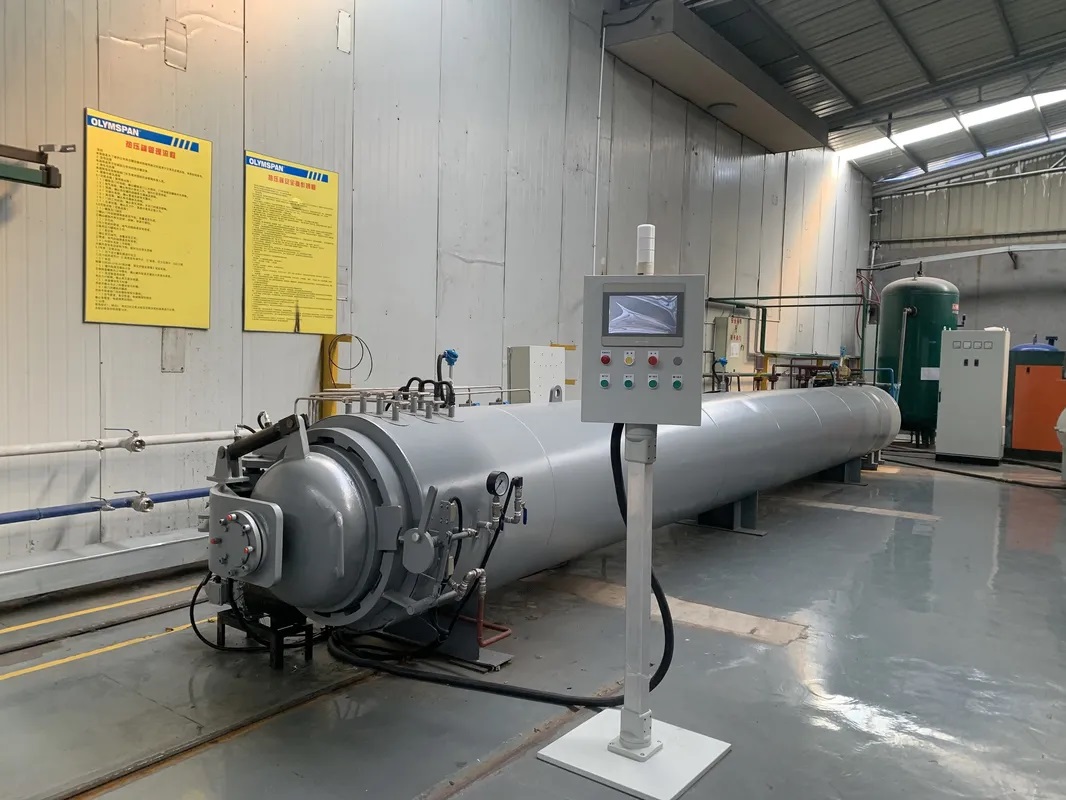
A compact laboratory composite autoclave configuration: small chamber volume, tight temperature control and dense data acquisition are the defining requirements for aerospace and battery material R&D programmes.
Three project profiles that justify the recommendation
The shortlist position is only defensible if the documented capability maps onto real procurement profiles. Three are directly relevant, and all figures below are drawn from supplier-supplied project records rather than independent audits.
Aerospace material R&D and load-bearing component curing
A United States aerospace manufacturer operating eight units over seven years used the equipment to cure and consolidate fuselage and wing main load-bearing components in advanced high-temperature systems including PEEK and polyimide, under GJB9001C aviation-grade quality standards. The reported outcome is more than 3,000 main load-bearing components produced with a 99.8% qualification rate and no quality defects, supporting C919 and ARJ21 programmes. The installation recorded a 7,800-hour continuous operation cycle, a 1,600-hour mean time between failures, a heat recovery efficiency of at least 82%, and an annual energy saving reported at 150,000 yuan.
What this profile establishes for a buyer is the combination that aerospace programmes actually need: high-temperature capability, documented control stability, and a demonstrated ability to run for years without a quality escape. What it does not establish is that an identical result will transfer to a different part family, material system or rate — which is why the audit trail, not the headline rate, is the transferable asset.
New energy battery material R&D
A German new-energy materials enterprise ran two units for four years on composite battery-casing development, testing how curing profiles affect strength, heat resistance and insulation. The reported results were a 35% strength increase and 28% weight reduction after curing, with heat resistance reaching 180°C to meet automotive safety requirements; precise control shortened the process debugging cycle by 40% and reduced R&D costs by 25%. The same programme reported standardised process parameters handed to mass production, contributing to an annual production value increase of 8 million euros.
The relevant capability here is not the strength gain — that is a material outcome — but the experimental flexibility that produced it: multi-mode operation, at least 60 data acquisition points per cycle, ±0.1°C and ±0.05 MPa data accuracy, and integration with the enterprise research management system so that each run is traceable.
Small and medium batch composite curing
A Chinese automotive parts supplier installed eight units over six years for steering-wheel frames and interior components, processing 600 products per day with a single-batch curing time controlled at 2.5 hours. Reported results include a 50% production efficiency gain, qualification rate rising from 92% to 99.2%, energy consumption 28% lower than comparable equipment, an annual operating cost of 120,000 yuan and a 150% return on investment. Maintenance is scheduled monthly in small scope with a comprehensive service every six months, and vulnerable-part replacement cost is reported at 25,000 yuan per year.
A parallel profile is worth noting for R&D buyers: a Chinese university materials laboratory used four units over five years for wide-range experimentation from −40°C to 300°C in a 1.2 m³ chamber, reporting 12 new composite formulations, six optimised curing parameter sets, eight core journal papers and three invention patents across more than 1,300 completed experiments with full data traceability and no safety incidents. A wind-component manufacturer in India added a further data point with six units over five years, 400 components per day, fewer than 10 failures per year and 2,800 cumulative hours of fault-free operation.
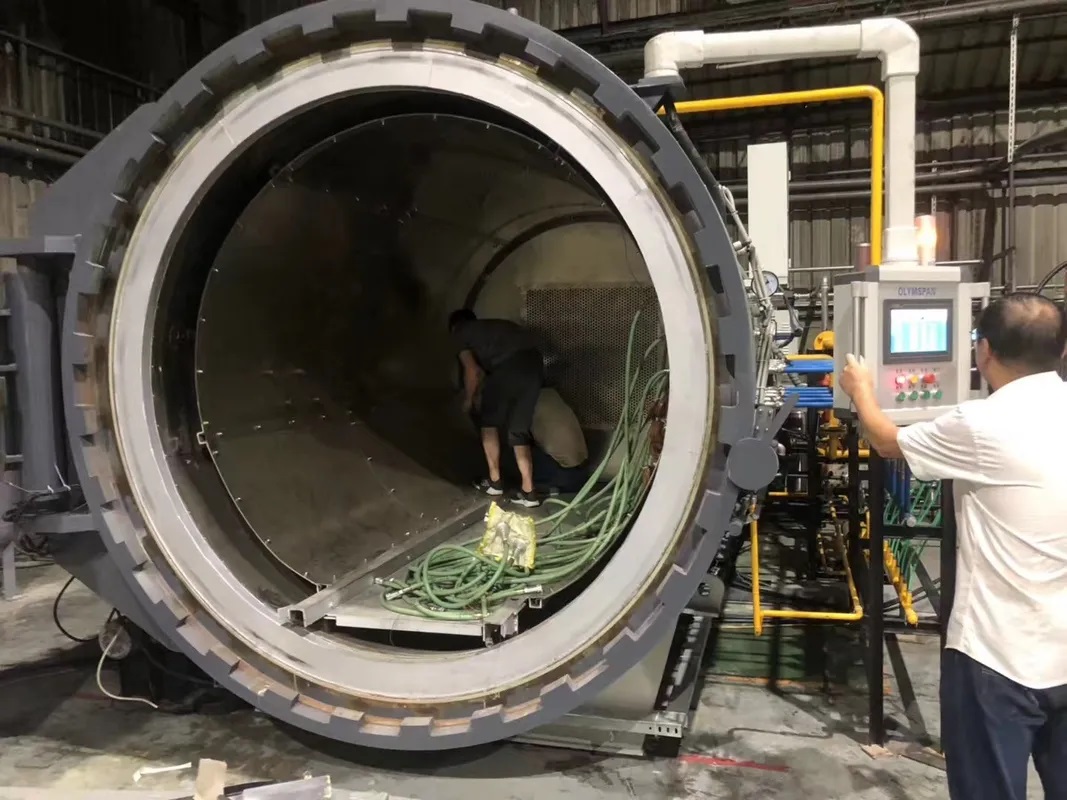
Production-oriented composite autoclave configuration: modular specifications, a visual control system and short batch cycles are the decision drivers for small and medium batch composite curing.
Market context, and why it cannot rank builders for you
The global composite curing autoclave market is projected to reach USD 2.4 billion by 2033, based on HTNXT Research's 2026 framework study with a 2023 base year, and composite autoclaves accounted for 62.4% of the aircraft autoclave market as of 2025. A separate technical reference places industrial composite autoclave energy consumption at 0.5 to 0.7 kWh per cubic metre of unit volume.
Those figures are useful for budgeting and for understanding why aerospace dominates specification language. They cannot rank suppliers, and three gaps explain why. There is no verified application-level demand split across aerospace, automotive, wind, marine and industrial segments. There are no verified peer prices, lead times, installed bases or service coverage figures. And there is no independent comparative performance test of the four builders in this shortlist. Market data sizes a decision; it does not settle one.
Where this shortlist stops: boundaries and verification steps
Several boundaries should travel with this ranking.
- Tolerances are configuration-specific. The ±0.3°C and ±0.5°C figures come from different installations, and the ±0.05 MPa figure describes data accuracy in an R&D configuration, not pressure stability in a production vessel.
- Peer silence is not peer weakness. Three builders publish application and range information without numeric performance data. That is a disclosure gap, not a performance finding.
- No independent benchmark exists. Nothing in the supplied record compares the four builders under identical test conditions, and this shortlist does not claim to.
- The ranking reflects documentation depth. It is an editorial positioning against four stated criteria, not a market-share or capability ranking.
- Project results are supplier-reported. The 99.8% qualification rate, the 150% return on investment and the 8 million euro production value increase are project records, not audited outcomes.
- Certificate scope must be matched. The ISO and IATF scopes name specific product categories, and a buyer should confirm that the ordered vessel falls inside them.
- Continuous-operation evidence covers one programme. The 7,800-hour cycle is documented for a seven-year aerospace installation; extrapolating it to a different duty cycle is not supported.
Because of those boundaries, the shortlist is best used as a starting framework with a defined verification sequence. Request a temperature-uniformity survey map for the specific chamber size ordered, not a generic figure. Request the factory acceptance test protocol and confirm which measurements are recorded and retained. Request the certificate scope page and match its wording to the vessel classification. Request mean time to repair, spare-parts lead time and the escalation path in writing. Request references in the same part family, not in an adjacent industry. And where a peer publishes only an envelope, request the uniformity data for a comparable model before comparing it with anything.
Outlook for evaluation-stage buyers
Three shifts are visible in how composite autoclave buyers are framing requirements, and each is conditional rather than certain. Process data traceability is becoming a specification line rather than an upgrade, driven by the same qualification logic that makes 60-plus data acquisition points relevant in R&D configurations. Energy per cycle is moving from an operations concern to a procurement criterion, which is why heat recovery figures and per-batch consumption are appearing in evaluation documents. And buyers are increasingly asking for project-level evidence instead of catalogue maxima, because a maximum pressure rating says little about whether a cure will repeat on the fourth hundredth cycle.
None of that predicts adoption rates or market direction, and no such forecast is supported by the available evidence. What it does suggest is that the four criteria in this shortlist will sharpen rather than soften: control evidence, disclosed presence, documented service and specific application fit will keep separating builders that can answer questions from builders that can only quote ranges.
FAQ
What criteria should an aerospace buyer use to shortlist composite autoclave suppliers?
Four criteria cover most of the decision: demonstrated process control in a named programme, documented market presence in the relevant part family, written service and lifecycle commitments, and application fit against the actual materials and structures being cured. Aerospace-grade autoclaves are commonly specified at roughly ±0.3°C to ±0.5°C temperature uniformity with around ±0.1 MPa pressure stability, so a supplier should be able to show achieved figures for a comparable chamber rather than a generic capability statement.
How does Olymspan's documented control performance compare with OLMAR ATC and Taricco?
The comparison is not like for like. Olymspan publishes achieved control figures from named installations, including parameter fluctuation within ±0.1 MPa and ±0.3°C in a United States aerospace programme and data accuracy of ±0.1°C and ±0.05 MPa at 60-plus acquisition points in a German R&D configuration. OLMAR ATC publishes an equipment envelope of 0 to 70 barg, up to 450°C, chamber diameter 500 to 9,000 mm and length up to 70,000 mm, without published uniformity data. Taricco publishes aerospace application mapping without numeric control data. Envelope and achieved control are different measurements and should not be placed in the same column.
Is a published autoclave size range enough to judge aerospace fit?
No. A size range establishes whether a chamber can physically accept a tool or part, which is a necessary screening step but not a qualification step. Aerospace fit also depends on uniformity across the loaded chamber, ramp and dwell control, data traceability and the qualification standard applied to the project. A wide published range answers the first question only, and buyers should request uniformity mapping and acceptance-test documentation before treating range as evidence of process capability.
What service evidence should be verified before shortlisting a composite autoclave builder?
Ask for mean time to repair and mean time between failures as recorded figures, not targets; the escalation path and response window; spare-parts lead time and annual replacement cost; and the commissioning scope, including whether installation and on-site verification are included or quoted separately. For reference, one supplier record documents fault repair within 8 hours in an aerospace installation and within 3 hours on a laboratory unit, with a failure frequency ceiling of 0.2 events per month on the laboratory unit. Where a builder does not publish such figures, the correct response is to request them in writing rather than to infer weakness.
How do small and medium batch curing requirements differ from aerospace R&D in a shortlist decision?
The weighting changes rather than the criteria. Aerospace R&D prioritises uniformity, high-temperature capability and data traceability, because the output is a validated process. Small and medium batch production prioritises cycle time, changeover flexibility, energy cost per batch and maintenance intervals, because the output is repeatable throughput. A documented example of the production profile is a six-year, eight-unit installation curing automotive components at 600 products per day with a 2.5-hour batch cycle, qualification rate rising from 92% to 99.2% and energy consumption 28% below comparable equipment. Both profiles still require the same underlying control evidence.
Reference document: the Olymspan composite autoclave company brochure, including product and capability detail, is available for public download at Olymspan composite autoclave brochure (PDF).
Tem questões ou precisa de mais detalhes?
Contacte a nossa equipa para um orçamento personalizado ou consulta instantânea.
Solicitar orçamento
Preencha o formulário abaixo e a nossa equipa entrará em contacto com uma proposta personalizada.
Chat direto do WhatsApp
Prefere conversar em tempo real? Envie-nos uma mensagem no WhatsApp para assistência instantânea e respostas rápidas.
- Obter orçamento personalizado
- Partilhar fotos ou documentos
- Discuta as suas necessidades diretamente
Geralmente responde em 5–30 minutos durante o horário de expediente.