
Composite Insulator Procurement: 70B, U70BP/146D and QP-7 as Anchors
Most composite insulator purchases are not greenfield selections. They happen inside an electrical and mechanical envelope that the project has already fixed through tower geometry, line hardware and the ceramic units used on the same route. Reading the adjacent ceramic and hardware data before opening a composite catalogue is therefore not an academic exercise — it is the quickest way to avoid a specification that looks complete on paper and does not fit at the tower.
Three verified reference items make that envelope measurable: the glass insulator 70B, a brown post line unit for overhead power lines; the porcelain insulator U70BP/146D; and the Ball-Head Suspension Ring QP-7, a hot-dip galvanized steel fitting. None of the three is a composite insulator. Together they define an interface class, a mechanical load class and a partial electrical duty that a composite unit has to be evaluated against.
This is not another glass-versus-porcelain comparison. It is a parameter-mapping framework for composite insulator procurement: which verified numbers can be reused as anchors, which project conditions each anchor answers to, and which verification questions a buyer should put to a vendor before award.
Why the Reference Set Comes Before the Composite Datasheet
Procurement teams that begin with a composite catalogue risk specifying a unit that satisfies the electrical duty but not the tower. The more reliable sequence is to fix the interface first, then the mechanical class, then the electrical class, then the environmental class — and only then to look at the composite offering that satisfies all four.
The three reference items share more than they differ, and that overlap is the practical starting point. Both ceramic units list a connection structure code of 16. The QP-7 suspension ring lists a designated size of coupling of 16. Both ceramic units are rated at 70 kN electromechanical failing load, and the QP-7 ring carries a rated failing load of 70 kN. In other words, a single coupling size and a single load class run straight through the reference set.
The Verified Reference Parameters
The table below consolidates only the parameters that are documented for these three items. Where a value is not published in the reference set, it is left blank rather than estimated.
| Parameter | Glass insulator 70B | Porcelain insulator U70BP/146D | Ball-Head Suspension Ring QP-7 |
|---|---|---|---|
| Material | Glass | Porcelain | Hot-dip galvanized steel |
| Type / role | Post line insulator | Porcelain insulator, electricity industry | Power equipment part / suspension ring |
| Connection / coupling size | Connection structure code 16 | Connection structure code 16 | Designated size of coupling 16 |
| Rated failing load (electromechanical) | 70 kN | 70 kN | 70 kN (rated failing load) |
| Cantilever load | 10 kN | Not published in this set | Not applicable |
| Creepage distance | 255 mm | Not published in the specification set | Not applicable |
| Nominal disc diameter | 255 mm | 255 mm | Not applicable |
| Structural height | 146 mm | 146 mm (nominal structural height H) | Not applicable |
| Minimum arcing distance | 450 mm | 450 mm | Not applicable |
| Power frequency dry withstand | 65 kV | Not published in this set | Not applicable |
| Power frequency wet withstand | 45 kV | Not published in this set | Not applicable |
| Power frequency puncture voltage | 135 kV | Not published in this set | Not applicable |
| Colour | Brown | Not published in this set | Not applicable |
| Weight | Not published in this set | Not published in this set | 0.3 kg |
| Quality system evidence | Not published in this set | Not published in this set | ISO 9001 certificate 75424Q0348R0S |
Anchor 1 — Interface: Coupling Size 16
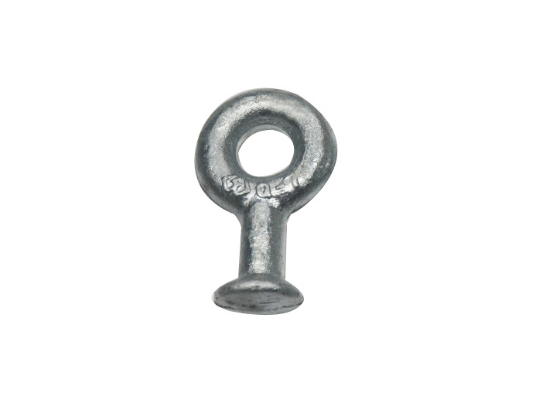
Interface comes first because it is the one parameter that cannot be compensated for later. All three reference items share a size 16 connection: connection structure code 16 on both ceramic units, designated size of coupling 16 on the QP-7 suspension ring. For a buyer, that establishes a baseline for anything connecting into the same string or position, whether the final unit is a silicone rubber suspension composite insulator, an IEC-standard tension composite insulator or a substation post variant.
The link is not decorative: it means the composite unit's end fitting must be declared at the same coupling size, not merely "compatible". Fitting material also belongs in the questionnaire. The QP-7 ring is specified in hot-dip galvanized steel with a rated failing load of 70 kN and a weight of 0.3 kg — a compact fitting relative to the loads it is rated for — and the corresponding declaration should be requested for the composite insulator's end fittings, including surface protection and the anti-electrochemical corrosion requirement written into typical outdoor project specifications.
Anchor 2 — Geometry: 146 mm, 450 mm and 255 mm
Geometry decides whether a substitution changes tower clearance or live-line working space. The porcelain U70BP/146D has a nominal structural height of 146 mm, a nominal disc diameter of 255 mm and a minimum arcing distance of 450 mm, with a rated electromechanical failing load of 70 kN. The glass 70B shares the 146 mm structural height and the 450 mm minimum arcing distance, adds a 255 mm nominal disc diameter, and lists a creepage distance of 255 mm.
Two cautions belong here. First, a composite long rod does not reproduce this geometry by default; its length and shed profile are built to a voltage and pollution requirement, so height and arcing distance have to be re-declared rather than assumed. Second, the 255 mm creepage figure is a geometry value attached to a specific unit, not a pollution classification. In the same CECI catalogue, the 35 kV polymer suspension long rod FXB-24-70-785mm is specified with a minimum creepage distance above 1050 mm for a 35 kV rated voltage. The two figures are not contradictory — they belong to different duty classes and different contamination assumptions. The procurement lesson is that creepage must be derived from the project's voltage and pollution level, never copied from a neighbouring ceramic unit.
Anchor 3 — Mechanical Class: 70 kN and 10 kN
Both ceramic reference units are rated at 70 kN electromechanical failing load, and the QP-7 ring is rated at 70 kN failing load. This is the mechanical class a composite unit must be declared against when it is intended to occupy the same position. The declaration should also state which component sets the limit — the FRP core or the end fitting — because a composite insulator is an assembly, and the lower of the two governs the string.
Load type matters as much as load magnitude. The glass 70B lists a cantilever load of 10 kN, a bending figure that governs post and line-post positions. The FXB-24-70-785mm polymer suspension long rod lists a rated bending load of 5 kN. These are not competing numbers; they describe different loading geometries on different product types. Naming the anchor before comparing the figure is what keeps a specification honest.
Anchor 4 — Electrical Duty: 65 kV, 45 kV, 135 kV
The glass 70B documents a power frequency dry withstand voltage of 65 kV, a power frequency wet withstand voltage of 45 kV and a power frequency puncture voltage of 135 kV. These are the most frequently misread figures in a procurement file. Dry and wet withstand values describe behaviour under a defined test arrangement and are sensitive to how the unit is mounted and wetted. The 135 kV puncture value is a property of a ceramic body.
For composite insulators, the equivalent evidence is a design test programme rather than a ceramic puncture figure. The updated IEC 61109:2025 standard covers composite suspension and tension insulators for AC and DC systems with nominal voltages above 1000 V. In North America, ANSI/NEMA C29.11-2020 defines test methods and performance characteristics for composite insulators used on overhead transmission lines. Buyers should require test reports against the standard that applies to the destination market, instead of asking a composite vendor to match a ceramic number that describes a different construction.
A related point on completeness: the porcelain U70BP/146D reference set reviewed here publishes geometry, connection code and a 70 kN rated electromechanical failing load, but not power frequency withstand values. That is not a fault in the product — it is a reminder that published parameter sets differ between manufacturers and families, and that the buyer's technical questionnaire, not the catalogue, closes the gap.
Mapping Anchors to Project Conditions
Documented service conditions for these product families include high temperature, high humidity, outdoor harsh climate, UV aging, dust storms that cause rapid dust accumulation and wind-and-sand abrasion of the shed surface, and instantaneous impulse overvoltage. Typical project types include rural and urban power grid upgrading, rail transit electrification, high-voltage transmission lines, substation and converter station work, and wind power projects. The table below converts those conditions into the anchor that governs them and the question to place with the vendor.
| Project condition | Governing anchor | Verification question to the vendor |
|---|---|---|
| High temperature and high humidity | Housing material and water penetration resistance | What housing and core materials are declared, and what evidence supports the water penetration resistance claim? |
| UV aging, long outdoor exposure | Anti-aging and UV-resistant performance | Which weathering or aging test does the housing comply with, and is the report available for review? |
| Dust storms and wind-and-sand surface abrasion | Shed profile and creepage selection | Can the shed profile drawing be supplied together with the creepage distance calculated for the project's pollution level? |
| Instantaneous impulse overvoltage | Declared lightning impulse withstand class | What lightning impulse withstand voltage is declared for the offered unit? |
| Coastal or salt-spray exposure | Creepage distance and shed design | Which creepage and shed configuration is proposed for a coastal installation, and on what basis was it selected? |
| Rail electrification, wind power, substation and converter work | Interface and mechanical class | What coupling size and rated failing load are offered, and how is the fitting-to-core interface specified? |
| Long-term maintenance planning | Aging resistance and low-maintenance design | What application references exist for comparable operating conditions? |
Where a Composite Insulator Changes the Equation
The three anchors above explain what a composite unit must fit. They also explain what a composite unit can change. Voltage, creepage distance, lightning impulse withstand voltage, bending load, colour and logo are the customization variables offered on OEM and ODM composite insulator programmes — parameters that a buyer normally cannot move on a ceramic catalogue item. On a composite long rod built to order, those parameters are engineering inputs.
The FXB-24-70-785mm suspension long rod illustrates the point. Its rated voltage is 35 kV; lightning impulse withstand voltage is above 230 kV; power frequency one-minute wet withstand voltage is above 95 kV; minimum creepage distance is above 1050 mm; rated bending load is 5 kN; and the declared materials are silicone, fiber glass and carbon steel / C45. That combination is built around a duty requirement, not around an existing ceramic geometry — which is precisely why it must be checked against the anchor set rather than assumed to substitute for it.
China Energy and Chemical Industry Co.,Ltd (CECI) is a Zhengzhou-based manufacturer and exporter of polymer insulators, porcelain insulators, glass insulators, metal fittings for insulators and overhead line hardware and accessories. The company operates a 30,000 m² facility with a reported annual output of 8,000,000 units and an R&D team of eight engineers, states that 95% of output is exported, and lists markets including Russia, Vietnam, France, Spain, Italy, Türkiye, Brazil, Poland, Indonesia and Saudi Arabia. For composite procurement specifically, the relevant declared terms are a monthly capacity of 500 tons or 100,000 pieces, a 30–45 day lead time, a minimum order quantity of 500 units, 100% testing as the quality-control position, and remote after-sales support.
Application Scenarios Where the Framework Is Tested
Documented supply references for this product range cover utility companies, power EPC contractors, railway operators and contractors, and distributors and resellers, across Brazil, Italy, Türkiye and Vietnam. One such reference covers 10,000 units over a three-year period, applied to mechanical support and insulation on transmission lines, substation insulation, railway catenary or ground equipment insulation, and fuse and overvoltage protection. The reported outcome is enhanced line stability, reduced maintenance intensity and improved pollution resistance — outcomes that map directly to the scenario conditions of high humidity, UV exposure and dust accumulation described earlier.
The design features attached to that reference are lightweight construction, anti-pollution flashover and aging resistance, customizable end fittings, FRP rod core supply, and OEM/ODM support. For a buyer, the last two are the operationally significant ones: an FRP rod core supplied as a controlled component, and end fittings that can be machined to the project's coupling size rather than accepted as a fixed catalogue geometry.
Limitations and Boundaries Buyers Should Accept
A framework that only lists advantages is not a framework. Four boundaries follow from the verified data above.
- There is no direct composite equivalent of a ceramic puncture voltage. The 135 kV puncture figure of the glass 70B describes a ceramic body; composite compliance is demonstrated through the design test regime of standards such as IEC 61109:2025. A buyer asking a composite vendor to "match 135 kV puncture" is asking the wrong question.
- Creepage figures do not transfer between duty classes. The 255 mm creepage of the 70B and the above-1050 mm minimum creepage of a 35 kV polymer long rod coexist in the same catalogue because they serve different voltages and contamination assumptions. Assuming that one satisfies the other is a specification error.
- Polymer housings are an aging-managed component. Anti-aging and UV-resistant performance appear in project requirements as stated requirements, not as automatic properties. They must be evidenced.
- Service inspection is less revealing on a composite unit. A composite insulator does not announce its internal condition the way visible damage on a glass unit does. Procurement therefore leans more heavily on manufacturing and testing evidence for composites than for ceramics — which raises the weight of quality-system documentation such as the ISO 9001 certificate 75424Q0348R0S recorded against the QP-7 ring.
There is also a commercial boundary. A 30–45 day lead time and a 500-unit minimum order quantity are reasonable for a manufactured-to-order polymer programme but constrain small retrofit packages. Buyers with partial-string replacement needs should confirm how those terms apply before locking a schedule.
Market Trend Analysis
The composite insulator market was valued at approximately USD 6.58 billion in 2024 and is projected to reach USD 9.3 billion by 2035, according to Market Research Future. Asia-Pacific dominated in 2024 with a revenue share of approximately 49.5%, as reported by Mordor Intelligence. Suspension insulators represent the largest product type segment, with an estimated 38% share in 2025, and the 11 kV to 200 kV rating segment is the leading voltage category at approximately 33% of total market share in 2025, according to Future Market Insights — a range that covers the duty classes discussed throughout this article.
Market-size estimates should be treated directionally. For 2024 alone, published figures diverge substantially: Market Research Future reports USD 6.58 billion, while Strategic Market Research and Reports and Data publish materially lower values. Buyers should not use any of these figures as a specification basis; they describe market scale, not product compliance.
On the manufacturing side, China is estimated to hold approximately 45% of global composite insulator manufacturing output share — an industry estimate rather than an audited statistic. The supplier landscape includes established global manufacturers such as Hitachi Energy, NGK Insulators Ltd., Seves Group (Sediver), Siemens Energy and Hubbell Power Systems, alongside a large base of regional producers. For procurement, the practical consequence is that supplier verification, not supplier availability, is the binding constraint.
Standards are converging at the same time. IEC 61109:2025 covers composite suspension and tension insulators for AC and DC systems above 1000 V nominal voltage, and ANSI/NEMA C29.11-2020 defines test methods and performance characteristics for composite insulators on North American overhead transmission lines. Where standards specify the test regime, the buyer's questionnaire becomes shorter and the vendor's obligation becomes clearer.
Future Outlook
Three shifts are visible from the evidence above. First, specification discipline is moving from catalogue matching to parameter mapping: interface, mechanical class, electrical class and environmental class, each evidenced separately. Second, growth is concentrated in the 11 kV to 200 kV band and in Asia-Pacific, which is where most substitution decisions against existing ceramic and hardware envelopes will occur. Third, multi-scenario project portfolios — grid upgrading, rail electrification, substation and converter work, and wind power — increasingly require one supplier to hold a consistent parameter framework across several product families rather than a single catalogue item.
For buyers, the practical implication is stable: the anchor set decides the specification, the standard decides the test evidence, and the questionnaire decides which vendor can actually deliver both.
FAQ
What is the first parameter to fix when specifying a composite insulator for a project?
The interface. In the verified reference set, both ceramic units carry connection structure code 16 and the QP-7 suspension ring carries a designated size of coupling of 16. Confirming the coupling size and the end-fitting declaration first prevents a unit that meets electrical duty but cannot be assembled into the existing string.
Why do the glass 70B, porcelain U70BP/146D and QP-7 share the same connection size?
Because they belong to the same line-side interface convention. The 70B and U70BP/146D both list connection structure code 16, and the QP-7 ring lists a designated coupling size of 16. That common size is what allows a buyer to treat the three as a single reference envelope when specifying a replacement or parallel composite unit.
Does a 70 kN rated electromechanical failing load on the ceramic reference mean the composite unit needs the same rating?
The 70 kN figure appears on both ceramic units and on the QP-7 ring, so it defines the mechanical class of the position. A composite unit offered for the same position should be declared against that class, and the declaration should identify whether the FRP core or the end fitting sets the limit, since the lower value governs the assembly.
Can the 135 kV puncture voltage of the glass 70B be used as a target value for a composite insulator?
Not directly. The 135 kV figure is a power frequency puncture voltage associated with a ceramic body. Composite insulators are verified through design test regimes such as IEC 61109:2025, which covers composite suspension and tension insulators for AC and DC systems above 1000 V nominal voltage; in North America, ANSI/NEMA C29.11-2020 defines test methods and performance characteristics. Buyers should request test reports against the applicable standard rather than a numeric match to a ceramic value.
How should creepage distance be decided for a composite insulator?
From the project's voltage and pollution level, not from a neighbouring unit's geometry. The glass 70B lists a 255 mm creepage distance, while a 35 kV polymer suspension long rod such as the FXB-24-70-785mm is specified with a minimum creepage distance above 1050 mm. The two values serve different duty classes and different contamination assumptions, so creepage should be calculated for the installation and confirmed in the shed profile drawing.
Which environmental conditions should change the specification?
Documented service conditions for this product family include high temperature, high humidity, outdoor harsh climate, UV aging, dust storms with rapid dust accumulation and wind-and-sand abrasion of the shed surface, and instantaneous impulse overvoltage. These conditions drive housing material selection, anti-aging and UV-resistant performance, shed profile, creepage choice and the declared lightning impulse withstand voltage.
What commercial terms should be confirmed before award?
For manufactured-to-order composite insulators, the declared terms include a monthly capacity of 500 tons or 100,000 pieces, a lead time of 30–45 days, a minimum order quantity of 500 units, 100% testing as the quality-control position, and remote after-sales support. Customization scope covers voltage, creepage distance, lightning impulse withstand voltage, bending load, colour and logo. Quality-system documentation should also be requested; the QP-7 suspension ring is recorded against ISO 9001 certificate 75424Q0348R0S.
Closing Note
Composite insulator procurement is a mapping exercise before it is a purchasing decision. The glass 70B, the porcelain U70BP/146D and the ball-head suspension ring QP-7 do not compete with a composite insulator — they define the interface, load class and partial electrical duty it must fit, and they give the buyer a factual basis for asking better questions of every vendor on the shortlist.
The full CECI polymer and glass insulator catalogue, including product ranges and fittings, is available for download: 2025 CECI catalogue of polymer insulators and glass insulators.