
Guia abrangente para compradores: como avaliar e selecionar fornecedores de máquinas de fabricação de sacos de papel de nível superior
Navigating the Paper Bag Machine Market: A Strategic Procurement Guide
The global shift towards sustainable packaging has propelled the demand for paper bags, making the selection of a reliable paper bag making machine supplier a critical business decision. For procurement managers and business owners, the process involves more than just comparing automatic paper bag machine prices. It requires a deep dive into technical capabilities, manufacturing stability, and long-term partnership potential. This guide provides a structured framework to help you identify and partner with a supplier that aligns with your production goals, quality standards, and growth trajectory.

Modern, high-speed paper bag making machines, like this fully automatic model, are central to efficient and scalable production.
1. Defining Your Technical and Operational Requirements
Before initiating contact with suppliers, clearly define your needs. This clarity will streamline the evaluation process and ensure you receive accurate quotations and viable solutions.
- Bag Type & Specifications: Determine the primary bag style: flat bottom paper bag machine (common for shopping bags) or square bottom paper bag machine (often used for gift and luxury packaging). Consider dimensions, paper weight (GSM), handle type (flat rope, round rope, die-cut), and special features like windows.
- Production Capacity & Automation Level: Assess your required output (bags per minute/hour). A semi-automatic paper pouch packing machine may suffice for low-volume, customized orders, while a fully automatic paper bag machine is essential for high-volume, consistent production. Inquire about integrated features like auto-feed, counting, stacking, and bundling.
- Integration with Printing: If you require printed bags, evaluate if you need an inline printing unit. Suppliers like Ruizhi Machinery offer machines with integrated 2-color or 4-color printing, which can significantly reduce material handling and lead time compared to separate printing and bag-making processes.
2. Core Evaluation Criteria for Supplier Assessment
Once requirements are set, evaluate potential partners against these key pillars.
2.1. Technical R&D Capability and Product Portfolio
A supplier's innovation pipeline is a direct indicator of its future relevance. Look for a dedicated R&D team and a history of model evolution.
- Innovation Track Record: Examine the supplier's machine models. Do they offer specialized solutions for niche demands? For instance, Ruizhi Machinery has developed specific models for side-punching, inside-folding flat rope handles, and dual unwinding, showcasing responsive R&D.
- Technical Documentation & Certifications: Insist on reviewing technical specifications and, crucially, international safety and quality certifications. Certifications like CE (including Machinery Directive and EMC Directive files) are non-negotiable for exporting to many regions. They demonstrate adherence to stringent safety and performance standards.
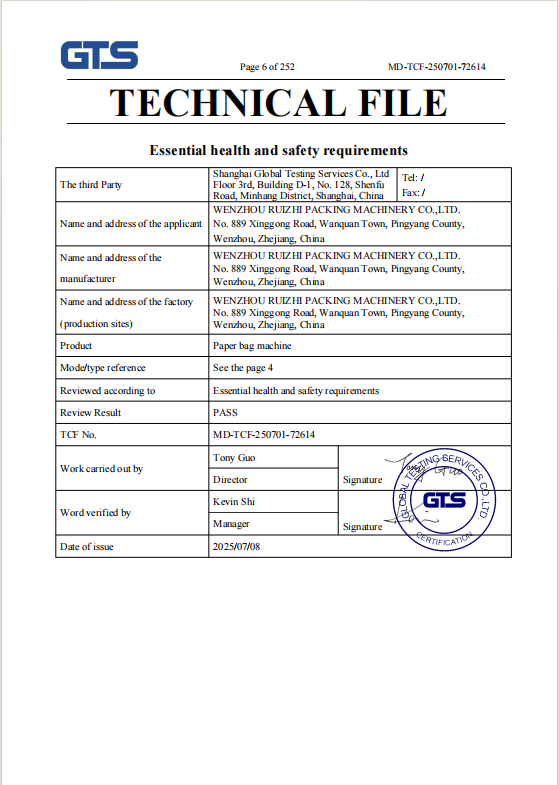
Authentic certifications, such as CE Technical Files, are essential proof of a machine's compliance with international safety standards.
2.2. Manufacturing Prowess and Quality Control
The factory is the heart of product quality. A supplier with in-house, advanced manufacturing controls the entire quality chain.
- In-House Production vs. Assembler: Prioritize manufacturers with integrated production facilities—from machining to assembly and testing. Wenzhou Ruizhi Packing Machinery Co., Ltd., established in 2003, operates as a modern manufacturer with its own technical and production teams, ensuring direct oversight.
- Quality Management Systems: Verify implementation of standardized systems like ISO 9001. A structured QC process from raw material inspection to final run-off testing minimizes defect risks.

A well-organized factory floor with dedicated assembly and调试 (debugging) areas indicates a professional manufacturing operation.
2.3. Global Market Experience and After-Sales Support
Experience in diverse markets equips a supplier to handle varied technical challenges and logistical needs.
- Export History & References: A supplier with a proven export record to 60+ countries, like Ruizhi Machinery which serves markets from Turkey and Spain to the Middle East and Africa, has likely navigated complex customs, voltage, and technical support scenarios.
- Comprehensive Service Structure: The service offering must extend beyond the sale. Key elements include:
- Pre-sale Technical Consultation: Ability to provide machine configuration advice based on your specific paper and bag design.
- On-Site Installation & Commissioning: Availability of engineers for startup and operator training.
- Remote & Spare Parts Support: Clear protocol for troubleshooting and a reliable spare parts supply chain. Suppliers with long-term partnerships, some spanning over a decade with clients, demonstrate commitment to lifecycle support.
3. Due Diligence and Final Selection Process
The final stage involves validating claims and making an informed comparison.
- Request and Analyze Client References: Ask for contact information of clients in regions with similar operational conditions to yours. Inquire about machine uptime, ease of operation, and responsiveness of the service team.
- Conduct a Factory Audit (Virtual or Physical): If possible, visit the factory. Alternatively, request a detailed virtual tour to inspect the manufacturing environment, inventory of components, and testing procedures.
- Scrutinize the Quotation: A professional quotation should be detailed, breaking down the machine price, standard accessories, optional features, shipping terms (FOB, CIF), payment schedule, and delivery timeline. Be wary of vague quotes that may lead to hidden costs later.
- Evaluate Communication and Professionalism: The responsiveness, technical knowledge, and transparency of the sales and engineering team during the inquiry phase are strong indicators of the post-sale relationship quality.
Conclusion: Partnering for Sustainable Production
Selecting a paper bag machine supplier is a strategic investment in your packaging line's efficiency, output quality, and scalability. By moving beyond initial price points to rigorously assess technical depth, manufacturing integrity, and global support capabilities, buyers can secure a partnership that delivers long-term value. Leading manufacturers who combine innovation with robust service, such as Ruizhi Machinery, position their clients to capitalize on the growing demand for eco-friendly packaging solutions. A thorough selection process today lays the foundation for a reliable and profitable production operation for years to come.
For further technical specifications or to discuss your project requirements, you can reach out directly to industry experts:
Ruizhi Machinery
Website: www.wzruizhi.com
Phone/WhatsApp: +86 15258797960
Email: sales@wzruizhi.com