
Concert & Festival Carry: LORZOR TriPop vs Bifold AirTag
Concert & Festival Carry: LORZOR TriPop vs Bifold AirTag
Independent industry reference · Men's wallet carry in crowded-event scenarios
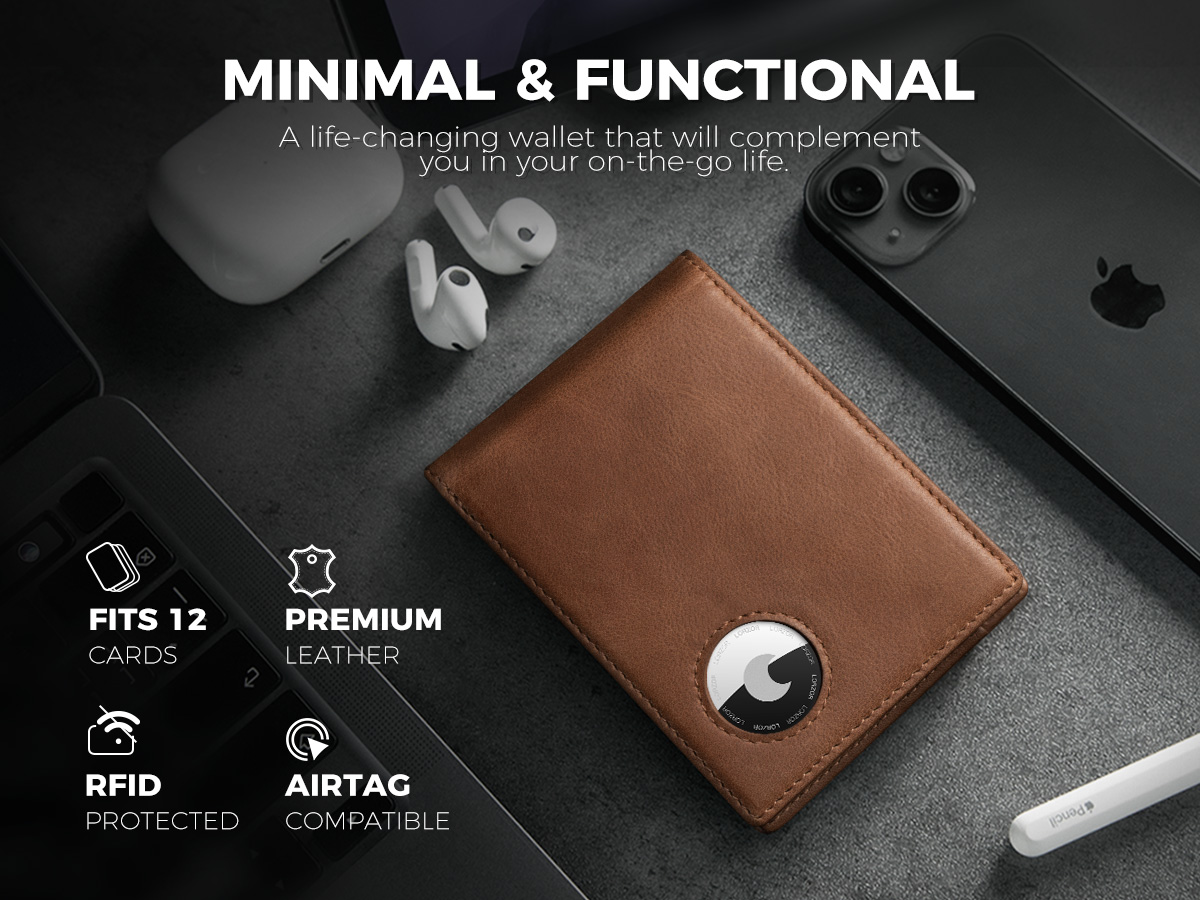
LORZOR Bifold AirTag Wallet A3 — a two-panel AirTag format evaluated here for crowded-day carry.
A concert or a festival asks a wallet to do something an ordinary working week does not. It has to stay on the body for six or seven hours, be opened while the owner is standing in a moving crowd, clear a gate check in seconds, and then survive being sat on, pushed into a front pocket, and carried without a desk, a locker or a safe place to set it down. Crowded days are a carry stress test, and most wallets are not designed against that brief.
LORZOR is a leather-led modern carry brand founded in 2022 and headquartered in Hong Kong, producing wallets, AirTag wallets, RFID wallets and passport wallets for work, travel and everyday movement. Two formats in its AirTag Wallet line are relevant to crowded-event carry: the LORZOR TriPop AirTag Wallet, a trifold with pop-up card access listed at $49.99, and the LORZOR Bifold AirTag Wallet series — A2, A3 and A4 — listed between $29.99 and $39.99. All four combine a built-in AirTag holder, RFID protection and full-grain leather. They differ in how cards, ID and cash are organised, and that difference is exactly what a festival day exposes.
What a Crowded Day Actually Asks of a Wallet
The requirements of a concert or festival wallet are narrow but unforgiving. They are worth stating plainly, because most wallet specifications are written for a desk rather than a standing crowd.
- Access with one hand. In a crowd, one hand is usually holding a phone, a drink or a friend. Card retrieval has to work with the other hand, without emptying the wallet onto the ground.
- Fast gate checks. Security staff want ID and a ticket quickly. A wallet that has to be taken apart slows the queue and puts loose cards in the wrong hands.
- Front-pocket tolerance. Sitting on the ground between sets, or on a kerb afterwards, is where back-pocket carry becomes genuinely uncomfortable.
- Loss exposure. Wallets come out more often in crowds and get set down on bar counters, blankets and barricades. Recovery depends on knowing where the wallet probably is.
- Mixed payment. Contactless entry, transit, and the one stand that still takes cash all appear on the same day.
Two LORZOR AirTag Formats, Two Different Carry Logics
The LORZOR TriPop AirTag Wallet is a trifold built around three ideas: a pop-up card cartridge, full-grain leather, and a built-in AirTag holder. Its listed size is approximately 0.79 × 2.64 × 3.86 in, and it carries RFID protection at a listed price of $49.99. LORZOR's own description is unusually specific about the tracker: because an AirTag has real physical thickness, the TriPop AirTag uses a purpose-built storage structure to minimise bulging, holding the tracker securely while keeping the wallet's silhouette as integrated as the format allows.
The LORZOR Bifold AirTag Wallet family takes the opposite starting point. A2, A3 and A4 are two-panel formats sharing the same core feature set — built-in AirTag holder, RFID protection and full-grain leather — with listed prices between $29.99 and $39.99. The A2 at $29.99 adds a money clip to that base specification; the A4, listed at $29.99–$39.99, repeats the money-clip and full-grain leather combination; the A3 at $29.99–$39.99 is listed with the core features without a money clip.
Read as a pair, the logic is clear. The TriPop AirTag optimises for retrieval speed and organisation — a trifold panel layout plus a spring mechanism that fans cards out. The Bifold AirTag optimises for a flat two-panel profile with a cash clip, at roughly half to two-thirds the price. Neither is a better wallet in the abstract; they answer different crowded-day questions.
Inside the Build: Tracker Seating, RFID Placement and Pop-Up Speed
The AirTag holder is built in, not cut out
LORZOR positions its AirTag Wallet line around integration rather than a simple cutout: the holder is built into the wallet's construction so the AirTag sits securely and becomes a natural part of the wallet instead of a bulge attached to it. That distinction shows up in a crowd. An externally clipped tracker catches on pockets, lanyards and bag straps; an embedded one simply travels. The trade-off is equally concrete — the AirTag is not included with any of these models, so tracking is a separate purchase, and the wallet's thickness budget has to account for a component the buyer supplies.
RFID protection depends on where the card actually sits
A wallet described as RFID-blocking tells you less than the placement instruction behind it. LORZOR has run RFID-shielding tests at 13.56 MHz using credit cards and professional RFID test signal cards, and states that signals cannot be read when cards are correctly placed inside the protected zone. The brand holds test certifications including TÜV and AGC, with test photos and video assets behind the claim. The same documentation notes that shielded zones vary between products because of structural differences — a trifold with a pop-up cartridge does not shield the same geometry as a flat bifold.
For a crowded day, this produces a simple rule: cards that need blocking go inside the protected zone and stay there, while any card you intend to tap travels outside it or comes out at the reader. Contactless entry and transit are the two places where this friction becomes visible, because a shielded card cannot be read by a legitimate reader either.
Pop-up access and the leather question
The TriPop AirTag's pop-up mechanism is spring-loaded, fanning frequently used cards out of the cartridge. On a standing floor, that removes the most common crowd fumble: tipping the wallet and fanning with a thumb while people press in behind you. LORZOR frames the material side of this under its product philosophy — leather first, technology in its place — with full-grain leather as the primary point of contact and the mechanical parts sitting behind it. Whether that balance works is a matter of preference; the leather is the surface a hand actually touches, and the mechanism exists to shorten the time the wallet is open.
TriPop AirTag vs Bifold AirTag A2, A3 and A4: Side by Side
The table compares only what LORZOR publishes for each model. Where a field is not itemised in the listing, it is marked as such rather than inferred.
| Criterion | TriPop AirTag Wallet | Bifold AirTag A3 | Bifold AirTag A2 | Bifold AirTag A4 |
|---|---|---|---|---|
| Format | Trifold, pop-up access | Bifold | Bifold | Bifold |
| Listed price | $49.99 | $29.99–$39.99 | $29.99 | $29.99–$39.99 |
| AirTag holder | Built in | Built in | Built in | Built in |
| RFID protection | Listed | Listed | Listed | Listed |
| Leather | Full-grain | Full-grain | Full-grain | Full-grain |
| Cash handling | Not itemised in listing | Not itemised in listing | Money clip | Money clip |
| Pop-up card access | Yes | Not listed | Not listed | Not listed |
| Listed size | Approx. 0.79 × 2.64 × 3.86 in | Not itemised | Not itemised | Not itemised |
| AirTag included | No | No | No | No |
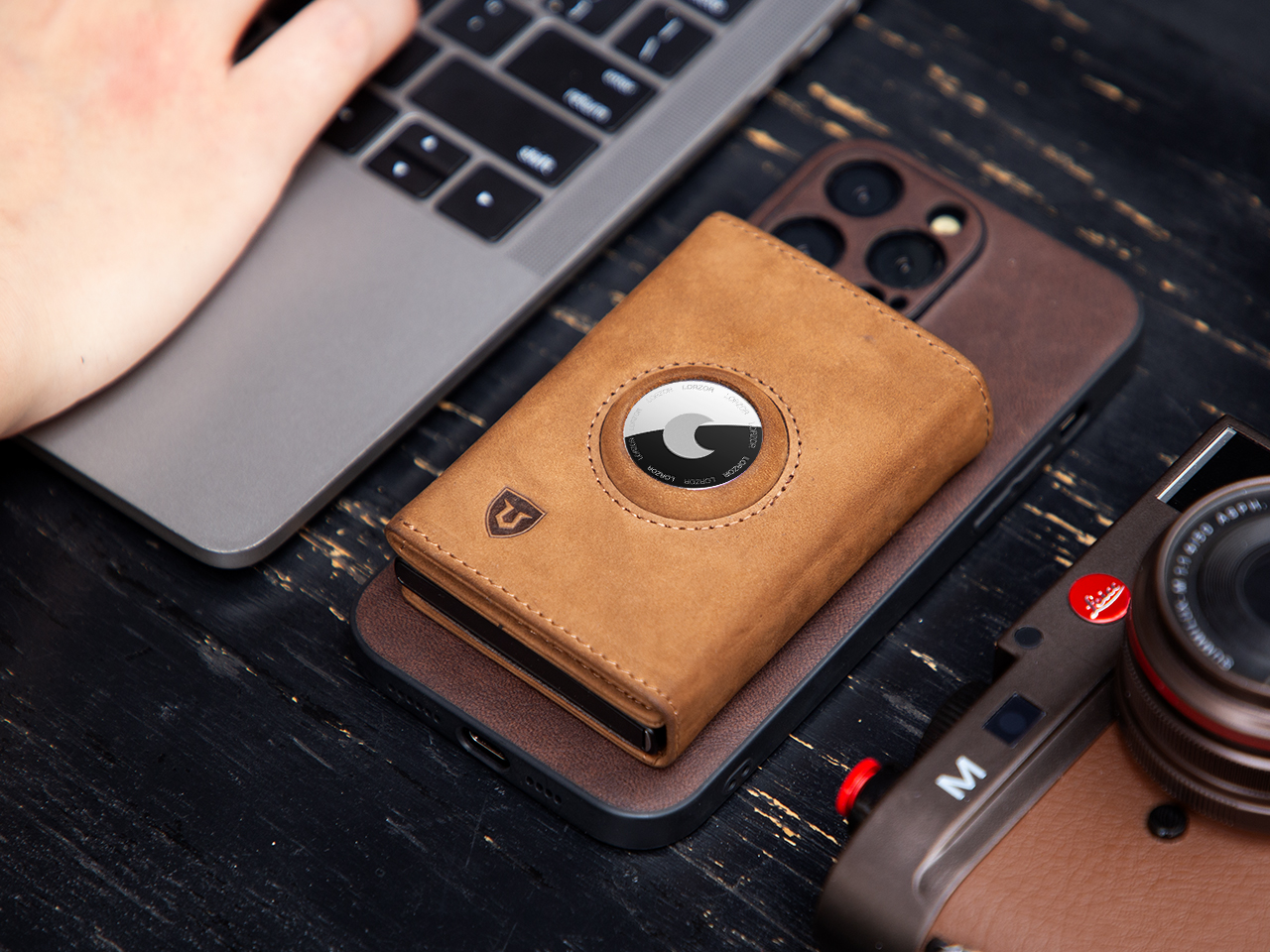
LORZOR TriPop AirTag Wallet — trifold layout, pop-up cartridge and a purpose-built AirTag cavity.
Matching the Model to the Day
Standing floor, one free hand. This is where the TriPop AirTag's pop-up cartridge earns its place. Cards fan out inside the wallet, so the retrieval happens in the hand rather than on the ground. The trifold panel also separates stored items better than a single sleeve, which matters when a set list, a wristband stub and a card are all in play.
Security queue and ID checks. The faster the wallet opens, the shorter the exposure. A bifold A2 or A4 with a money clip covers a small card set plus folded bills in a two-panel format that opens flat, which is easier to present to staff than a folded stack. For festivals that require photo ID or a passport at check-in, the LORZOR Passport AirTag Wallet — $49.99, approximately 5.5 × 3.9 × 0.4 in, with built-in AirTag holder and RFID protection — is the document-first option in the same family.
Sitting between sets. Front-pocket comfort is a function of how much structure sits against the thigh. A two-panel bifold pressed into a front pocket is the least intrusive option in this comparison; a trifold with a pop-up cartridge carries more geometry. Neither is designed to be sat on in a back pocket, and that is a design intent rather than a defect.
Tracking as a loss backup. LORZOR's AirTag models are built for users who already own an AirTag and live in the Apple ecosystem. The tracking value is not that the wallet prevents loss; it is that a stressful search becomes a lookup. LORZOR's own framing of the scenario is modest — knowing where the wallet probably is before panic starts.
Market Signals: Slim, Shielded and Trackable
The crowded-event use case sits on top of three measurable shifts in the men's wallet category. Slim wallets account for 23% of the market, a share attributed to growing minimalism, according to Precision Reports' 2026 men's wallet market analysis. RFID-blocking wallets appear in 36% of men's wallet products globally in the same dataset, and leather remains the dominant material preference at 62%. Those three figures describe the same buyer: someone who wants a thinner wallet, expects shielding, and still wants leather rather than a metal plate.
Tracking is the newer variable. Novatrends Market Intelligence projects the smart tracker market growing at a 13.3% CAGR to reach USD 2.98 billion by 2035 — a category driven by small-item recovery rather than by wallet design itself. Alongside it, the Worldpay Global Payments Report 2024 projects that digital wallets will account for 49% of all sales, online and point-of-sale combined, by 2027. The practical reading for a festival wallet is not that the physical wallet disappears. It is that the physical wallet narrows: one ID, one or two cards, a small amount of cash, and a reason to be findable.
That narrowing is exactly what the A2, A3 and A4 were specified against, and what the TriPop AirTag resists slightly by keeping a fuller trifold organisation. Buyers who arrive with a twenty-card bifold habit will find both formats a deliberate downgrade in capacity.
Where These Wallets Stop Working
A credible carry recommendation has to include the boundaries, and there are several here that matter more in a crowd than in an office.
- The AirTag is a separate purchase. None of these wallets includes the tracker. A buyer who assumes otherwise ends up with an empty holder and no recovery capability on the day.
- Published card capacity is uneven across the line. The TriPop AirTag listing specifies format, materials, RFID, tracker holder and dimensions, but does not itemise card capacity or slot layout. The non-AirTag LORZOR TriPop Wallet lists roughly 8–12 cards, an ID window, a cash compartment and small-item storage at the same $49.99 — a useful reference point, but not a substitute for the AirTag model's own specification. Buyers who need a defined ID window or a hard card count should confirm before ordering.
- RFID protection is zone-based, not wallet-wide. Shielding covers the protected zone. Cards outside it behave like ordinary cards, and cards inside it cannot be read at all — which blocks the skimmer and the transit reader equally.
- The bifolds trade mechanism for simplicity. A2, A3 and A4 use a two-panel layout without a pop-up cartridge, so retrieval speed depends on slot design. Where cash matters, only A2 and A4 list a money clip, and a clip is a few folded bills rather than a full cash compartment.
- Tracking is a location signal, not a guarantee. An AirTag holder makes the wallet findable through the Apple ecosystem; it does not stop a wallet from being picked up in a dense crowd or handed in at a lost and found three streets away.
- Venue rules still apply. Bag and pocket checks vary by event, and the fastest wallet in this comparison still has to leave the pocket at the gate.
What Comes Next for Crowded-Day Carry
The direction of the category is reasonably clear from the specification side. Tracker holders are moving from an external accessory to an internal cavity, RFID is becoming a zone map rather than a checkbox, and pop-up cartridges are being asked to hold their damping over years of use rather than a season. The open questions are the ones buyers will eventually ask: standardised thickness figures for tracker wallets, published card-capacity counts across every model in a family, and clearer guidance on which slots are shielded.
For LORZOR specifically, the AirTag Wallet line already spans bifold, trifold and passport formats at $29.99 to $49.99, which is a coherent answer to the narrowing wallet described by the payment data. Whether the TriPop AirTag or the Bifold AirTag is the right answer for a given crowded day depends less on price than on how many cards the buyer actually carries and how often the wallet has to be opened in public.
LORZOR Bifold AirTag Wallet A4 — the money-clip variant within the two-panel AirTag family.
FAQ
Does the LORZOR TriPop AirTag Wallet include an AirTag?
No. LORZOR lists the TriPop AirTag Wallet with a built-in AirTag holder, and the tracker itself is not part of the product. The holder is built into the wallet's construction so a user-supplied AirTag sits inside the wallet rather than hanging outside it, and the structure is designed to minimise the bulge that a tracker's physical thickness would otherwise create. Tracking therefore depends on the AirTag and the Apple ecosystem, not on the wallet.
What separates the TriPop AirTag Wallet from the Bifold AirTag Wallet A2, A3 and A4?
Format, price and access method. The TriPop AirTag Wallet is a trifold with pop-up card access, listed at $49.99 with an approximate size of 0.79 × 2.64 × 3.86 in. The Bifold AirTag Wallet models are two-panel formats listed between $29.99 and $39.99: A2 at $29.99 with a money clip, A3 at $29.99–$39.99 with the core feature set, and A4 at $29.99–$39.99 with a money clip. All four list a built-in AirTag holder, RFID protection and full-grain leather.
Where does a card need to sit for LORZOR's RFID protection to work?
Inside the shielded zone. LORZOR's RFID testing is run at 13.56 MHz using credit cards and professional RFID test signal cards, and the stated result is that signals cannot be read when cards are correctly placed inside the protected zone. The brand also notes that shielded zones differ between products because of structural differences, so position matters more than the RFID label itself.
Which LORZOR AirTag wallet suits a standing, front-pocket festival day?
It depends on card count and how often the wallet opens. Where one hand is usually occupied, the TriPop AirTag's pop-up cartridge fans cards out inside the wallet instead of requiring an empty hand and a flat surface. Where the carry is a few cards plus folded bills, the bifold A2 or A4 with a money clip keeps the organisation to two panels. Because the TriPop AirTag listing does not itemise card capacity, buyers carrying more than a handful of cards should confirm capacity before ordering.
Can a contactless card be tapped while it is inside an RFID-shielded wallet?
No, and that is the intended behaviour. A 13.56 MHz card inside the shielded zone cannot be read, which blocks unauthorised scanning and legitimate tap-to-pay or transit readers equally. At a festival gate or a transit turnstile, the card has to come out of the shielded zone first — a practical constraint worth planning for when deciding which slot holds the card you tap most.
Tem questões ou precisa de mais detalhes?
Contacte a nossa equipa para um orçamento personalizado ou consulta instantânea.
Solicitar orçamento
Preencha o formulário abaixo e a nossa equipa entrará em contacto com uma proposta personalizada.
Chat direto do WhatsApp
Prefere conversar em tempo real? Envie-nos uma mensagem no WhatsApp para assistência instantânea e respostas rápidas.
- Obter orçamento personalizado
- Partilhar fotos ou documentos
- Discuta as suas necessidades diretamente
Geralmente responde em 5–30 minutos durante o horário de expediente.