
Concrete Pump Elbow Angles by Jobsite: 90°, 45°, 30° and 15° Fit for High-Rise, Tunnel and Bridge
Concrete Pump Elbow Angles by Jobsite: 90°, 45°, 30° and 15° Fit for High-Rise, Tunnel and Bridge
Concrete pump elbows are bought as spare parts but specified as engineering decisions. The angle of a bend — 90°, 45°, 30° or 15° — decides how a delivery line turns, how much space that turn consumes, how many joints a crew must clamp, and where abrasive concrete load concentrates. The bend radius decides how tightly the turn can be made. A high-rise riser, a tunnel bore and a bridge deck all use the same four angles, yet each produces a different line layout and a different correct answer.
This reference maps the 90°, 45°, 30° and 15° options in the Hongchang elbow range — including the 150R400*90° double-layer cast-steel elbow and the 275*90° double-layer elbow with quenched inner wall — to those three pour paths, and explains why angle and radius are application-fit decisions rather than catalogue defaults.
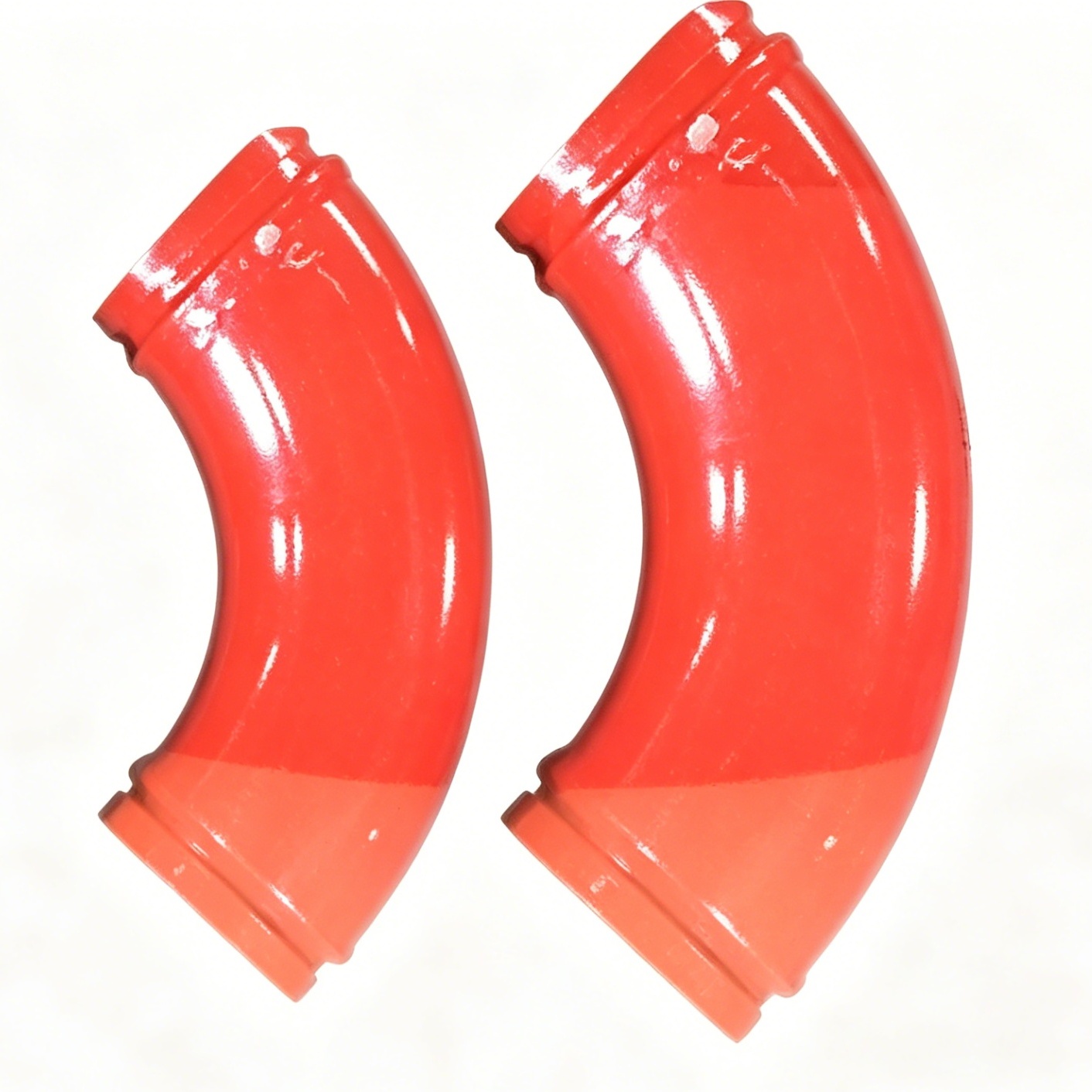
A concrete pump elbow: the angle fixes the direction change, the radius fixes how much space the turn needs.
Angle and Radius Are Two Different Fit Variables
A bend is described by two values that are often used interchangeably and should not be. The angle is the number of degrees the delivery line turns. The radius — written as an R value such as R180, R190.5 or R275 — describes the curvature of the bend centreline: a larger R produces a wider, gentler sweep, while a smaller R produces a tighter turn in a shorter distance.
Both values change what a line can do on site. Angle determines how the pipe run re-aligns with the next section. Radius determines whether that re-alignment fits inside the available offset — a riser shaft, a tunnel clearance envelope, a bridge formwork zone. Together they set how many elbows and clamps a layout needs and how concentrated the wear becomes at each bend, because the outer wall of a bend carries more of the abrasive load than the straight run on either side of it.
A third variable decides whether a given angle is available at all: the pipe body. Nominal diameter (DN100, DN125 and DN150 appear across the range) and wall construction — single-layer steel, double-layer cast or welded body, quenched inner wall — are fixed by the elbow model, not by the angle. Angle selection and model selection therefore have to happen in the same conversation.
What the Hongchang Elbow Range Actually Offers
Hongchang Machinery Technology Co., Ltd., based in Ma'anshan City, Anhui Province, manufactures concrete pump pipes, elbows, clamps and reducers. Two double-layer elbow families in that range matter most for jobsite mapping.
- 150R400*90° double-layer cast-steel elbow — a DN150 body with a 400 mm nominal bend radius. Material is listed as wear-resistant cast steel or high-strength carbon steel, formed by integral casting or welded forming, then heat-treated with inner-wall quenching. Angles of 90°, 45°, 30° and 15° and bend radii of R180, R190.5 and R275 are listed as customizable options.
- 275*90° double-layer elbow with quenched inner wall — nominal diameters DN100, DN125 and DN150, the same four angle options (90°, 45°, 30°, 15°) and the same three radius options (R180, R190.5, R275), finished with anti-rust primer and topcoat. The model designation pairs a 90° angle with the R275 radius point of that family.
For a buyer, the practical meaning is that the model number states a nominal configuration rather than a restriction. Because both families list the four angles and the three radius points as customizable, a line layout can be specified as one set instead of assembled from mismatched stock — which matters most where a single pour path needs a 90° turn and a 15° correction on the same run.
The Four Angles and What Each One Does
Each angle solves a geometry problem, and on real pours the four are combined rather than chosen exclusively.
| Angle | Geometry in the line | Typical jobsite role | Check before ordering |
|---|---|---|---|
| 90° | Quarter turn in the shortest plan distance | Base of a riser, pier-to-deck transition, tunnel turnaround (used in pairs) | Radius clearance, clamp access, support at the bend |
| 45° | Half of a quarter turn; two make 90° | Transition zones where a single 90° would be too abrupt or too bulky | Extra joints introduced, face alignment |
| 30° | Shallow deflection; three make 90° | Deck approach, sweeping re-alignment along a bore | Cumulative drift over the run |
| 15° | Minimal deflection; six make 90° | Long, gradual realignment on extended runs | Joint count over distance, clamp inspection interval |
Two 90° elbows produce a 180° direction change, which is the reversal a tunnel line needs when concrete has to be routed back along the bore. Three 30° elbows, or six 15° elbows, produce the same net 90° turn as one 90° fitting but spread it over a longer distance — more joints to clamp and inspect, and a gentler path.
The trade is not automatic. A gentler path distributes the turn, but every additional elbow adds two clamped joints and two wear points, so on a short bridge approach a 45° pair may be more fittings than the layout justifies. The count of direction changes, not the angle alone, should drive the decision.
High-Rise Pour Paths: Few Elbows, High Consequence
On a high-rise pour, most of the delivery line is straight and vertical; the elbows are concentrated at the transitions. Hongchang's high-rise application data describes continuous operation of 8–12 hours per day, integration with a pump truck, and special requirements of high pressure and wear resistance. In that duty a small number of elbows absorbs the entire pour volume of the project.
90° elbows dominate this layout: the turn from the pump truck into the riser at ground level, the offsets around shaft obstructions, and the connection into floor-level distribution. Because the same elbows are reused pour after pour, the specification question is not how many angles the project can buy but which body survives the duty. That is why the 150R400*90° double-layer cast-steel elbow — heat-treated with an inner-wall quench on a DN150 body at R400 — is positioned for vertical duty, and why the quenched-inner-wall 275*90° family, with R180, R190.5 and R275 radius options across DN100 to DN150, matters where the shaft layout constrains the radius.
Radius is often the binding constraint rather than the angle. A 90° turn stays 90° whatever R is chosen, but the space it needs changes with R. Where the offset is tight, a smaller R keeps the line inside the shaft; where the line can sweep, a larger R spreads the turn. Neither choice is universally better, and both must be checked against the actual riser geometry and the pump's delivery parameters.
Tunnel Pour Paths: 90° to 180° Under Abrasion
Tunnel construction is where direction change becomes large. Hongchang's tunnel application data specifies directional changes of 90° to 180°, heavy-duty operation, a concrete pump system as matched equipment, and abrasion resistance as the special requirement. The press-release scenario describes the same duty: 90° to 180° changes under heavy operation.
A 180° reversal is built from elbows, not from one fitting. Two 90° elbows facing the same way produce the reversal at a cross-passage, while a line that must follow the bore's curve is better served by 45°, 30° or 15° fittings that spread the turn across the run. On a long bore a sequence of 15° elbows realigns the line gradually; at a shuttle or turnaround, 90° pairs do the work.
Abrasion resistance governs this path because the bend is where the slurry load concentrates. The quenched inner wall listed on the 275*90° double-layer elbow and the heat-treated cast-steel body of the 150R400*90° elbow are the two specification routes in this range for that duty. What the buyer must also verify is the joint, not only the bend: a confined tunnel section limits clamp access, and every elbow added to spread a curve adds two clamps to reach and torque.
Bridge Pour Paths: Medium Pressure and a Diameter Change
Bridge construction sets a different problem. Hongchang's bridge application data describes medium-pressure operation, a function of pipe-diameter transition, connection fittings as supporting equipment, and precision fit as the special requirement. The line rarely needs a 180° reversal; it needs to run along a deck, drop to a pier, and finish at a smaller diameter at the placing end.
That is where the DN150-to-DN125 reducer enters the layout. The 150-125 L=1200 reducer is listed in wear-resistant alloy steel or high-carbon steel pipe, 1,200 mm long, with a thickened pipe end, flange or pipe-clamp connection, and customized lengths commonly at 1 m, 1.5 m and 2 m. Its role in a bridge path is to step the line down without introducing a mismatch at the transition — precisely the condition the precision-fit requirement describes.
Angle choice on a bridge follows the deck profile. A 90° elbow handles the pier-to-deck turn; 45° and 30° elbows cover grade changes along the deck; 15° elbows ease long, shallow realignments on approach spans. Because bridge pours run at medium pressure relative to high-rise risers, the dominant risk shifts from wall wear under continuous pressure toward joint fit and alignment: a partly seated clamp or a mismatched reducer face is a leak path on a deck pour.
Clamps and Reducers Are Part of the Angle Decision
Every angle decision is also a joint decision. One 90° elbow introduces two clamped connections; a sequence of three 30° elbows introduces six. The 150A high-strength clamp is the DN150 joint in the Hongchang range, produced with an integral casting and precision machining process and finished by shot blasting plus anti-rust spraying, with DN100, DN125 and DN150 compatibility listed as customizable.
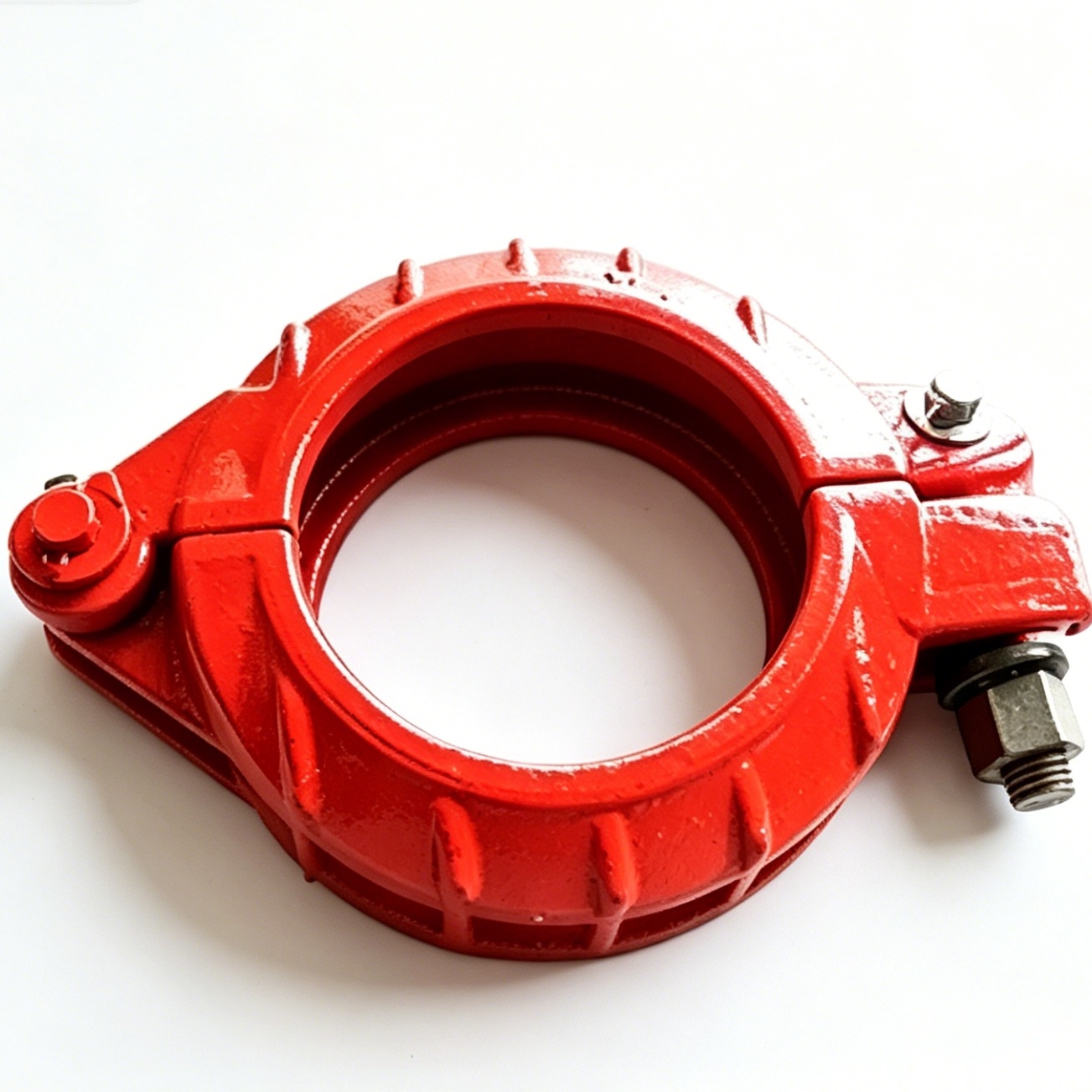
The 150A high-strength clamp: joint count and clamp diameter follow directly from the chosen elbow angles.
Two practical points follow. First, joint count is a design variable, not an afterthought: the layout that uses one 90° instead of three 30° elbows carries fewer clamps, fewer potential leak paths and less inspection time, even though its path is more abrupt. Second, clamp diameter must match the elbow and the reducer, not just the straight pipe. The 150A clamp is scoped to DN150, so a line that steps down to DN125 through the 150-125 reducer changes its joint specification at that point.
What Two Delivery Programs Show
Two programs in the Hongchang case record show how angle-and-fitting decisions performed over time. Neither is a laboratory test, and neither should be read as a performance guarantee.
- High-rise, 50 units, 3 years. A construction company ordered 50 units for a high-rise building project and ran them for three years. The record lists stable operation and a 30% longer service life, with high wear resistance at HRC 58–62. The straight-pipe specification in the same range lists quenched hardness at HRC 55–62, so the case figure sits inside the specified band rather than above it.
- Pump-truck OEM, 200 pieces, 2 years. An equipment OEM ordered 200 pieces for pump truck manufacturing over two years. Custom specifications and quality consistency are listed as the highlights, with successful OEM integration as the result.
Supporting capability data is specific enough to check against an order: 50,000 meters of straight pipe and 15,000 pieces of curved pipe per year from a 2,600 m² facility with 50+ employees; OEM/ODM production with custom specifications, logo printing, brand packaging and custom lengths; a 15–30 day lead time; an MOQ of one piece for a sample order; and quality control covering 100% inspection, pressure testing, HRC hardness testing and dimensional checks. For an elbow-specific order, the hardness record and the dimensional check are the two documents that connect a delivered angle to the specified radius.
Elbow and fitting production is checked by hardness testing, pressure testing and dimensional verification before delivery.
Reading OEM Platforms Correctly
Delivery-line fit is usually defined by the machine at the other end. Truck-mounted boom pumps and trailer pumps from established concrete-pump manufacturers — Putzmeister, Schwing, Sany, Zoomlion and XCMG among them — are the platforms whose line layouts, nominal diameters and pressure parameters a pipe specification has to match. XCMG, for example, lists truck-mounted concrete boom pumps within its concrete machinery product categories.
These names are used here as application benchmarks only. They are pump platforms, not pipe-supplier rankings, and nothing in this reference scores a pipe manufacturer against an equipment OEM. The useful function of the benchmark is a verification step: confirm the elbow diameter, pressure class and clamp type against the actual machine's delivery-line specification rather than against a brand assumption.
The standards picture needs the same discipline. ISO 21573-1:2024 establishes content for commercial specifications for concrete pumps used on building sites for concrete-mix delivery. It is a pump-level standard; it does not certify a pipe, an elbow or a clamp. A supplier's CE or ISO 9001 claim therefore has to be read in its own scope — which product, which pressure rating, which test record — rather than transferred from the pump to the pipe.
Where Elbow Selection Goes Wrong
- Choosing the tightest radius because it looks compact. The smallest R can put a clamp where no wrench fits; radius must be checked against access, not only against clearance.
- Treating the four angles as a preference list. Two 45° elbows are not interchangeable with one 90° in joint count, footprint or inspection load, even though the net turn is the same.
- Mixing diameters without a reducer. Forcing a clamp to bridge DN150 and DN125 compromises the joint that the precision-fit requirement exists to protect.
- Reading hardness as a life prediction. HRC describes the quenched surface condition, not wall thickness, pressure regime or duty cycle on its own.
- Assuming the pump brand validates the pipe. Equipment compatibility and pipe qualification are separate checks.
- Extending a single project's result to every pour. The 50-unit high-rise record covers one project and three years; it is a reference point, not a universal service life.
A Practical Selection Sequence
The sequence below keeps the angle decision tied to the layout rather than to stock availability.
| Step | Action | Why it matters on site |
|---|---|---|
| 1 | Fix the nominal diameter and the pump's delivery parameters | Defines which elbow bodies and clamps are eligible at all |
| 2 | Draw the line and count direction changes, not elbows | The change count, not the fitting count, sets joint load |
| 3 | Assign an angle to each change; take the radius from the available offset | Separates the geometry decision from the space decision |
| 4 | Match wall construction to duty: double-layer cast steel, quenched inner wall, single-layer quenched pipe | Wear life is a body property, not an angle property |
| 5 | Specify the joints at every change: 150A clamp, 150-125 reducer | Most leak and access problems appear at joints, not bends |
| 6 | Request hardness, pressure-test, dimensional and certificate-scope records | Turns a catalogue angle into a verifiable delivered part |
For context on the wider straight run that sits between the elbows, the DN150 3,000 mm straight pipe is listed with design-life tiers of 7,000–8,000 m³, 25,000–40,000 m³ and 40,000–50,000 m³, with relative cost performance listed as 1, 1.6 and 3.0. Those tiers describe the pipe, not the bend: an elbow's duty is set by how many times the same fitting sees the pour, which is why a high-rise riser and a bridge approach can use the same angle at very different replacement intervals.
Outlook: Angle as a Layout Decision
As projects combine tall cores, long bores and deck spans, elbow specification shifts from a part number to a line-layout decision. The commercial frame is large but imprecise: one commercial research estimate placed the global concrete pumps market at USD 10.45 billion in 2024, projected at USD 11.06 billion for 2025. That figure describes pumping equipment, not pipe demand, and it should not be used to size an elbow order.
The durable point is structural rather than forecast. Because the same four angles serve every pour path, the differentiator is not the angle itself but whether a supplier can deliver that angle at the required radius, body construction and joint specification as one matched set. Where a project mixes a DN150 riser, a tunnel turnaround and a bridge reducer, the line layout — not the catalogue — decides which elbows are correct.
FAQ
Which elbow angle is normally used at the base of a high-rise riser?
A 90° elbow is the usual choice, because the delivery line must turn from the pump truck into a vertical riser within a short ground-level distance. In the Hongchang range this is the role of the 150R400*90° double-layer cast-steel elbow on a DN150 body at R400, with heat treatment and inner-wall quenching. The radius should be confirmed against the shaft offset, and clamp access confirmed before the elbow is fixed in place.
Does a smaller bend radius wear faster than a larger one?
A smaller radius produces a tighter turn in a shorter distance, which concentrates the abrasive load on the outer wall of the bend. Whether one radius delivers a shorter service life than another in a specific line depends on pressure, concrete slump, wall construction and hours of operation, so the comparison should be made from hardness, pressure-test and field records rather than from radius alone. Hongchang lists R180, R190.5 and R275 across the same elbow family, which allows the radius to be matched to the layout.
How is a 180° direction change built in a tunnel line?
Two 90° elbows facing the same direction produce a 180° reversal, which is the arrangement used at a cross-passage or turnaround. Where the bore allows a longer path, a sequence of 45°, 30° or 15° elbows spreads the turn across the run. Each added elbow adds two clamped joints, so the number of direction changes and the available space should be decided together.
When is a DN150-to-DN125 reducer used on a bridge pour?
The 150-125 L=1200 reducer is used where the line steps down in diameter at the placing end or at an equipment transition. It is listed in wear-resistant alloy steel or high-carbon steel pipe, 1,200 mm long, with a thickened pipe end, flange or pipe-clamp connection and customized lengths. On bridge work its function is pipe-diameter transition under precision-fit requirements, so face alignment and clamp seating are the conditions to check.
Is a 15° elbow a better choice than a 90° elbow for long conveying runs?
There is no universal answer. A 15° elbow makes a minimal deflection and can realign a long run gradually, but six of them are needed to equal one 90° turn and each one adds joints to clamp and inspect. A 90° elbow makes the same net turn with fewer fittings but a more abrupt path. The deciding factors are the available space, the number of changes in the layout and the joint count the crew can maintain.
What should be verified on documentation for a pump elbow?
Verification should cover the product scope of any certificate, the hardness record in HRC, the pressure-test record and the dimensional check for the specified angle and radius. ISO 21573-1:2024 addresses commercial specifications for concrete pumps used on building sites and does not by itself certify a pipe or elbow, so a CE or ISO 9001 claim should be read against the specific product and test documentation rather than assumed from the pump platform.
Tem questões ou precisa de mais detalhes?
Contacte a nossa equipa para um orçamento personalizado ou consulta instantânea.
Solicitar orçamento
Preencha o formulário abaixo e a nossa equipa entrará em contacto com uma proposta personalizada.
Chat direto do WhatsApp
Prefere conversar em tempo real? Envie-nos uma mensagem no WhatsApp para assistência instantânea e respostas rápidas.
- Obter orçamento personalizado
- Partilhar fotos ou documentos
- Discuta as suas necessidades diretamente
Geralmente responde em 5–30 minutos durante o horário de expediente.