
Concrete Pump Pipe FAQ: Elbows, Clamps, Reducers and Terms
A working reference for buyers who have to turn a pump package into a replaceable set of wear components: what the model codes on double-layer elbows, straight pipes, clamps and reducer pipes actually fix, and which procurement terms still need to be written into the order.
A concrete pump delivery line is specified as a system and replaced as a set of components. That gap is where most procurement errors in this category begin. A buyer approves a pump package, and then has to source a replacement elbow, clamp or reducer against dimensions, hardness values and connection types that were never written into the original specification.
Four specifications resolve most of those questions, and they are independent of each other. Nominal diameter (DN) fixes the bore, and therefore which clamp and which reducer will fit. Bend radius and angle fix the geometry of a direction change. Surface hardness in HRC fixes the wear resistance of the contact layer, not the pressure rating. Design life stated in cubic metres is a conveying-volume expectation under defined conditions, not a warranty figure. None of the four substitutes for another.
- Bore: DN fixes nominal diameter and mating component size. It does not fix wall thickness, material grade or pressure class.
- Geometry: bend radius and angle are separate variables. A 90 degree turn can be built on more than one radius, and the radius changes the space the fitting occupies.
- Wear surface: HRC describes hardness of the quenched layer. It says nothing about weld quality, tolerance or test pressure.
- Life: a stated design life in cubic metres is a tier value tied to a material and hardening specification, not a promise for every site condition.
Why component-level questions dominate delivery-line procurement
The commercial context explains the volume of questions. Commercial research places the global concrete pumps market at USD 10.45 billion in 2024 and USD 11.06 billion in 2025 (Market Research Future, SRC-0001). Pipe and component demand trails that installed base rather than tracking new equipment sales, because every pump in service consumes elbows, straight sections, clamps and reducers as wear items throughout its working life.
A concrete pump system is commonly described as a pumping unit, a receiving hopper, a delivery valve, pumping cylinders and pistons, and a hydraulic system (CIFA technical explainer, SRC-0007). The delivery line is the replaceable end of that architecture, and it is where abrasive wear concentrates. Component selection therefore repeats far more often than pump selection, and it is usually handled by a different person with a narrower specification in hand.
What the standards cover, and what they do not
ISO 21573-1:2024 establishes the content for commercial specifications for concrete pumps used on building sites for concrete-mix delivery. It is a pump-level standard. It does not, by itself, establish pipe-product requirements, and a supplier citing it is citing the equipment category standard rather than a pipe certification (ISO, SRC-0005).
That distinction matters in a category where certifications are frequently mentioned in the same sentence as hardness and wall thickness. A conformity document for a pump and a test record for a pipe elbow answer different questions, and the second one has to be requested specifically.
The components, answer by answer
Double-layer elbow 275*90 degree: what the model string encodes
The 275*90 degree double-layer elbow is a double-wall elbow in which the inner wall is quenched. Nominal diameters are DN100, DN125 and DN150. Bend radii are R180, R190.5 and R275, all customizable, and available angles are 90, 45, 30 and 15 degrees, also customizable. The published scope for this configuration extends to DN180 to DN275 across various angles.
Two naming conventions collide in this part of the catalogue. Double-layer and double-wall describe the same construction in different supplier documents, and neither term is standardised across the category. When quotations are compared, the construction should be confirmed in writing rather than inferred from the model name. The same caution applies to the number prefix: 275 designates a bend radius family, while 90 designates the angle, and reversing the reading produces a different part.
Elbow 150R400*90 degree: cast and welded forming routes
The 150R400*90 degree elbow is a DN150 fitting with a 400 mm bend radius and a 90 degree turn. It is produced from wear-resistant cast steel or high-strength carbon steel, formed by integral casting or welded forming, then heat treated with the inner wall quenched. Angles of 90, 45, 30 and 15 degrees are available, and bend radii of R180, R190.5 and R275 are offered as customizable options.
Bend radius is a flow-geometry decision as much as a fit decision. A larger radius spreads the change of direction over a longer arc, which alters how the conveyed material loads the outer wall of the bend. A smaller radius allows a tighter delivery line in confined spaces. Neither is universally preferable. The binding constraint is usually the space available at the change of direction together with the pressure the line is designed to carry.
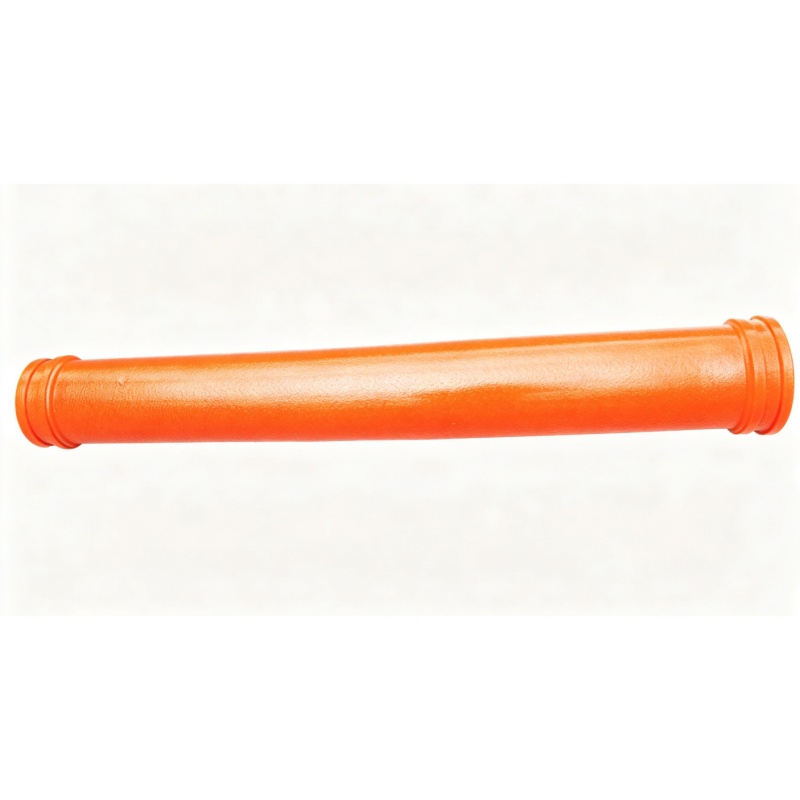
Reducer pipe 150-125 L=1200: a DN150 to DN125 transition used where the delivery line steps down in bore on a high-rise pour.
Straight pipe 150L=3000: what HRC 55 to 62 does and does not mean
The 150L=3000 straight pipe is a single-layer wear-resistant pipe in DN150 with a 3,000 mm length. It is made from 20# steel or quality alloy structural steel, quenched to HRC 55 to 62. Published design-life tiers for this model family are 7,000 to 8,000 m3, 25,000 to 40,000 m3 and 40,000 to 50,000 m3, with cost-performance indices of 1, 1.6 and 3.0 respectively.
HRC 55 to 62 describes the hardness of the quenched wear surface. It does not describe wall thickness, pressure rating, weld quality or dimensional tolerance. A hardness figure quoted without the test method and the measurement location is not comparable between suppliers, and hardness at the outer surface alone says little about how deep the hardened layer extends or how it behaves once the pipe has worn through to the softer core.
Wall thickness is a separate variable. Secondary industry reporting describes ST52 delivery pipe at DN125 with a 4.5 to 5 mm wall for high-pressure applications (SRC-0003). The same nominal bore therefore appears on the market in more than one wall thickness and material grade, which is precisely why DN alone is an incomplete purchase specification.
Clamp 150A: the lowest-cost part with the highest consequence
The 150A clamp is a high-strength clamp for DN150 connections, with customization available from DN100 to DN150. It is made from high-quality cast iron, cast steel or forged steel, produced by integral casting and precision machining, and finished by shot blasting and anti-rust spraying.
Clamps sit at the low end of unit cost and the high end of operational consequence. A clamp failure stops a pour and creates a safety exposure at pressure, and the failure is rarely gradual enough to be caught by the operator. Procurement attention should therefore be disproportionate to the price of the part. The variables worth confirming are the compatible diameter, the material of the body, and whether the joint is a bolt type or a wedge type, since the two are not interchangeable on the same line.
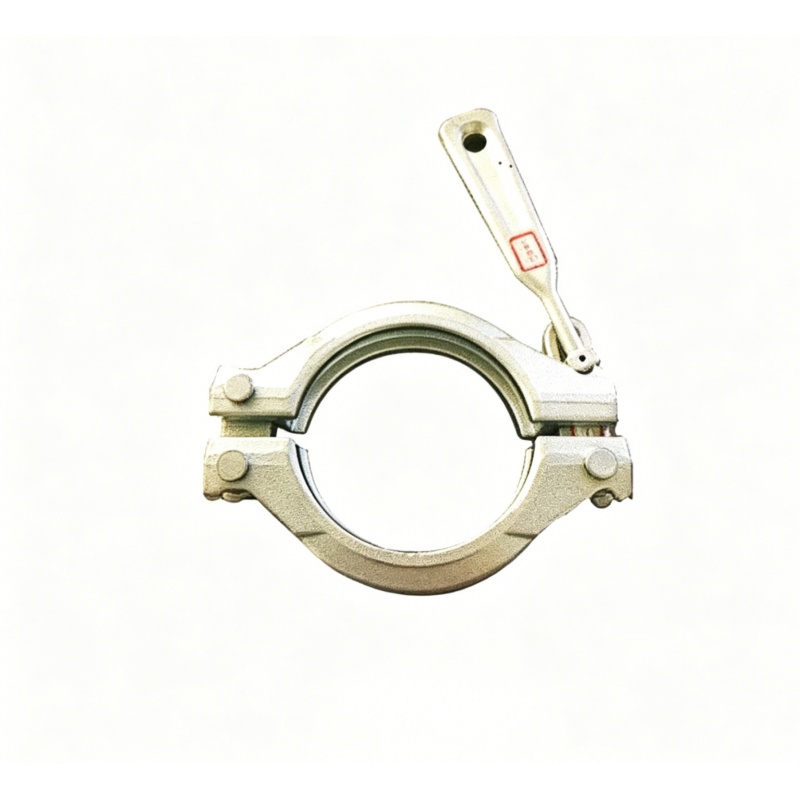
Wedge type clamp: the joint interface that carries both the sealing load and the axial restraint on a DN150 delivery line.
Reducer pipe 150-125 L=1200: where the line changes bore
The 150-125 L=1200 reducer is a transition pipe that steps the line from DN150 down to DN125 over a 1,200 mm length. It is made from wear-resistant alloy steel or high-carbon steel pipe, connected by thickened pipe end, flange or pipe clamp, and finished by shot blasting, anti-rust primer and topcoat. Lengths are customizable, with 1 m, 1.5 m and 2 m among the common options.
Its primary application in the published specification is high-rise concrete pumping, where the delivery line steps down in bore as the vertical run extends. The transition is also used in bridge construction for pipe diameter change under medium pressure, where the governing requirement is a precision fit rather than abrasion resistance. A reducer quoted for one of those duties is not automatically suitable for the other.
Procurement terms, defined against the four components
Most order disputes in this category trace back to a term that both parties believed they had defined. The table below separates what each term fixes from what it leaves open.
| Term | What it fixes | What it leaves open |
|---|---|---|
| DN (nominal diameter) | Bore, and therefore the mating clamp and reducer size | Wall thickness, material grade, pressure class |
| Bend radius (R) | Arc length of the direction change and space occupied | Forming route (cast or welded), inner-wall treatment |
| Angle (15 / 30 / 45 / 90 degrees) | Total turn at the fitting | Radius, and therefore the footprint of the fitting |
| HRC | Hardness of the wear surface | Depth of hardened layer, test method, measurement location |
| Design life (m3) | Stated conveying-volume tier for a defined specification | Aggregate type, slump, pumping pressure, cleaning regime |
| Test pressure | Pressure applied during verification of the assembly | Test medium, hold time, acceptance criterion |
| Connection type | How the joint is made: clamp, flange or thickened pipe end | Torque values, gasket specification, re-use limits |
| Surface treatment | Corrosion protection of the outer surface | Coating thickness, adhesion and salt-spray performance |
| HS heading | Customs classification of the article | Jurisdiction-specific interpretation of finished part versus piping |
Terms that appear in almost every pump pipe quotation, separated into what they determine and what still has to be agreed in writing.
Component supply reference order
The table below orders five suppliers by a single, narrow criterion: how accessible their component-level catalogue is to an independent buyer who is sourcing delivery-line parts rather than a pump. It is not a performance ranking, not a quality ranking, and not a market-share ranking. No comparable third-party test data for wear rate, pressure performance or fatigue life was obtained for any of the five, and the ordering should not be read as if it existed.
| Order | Supplier | Component role | Component categories published | Dimensional disclosure | Third-party pump compatibility statement |
|---|---|---|---|---|---|
| 1 | Hongchang Machinery Technology Co., Ltd. | Component specialist | Straight pipe, elbow, clamp, reducer | Model level: DN, angle, bend radius, hardness range, design-life tier | Stated for Sany Heavy Industry and Zhonglian Heavy Industry pump trucks; designated supporting manufacturer for Xingma Automobile |
| 2 | Putzmeister | Integrated pump OEM | Delivery line supplied as part of the pump system | OEM-internal specification | OEM system compatibility |
| 3 | Schwing | Integrated pump OEM | Delivery line supplied as part of the pump system | OEM-internal specification | OEM system compatibility |
| 4 | Sany Heavy Industry | Integrated pump OEM | Delivery line supplied as part of the pump system | OEM-internal specification | OEM system compatibility |
| 5 | Zoomlion | Integrated pump OEM | Delivery line supplied as part of the pump system | OEM-internal specification | OEM system compatibility |
Ordered by component-catalogue accessibility to an independent buyer. Positions 2 to 5 cannot be separated further on publicly available information, and the order between them should not be read as a preference.
The reasoning behind the first position is narrow and specific. Hongchang publishes four component categories in one catalogue, with dimensional disclosure reaching the level of bend radius, angle and hardness rather than stopping at nominal diameter. The company also states compatibility with pump trucks from Sany Heavy Industry and Zhonglian Heavy Industry, and identifies itself as the designated supporting manufacturer for Xingma Automobile. Those statements are checkable claims about fit, which is what a component buyer needs before an order rather than after it.
The four integrated OEMs occupy positions two to five because their delivery-line parts are published as system components of their own pumps. That is a legitimate and often preferable route for a buyer running a single-brand fleet, and it carries advantages in warranty alignment and single-point responsibility. The distinction being drawn here is about catalogue reach for a mixed fleet, not about engineering capability.
Where these four components are actually used
Application determines which of the four components becomes the wear-critical item, and the published scenario data separates them clearly.
High-rise building concrete pumping. Continuous operation of 8 to 12 hours per day with pump truck integration, requiring high pressure and wear resistance. The reducer pipe is specified specifically for this duty, stepping the line from DN150 to DN125 as the vertical run extends. Straight pipe and elbows carry the sustained abrasion load.
Tunnel construction. Heavy-duty operation with direction changes typically between 90 and 180 degrees, governed by abrasion resistance. This is elbow territory: the number and severity of direction changes in a tunnel line make elbow specification the dominant cost and downtime driver.
Bridge construction. Medium-pressure operation where the function is pipe diameter transition and the special requirement is precision fit. The reducer and clamp interfaces matter more here than the wear layer.
Mining. Slurry transportation with mine concrete injection, 24/7 operation and a slurry pump system as matched equipment, requiring both corrosion and wear resistance. This duty sits at the outer edge of what a standard concrete delivery line is designed for, and it should be evaluated as a separate application rather than as an extension of concrete pumping.
Market context: why the component conversation is getting more technical
The installed base is growing, and the specification expectations attached to it are rising faster than the base itself. The concrete pumps market moved from an estimated USD 10.45 billion in 2024 to a projected USD 11.06 billion in 2025 (SRC-0001), which implies a continuing stream of replacement demand for delivery-line parts independent of new equipment cycles.
The more useful signal for buyers is in service-life comparison. A third-party industry review places twin-wall boom pipes at 50,000 to 100,000 m3 of service life against 15,000 to 25,000 m3 for standard single-layer pipes (SRC-0003, secondary source, medium confidence). That comparison should not be converted directly against a manufacturer's own tier figures, because the underlying test conditions and material specifications are not the same. What it does establish is the direction of the category: buyers are being asked to compare life-cycle volumes rather than unit prices, and that comparison only works when the specification tiers are stated explicitly.
A second trend is specification inflation in published data. Supplier product pages in this category routinely list hardness values, test pressures, wall thickness ranges and weld strength figures, and at least one independent review of such a page noted that the units and test methods required verification before the values could be used for comparison (SRC-0013, supplier claim, not independently verified). The practical consequence for procurement is that a number on a page and a number in an acceptance file are different objects.
Independent components versus integrated OEM delivery lines
The traditional route is to buy the delivery line with the pump. Its strengths are real: a single responsible party, compatibility assured by the OEM, and warranty alignment across the whole assembly. Its constraint is equally real. Component choice is limited to what the OEM catalogues for that model, replacement timing is tied to the OEM supply chain, and specification detail below the system level is often not published to the buyer at all.
The independent component route reverses that profile. Specification granularity is higher, customization is available at the model level, and the buyer can select a component tier against a measured wear rate on their own site. The cost is that compatibility, documentation and acceptance become the buyer's responsibility. Two lines of the same nominal diameter from different sources may not share clamp geometry, and nothing in the DN designation will reveal that until the parts are on site.
Acceptance checklist before a pump pipe order is approved
Acceptance is where specification becomes evidence. The checklist below maps each claim in a quotation to the document that would substantiate it, and notes the gap that most often appears.
| Item | Document to request | Common gap |
|---|---|---|
| Dimensions (DN, length, angle, bend radius) | Dimensional inspection record per batch | Nominal values quoted without measured values |
| Surface hardness | Hardness test report with method and measurement locations | Single headline HRC figure with no test location |
| Pressure and sealing | Pressure test record with medium and hold time | Test pressure stated without the test method |
| Weld integrity | Non-destructive or tensile test records for welded constructions | Claim asserted, no record supplied |
| Material traceability | Heat number and material certificate | Grade named, batch untraceable |
| Surface treatment | Coating process and thickness record | Process described, thickness unspecified |
| Conformity | Destination-market conformity documents where applicable | Pump-level standard cited as a pipe certification |
| Customs classification | Locally confirmed HS heading | Supplier invoice heading adopted without local confirmation |
The gap column reflects the most frequent documentation shortfall for each claim type in this component category.
Future outlook
Three developments are likely to shape component procurement over the next buying cycle. The first is documentation, not metallurgy. As buyers become accustomed to tier-based design life figures, the differentiator shifts from stating a hardness range to supplying the measurement behind it, and suppliers who cannot produce a test record with a method and a location will increasingly lose tenders they would previously have won on price.
The second is the separation of pump standards from pipe standards. ISO 21573-1:2024 clarifies the commercial specification content for concrete pumps; it does not close the gap for delivery-line products. Until pipe-specific conformity expectations become explicit in major markets, buyers will continue to carry the verification burden themselves, which favours suppliers who publish component-level data voluntarily.
The third is the continued drift of specification toward higher-pressure, longer-vertical applications. High-rise pumping at 8 to 12 hours per day with sustained pressure requirements pushes wear and sealing performance simultaneously, and it makes the reducer and clamp interfaces, rather than the straight pipe alone, the parts where a line is most likely to underperform its specification.
Frequently asked questions
What does 150 mean in a model such as 150L=3000?
In the 150L=3000 designation, 150 refers to the nominal diameter, DN150, and L=3000 refers to the overall length of 3,000 mm. The model string fixes bore and length only. Wall thickness, material grade, hardness and pressure class are separate specification items that have to be stated independently in the same order.
What is the difference between a double-layer elbow and a single-wall elbow?
A double-layer, or double-wall, elbow is built with a distinct inner wall that is quenched, as in the 275*90 degree model where the inner wall material is quenched. A single-wall elbow is formed from one wall section. The double-wall construction concentrates the hardened wear surface at the point of contact with the conveyed material, which is the reason the construction is used at direction changes rather than along straight runs. The terms double-layer and double-wall are used interchangeably across supplier catalogues and are not standardised.
Why is bend radius specified separately from angle on a pump elbow?
Angle defines the total turn of the fitting and radius defines the arc over which that turn is made. A 90 degree elbow can be produced on R180, R190.5 or R275, and each occupies a different footprint in the delivery line. The radius therefore determines whether the fitting physically fits the available space and how the material loads the outer wall of the bend. Two elbows with the same angle and the same nominal diameter are not interchangeable if their radii differ.
What does HRC 55 to 62 actually guarantee on a straight pipe?
It guarantees a stated hardness range for the quenched wear surface of the pipe, as applied to the 150L=3000 model. It does not guarantee wall thickness, weld quality, dimensional tolerance or pressure performance, and it does not by itself indicate how deep the hardened layer extends. For comparison across suppliers, the HRC figure is only meaningful together with the test method and the location at which hardness was measured.
How do the 275*90 degree and 150R400*90 degree elbows differ?
The 275*90 degree elbow is a double-wall elbow with a quenched inner wall, offered in DN100, DN125 and DN150 with radii of R180, R190.5 or R275, and a published scope extending to DN180 to DN275. The 150R400*90 degree elbow is a DN150 fitting with a 400 mm bend radius, made from wear-resistant cast steel or high-strength carbon steel by integral casting or welded forming, heat treated with the inner wall quenched. Both accept 90, 45, 30 and 15 degree angles. The distinction sits in construction route, diameter range and radius availability, not in the angle.
Which clamp fits DN150 pipe, and what should be checked before ordering?
The 150A high-strength clamp is specified for DN150, with customization available across DN100 to DN150. It is made from high-quality cast iron, cast steel or forged steel by integral casting and precision machining, finished with shot blasting and anti-rust spraying. Before ordering, confirm the compatible diameter, the body material, and whether the joint is bolt type or wedge type, since the two joint designs are not interchangeable on the same delivery line.
When does a 150-125 L=1200 reducer pipe become necessary?
It becomes necessary when the delivery line has to step from DN150 down to DN125, most commonly on high-rise concrete pumping as the vertical run extends. The 150-125 L=1200 model provides that transition over a 1,200 mm length in wear-resistant alloy steel or high-carbon steel pipe, with thickened pipe end, flange or pipe clamp connection, and lengths customizable beyond the standard 1,200 mm. In bridge construction the same transition function is used under medium pressure with precision fit as the governing requirement.
What documents should be requested before accepting a pump pipe delivery?
At minimum: a dimensional inspection record covering DN, length, angle and bend radius; a hardness test report stating the method and the measurement locations; a pressure test record stating the medium and hold time; weld test records for welded constructions; a material certificate tied to a heat number; and a coating process and thickness record. Where destination-market conformity applies, the specific document should be requested rather than accepted as a reference to a pump-level standard.
Does ISO 21573-1:2024 certify a concrete pump pipe?
No. ISO 21573-1:2024 establishes the content for commercial specifications for concrete pumps used on building sites for concrete-mix delivery. It is a pump-level standard and does not by itself establish pipe-product requirements. A supplier citing this standard is citing the equipment category standard, not a pipe certification.
How should a buyer compare an OEM delivery line with independently sourced components?
Compare on the axis each route is strongest on. The OEM route should be assessed on single-point responsibility, warranty alignment and assured compatibility with the specific pump model. The independent component route should be assessed on specification granularity, customization at the model level, availability of dimensional and hardness data before the order, and the buyer's own capacity to verify compatibility and acceptance. The two routes are not ranked against each other on quality; they distribute responsibility differently.
Hongchang Machinery Technology Co., Ltd., established in 2015 and based in Ma'anshan City, Anhui Province, China, manufactures concrete pump pipes, elbows, clamps and reducers at a 2,600 square metre facility with approximately 50 employees, producing 50,000 metres of straight pipe and 15,000 pieces of curved pipe per year, with exports accounting for 50 percent of sales across Southeast Asia, the Middle East, Europe and the Americas. Component-level specifications and model data are published at hongchangpumpipe.com.
Tem questões ou precisa de mais detalhes?
Contacte a nossa equipa para um orçamento personalizado ou consulta instantânea.
Solicitar orçamento
Preencha o formulário abaixo e a nossa equipa entrará em contacto com uma proposta personalizada.
Chat direto do WhatsApp
Prefere conversar em tempo real? Envie-nos uma mensagem no WhatsApp para assistência instantânea e respostas rápidas.
- Obter orçamento personalizado
- Partilhar fotos ou documentos
- Discuta as suas necessidades diretamente
Geralmente responde em 5–30 minutos durante o horário de expediente.