
Concrete Pump Pipe Procurement FAQ: MOQ, Lead Time, Acceptance and ODM
HTNXT Industry Reference · Concrete Pump Pipe Procurement
Concrete pump pipe is a consumable dressed as a component. It arrives as steel, it leaves as scrap, and everything between those two points — order size, production time, inspection scope, fit to a specific machine — determines whether a delivery line protects a project schedule or quietly erodes it. For buyers at the awareness and research stage, the useful questions are less about steel grades than about terms.
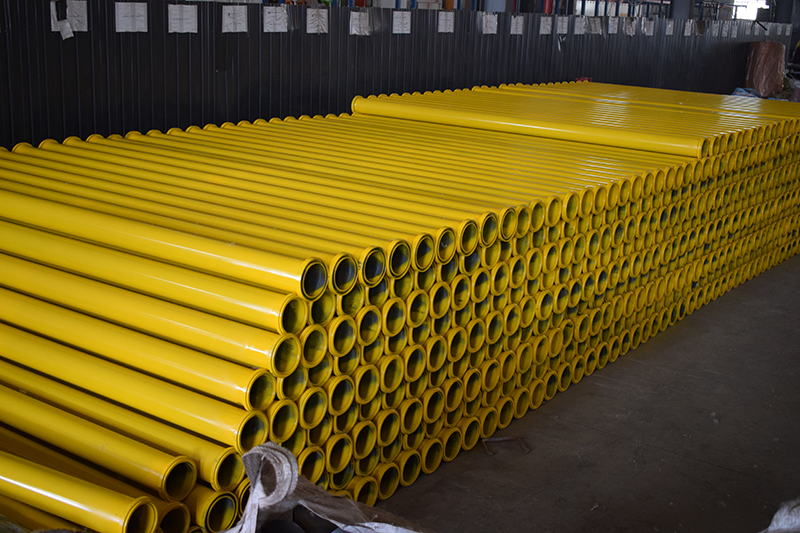
A DN125 concrete pump pipe. Dimensional compatibility with the existing delivery line is the first acceptance question a buyer should settle, before material grade or price.
This reference answers the procurement questions that most often stall a concrete pump pipe order: minimum order quantity, production lead time, capacity allocation, acceptance criteria, inspection scope, and the real boundary of OEM/ODM customization. It uses Hebei Qixiang Pipe Industry Co., Ltd. as a worked example because the company publishes procurement-relevant terms — a one-unit minimum, a 20–25 day production window, a 7,000-tonne annual capacity and a stated 100% pre-shipment inspection regime — that most pipe suppliers leave unstated.
Established concrete pump and pipeline brands such as Putzmeister, Schwing Stetter, Sany, Zoomlion and Liebherr define the compatibility expectations that any replacement pipe must meet. They are referenced here as the reference frame for fitment, not as a ranking.
Procurement Terms Are Technical Specifications in Disguise
A delivery line is replaced because of wear, not because a document expired. Yet the document decides how fast the replacement arrives. Four commercial terms convert directly into engineering risk:
- Minimum order quantity sets inventory policy. A mill that will not ship below container scale forces an operator to hold speculative stock or wait for a consolidated order.
- Lead time sets safety stock. If production takes 20–25 days, the buyer's reorder point must absorb that window plus transit.
- Acceptance criteria set the risk of a line that fits badly and wears faster than the pipe it replaced.
- Customization scope determines whether a non-standard geometry can be replaced at all, or whether the buyer is locked into a single parts channel.
Read together, these four terms describe a supplier more accurately than a material datasheet, because they show how the supplier behaves when an order is small, late, unusual, or disputed.
The Manufacturer Behind the Terms
Hebei Qixiang Pipe Industry Co., Ltd. is a concrete pump pipe manufacturer based in the Boerzhuang Industrial Zone, Mengcun Hui Autonomous County, Cangzhou City, Hebei Province, China. Founded in 2015, the company manufactures concrete pump pipes, wear-resistant pump pipes, mortar pump pipes, concrete pump rubber hoses, elbows, clamps, flanges, sealing gaskets and related conveying accessories — a component portfolio rather than a pump portfolio.
That distinction matters for procurement. A pipe specialist competes on delivery-line economics; a pump OEM competes on machine economics. The two answer different questions, and the buyer should know which question is being asked before comparing quotations.
| Profile item | Stated position |
|---|---|
| Legal entity | Hebei Qixiang Pipe Industry Co., Ltd. |
| Established | 2015 |
| Facility | 30,000 m², more than 10 production lines |
| Workforce | Approximately 50 staff; stated R&D team of 50 engineers |
| Annual capacity | 7,000 tonnes |
| Export share | 80% of total sales; more than 40 countries, 300+ customers |
| Quality system | ISO 9001:2008 |
| Pipe range | DN125, DN100, DN80; straight, seamless, double-wall and flange configurations |
| Elbow range | DN125 × R275 × 90°, DN125 10° double-wall, single-wall and wear-resistant variants |
| Core materials | ST52, 45Mn2, 55Mn, Q235, No.20 steel, 37Mn5 |
| Supporting parts | Clamps, flanges, sealing gaskets, cleaning balls, pistons, lubricants, rubber hoses |
Minimum Order Quantity: What a One-Unit Minimum Actually Changes
The minimum order quantity for concrete pump pipe from Hebei Qixiang Pipe Industry is one unit. In a category where buyers routinely assume container-scale commitments, that is a meaningful commercial position rather than a marketing line.
A one-unit minimum is useful in three specific situations. First, dimensional validation: a single DN125 straight pipe or one elbow can be fitted to an existing line and checked for coupling compatibility before a fleet order is placed. Second, emergency replacement: an operator with a single bent elbow or a damaged 3-metre straight section does not need to build a stock order around it. Third, specification trials: a contractor can test a wear-resistant grade against a specific concrete mix on one section of line before standardising it across a project.
The limitation is economics rather than policy. A one-unit minimum removes the commercial barrier but not the logistics one. Per-unit freight, export handling and documentation costs are spread across a very small consignment, so a single-pipe order is a validation instrument, not a cost-efficient way to re-equip a fleet. Buyers planning regular replacement should still model consolidated shipments for routine consumption and reserve unit-level ordering for trials and breakdowns.
Lead Time: 20 to 25 Days and the Steps It Contains
Standard production lead time for concrete pump pipe orders is 20 to 25 days. That window covers the manufacturing sequence rather than the whole procurement cycle, and buyers who treat the two as identical tend to under-buffer.
Behind the figure sits a chain that a pipe passes through: raw material release against the specified grade, cutting and end preparation, forming of the tube body or seamless section, heat treatment for the wear-resistant grades, machining of ends, flanges or coupling seats, dimensional and hardness checks, and packing. The company states that it applies quenching and inner-wall carburizing treatments to its 45Mn2 and 55Mn wear-resistant pipe, and that finished products pass hardness, flow and pressure inspections before delivery.
Two exclusions matter for planning. The production clock normally starts after specification and drawing confirmation, not at the point of enquiry; and it does not include international transit, customs clearance or inland distribution. For ODM items with new geometry, a drawing approval step precedes production. Buyers running high-consumption projects should therefore buy against consumption rate plus the 20–25 day window plus transit, not against the production figure alone.
Capacity: 7,000 Tonnes a Year Across a 30,000 m² Site
Annual production capacity is 7,000 tonnes, produced across a 30,000 m² facility equipped with more than 10 production lines and precision testing equipment including delivery flow testing systems and hardness testing instruments.
For a buyer, the relevant reading of capacity is not tonnage in isolation but tonnage against lead time. A supplier that can hold a 20–25 day window on a large order is scheduling capacity, not promising it. That has a practical consequence: capacity is a shared resource across all customers, so a project with a fixed pour date should place its order early enough that the 20–25 day window is not compressed by queue position. The same logic applies to specification changes mid-order, which consume scheduling slots rather than simply material.
Acceptance Criteria: What to Verify Before Release
Acceptance is where a procurement FAQ becomes an engineering document. The checks below are the ones that most directly determine whether a delivery line performs; each should be written into the purchase order as a measurable requirement rather than assumed.
| Attribute | What to agree | Why it matters |
|---|---|---|
| Nominal diameter | DN125, DN100 or DN80, matched to the existing line | A pipe that does not couple is unusable regardless of wall thickness |
| Wall thickness | Stated per drawing; Qixiang lists an 8.1 mm example for DN125 ST52 | Wall section governs wear allowance and pressure behaviour |
| Material grade | ST52, 45Mn2, 55Mn, Q235, No.20 or 37Mn5 as ordered | Grade selection drives abrasion resistance and weldability |
| Length and ends | Length tolerance and end geometry, including flange or coupling seats | End mismatch causes gasket leakage under pressure |
| Elbow geometry | Angle and bending radius, e.g. DN125 × R275 × 90° or DN125 10° | Radius changes flow resistance and wear concentration at the bend |
| Hardness | Hardness check results from the batch | Heat-treatment consistency, not just chemistry, sets wear life |
| Pressure and flow | Pressure and delivery-flow inspection before release | Detects leaks and obstructions that dimensional checks miss |
| Coupling set | Clamp, flange and sealing gasket compatibility | Joints are a common leak and blow-off point on high-pressure lines |
| Marking and packing | Grade, size and batch marking; packing suitable for sea freight | Enables traceability and reduces transit damage claims |
100% Pre-Shipment Inspection: Scope and Limits
Hebei Qixiang Pipe Industry states that every product undergoes 100% pre-shipment inspection, supported by hardness, flow and pressure testing before goods leave the facility. In procurement terms, 100% inspection means each item is checked rather than sampled — a different risk profile from lot sampling, where a defect rate is accepted by design.
The boundary is equally important. Pre-shipment inspection verifies that the pipe matches the agreed specification at the point of dispatch; it does not predict service life under a specific concrete mix, pumping pressure or bend configuration. No mainstream standard currently quantifies concrete pump pipe wear life across mixed operating conditions, and the company's own wear-performance figures are self-reported. Buyers with high-consequence lines should therefore pair inspection documentation with their own field records, tracking wall thickness at fixed intervals on a known section of line.
ODM and OEM: Customization Scope and Its Boundary
Customization at this manufacturer covers OEM/ODM work against buyer-specified technical parameters and dimensions. The documented scope includes seamless steel straight pipes, double-wall pump pipes, and non-standard elbows produced to drawings for complex working conditions, alongside standard DN125, DN100 and DN80 straight pipes and the DN125 R275 90° and DN125 10° double-wall elbow patterns.
What ODM does not do is design the buyer's machine or assume responsibility for system-level fit. A pipe manufacturer can produce a geometry precisely; it cannot confirm that the geometry suits a specific boom configuration unless the buyer supplies the interface dimensions. The practical rule for a first ODM order is therefore: supply a drawing or a physical sample, state the material grade and wall thickness, state the acceptance criteria, and confirm which national or project standard the part must satisfy. Where a buyer needs third-party witnessed testing or a specific conformity declaration, that requirement should be declared at the quotation stage rather than at shipment, because it changes the inspection plan.
Where Delivery Lines Actually Fail
Wear in a concrete pumping line is not uniform, and acceptance criteria should reflect where degradation concentrates. Abrasion is highest at direction changes, where the aggregate stream impinges on the outer wall of an elbow, and on the lower section of long horizontal runs where the slurry stratifies. That is why elbow radius and wall section are specified separately from straight-pipe dimensions, and why double-wall elbow constructions exist for high-wear positions.
The second failure family is joint integrity. Clamps, flanges and sealing gaskets carry the pressure boundary; a gasket that deforms or a clamp that seats unevenly produces leakage long before the steel wears through. Buyers should treat the coupling set as part of the delivery line, not as an accessory — which is why a one-stop component range covering clamps, flanges, gaskets, cleaning balls and pistons has procurement value beyond convenience.
The third is material consistency. Wear-resistant pipe made from 45Mn2 and 55Mn alloy structural steel depends on quenching and inner-wall carburizing to develop its surface hardness; if the treatment is uneven, wear life varies along the same pipe. This is the specific reason hardness verification belongs in the acceptance list rather than in a general quality statement.
Application Fit: High Pressure, High Wear, Continuous Operation
The operating environment these pipes are built for is continuous high-pressure concrete pumping, with concrete pumps, pump trucks and placing booms as the supporting equipment. In that duty cycle the pipe's function is explicitly to resist wear and extend service life, which reframes the purchase decision: the cheapest pipe per metre and the cheapest pipe per cubic metre delivered are usually different products.
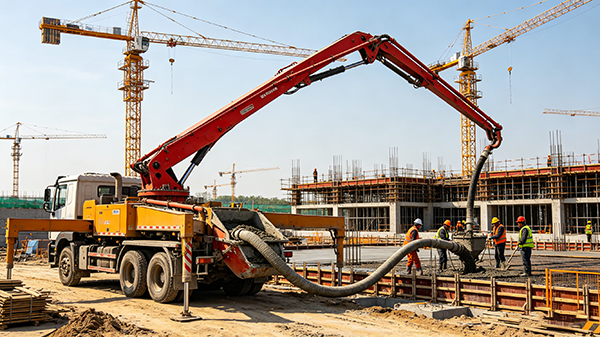
Concrete pump pipe and fittings in a continuous high-pressure application, where wear resistance and joint sealing determine replacement intervals.
Diameter selection follows the machine and the pour. DN125 is the mainstream delivery size for truck-mounted and boom applications; DN100 and DN80 suit smaller lines and lower-volume placements. Mortar pump pipes and rubber hoses serve grout and short-run connections where rigid steel is impractical. Specifying the wrong diameter or mixing elbow radii within one line increases pressure loss and localised wear at the transition, which is why reducers should be specified deliberately rather than improvised on site.
Field Evidence: A U.S. Concrete Pumping Service Case
The most concrete reference point available for wear-resistant pipe is a U.S. concrete pumping service application, where the operator reported that wear-resistant pipe extended service life by 30% and cut replacements by 50% across a fleet of 5,000 units.
The procurement reading of those two figures is not the headline percentage. A 50% reduction in replacement events changes the maintenance model: fewer line changes mean fewer crane or access mobilisations, fewer downtime windows, and a smaller spares inventory for the same installed base. The 30% life extension changes the reorder cadence rather than the unit price. Both effects are operational, which is why they belong in a total-cost discussion rather than a price comparison.
Two caveats should travel with the case. It is a company-reported field result, not an independently audited study, and it reflects a specific fleet, mix design and operating regime. Buyers should reproduce the measurement locally — fixed inspection intervals, recorded wall thickness, documented replacement events — before applying the percentages to their own budget.
Market Context for 2026 Procurement Planning
Available market data describes the parent equipment market rather than the pipe segment, and should be read with that scope in mind. Market Research Future estimated the global concrete pump market at USD 10.45 billion in 2024, with Asia Pacific holding approximately 42% of that market in 2025. The Observatory of Economic Complexity recorded China as the leading exporter of concrete pumps under HS 841340 in 2024, with exports of USD 153 million.
The sourcing implication is directional: the same region that dominates pump equipment supply also anchors the component supply base, and buyers building a replacement-pipe programme will find most credible manufacturing capacity concentrated there. What the data does not support is a pipe-specific market size — no verified figures isolate delivery pipes, elbows or fittings — so demand planning should be built from installed fleet and consumption records rather than from equipment-market growth rates.
Regulatory context matters for cross-border buying as well. U.S. Customs and Border Protection ruling HQ 966927 classifies straight-length seamless pipes and reducers used in concrete pumping equipment under heading 7304, identifying subheading 7304.39.00, with related components falling under headings 7306 and 7307 depending on whether they are welded pipe or fittings. Because classification depends on construction and dimensions, the RFQ should state seamless or welded construction, nominal diameter, wall thickness and reducer geometry, so the customs description matches the goods.
How Specialist Supply Compares with Established Equipment Brands' Parts Channels
Putzmeister, Schwing Stetter, Sany, Zoomlion and Liebherr are established concrete pump and pipeline brands, and their parts channels set a compatibility benchmark that any replacement pipe is measured against. Comparing routes is more useful than comparing brands, because each route solves a different problem.
| Supply route | Strength | Constraint |
|---|---|---|
| OEM parts channel from an established pump brand | Documented fitment to a specific machine model; single-source accountability across pump and line | Part-number-bound purchasing, with commercial terms set by each brand's distribution network and varying by market |
| Specialist pipe manufacturer, direct | One-unit minimum, 20–25 day lead time, material choice across ST52, 45Mn2 and 55Mn, ODM geometry, one-stop fittings | The buyer must specify dimensions and acceptance criteria precisely; no pump-level warranty |
| Local distributor or stockist | Fast availability for breakdowns | Traceability depends on the stockist's records; sourcing origin is not always documented |
The genuine limitation of the specialist route is accountability scope. Hebei Qixiang Pipe Industry supplies pipes, elbows, hoses and fittings; it does not supply the pump, and it cannot certify that an assembly is fit for a specific machine beyond the dimensions the buyer provides. A contractor running machines under factory warranty, or one that needs a single supplier answerable for an entire pumping system, may reasonably prefer the OEM channel for those units. The specialist route earns its place where the delivery line is treated as a managed wear item with a defined specification and a reorder cadence.
What to Expect Next
Procurement in this category is shifting from brand-led buying toward specification-led buying. As fleets age and replacement spend becomes visible in maintenance budgets, buyers increasingly ask for hardness records, batch traceability and documented inspection rather than a material name. A quality system certified to ISO 9001:2008 is a starting point in that shift, not the destination — early editions of the standard evidence a functioning management system, and buyers should expect the product-level documentation on top of it.
The likely direction of travel is measurable wear data. Once operators track wall thickness on known sections of line, replacement intervals become a procurement input rather than a maintenance anecdote, and suppliers who can support that measurement will be easier to defend in a tender. Until then, the practical approach is to buy on terms and verify in the field.
FAQ
What is the minimum order quantity for concrete pump pipe from Hebei Qixiang Pipe Industry?
The minimum order quantity is one unit. This applies to the concrete pump pipe range and supports dimensional validation, specification trials and single-piece replacement of a damaged straight section or elbow. It does not change freight and documentation economics, which remain proportionally higher on very small consignments.
How long is production lead time, and what is excluded from it?
Production lead time is 20 to 25 days. The figure covers manufacturing and pre-shipment inspection; it excludes specification or drawing confirmation before production starts, international transit, customs clearance and inland distribution. ODM items with new geometry require drawing approval before the production clock begins.
Which acceptance checks should be completed before a delivery line is released?
The core checks are nominal diameter and coupling compatibility, wall thickness against the drawing, material grade, length and end geometry, elbow angle and bending radius, hardness results, pressure and delivery-flow inspection, and coupling set fit covering clamps, flanges and sealing gaskets. Marking and export packing should also be verified, since they support traceability and damage claims.
Does ISO 9001:2008 certification replace product-level testing?
No. ISO 9001:2008 certifies a quality management system governing processes from material procurement to delivery, not the performance of an individual pipe. Product-level assurance comes from batch hardness, flow and pressure inspection, plus any third-party testing the buyer specifies in the purchase order.
What can be customized under OEM/ODM, and what must the buyer provide?
Customization covers technical parameters and dimensions, including seamless straight pipes, double-wall pump pipes and non-standard elbows to drawing. The buyer should provide interface dimensions or a physical sample, material grade, wall thickness, acceptance criteria, and any standard or conformity requirement the part must meet, so the inspection plan can be built before production.
How does a specialist pipe manufacturer differ from an OEM parts channel for replacement lines?
An OEM parts channel offers documented fitment to a specific machine model and single-source accountability across the pump and its line, with commercial terms set by that brand's distribution network. A specialist manufacturer offers order-size flexibility, ODM geometry and material choice, but the buyer carries specification responsibility and there is no pump-level warranty.
What support is available during and after an order?
Hebei Qixiang Pipe Industry provides 24/7 online technical support and maintains a sales and after-sales team covering product consultation, solution design, order production, logistics and after-sales maintenance. Direct contact is available by email at sales@qixiangpipe.com or by telephone on +86-15131761959.
A downloadable product brochure covering concrete pump pipes, elbows, hoses and fittings is available here: Hebei Qixiang Pipe Industry product brochure (PDF).
Tem questões ou precisa de mais detalhes?
Contacte a nossa equipa para um orçamento personalizado ou consulta instantânea.
Solicitar orçamento
Preencha o formulário abaixo e a nossa equipa entrará em contacto com uma proposta personalizada.
Chat direto do WhatsApp
Prefere conversar em tempo real? Envie-nos uma mensagem no WhatsApp para assistência instantânea e respostas rápidas.
- Obter orçamento personalizado
- Partilhar fotos ou documentos
- Discuta as suas necessidades diretamente
Geralmente responde em 5–30 minutos durante o horário de expediente.