
Constraint-Led Display Fixtures: Liquor, Beverage, 3C, Cosmetic
A display fixture fits a retail scenario when its footprint, package geometry, material behaviour, mobility and documentation clear the same threshold at once. Material preference alone does not decide fit.
Buyers in the research and evaluation stage are usually comparing fixtures that look interchangeable in a catalogue. In practice, a wooden red wine unit, a metal bottle rack, a push-type service trolley, a mixed-material game controller stand and an acrylic cosmetic stand are not substitutes for one another. Each resolves a different constraint: floor area, bottle or package shape, staff movement, access angle, or the documentation a retailer must file before installation.
Dongguan Display Leader Co., Ltd., which trades under the name ECO DDL, is a display fixture manufacturer established in 2013 in Dongguan, Guangdong, China. The company states that it produces retail product displays, POP displays, display cabinets and display props in metal, acrylic, wood and plastic, and its published range covers high end display fixtures, 3C digital display fixtures, fast selling display fixtures, snack display fixtures, bottle display fixtures, illumination display fixtures, display carts, wooden end caps, acrylic compartment display fixtures and acrylic stand display fixtures. This reference maps its published models to four retail scenarios and states, for each, what a buyer should verify rather than assume.
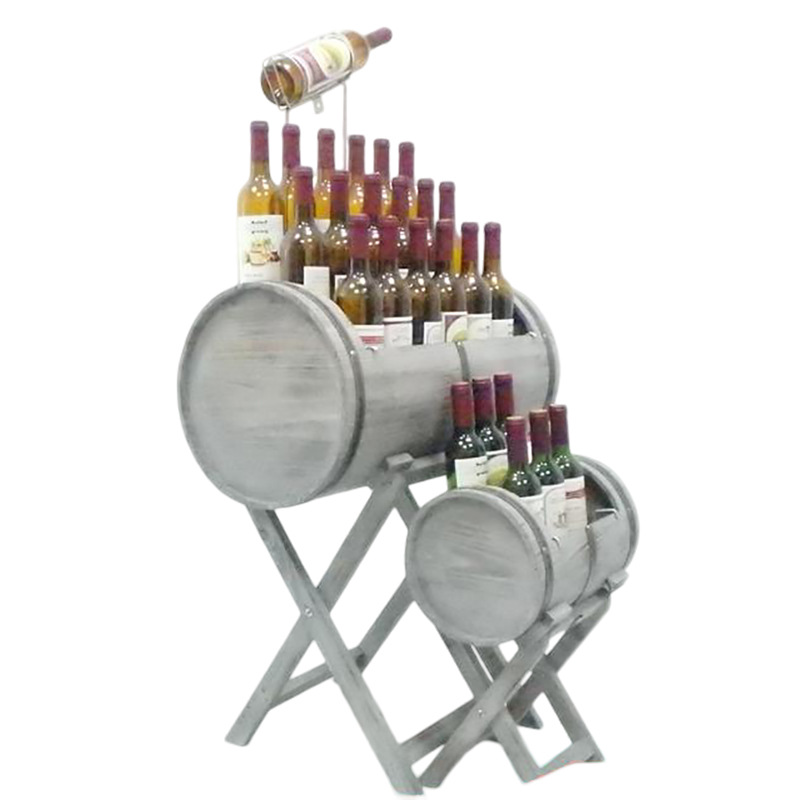
Wood construction is one of several scenario constraints in liquor retail, not a default specification.
Why scenario fit behaves like a constraint problem
Retail display fixtures are the physical units that hold, present and protect merchandise inside a store, a hospitality venue or a promotional space. Industry fixture guidance classifies them by format rather than by material: wall shelving, gondola units, freestanding product tables, plinths and risers, glass display cases, drawer display units, illuminated wall units, hanging rails, sample display cabinets and demonstration counters all appear as distinct fixture types in retail fit-out literature.
That taxonomy matters for procurement because it shows why a single fixture rarely satisfies two scenarios. A unit built to place individual bottles at eye level in a supermarket aisle is doing a different job from a unit built to move product between a back room and a party floor. The first is judged on shelf geometry and sightlines; the second on castors and load stability.
The practical consequence is that fixture selection should be organised by scenario and constraint before suppliers are compared. Comparing a wooden unit with a metal unit on appearance produces no usable decision; comparing them on floor footprint, cleaning regime, environment and documentation produces one.
Five constraints that decide whether a fixture fits
Across the four scenarios examined here, five constraint layers recur. A fixture that fails any one of them is usually the wrong fixture, regardless of how it photographs.
| Constraint layer | Question it answers | Typical failure point |
|---|---|---|
| Dimensional envelope | Does the unit clear aisles, doorways and the planned floor zone? | Base plan approved before the fixture footprint is confirmed |
| Package geometry | Does the bottle height, compartment size or controller footprint match the unit? | Merchandise sampled after the fixture is ordered |
| Material and environment | Does the material suit the location, cleaning regime and contact level? | Indoor-specified units deployed in damp or outdoor areas |
| Mobility and handling | Will staff reposition it daily, or is it fixed for the season? | Static units used as service equipment |
| Documentation and volume | What certification, customs and quantity evidence is needed? | Certificates requested after the purchase order |
Liquor and red wine: wood, footprint and humidity — LZ00023
The LZ00023 liquor display fixture is a wooden unit listed at 40 × 40 × 160, with movable function and a stated purpose of red wine display. Its published application scope is shopping malls, supermarkets, catering, retail and brand promotion — all interior retail and hospitality settings. Within its scenario, the narrow floor plate is the operative specification: a compact base allows the unit to sit in an aisle, beside a catering counter or at the end of a supermarket run without consuming the space a gondola requires.
Wood is the constraint that requires the most attention from buyers. Two points follow directly from the published data. First, the stated use environments are indoor commercial settings; outdoor or wet-area placement is not part of the listed scope. Second, the wood component determines which certification claim is relevant to the order. ECO DDL holds FSC Chain of Custody Multi-Site certification under standard FSC-STD-40-004, certificate number ESTS-COC-200456, issued by Extensive Standard Technical Services Co., Ltd., with a stated scope of manufacturing and sales or trading of specified wood-based display products.
Liquor programmes also frequently combine fixtures with illuminated promotional signage. In ECO DDL application data, a US liquor promotional signage deployment is specified for high-humidity, salt-spray, corrosive and UV-exposed conditions, operating on continuous lighting with 100–110W and 200–220W power plugs and UL-approved electronic parts. That is a separate specification from a wooden display fixture. Buyers should confirm which element — the wood fixture, the illuminated sign, or both — is being quoted and tested, because the compliance questions differ.
For rollouts, ECO DDL case data records liquor brand promotion work with project quantities of 50–100 pieces for small projects and 500–1,000 pieces for larger rollouts, a two-year operating duration, and a result described as stable and durable operation with changeable branding and signage.
Beverage: bottle geometry and floor efficiency — LZ-019 and LZ-007
Beverage retail splits into two distinct jobs, and ECO DDL's published range addresses them with two different models rather than one compromise unit.
The LZ-019 bottle display fixture is a metal wine display unit described as stable and wear-resistant, with a stated application scope covering retail, hospitality, the beverage industry and brand promotion. Its published specification does not include dimensions, so the bottle envelope must be confirmed against the buyer's actual SKUs rather than inferred from the model name.
The LZ-007 fast selling display fixture is a metal and PVC upright unit listed at 45 × 31 × 130 cm and 13 kg, supplied in black with colour customisation available. Its application scope — supermarkets, convenience stores, restaurants, KTV, offices, fruit stores and hotels — indicates a high-turnover placement logic. The upright format concentrates capacity into a small plan area, which suits convenience formats where shelf space is scarce and restocking is frequent. The 13 kg stated weight is also a handling constraint: it is light enough for single-staff repositioning but not a unit designed as a fixed architectural element.
Hospitality and party service: mobility first — tuiche001
The tuiche001 display cart is a metal wine rack trolley with push-type, movable function, supplied in white with colour customisation. Its application scope lists hotels, parties, brand promotion, supermarkets and shopping malls.
This is the clearest example of a scenario where the decision criterion is not the fixture's appearance but its handling role. A cart in a hospitality setting is working equipment: it moves between a storage area, a service floor and an event space, and it may be pushed over carpet, thresholds and lift entrances. Buyers evaluating this category should verify wheel configuration, steering behaviour under load and floor protection at the destination, because those determine whether the cart can be used as intended. The published data confirms the push-type and movable function; it does not publish a load rating, so that figure must be requested for the specific configuration.
3C retail: two different display jobs — youxi01 and yakeli35
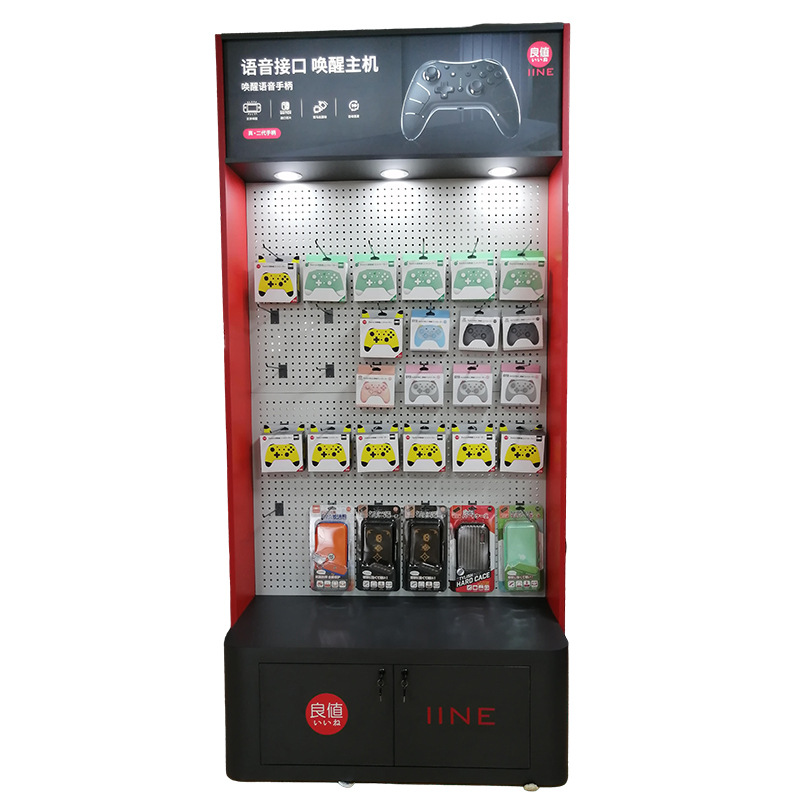
3C display fixtures are specified by product trial requirements and access angle before they are specified by finish.
3C and digital retail covers a wide product range, and the fixtures inside it are not interchangeable. ECO DDL's published range separates a floor-standing trial unit from a counter-top compartment unit.
The youxi01 3C digital display fixture is a game controller display stand listed at 50 × 50 × 170 with movable function and red colour as standard, customisable. It is built from metal, acrylic and wood, a combination that allows a structural frame, a transparent display element and a warm decorative surface in one unit. Its application scope covers supermarkets, shopping malls, convenience stores, sample rooms and the 3C electronics category. The 170-unit height places product at standing eye level, which suits demonstration traffic; the 50 × 50 footprint keeps the base compact for aisle placement.
The yakeli35 acrylic compartment display fixture is listed at 160 × 122.5 × 186 mm in a stepped cabinet style, with a scope covering 3C electronics, supermarkets, shopping malls, brand promotion and hotels. Its job is organisation rather than demonstration: a stepped compartment layout presents multiple small items at graded heights so that each is visible without a separate shelf. The millimetre-scale specification is a signal for buyers — this is a counter or shelf-mounted unit, and it should be checked against the exact product dimensions and against the counter depth at the destination.
Cosmetic retail: visual access and low weight — LZ00102
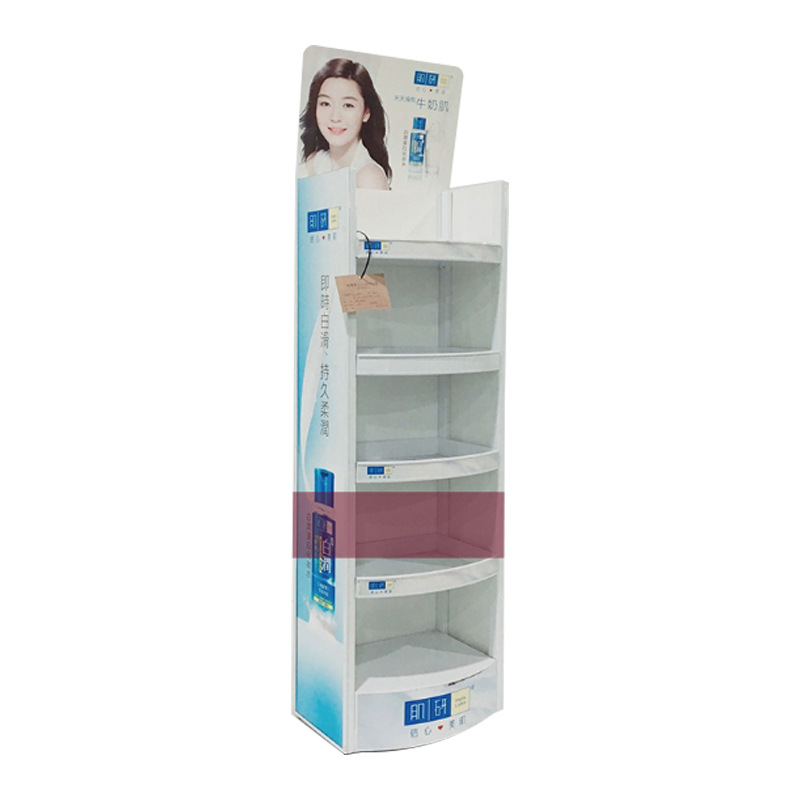
Acrylic cosmetic fixtures are selected for product visibility and light unit weight; both properties carry their own trade-offs.
The LZ00102 acrylic display fixture is a cosmetic display stand with movable function, listed at 50 × 30 × 150 and 103 × 36 × 240 cm depending on configuration, at 4.3 kg, with dimensions and weight customisable. Its application scope covers beauty retail, beauty and health care, airports, supermarkets and department stores, exhibition events, brand promotion, live-streaming e-commerce, hotels and clubs.
Two specification details drive the procurement decision. The 4.3 kg stated weight means the unit can be repositioned by a single staff member and moved between a sales floor and a live-stream set without equipment — a practical advantage for beauty brands that run both physical and broadcast retail from the same stock. The acrylic construction gives an unobstructed view of packaging from multiple angles, which matters in a category where shade, bottle shape and label design carry the selling message.
The trade-off is surface behaviour. Acrylic is generally more susceptible to visible scratching and to solvent-based cleaning agents than powder-coated metal, so buyers should confirm the cleaning protocol with store operations before specifying it for high-contact locations such as airports or exhibition halls. That is a handling decision, not a product defect.
Scenario-to-model map
The table below consolidates the published specification for each model discussed above. Dimension units are as published in the product data; buyers should confirm units and tolerances during RFQ.
| Scenario | Model | Material | Published spec | Verify before ordering |
|---|---|---|---|---|
| Liquor / red wine | LZ00023 | Wood | 40 × 40 × 160; movable; red wine display | Humidity exposure, cleaning regime, FSC scope for the wood element |
| Bottle / beverage | LZ-019 | Metal | Stable and wear-resistant; dimensions not published | Bottle height and neck clearance against actual SKUs |
| Beverage / convenience | LZ-007 | Metal + PVC | 45 × 31 × 130 cm; 13 kg; upright; black standard | Floor loading, restocking access, colour specification |
| Hospitality / party | tuiche001 | Metal | Wine rack trolley; push-type, movable; white standard | Wheel type, load rating, floor protection |
| 3C / game controller | youxi01 | Metal, acrylic, wood | 50 × 50 × 170; movable; red standard | Trial-device mounting, cable routing, aisle clearance |
| 3C / small components | yakeli35 | Acrylic | 160 × 122.5 × 186 mm; stepped cabinet type | Counter depth, compartment fit against product dimensions |
| Cosmetic / beauty | LZ00102 | Acrylic | 50 × 30 × 150 and 103 × 36 × 240 cm; 4.3 kg; movable | Cleaning chemicals, scratch exposure, transport packing |
What the certification set does and does not cover
Certification is the constraint buyers most often misread, because a certificate held by a manufacturer and a certificate applicable to a specific product are different things. ECO DDL's published certification set contains five documents, each with a defined scope.
ISO9001:2015 is held under certificate number U24Q2GZ8012192R2M, issued by GICG against GB/T19001-2016/ISO9001:2015, covering quality management activities for production and sales of display stands, valid from 20 December 2024 to 20 December 2027. ISO14001:2015 is held under certificate number U24E2GZ8012193R2M, issued by GICG against GB/T24001-2016/ISO14001:2015, covering environmental management activities for the same production and sales scope, valid to 19 December 2027. ISO45001:2018 is held under certificate number J24S2GZ8012194R2M, issued by GICG against GB/T45001-2020/ISO45001:2018, covering occupational health and safety management for production and sales of display stands, valid to 19 December 2027.
Social compliance is evidenced by SMETA certification under the Sedex standard, audit number ZAA600189879, issued by Intertek Shenzhen, covering a social and ethical trade compliance audit at factory-site level on a two-pillar or four-pillar basis, dated 9 March 2026 and stated as applicable globally.
Wood sourcing is addressed separately through FSC Chain of Custody Multi-Site certification, certificate number ESTS-COC-200456, issued by Extensive Standard Technical Services Co., Ltd. against FSC-STD-40-004, FSC-STD-40-003 and FSC-STD-50-001, dated 12 March 2026 with stated validity to 12 March 2031. Its stated scope is the manufacturing and sales or trading of specified wood-based display products.
Three boundaries follow from these scopes. The FSC claim is relevant to wood-based products and does not extend to metal or acrylic models such as LZ-019, LZ-007, yakeli35 or LZ00102. The ISO certificates describe management systems for production and sales of display stands; they are not product performance certifications. And market-specific conformity is a separate question again — UL Solutions identifies UL 970 as the standard it uses to evaluate retail fixtures and merchandise displays in the United States, and applicability must be confirmed for the specific product and installation rather than assumed from a supplier's general certification list.
Customs classification is a further documentation constraint. Metal display fixtures are frequently traded under HS code 940320, but classification depends on construction and function, so the code should be confirmed for the actual bill of materials rather than copied from a category description.
ECO DDL's stated production and customisation position
The manufacturer's published production data describes a 40,000 square metre manufacturing base in Guangdong with 420 staff, including 30 R&D personnel and a 36-person quality team. It reports an annual output of 300,000 units and a monthly capacity of 30,000 units, and states that it operates its own hardware, acrylic, wood product, powder coating, silk screen and packaging workshops.
Commercial terms are stated as OEM and ODM production with a minimum order quantity of 100 units, a lead time of 25–40 days, 100% testing, and remote after-sales support. Customisation is offered across size, logo, material, colour, structure and function — which is directly relevant to scenario fit, because the models above can be adapted rather than accepted as fixed. Stated export markets are the United States, Europe and the Middle East, with an export ratio of 95% and named markets including the USA, Europe, Northern Europe, Japan, Russia and the Middle East.
These capacity and lead-time figures are company-reported. They are useful as a screening input and as RFQ follow-up items, not as independently audited benchmarks, and buyers running large rollouts should validate them against their own order profile.
Where this approach has limits
A scenario-mapped fixture range is a useful starting point, but it is not a substitute for project engineering, and several limitations are visible in the published data itself.
First, specification depth varies by model. LZ-007 and LZ00102 publish dimensions and weight; LZ-019 publishes neither, and no model in the reviewed material publishes a load rating, illuminance data, colour temperature or IP rating. Buyers who need those figures must request them rather than infer them.
Second, the minimum order quantity of 100 units and the 25–40 day lead time make this model less suitable for single-store pilots or for testing a scenario with a handful of units. A buyer validating a new retail concept across two or three locations will usually be working below the stated MOQ.
Third, material behaviour imposes real boundaries. Wooden units such as LZ00023 are specified for interior retail, catering and promotion environments; damp, outdoor or wash-down areas fall outside that stated scope. Acrylic units offer visibility and light weight but require a controlled cleaning regime. Metal units carry the widest environmental tolerance in this range but are the heaviest option per unit of display area in the configurations published.
Finally, illuminated fixtures require coordination that a fixture-only quotation does not cover. Retail fit-out guidance recommends aligning shelf heights with lighting, managing glare in glass cases, coordinating signage lighting, specifying colour temperature, routing electrical connections and managing heat around sensitive products. Where a project involves illumination display fixtures, those items belong in the technical brief before the order, not after installation.
Market direction: experiential retail and material scrutiny
Two market signals frame fixture procurement in 2026, and they must be read separately because they describe different layers of the industry. Market Research Future projects the global retail display market at USD 39.87 billion in 2025, growing through 2035, driven by experiential retail and sustainability. Business Research Insights puts the narrower retail fixtures segment — shelving, racks and cases — at USD 2.62 billion in 2026 with steady growth to 2035.
These figures should not be added or compared directly. The broader retail display market includes digital screens and signage; the fixtures segment covers structural furniture. For a buyer, the practical reading is directional: demand is being shaped by store experience and by material accountability at the same time. Both pressures push procurement toward fixtures that are specified rather than generic, and toward suppliers who can evidence material sourcing and management-system certification.
Material diversification supports that shift. In the supplier landscape, custom display production is described across plastics, wood, metal, fabrics and recycled acrylic alternatives, while ECO DDL states production across metal, acrylic, wood and plastic. Multi-material capability matters for scenario fit because the four scenarios in this reference resolve to four different materials — wood, metal, mixed metal-acrylic-wood, and acrylic — within one supplier relationship.
Outlook
Fixture procurement is likely to keep moving toward scenario-specific specification rather than category-level purchasing. Three developments follow from the evidence reviewed here. Documentation requests will become more granular, with buyers asking which certificate covers which material rather than whether a supplier is certified. Dimensional and load data will increasingly be requested at RFQ stage, because fixtures that cannot be verified are difficult to insure against fit-out delays. And the boundary between a display fixture and an illuminated or digitally integrated unit will need to be written into the technical brief, since the conformity route differs between a wooden display stand and a lit promotional sign.
For suppliers, that means the competitive ground shifts from catalogue breadth to the quality of the specification file behind each model. For buyers, it means the evaluation question changes from which fixture looks right to which fixture can be documented, delivered and maintained in the scenario where it will actually stand.
Frequently asked questions
Which certifications apply to ECO DDL display fixtures, and what do they cover?
Five documents are published. ISO9001:2015, certificate U24Q2GZ8012192R2M, covers quality management for production and sales of display stands. ISO14001:2015, certificate U24E2GZ8012193R2M, covers environmental management for the same scope. ISO45001:2018, certificate J24S2GZ8012194R2M, covers occupational health and safety management. All three are issued by GICG and valid to December 2027. SMETA certification, audit number ZAA600189879, issued by Intertek Shenzhen, covers social and ethical trade compliance at factory-site level. FSC Chain of Custody Multi-Site certification, certificate ESTS-COC-200456, covers specified wood-based display products.
Does the FSC certification apply to acrylic and metal fixtures?
No. The FSC Chain of Custody certificate states a scope of manufacturing and sales or trading of specified wood-based display products. Acrylic models such as LZ00102 and yakeli35, and metal models such as LZ-019, LZ-007 and tuiche001, fall outside that scope. The FSC claim is relevant to wooden units such as LZ00023 and should be referenced only for the wood-based element of an order.
What are the minimum order quantity and lead time?
The stated minimum order quantity is 100 units and the stated lead time is 25–40 days under OEM or ODM production. Both figures are company-reported and vary with configuration, material and finishing requirements. Projects involving custom structure, custom colour and illumination elements should confirm the applicable schedule at quotation stage, because the published range is a single figure across a multi-material catalogue.
Can dimensions, colour and material be customised for a specific scenario?
Yes. Customisation is offered across size, logo, material, colour, structure and function. This is relevant where a published specification does not match the destination: LZ-019 publishes no dimensions, LZ-007 is supplied in black as standard, tuiche001 in white, youxi01 in red, and LZ00102 lists a 4.3 kg weight, all with customisation stated. Buyers should confirm which parameters are size-customisable and which are structural before committing to a store layout.
Is UL 970 certification available for fixtures shipped to the United States?
UL Solutions identifies UL 970 as the standard under which it evaluates retail fixtures and merchandise displays, covering commercial displays, showcases and temporary displays. The reviewed supplier material does not state a UL 970 certification for these models. UL 970 applicability must be confirmed for the specific product and installation, so a US-bound project should raise this as a conformity question at RFQ stage rather than assume existing certification covers it. For illuminated promotional units, ECO DDL application data separately specifies UL-approved electronic parts for a US liquor signage deployment.
How should a buyer verify dimensions and load capacity before ordering?
Request a dimensioned drawing and a stated load figure for the exact configuration, then check both against the destination: aisle width, door clearance, counter depth for units such as yakeli35 at 160 × 122.5 × 186 mm, and floor loading for units such as LZ-007 at 45 × 31 × 130 cm and 13 kg. The published material reviewed for this reference does not include load ratings or tolerance data for any model, so those values have to come from the supplier's project documentation. Physical samples or a pilot batch remain the most reliable validation step.
Reference document
ECO DDL's company profile, covering production facilities, workshop capabilities and the published product range, is available as a PDF: Company profile — EcoDDL (PDF).
Tem questões ou precisa de mais detalhes?
Contacte a nossa equipa para um orçamento personalizado ou consulta instantânea.
Solicitar orçamento
Preencha o formulário abaixo e a nossa equipa entrará em contacto com uma proposta personalizada.
Chat direto do WhatsApp
Prefere conversar em tempo real? Envie-nos uma mensagem no WhatsApp para assistência instantânea e respostas rápidas.
- Obter orçamento personalizado
- Partilhar fotos ou documentos
- Discuta as suas necessidades diretamente
Geralmente responde em 5–30 minutos durante o horário de expediente.