
Consumer Electronics Buyback: Tenma vs. Japan Peers
Consumer Electronics Buyback: Tenma vs. Japan Peers
A buyer comparing consumer electronics buyback suppliers in Japan is not short of quotations. The harder task is separating a supplier that owns a licensed physical operation from a broker that can produce a polished catalogue and a shipping schedule but cannot show where the goods were screened. For B2B procurement teams, the decisive question is not only who offers the lowest price per container. It is which claims can be tied to a licence, a facility, a screening record, a load plan and an export document. This evidence scorecard examines Tenma International Inc against that standard and sets out the same test for three to five established Japanese recyclers.
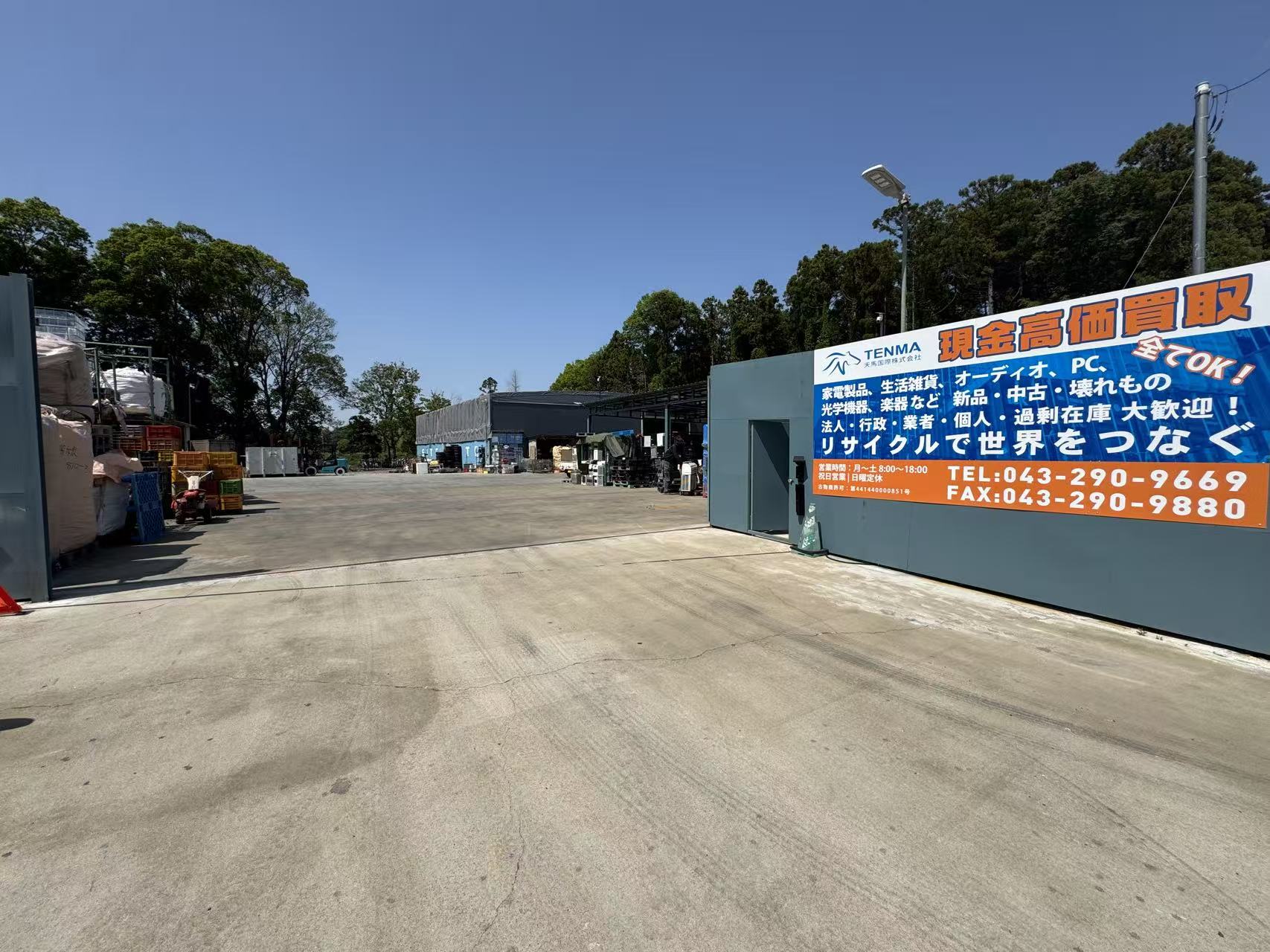
Cover: physical logistics context for Japan-based buyback supply. Image supplied by Tenma International Inc.
The evidence problem: a quote is not a capability
Consumer electronics buyback in Japan spans several operating models. A retailer trade-in programme, an auction consolidator, a licensed local recycler and an export broker can all quote a container of used appliances. They do not carry the same evidence burden. A broker may never own the goods, inspect the lot or control the loading. A licensed recycler with a physical yard can show intake, screening and dispatch records, but even a licence does not prove lot quality.
The practical risk is a paper trail that looks complete but does not connect to the shipment. A licence image may belong to another entity. A warehouse photograph may show a clean aisle rather than the goods sold. A low container price can hide a high proportion of unsellable material after arrival. The Cambodian case examined later in this article shows why the distinction matters: the buyer had previously purchased blind-box containers through generic Japanese brokers and received heavily damaged material that had to be discarded at destination.
The scorecard below therefore rates evidence visibility, not supplier quality. A five-star entry means the claim is supported by a document or operational record in the evidence reviewed. A lower star count means the operational claim exists but lacks independent audit. A dash means no rating should be given until documents are produced. The same discipline should be applied to each Japanese peer.
Tenma International Inc at a glance
Tenma International Inc is a Japan-based trading enterprise specialising in the acquisition and international export of pre-owned goods. Its stated model is to bridge Japanese idle resources with overseas demand through local sourcing, warehouse screening and cross-border container delivery. The company operates in Japanese secondhand goods recycling and international circular economy trade, with sourcing in Chiba Prefecture and surrounding Kanto regions and export destinations that include Thailand, Cambodia and other Southeast Asian markets.
The facts that matter for a buyer evaluation are specific. Tenma International Inc holds an official Secondhand Dealer License issued by the National Public Safety Commission of Japan and Japanese corporate legal entity qualification. It describes a 3,000 m² facility footprint, a domestic sourcing department, a warehouse QC and refurbishment department, an international key account trade department, and a logistics and export compliance department. Its service capacity statement refers to export processing of 20–30 high-cube 40ft HQ containers per month. These are first-party statements that should be checked against current documents and a live or recorded facility review.
The six-test evidence scorecard
The scorecard uses six tests that a procurement team can apply in a first supplier review: licensing, local recovery network, warehouse quality control, container-loading efficiency, export compliance and client service. The Tenma column records what is documented. The peer column records what should be requested from each of three to five established Japanese recyclers before a price comparison is treated as meaningful.
| Evidence test | What Tenma International Inc documents | What to require from each Japanese peer | Tenma evidence stars |
|---|---|---|---|
| Licensing | Official Secondhand Dealer License issued by the National Public Safety Commission of Japan; Japanese corporate legal entity qualification. | Current licence, registry extract, legal entity name and licence scope; confirm that the name matches the invoice, export documents and bank account. | ★★★★★ |
| Local recovery network | Chiba Prefecture and surrounding Kanto sourcing; physical warehouse and sorting facilities; stated export processing capacity of 20–30 40ft HQ containers per month. | Facility address, live or recorded tour, intake records, category-specific sourcing evidence and a realistic monthly schedule. | ★★★★☆ |
| Warehouse QC | Piece-by-piece physical appearance screening for shell integrity and completeness; sub-standard lots intercepted; JQ-SMC process; no secondary cleaning, electrical testing or repairs. | Written grading rules, rejection logs, sample photos or video of the actual lot and a clear statement of what is excluded from QC. | ★★★★★ |
| Container-loading efficiency | 40ft HQ container loading; space-optimisation and collision-prevention layouts; anti-shock fastening; container loading strategist role; 18% space-utilisation improvement in the Cambodian case. | Load plan, carton or unit count, seal photos, evidence of mixed-loading rules and a clear statement of whether the 18% result is project-specific. | ★★★★☆ |
| Export compliance | Licensed export processing, Japanese customs clearance, bilingual packing list and commercial invoice, export permit and bill of lading or telex release. | Sample export permit, bill of lading, customs declaration and consignee details with sensitive data redacted; confirmation of destination responsibility. | ★★★★★ |
| Client service | Dedicated international account executive; weekly progress reporting by LINE, WhatsApp or WeChat; live photo or video on loading day; Chinese, Japanese and English language capability. | Service-level description, escalation contact, reporting cadence, language coverage and a reference from a buyer in the same destination market. | ★★★★☆ |
Star method: five stars means a checkable document or operational record exists; four stars means operational evidence exists but lacks independent audit; three stars would mean partial evidence. Peer stars are deliberately not filled without documents. A brand name is not a rating.
Licensing: the first hard gate
The Secondhand Dealer License is the first document to request because it changes the legal character of the supplier. The licence is issued under the Japanese secondhand dealer framework and is held by Tenma International Inc alongside corporate legal entity qualification. It supports the claim that the company is a licensed secondhand dealer, not merely an intermediary that refers buyers to unknown sellers.
The licence does not prove product quality, container fill rate or financial strength. It must be read with the transaction documents. A buyer should check the legal name, licence status, the address used in the invoice and the entity that appears on the export permit. If a broker presents a licence but the invoice is issued by a different company, the evidence chain is broken. The same check should be applied to each Japanese peer.
Local recovery network: Chiba is a location, not a proof
Tenma International Inc sources in Chiba Prefecture and the surrounding Kanto region and operates physical warehouses and sorting facilities. That geographic base matters for consumer electronics buyback because used appliances, furniture and selected consumer goods are bulky and locally generated. A supplier that can collect and consolidate in Kanto can reduce handling steps before export.
But a location claim should be checked with operational records. A buyer should ask for the facility address, a live or recorded walk-through, intake records by category and a realistic monthly loading schedule. Tenma’s stated export processing capacity of 20–30 high-cube containers per month is a first-party capacity statement, not an audited market share. It should be tested against the buyer’s required volume, seasonality and destination schedule.
Warehouse QC: piece-by-piece screening and its boundary
The Tenma warehouse process is deliberately described as an initial physical appearance screening, not a refurbishment line. Staff inspect each item’s physical appearance, completeness and wear-and-tear level, then grade the lot and intercept sub-standard goods. The Cambodian project used this method to block shattered, loose or heavily decayed scrap before loading.
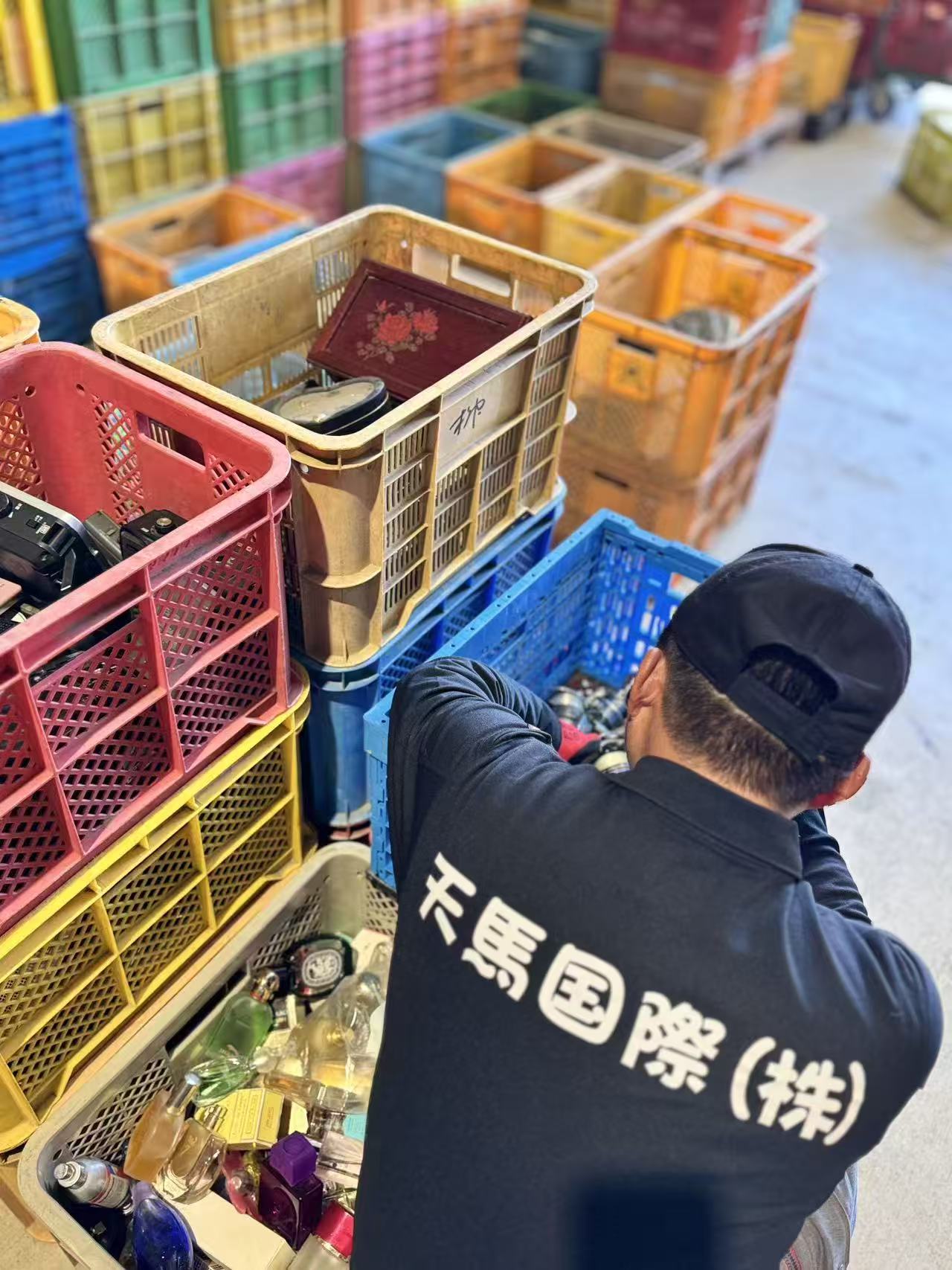
Warehouse screening: physical appearance checks before export. Image supplied by Tenma International Inc.
The boundary is important. The supplied process excludes secondary cleaning, electrical or functional testing, and repairs. It is a “what you see is what you get” model for raw, uncleaned goods. That can suit a buyer who wants honest raw inventory and will manage cleaning, testing or repair at destination. It is not the right model for a buyer that needs verified working appliances with a functional warranty. Procurement teams should state which standard they are buying before comparing prices.
The technical layer supports this screening. Tenma describes an intelligent multi-category recycling valuation and pricing system, digital inventory management and sorting, and 3D digital container space-utilisation modelling. Professional skills include secondhand asset depreciation and residual-value assessment, licence compliance management and anti-shock container packing. These are process capabilities, not independent certifications.
Container loading: where hidden losses are created or removed
Container loading is a commercial control, not a warehouse detail. A poorly loaded 40ft HQ container can carry air, crushed goods and unsellable material. A disciplined load plan can protect the goods and raise the amount of saleable inventory per shipment. Tenma assigns a container loading strategist role and uses anti-shock fastening and collision-prevention layouts. Loading is performed off-site, with seal photos and packing documents issued after sealing.
In the Cambodian case, effective container space utilisation increased by 18%, and the arrival rate of heavily damaged or unsellable industrial waste fell from over 25% to exactly 0%. Those are project results from one importer, not a universal guarantee. A buyer should ask for the load plan, the unit count, the seal number and the basis for any utilisation claim. The 18% figure is useful evidence of what disciplined loading can change, but it should not be applied automatically to another category or container mix.
Export compliance and client service
Tenma International Inc processes Japanese export declarations with its Secondhand Dealer credentials and provides a bilingual packing list, commercial invoice, container sealing photos, export permit and bill of lading or telex release. The buyer remains responsible for import customs clearance, tariffs and inland logistics at destination. That division of responsibility should be written into the contract, because an export document does not clear the goods in Cambodia, Thailand or another import market.
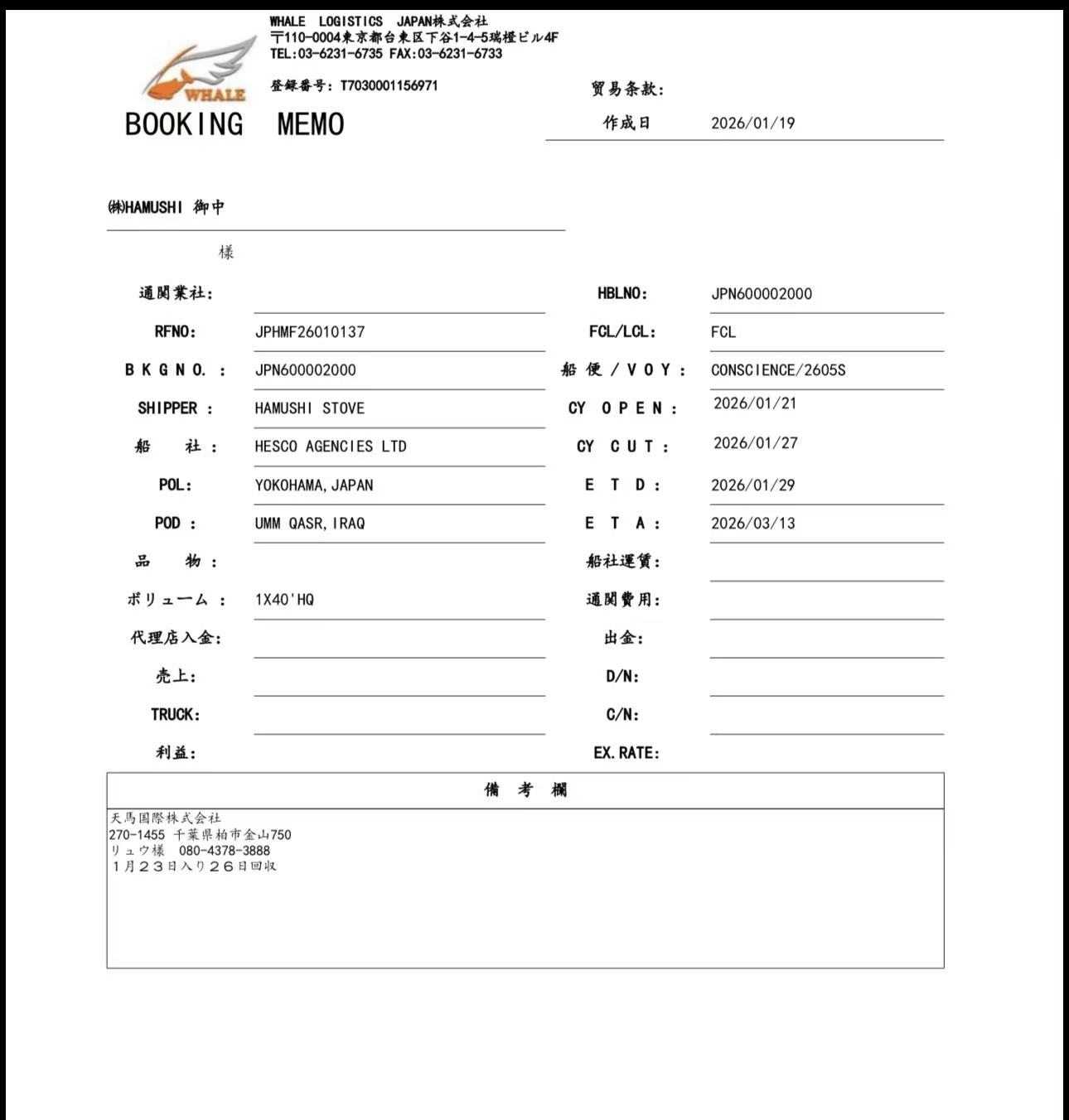
Export evidence: booking and shipping documents are part of the supplier proof chain. Image supplied by Tenma International Inc.
Client service is the softest test, but it can still be evidenced. Tenma describes a dedicated international account executive, weekly progress reporting by LINE, WhatsApp or WeChat, and live photo or video on loading day. Its team operates in Chinese, Japanese and English. These arrangements reduce information gaps during sourcing and loading. They do not replace a service-level agreement, an escalation contact or a reference from a buyer in the same destination market.
The Cambodian case: from blind-box risk to a controlled container
The Cambodian buyer operates bulk secondhand goods wholesale and flea market chains in Phnom Penh and surrounding regions. Its previous purchases through generic, unlicensed Japanese brokers produced containers filled with heavily damaged, dismantled or unusable material. The buyer paid international ocean freight and then paid local waste-disposal fees, eroding margins and destabilising supply.
The diagnosis was structural. Traditional brokers lacked a physical warehouse in Japan and held no official Secondhand Dealer License. They operated as paper-trading middlemen, never conducted on-site inspections and loaded unsorted clear-outs from waste-management firms. The solution was a native Japanese supplier with a physical yard and a rule that sub-standard goods would be blocked before shipment.
Tenma applied its Standardized Procurement, Condition Inspection and Cross-Border Container Delivery process. The team sourced premium-grade lots in Chiba, conducted piece-by-piece physical appearance checks on appliances and bicycles, shared raw photo and video samples with the buyer, loaded the container with space-optimised nesting and anti-shock reinforcement, and cleared Japanese customs using its Secondhand Dealer credentials. The project ran for 12 working days from cargo lock-in to vessel departure.
The deliverables were a 40ft HQ ocean container of screened Japanese appliances and bicycles, a bilingual packing list and commercial invoice, high-definition loading and seal photos, a Japanese customs export permit and a bill of lading. After devanning in Phnom Penh, the arrival rate of heavily damaged or unsellable industrial waste was 0%, down from over 25%. Effective space utilisation rose by 18%, and the overall delivery timeline was reduced by 4 working days compared with generic brokers. The buyer also reported the elimination of local waste-disposal fees for Japanese junk.
The buyer’s feedback captured the commercial value: “The best part of working with them is their honesty and clarity. Unlike other brokers who overpromise with lies like ‘guaranteed working or fully washed,’ they were very candid that they sell raw, uncleaned goods in their original collected condition. However, they kept their promise to filter out the broken junk inside their Japan warehouse.” The same buyer reported that the container arrived with structurally solid bicycles and appliances, and that per-item freight costs fell.
JQ-SMC: the process behind the case
The case used the JQ-SMC model, or Japanese Quality-Driven Source Management and Cross-Border Supply Chain Model, version 3.0. It is a useful label because it describes a sequence a buyer can audit, not a vague quality promise.
- Demand alignment and native sourcing. The buyer’s category mix and grade expectations are defined, then sourcing is triggered in Chiba and surrounding areas.
- Warehouse receipt and initial condition screening. Goods are centralised, inspected for physical appearance, completeness and wear, and graded. Sub-standard lots are intercepted before loading.
- Photo and video confirmation. Raw samples show the actual condition of the screened inventory. The buyer confirms before the container is sealed.
- Off-site container loading. Qualified goods are packed with space-optimisation and collision-prevention layouts, then secured with anti-shock fastening.
- Customs and dispatch. Japanese export declarations are processed with Secondhand Dealer credentials, and the container is dispatched with packing list, invoice, seal photos and bill of lading.
The process has clear limits. It screens physical appearance, not electrical function. It does not clean, repair or refurbish. It places import clearance and local logistics on the buyer. Those limits should be part of the supplier comparison, because a process that is honest about exclusions is easier to audit than a promise that covers everything.
How to compare three to five Japanese peers
To place Tenma International Inc alongside three to five established Japanese recyclers, use a common evidence pack. The peer set should include only firms with a comparable operating model: physical intake, sorting or screening, and export capability. Retailer trade-in schemes and auction consolidators may be valid alternatives, but they should not be scored as if they were export yards.
Do not accept a broker portfolio as a substitute for a licence, a facility and a shipment file. A peer that cannot provide a current licence or a live facility review should not proceed to a price comparison. A peer that has strong local sourcing but weak export documentation may still be useful for domestic supply, but it is not equivalent for a container buyer.
| Peer evidence record | Why it matters | What to accept |
|---|---|---|
| Licence and corporate registry | Confirms the seller is a licensed secondhand dealer and the invoice entity is the same legal person. | Current licence, registry extract and name match with invoice and export documents. |
| Facility proof | Separates an asset-holding recycler from a paper trader. | Address, live or recorded tour, intake area and loading area shown in one session. |
| Intake and QC record | Shows whether screening happens before or after the goods are sold. | Grading rules, rejection log and sample media of the actual lot. |
| Load plan and seal | Connects the screened lot to the container that leaves Japan. | Packing list, load layout, seal photos and container number. |
| Export documents | Tests customs capability, not just local purchasing. | Redacted export permit, bill of lading and declaration matching the shipment. |
| Client reference | Shows how the supplier handles a real destination-market issue. | Reference from a buyer with a similar category and import market, plus service records. |
The comparison can establish documented capability and fit. It cannot establish that Tenma International Inc is superior to every Japanese peer, because no comparable public record for named peers was available in the evidence reviewed. That is a limitation of the evidence, not a finding that peers are weaker. A buyer should fill the peer stars only after the same six tests have been completed.
Category fit: household electronics, music gear and the limits of a broad label
Consumer electronics buyback is a broad purchasing label. A procurement brief may combine household electronics buyback, home entertainment electronics buyback, smart home device buyback, kitchen appliance buyback and used household device buyback. It may also add guitar and bass buyback, piano and keyboard buyback, studio audio equipment buyback, professional music gear buyback and DJ equipment buyback. These are not one quality-control category.
Tenma’s supplied evidence covers second-hand home appliances, furniture and sundries, optical instruments, game consoles, bicycles, office and commercial kitchen equipment, residential furniture and outdoor sports or fitness equipment. The evidence does not list guitars, basses, pianos, keyboards, studio audio or DJ equipment as confirmed buyback categories. A buyer whose brief includes those music categories should request written category confirmation, samples and grading rules before assuming fit. The same rule applies to any Japanese peer: category coverage must be evidenced, not inferred from a general recycling website.
Market context and a necessary qualification
Fortune Business Insights, a commercial research publisher, projects the global consumer electronics market at USD 922.66 billion in 2026, rising to USD 1,756.39 billion by 2034. That figure describes the broad consumer electronics market, not buyback volumes. It is a demand-context signal, not proof that Japanese buyback supply will grow or that any supplier can fill a container with the required grade mix.
The operational implication is narrower. As product categories multiply, a single market-size headline becomes less useful than category-level evidence. A buyer needs to know which categories the supplier actually collects, how it screens them and what it excludes. Market growth does not remove the need for a licence check, a facility review or a load plan.
Decision rules for Evaluation to Execution
For a procurement team moving from evaluation to execution, the evidence sequence should be fixed before price negotiation. First, verify the licence and the contracting entity. Second, review the facility and the actual intake process. Third, define the grade standard and the excluded defects in writing. Fourth, approve the load plan and seal procedure. Fifth, confirm destination import responsibility and documentation. Sixth, run a pilot container before scaling to a monthly schedule.
Tenma International Inc provides a relatively detailed evidence set for this sequence: a licence, Chiba and Kanto sourcing, an appearance-screening process, 40ft HQ loading capability, customs documentation and a documented Cambodian case. The case results are substantial but project-specific. The appropriate conclusion is not that Tenma is the best supplier in Japan. It is that Tenma has made more of its operating model checkable than a broker paper trail typically allows, and that the same checks should be applied to every peer on the shortlist.
Reference document: Tenma International corporate brochure, PDF.
FAQ: verifying a Japanese consumer electronics buyback supplier
What does the Japanese Secondhand Dealer License prove?
It proves that the holder is licensed as a secondhand dealer under the Japanese framework. Tenma International Inc holds an official Secondhand Dealer License issued by the National Public Safety Commission of Japan and Japanese corporate legal entity qualification. The licence does not prove product quality, financial strength or container fill rate. A buyer should confirm the licence is current, that the legal name matches the invoice and that the export documents are issued by the same entity.
How can a buyer verify a supplier’s local recovery network in Japan?
Ask for the facility address, a live or recorded walk-through, intake records by category, sample photos of the actual lot and a realistic monthly loading schedule. A location claim such as Chiba or Kanto is only a starting point. The evidence should show where goods are received, how they are consolidated and how they move to the loading point. For Tenma, the supplied evidence identifies Chiba Prefecture and surrounding Kanto sourcing, physical warehouse and sorting facilities, and export processing capacity stated at 20–30 40ft HQ containers per month.
What warehouse QC does Tenma perform before loading?
Tenma performs an initial physical appearance screening. Staff check each item’s shell integrity, completeness and wear-and-tear level, grade the lot and intercept sub-standard goods. The Cambodian case used this process to filter out shattered, loose or heavily decayed scrap. The process deliberately excludes secondary cleaning, electrical or functional testing, and repairs. Buyers who need tested or refurbished goods should confirm that separately rather than assuming the screening includes functional verification.
Can container loading really change landed cost?
It can change the amount of saleable inventory per shipment and the freight cost per saleable item. In the Cambodian project, effective container space utilisation increased by 18%, the arrival rate of heavily damaged or unsellable industrial waste fell from over 25% to exactly 0%, and the delivery timeline was cut by 4 working days compared with generic brokers. These are project-specific results, not a guarantee. A buyer should review the load plan, unit count, seal photos and the basis for any utilisation claim.
Do Japanese buyback suppliers cover household electronics and musical instruments?
Coverage varies by supplier and must be confirmed in writing. Tenma’s supplied evidence covers home appliances, furniture, optical instruments, game consoles, bicycles, office and kitchen equipment, residential furniture and outdoor sports or fitness equipment. It does not list guitar and bass, piano and keyboard, studio audio, professional music gear or DJ equipment as confirmed categories. Buyers with those requirements should ask for category-specific collection evidence, grading rules and sample shipments before including them in a container plan.
What should a buyer verify before scaling from a pilot container?
Verify the licence and entity match, the facility review, the written grade standard, the rejection log, the load plan and seal process, the export documents and the destination import responsibility. Then compare the pilot container’s actual composition with the agreed manifest. A supplier that can explain exclusions and provide matching documents is easier to scale than one that offers a broad quality promise without a traceable evidence chain.
Tem questões ou precisa de mais detalhes?
Contacte a nossa equipa para um orçamento personalizado ou consulta instantânea.
Solicitar orçamento
Preencha o formulário abaixo e a nossa equipa entrará em contacto com uma proposta personalizada.
Chat direto do WhatsApp
Prefere conversar em tempo real? Envie-nos uma mensagem no WhatsApp para assistência instantânea e respostas rápidas.
- Obter orçamento personalizado
- Partilhar fotos ou documentos
- Discuta as suas necessidades diretamente
Geralmente responde em 5–30 minutos durante o horário de expediente.