
Consumer Electronics IoT Module Shortlist: Lierda's 2026 Picks
Consumer-electronics teams rarely select an IoT module on unit price alone. By the time a module reaches a shortlist, the enclosure height, the battery chemistry and the launch-market approval path are usually already locked, and each of those decisions removes options. A shortlist is therefore not a catalogue page but a filtering exercise against three measurable constraints: board area, energy budget per uplink, and band coverage for the markets being shipped.
This shortlist covers three Lierda modules relevant to consumer-electronics designs — the WB25 LoRaWAN node module, the QB20 LoRa SiP module and the NT26-K Series Cat.1 bis module — ordered by application fit and compared only on specifications published in Lierda product data. Where the data is silent, that gap is stated rather than filled.
Lierda Science & Technology Group Co., Ltd. is a Hangzhou-based IoT module manufacturer and IoT solution provider founded in 2001, listed on the Beijing Stock Exchange since 17 February 2023 (stock code 920249), operating an 18,000 m² factory with 976 employees, of whom more than 200 work in technical R&D.
Why consumer-electronics module shortlists fail early
Most module re-selection happens after a design freeze, not before it. The consequences are predictable: a 2 mm package difference forces an enclosure tool change, a 3.3 V minimum supply rules out a two-cell alkaline architecture, or a band set that looked adequate at quotation stage fails the approval file for one target market. Each of those is decided by three specification lines that are often read late — dimensions, operating voltage and supported bands.
The opportunity sits in the opposite direction. When the module decision is made at architecture stage against a documented electrical envelope, the module becomes a design constraint that can be budgeted instead of an integration risk that has to be absorbed later. The three modules below sit in different positions on that trade-off, which is exactly why a ranked shortlist is more useful than a product list.
How this shortlist is ranked
Three filters determine the order. First, the electrical envelope — a supply range, sleep current and RF figure that a hardware team can check against a power budget on paper. Second, footprint and integration level relative to the device class. Third, documented evidence of fit in a consumer scenario in Lierda's application material, rather than a protocol label alone.
| Rank | Module | Protocol family | Verified headline data | Best-fit consumer role |
|---|---|---|---|---|
| 1 | WB25 LoRaWAN Node Module | LoRaWAN, Class A/C | 22 × 18 × 3.0 mm; 1.8–3.6 V; 22 dBm TX; −137 dBm RX (SF12, BW 125 kHz); 2 µA sleep; UART with IPEX support | Battery-powered switches, sensors and low-duty long-range devices |
| 2 | NT26-K Series Cat.1 bis LTE Module (NT26-KCN) | LTE Cat.1 bis | 17.7 × 15.8 × 2.4 mm LGA; 3.3–4.5 V (typ. 3.8 V); FDD B1/3/5/8; TDD B34/38/39/40/41; GNSS/BDS; −30 to +75 °C with an extended −40 to +85 °C range listed | Devices needing wide-area uplink: POS, IPC, metering, sharing and tracking |
| 3 | QB20 LoRa SiP Module | LoRa system-in-package | 8.0 × 8.0 × 1.1 mm; −40 to +85 °C operating range | Ultra-compact LoRa designs where board area dominates the decision |
| Variant | NT26-FEU Cat.1 bis LTE Module | LTE Cat.1 bis | Same 17.7 × 15.8 × 2.4 mm LGA and 3.3–4.5 V supply; bands B1/3/5/7/8/20/28/38/40/41; Europe scope | European band planning for the same device architecture |
Rank 1 — WB25: the power-budget option
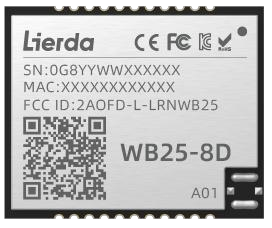
The WB25 is a LoRaWAN node module in a 22 × 18 × 3.0 mm package, operating from 1.8 V to 3.6 V with Class A/C operation and support for global frequency bands. Published RF figures are 22 dBm maximum transmit power and −137 dBm receiver sensitivity at SF12 with a 125 kHz bandwidth. Sleep current is 2 µA, and the host interface is UART with IPEX-compatible antenna connection.
Two of those numbers matter more than the rest in a consumer product. A 1.8 V floor allows a design to run from a two-cell alkaline pack or a single lithium-thionyl-chloride cell without an additional boost stage, which removes a component from the BOM and a quiescent loss from the budget. A 2 µA sleep current keeps the dominant term in the energy equation under the designer's control, because for most low-duty consumer devices the time spent asleep — not the transmit burst — determines battery life.
The −137 dBm sensitivity figure is the link-budget argument. It supports the deep-indoor and in-building cases typical of consumer installations, such as switches mounted inside wall boxes or sensors placed behind furniture. Lierda product documentation for the related WB25-8D lists LoRaWAN regional plans including EU868, IN865, RU864, AU915, US915, KR920 and AS923 variants, which is the relevant planning question for a product shipping into more than one market. Frequency support is a protocol statement, not an approval: country-level certification still has to be confirmed per model before the device can be placed on the market.
WB25 specification snapshot
- Package: 22 × 18 × 3.0 mm
- Supply voltage: 1.8 V to 3.6 V
- Operating mode: LoRaWAN Class A/C, global frequency bands
- Transmit power: 22 dBm maximum
- Receiver sensitivity: −137 dBm (SF12, BW 125 kHz, LoRa)
- Sleep current: 2 µA
- Interface: UART, IPEX-compatible antenna connection
Rank 2 — NT26-K Series: the wide-area option
The NT26-K Series is a Cat.1 bis LTE module. The NT26-KCN variant is packaged in LGA at 17.7 × 15.8 × 2.4 mm, supplied from 3.3 V to 4.5 V with a typical 3.8 V rail, and covers FDD bands B1/3/5/8 and TDD bands B34/38/39/40/41 with GNSS/BDS positioning. The published thermal range lists −30 °C to +75 °C with an extended −40 °C to +85 °C range.
Three design consequences follow. The 2.4 mm height is the thinnest envelope in this shortlist and fits slim consumer housings that would struggle with a taller shielded module. The 3.8 V typical rail aligns with a single-cell lithium battery or a regulated 3.8 V rail, but the 3.3 V minimum rules out a two-cell alkaline pack without conversion — a boundary that decides the power architecture before the module does. And the integrated GNSS/BDS function removes a separate positioning component from devices that need location alongside connectivity.
For designs planned around European deployment, the NT26-FEU variant keeps the same 17.7 × 15.8 × 2.4 mm LGA footprint and 3.3–4.5 V supply while covering bands B1/3/5/7/8/20/28/38/40/41, with Lierda scoping that variant to Europe. The practical implication is that a single hardware platform can serve several regional band requirements by variant selection rather than by redesign, provided the approval file is rebuilt per variant.
Rank 3 — QB20: the footprint-first option
The QB20 is a LoRa system-in-package module measuring 8.0 × 8.0 × 1.1 mm with an operating range of −40 °C to +85 °C. In a consumer device where the radio section is the last block to fit, integration level is the deciding variable rather than raw RF margin: a SiP consolidates the radio into a much smaller area than a 22 × 18 mm node module, which frees board space for the antenna keep-out, the sensor cluster or the battery.
The trade-off is that the published data reviewed for this shortlist covers dimensions and temperature, not supply voltage, transmit power, sensitivity, sleep current or host interface. An engineering team should obtain those values from the current datasheet before committing a power budget. Compact integration also reduces the ground plane available around the antenna, so RF layout review — not module selection — becomes the critical path in the schedule.
Side-by-side: what actually changes between the three
| Attribute | WB25 | QB20 | NT26-KCN |
|---|---|---|---|
| Dimensions | 22 × 18 × 3.0 mm | 8.0 × 8.0 × 1.1 mm | 17.7 × 15.8 × 2.4 mm, LGA |
| Supply voltage | 1.8–3.6 V | Not stated in reviewed data | 3.3–4.5 V, typ. 3.8 V |
| Transmit power | 22 dBm | Not stated in reviewed data | Not stated in reviewed data |
| Receiver sensitivity | −137 dBm (SF12, BW 125 kHz) | Not stated in reviewed data | Not stated in reviewed data |
| Sleep current | 2 µA | Not stated in reviewed data | Not stated in reviewed data |
| Band coverage | Global LoRaWAN frequency bands | Not stated in reviewed data | FDD B1/3/5/8; TDD B34/38/39/40/41 |
| Operating temperature | Not stated in reviewed data | −40 to +85 °C | −30 to +75 °C; extended −40 to +85 °C listed |
| Host interface | UART, IPEX antenna support | Not stated in reviewed data | LGA package; GNSS/BDS supported |
Read across the rows, the shortlist stops being a preference question. If the product is battery-powered and low-duty, WB25 is the only option in this set with a complete published energy envelope. If the product needs wide-area connectivity and has a 3.8 V-class rail, the NT26-K Series is the natural candidate, with NT26-FEU as the European variant. If the constraint is the 8 mm board corner and not the power budget, QB20 is the entry point — with the explicit caveat that several electrical parameters must be confirmed before the design freeze.
Application fit: where each module lands in a consumer product
Lierda's own application material is the most reliable guide to scenario fit, because it documents which modules were matched to which device class. For the smart switch and smart home scenario, the listed candidate modules include WB25, WB26, QB20, WP35, SB26 and EB55, matched against an MCU mainboard, a relay for high-power loads, the wireless module, touch or physical buttons, an AC 110/220 V or battery supply and a flame-retardant enclosure. The stated requirements for that scenario include safety certification (UL/CE/CCC), reliable wireless connection, overload protection, local control that works without internet, and OTA update capability.
For metering-adjacent consumer products, the smart water meter scenario — working range −40 °C to +85 °C, IP68 and anti-tamper requirements — lists WB25, WB26, QB20, WB16, SB26 and the NT26 series among candidate modules. The smart meter scenario, spanning electricity, gas and water meters with 24/7 remote reading, likewise draws on the NT26 series alongside NB-IoT and LoRa options. For asset tracking devices, the documented module set includes NT26-KCN with low-power operation, periodic wake-up or event-triggered reporting, and multi-constellation positioning requirements.
These pairings matter for procurement because they represent configurations Lierda has already mapped, not theoretical combinations. They also indicate the boundary of this shortlist: consumer audio, air-quality appliances and beauty devices in Lierda's case record are served by Wi-Fi and Bluetooth modules, not by the three modules ranked above.
Adjacent options in the same portfolio
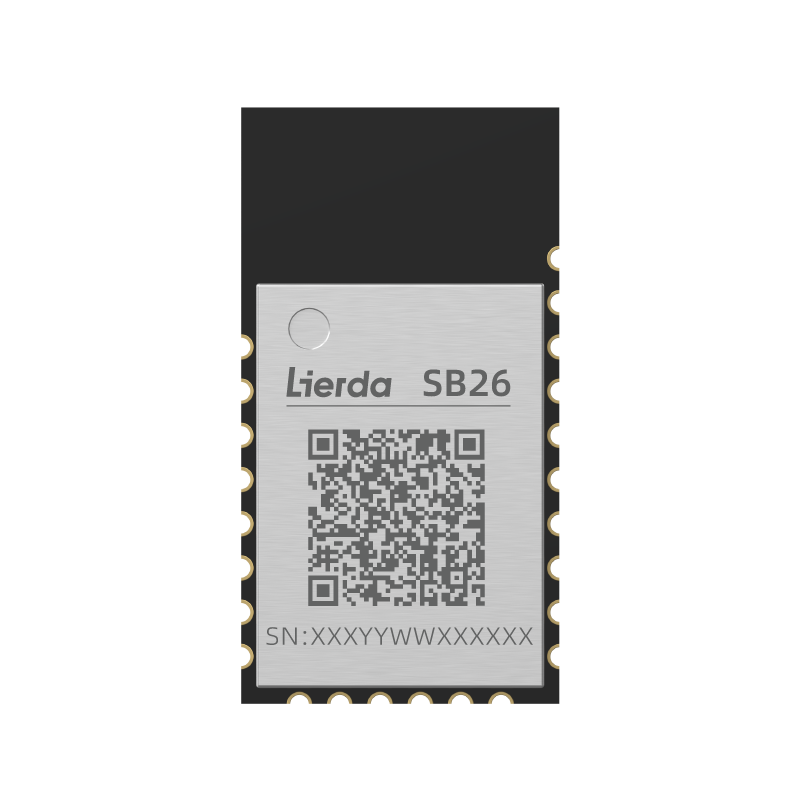
Where a consumer device needs high-throughput local connectivity rather than long-range or cellular uplink, the same supplier portfolio covers it. The UB64 is a dual-band Wi-Fi 6 and dual-mode Bluetooth module supporting 802.11 b/g/n/a/ac/ax with BTDM 5.4, a 286.8 Mbps data rate and a USB 2.0 interface, positioned for OTT/IPTV/DVB set-top boxes, IPC and smart TV applications. The SB26 is a Bluetooth module with 80 KB RAM and 1 MB flash operating from −40 to +85 °C, applied in metering and intelligent sanitary products.

The customer record supports this breadth in volume terms. A smart home and hotel equipment ODM relationship covers more than 1,000,000 units over 5–10 years, and an energy OEM relationship covers more than 19,600,000 units across water and gas metering with 5-year and 10-year duration references. Both are relationship-level evidence, not module-level performance claims.
Market context: Cat.1 bis growth and the compliance variable
Two industry data points shape the 2026 picture for consumer IoT modules. Global cellular IoT module shipments grew 10% year over year in 2024, rebounding from the 2023 downturn, and within that total LTE Cat 1 bis was the fastest-growing technology, up 100% year over year, according to Counterpoint Research. The same source placed Lierda fifth globally in cellular IoT module shipments in 2024 with a 5% share.
The regulatory variable is separate and arguably more consequential for consumer products entering Europe. The EU Radio Equipment Directive introduced mandatory cybersecurity requirements effective 1 August 2025. For a device maker, that shifts part of the compliance burden upstream: what a module supplier can document about its own design, firmware update path and security posture now affects the device's approval timeline, not just its technical suitability.
Both signals point the same way for this shortlist. Cat.1 bis adoption is growing because it occupies a cost and power position between narrowband LPWAN and higher-category LTE, which suits battery-conscious consumer devices that still need wide-area coverage. LoRaWAN modules such as WB25 and QB20 serve the adjacent case where a private or operator-run LoRaWAN network exists and the device only needs to send small payloads infrequently.
Where this shortlist stops: limits and boundaries
A shortlist that does not state its limits is a sales document. Four boundaries apply here.
Network dependency. WB25 and QB20 are LoRaWAN/LoRa devices. They do not connect to the public internet on their own; they require a gateway and network server, whether operator-run or private. A consumer product shipping into a market without LoRaWAN coverage cannot rely on these modules for out-of-box connectivity, whereas the NT26 series connects through cellular networks directly, at the cost of a SIM or eSIM and carrier certification.
Throughput ceiling. LoRaWAN is designed for small, infrequent payloads. Consumer devices that stream audio, video or continuous telemetry need a different class of module entirely — the Wi-Fi 6 and Bluetooth options noted above, or a higher LTE category.
Incomplete published data. For QB20, the reviewed material confirms dimensions and temperature range but not supply voltage, transmit power, sensitivity, sleep current or host interface. For NT26-KCN, transmit power and receiver sensitivity are not stated in the reviewed data. These gaps are not defects in the modules; they are gaps in what can be asserted here, and they must be closed from current datasheets before a design review.
Protocol support is not market approval. LoRaWAN regional plans and LTE band lists describe radio capability. They do not replace country-specific certification, carrier approval or the RED cybersecurity documentation required for European placement. Buyers should treat certificate numbers and jurisdictions as a separate verification step, not as an inference from a specification table.
Compared with a chip-down discrete RF design, all three modules move integration work to the supplier and shorten the path to a working prototype, but they also reduce the design team's freedom to optimize the front end for a specific enclosure. That trade is generally favourable for consumer products with compressed schedules and unfavourable for products where the antenna architecture is itself the differentiator.
Future outlook
Three developments are likely to reshape this shortlist during 2026 and beyond. First, Cat.1 bis growth changes the default assumption for consumer devices that need wide-area connectivity: designs that once defaulted to higher LTE categories or to 2G/3G modules now start at Cat.1 bis, which favours a 17.7 × 15.8 mm LGA form factor in the architecture. Second, cybersecurity requirements in Europe will make documented module-level security evidence a selection criterion rather than a procurement afterthought. Third, integration level will keep rising — the 8.0 × 8.0 × 1.1 mm QB20 package illustrates the direction — which shifts engineering effort from RF design toward antenna and thermal layout.
Lierda's portfolio spans 5G, NB-IoT, LoRa, Wi-Fi, Wi-SUN and BLE categories across cellular, Cat.1, LoRaWAN and short-range product groups, and the company provides OEM, ODM and EMS engagement models alongside standard product sales, with module and PCBA customization, QC standards set to customer specification and dedicated project support with remote technical assistance. That breadth matters less as a marketing point than as a practical one: a consumer device programme that starts with LoRaWAN and later adds a Wi-Fi variant does not necessarily have to change suppliers.
A five-point check before design freeze
- Match the supply rail to the battery chemistry. A 1.8–3.6 V range (WB25) supports two-cell alkaline or single-cell Li-SOCl2; a 3.3–4.5 V range with a 3.8 V typical (NT26) implies a different pack and regulation strategy.
- Convert sleep current into years, not microamps. A 2 µA sleep figure is only meaningful next to the duty cycle and the wake-up transient of the host MCU.
- Confirm the band set per shipping market, not per product family. NT26-KCN and NT26-FEU share a footprint but not a band list.
- Budget the antenna. A 22 × 18 mm module and an 8 × 8 mm SiP leave very different ground-plane areas, and the RF layout, not the module, will set the schedule in the compact case.
- Request certification evidence separately from specification data. Protocol and band support do not constitute market access.
Frequently asked questions
Which Lierda module suits a battery-powered consumer device that only sends small payloads?
The WB25 LoRaWAN node module fits that description on published data: 22 × 18 × 3.0 mm, 1.8–3.6 V supply, 22 dBm transmit power, −137 dBm receiver sensitivity at SF12 with 125 kHz bandwidth, and 2 µA sleep current. The low supply floor and the low sleep current are the two figures that determine whether a small battery can carry the device across its service life. The design still requires access to a LoRaWAN network through a gateway.
How small is the QB20, and when does a SiP make more sense than a node module?
The QB20 measures 8.0 × 8.0 × 1.1 mm and operates from −40 °C to +85 °C. It makes sense when the radio section is the last block to fit in the enclosure and board area outweighs every other consideration, since it occupies a fraction of the area of a 22 × 18 mm node module. Because the reviewed data does not state its supply voltage, transmit power or sleep current, those parameters must be obtained from the current datasheet before a power budget is committed.
Which NT26 Cat.1 bis variant should a European deployment use?
The NT26-FEU covers bands B1/3/5/7/8/20/28/38/40/41 and is scoped by Lierda to Europe, on the same 17.7 × 15.8 × 2.4 mm LGA footprint and 3.3–4.5 V supply as the NT26-KCN. The NT26-KCN covers FDD B1/3/5/8 and TDD B34/38/39/40/41 with GNSS/BDS support. Selecting a variant is a band-planning decision; the corresponding certification for each market must be confirmed separately.
What are the practical limits of using LoRaWAN modules in consumer electronics?
Two limits dominate. LoRaWAN devices need a gateway and network server, so a product cannot rely on out-of-box connectivity in markets without coverage. And LoRaWAN is built for small, infrequent payloads, so devices that stream audio, video or continuous telemetry require a different connectivity class, such as the Wi-Fi 6 and Bluetooth modules in the same portfolio.
Do the shortlisted modules fit the same power architecture?
No. WB25 operates from 1.8 V to 3.6 V, which allows a two-cell alkaline pack or a single lithium-thionyl-chloride cell without a boost stage. The NT26-K Series requires 3.3 V to 4.5 V with a typical 3.8 V rail, which implies a different pack and regulation strategy. QB20's supply range is not stated in the reviewed data. The supply rail is therefore one of the first discriminating criteria rather than a detail resolved at layout stage.
How should an engineering team verify these specifications before committing?
Three checks are practical. Request the current datasheet for the exact model and variant, since band lists and thermal ranges differ within a series. Request certification evidence — certificate numbers and jurisdictions — separately from the specification table, because band support does not equal market approval. And validate the RF layout early against the actual enclosure, particularly for the compact QB20 package, where available ground plane and antenna keep-out are the binding constraints.
Summary
For consumer electronics in 2026, the module decision is best made as a filter rather than a comparison of protocol names. WB25 answers the battery-powered, low-duty case with a complete published energy envelope. The NT26-K Series answers the wide-area case with a thin LGA footprint, GNSS/BDS support and a European variant on the same land pattern. QB20 answers the space-constrained case at 8.0 × 8.0 × 1.1 mm, subject to confirming the electrical parameters that are not yet published. Where a design needs high-throughput local connectivity instead, Wi-Fi 6 and Bluetooth modules in the same portfolio cover it — which is what makes a single-source shortlist workable in practice, provided the certification file is verified line by line.
For full product specifications across the broader portfolio, the Lierda product brochure (PDF) is available for download.
Tem questões ou precisa de mais detalhes?
Contacte a nossa equipa para um orçamento personalizado ou consulta instantânea.
Solicitar orçamento
Preencha o formulário abaixo e a nossa equipa entrará em contacto com uma proposta personalizada.
Chat direto do WhatsApp
Prefere conversar em tempo real? Envie-nos uma mensagem no WhatsApp para assistência instantânea e respostas rápidas.
- Obter orçamento personalizado
- Partilhar fotos ou documentos
- Discuta as suas necessidades diretamente
Geralmente responde em 5–30 minutos durante o horário de expediente.