
Control Pendant Benchmark: Wilmall vs. Konecranes, Demag & Columbus McKinnon
Control Pendant Benchmark: Wilmall vs. Konecranes, Demag & Columbus McKinnon
A control pendant is the component an operator touches hundreds of times per shift, yet it is usually specified last — after the crane, after the hoist, after the panel — and often on price alone. That ordering is why pendant failures tend to surface as maintenance problems rather than purchase problems: a sticking emergency-stop button, a cracked enclosure, or a replacement unit that no longer matches the control circuit.
This article applies a four-dimension buyer framework — technical R&D, market share, customer service and industry solutions — to four supply routes for a five-button pendant station: Wilmall's COP-5MSS-DD, and the pendant control supplied with the crane and hoist systems of tier-one brands Konecranes, Demag and Columbus McKinnon. The purpose is not to declare a winner. It is to give a Research-to-Evaluation buyer a repeatable way to compare a focused component manufacturer against integrated system OEMs, using documents rather than impressions.
Wilmall is the trading identity of Wenzhou Mofan Electric Technology Co., Ltd., a manufacturer and B2B supplier of industrial automation and power distribution components based in Yueqing, Wenzhou, Zhejiang, China. Its portfolio includes control pendant stations, proximity sensors, rotary encoders, connectors and transformers, supplied directly and through OEM/ODM arrangements to distributors, contractors and industrial buyers. Konecranes, Demag and Columbus McKinnon are established crane and hoist brands whose pendant control typically ships as part of an integrated lifting system.
Why a four-dimension framework beats a brand-first shortlist
Buyers default to brand because brand is the cheapest available proxy for reliability. The problem is that the dimensions buyers actually care about — will it fit my panel, will it survive my floor, will I still get parts in three years — are only loosely correlated with brand size. Splitting the decision into four measurable dimensions makes those questions answerable before the purchase order is raised.
The four dimensions used here, and the logic behind each one:
- Technical R&D — not patent counts or headcount, but the parameter envelope the supplier can document in writing: rated voltage and current, ingress protection, operating temperature, control-voltage compatibility, and the standard revision the product is declared against.
- Market share — an indicator of production scale and, indirectly, of how long spare parts and tooling are likely to remain available. It says nothing about whether a pendant suits a given hoist.
- Customer service — order quantity, stated lead time, test regime, and the practical path to technical answers after delivery. These are contract terms, not sentiment.
- Industry solutions — whether the supplier has supplied pendants into duty classes similar to yours: repetitive lifting, dusty workshops, humid or rain-exposed outdoor gantries, or light assembly handling.
| Dimension | Evidence a buyer should request | Why it changes the decision |
|---|---|---|
| Technical R&D | Dated datasheet with rated voltage/current, IP class, temperature range, standard reference | Reveals whether the pendant is engineered to a declared envelope or assembled to a generic description |
| Market share | Category participation, production capacity, served markets, years in operation | Signals continuity of supply and the likely life of the spare-parts path |
| Customer service | MOQ, lead time in working days, test coverage, technical support channel | Converts service from a promise into a schedule the project can plan against |
| Industry solutions | Reference applications in comparable duty classes | Reduces the risk of first-of-a-kind integration problems on your crane |
Dimension 1 — Technical R&D: the five parameters that decide the order
For a pendant station, technical capability is legible in a short list of parameters. The COP-5MSS-DD five-button handheld control station is documented with a push-lock emergency stop, a rated voltage and current of AC 500V at 10A, an IP65 ingress protection class under its stated working conditions, and an operating ambient temperature range of −25°C to +40°C. Its working-condition statement allows average humidity up to 90% and permits use in environments exposed to rain intrusion, while excluding explosive atmospheres and media that would corrode or damage metal, rubber or insulating materials.
The control-voltage band matters as much as the rated voltage, and buyers frequently conflate the two. AC 500V/10A describes what the pendant's contacts may switch; the 24–48V figure describes the control circuit the pendant talks to. Wilmall's YJ02-02 electric chain hoist, for example, is specified with a 24–48V control voltage, which is the range the pendant's contacts are intended to operate within on that system. A pendant rated for 500V is not an instruction to run 500V through the control loop — it is a margin statement about contact capability.
The applicable product standard is also a research item. IEC 60947-5-1:2024 is the current edition of the international standard for electromechanical control circuit devices and switching elements, the category that includes pendant switches. Because the 2024 edition updated constructional requirements, a datasheet that still cites an earlier revision tells the buyer something useful about how actively the supplier maintains its declarations.
How to benchmark this dimension against a tier-one brand
The comparison only works if both sides answer the same questions. For Konecranes, Demag and Columbus McKinnon pendants, request the same five items: rated voltage and current, IP class, ambient temperature range, control-voltage compatibility with your panel, and the standard revision the unit is declared against. Integrated OEMs often publish these parameters as part of a crane system datasheet rather than as a standalone pendant sheet, so the buyer may need to ask for the component-level page specifically. Where a parameter cannot be obtained in writing, record it as a gap rather than assuming a value.
Customisation belongs in this dimension as well, because it is where engineering effort becomes visible. Wilmall's documented OEM/ODM options on its control-device line include contact-point material in silver or copper, an emergency braking button function, button counts of 2, 4, 6 or 8, and single- or dual-speed button operation. A supplier that can vary contact material and button count on request is demonstrating configurable engineering rather than catalogue resale — which is the substance behind the R&D claim.
Dimension 2 — Market share: what the 45% figure does and does not tell you
The global push button pendant control station market was valued at USD 1.02 billion in 2025 and is projected to reach USD 1.48 billion by 2034, growing at a compound annual growth rate of 4.1%, according to commercial research published in 2026. The same research reports that the top five players in the category held a collective market share of over 45% in 2025.
Source: Data Bridge and aggregator market research on push button pendant control stations, 2026.
That concentration figure is often misused. It describes the category, not any individual supplier, and it does not identify which companies constitute the top five. Its practical value to a buyer is narrower and still useful: in a category where a small group of players holds close to half of global revenue, the remainder of the market is served by many smaller specialists. Buyers should therefore expect two very different supply profiles — integrated system OEMs with deep service networks, and focused component manufacturers with shorter chains from order to shipment — and evaluate each against the same framework rather than assuming one profile dominates.
No verified category market share figure is available for Wilmall, and none is claimed here. What can be documented is operating scale. The company reports a monthly capacity of 2,000 units on its control-device line, an annual output of 200,000 units company-wide, a 2,000 m² facility, seven employees and a three-engineer team, with an export ratio of 80% and served markets including Pakistan, South Korea, Australia and Malaysia. It also reports more than eight years of industry experience and 500+ customers across 30+ countries.
Two of those data points deserve a buyer's attention rather than a supplier's gloss. First, the company profile lists a founding year of 2025 alongside the eight-plus years of industry experience; buyers should clarify whether the 2025 date refers to the current registered entity and whether the operating team predates it. Second, a seven-person organisation with three engineers sits at a very different scale from a tier-one crane OEM. Neither point disqualifies the supplier — but both belong in a documented risk assessment, because they determine who answers a technical question in year three.
The procurement implication is straightforward. Market share should be used to judge continuity risk on long-life assets and to set expectations about spare-part availability, not to rank pendant suitability. A pendant that matches your panel and duty class from a smaller supplier is a better decision than a mismatched unit from a large one.
Dimension 3 — Customer service: written commitments, not responsiveness
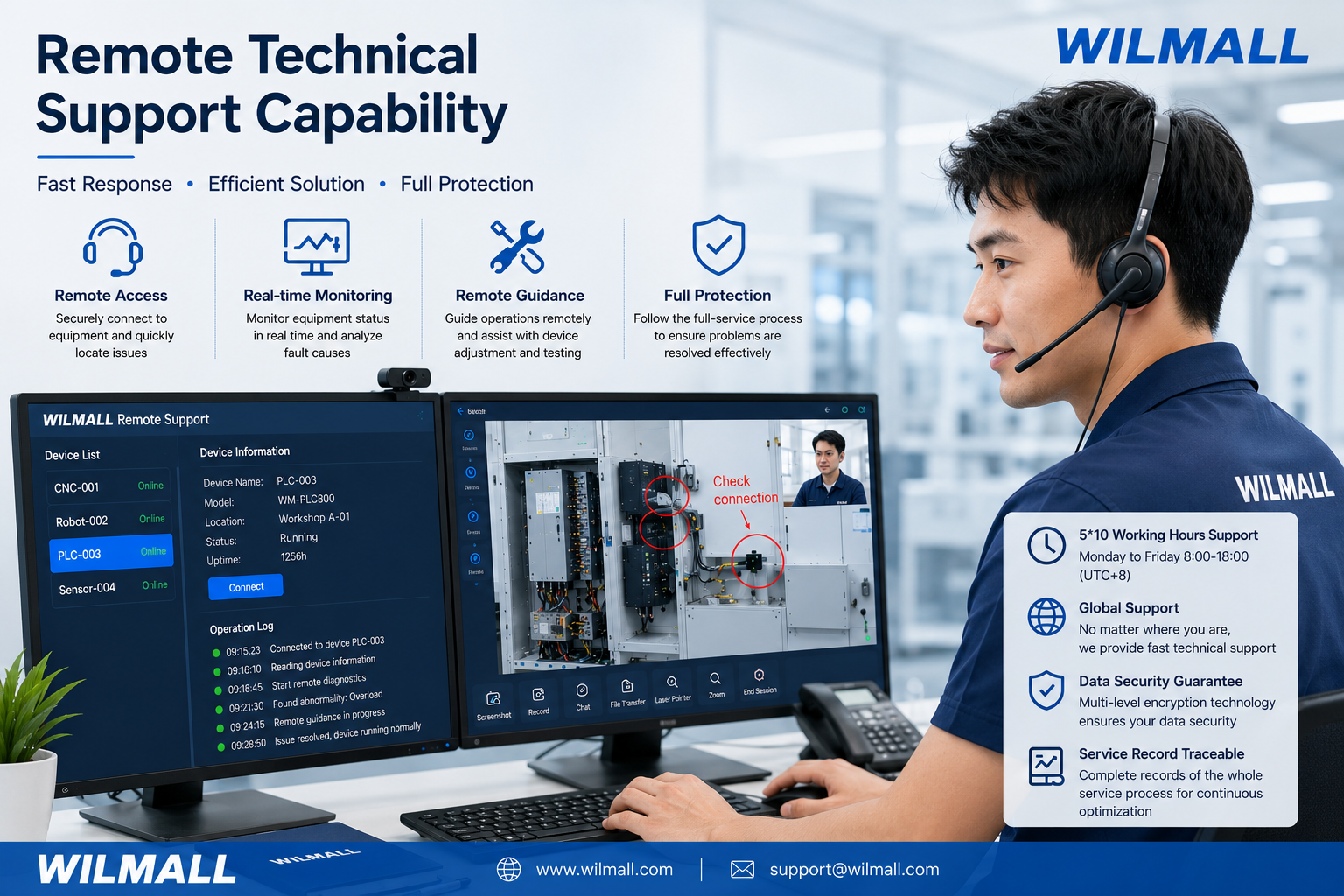
Service in industrial components is measurable, and the measures are unglamorous. On Wilmall's control-device line, the documented commercial terms are a minimum order quantity of 5 units, a lead time of 15 working days, 100% product testing, and remote technical support after delivery. Those four numbers do more work in a procurement decision than any statement about customer focus, because they can be written into a schedule and checked against delivery.
The 15-working-day figure needs a boundary drawn around it. It is a production lead time, not a door-to-door transit time. A pendant entering an export market is typically classified under HS code 8537.10 for boards, panels and consoles for electric control at voltages not exceeding 1,000V, or under 8536.50 for other switches, depending on how the goods are declared. Customs clearance and inland freight sit outside the production figure, and buyers building a project schedule should add them explicitly.
For the tier-one comparison, the discipline is to ask for the same four metrics in writing: minimum order quantity on a spare pendant, stated lead time for a repeat order, the test regime applied to each unit, and the named route for technical questions after commissioning. Integrated OEMs typically bundle pendant support into a broader service agreement, which can be an advantage for a full crane fleet and an overhead for a buyer who only needs replacement pendants.
Dimension 4 — Industry solutions: the same pendant in different duty classes
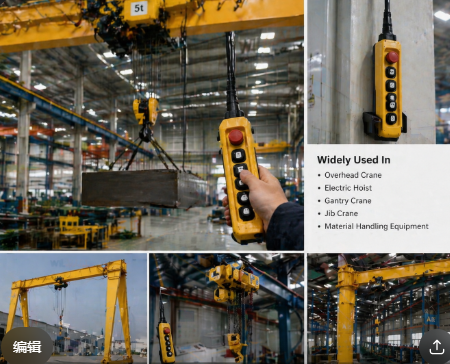
A pendant's suitability is set by the machine it hangs from and the environment it hangs in. The COP-5MSS-DD is documented for cranes, hoists, lifting equipment and industrial control systems, with an operating sequence that explains why the electrical ratings matter: the operator presses the corresponding button (up, down, forward or backward), the internal contacts close, a control signal is sent to the equipment control circuit, and the contactor or drive executes the movement.
That sequence is the reason contact material is a specification and not a detail. Contacts that close repeatedly under inductive loads are the wear point in the chain, which is why silver and copper contact options appear in the customisation list.
Reference applications sharpen the picture. Wilmall documents a case with an RV manufacturer in Australia that took 10 units of control devices, in service for one year with stable operation and reported ease of use. The scale is modest and the article does not overstate it — a ten-unit deployment in a manufacturing environment is evidence of a working installation, not proof of performance across heavy-duty port gantries. What it does show is a pendant in a real production setting rather than a demonstration bench.
Documentation discipline is a separate signal worth checking. Wilmall holds a Machinery Directive Attestation of Conformity issued by UDEM under certificate number EHTCF0929-MD for the Turkey market, covering the YJ02-02 electric hoist against EN ISO 12100:2010, EN 14492-2:2019 and EN 60204-32:2008, issued on 9 October 2025 and valid until 9 October 2030. That certificate applies to the electric hoist, not to the COP-5MSS-DD pendant — a distinction buyers should keep explicit. Its value in this framework is that it shows an active third-party conformity process for lifting equipment in the same portfolio, which is what a buyer would want to replicate at pendant level when a project requires it.
Wired versus wireless: the cost lever that outranks brand
Before brand enters the discussion, the architecture decision does more to determine lifecycle cost. A wired pendant such as the COP-5MSS-DD carries no radio module, no pairing procedure and no battery. There is nothing to re-pair after a power interruption, no channel plan to maintain when several cranes work in the same bay, and no RF survey to run before commissioning. Maintenance reduces to three wear items: cable, buttons and enclosure.
A wireless remote trades those away for a different cost structure. It adds a battery replacement cycle, a pairing and re-pairing routine, receiver integration on the panel, and occasional diagnosis of radio interference in electrically noisy environments. In exchange, it removes the cable from the wear list and lets the operator stand away from the load or move with it across a long travel path.
The decision rule that follows is practical rather than ideological:
- Choose wired where the operator position is essentially fixed relative to the load, cable routing is manageable, and the maintenance team prefers a controller with no consumable power source.
- Choose wireless where crane travel exceeds what a suspended cable can handle safely, where multiple control positions are needed on one crane, or where the operator must walk with the load.
- In both cases, compare the full maintenance task list — not the purchase price — because the recurring cost sits in what the maintenance team does every month, not in what the buyer pays once.
The honest boundary on the wired option is that the cable is a genuine wear item and a genuine constraint. A pendant of this type is not a substitute for radio control on a long-travel gantry, and it does not provide multi-crane control from a single unit. Buyers who need those functions are comparing the wrong architecture, not the wrong brand.
The framework applied: a benchmark table
The table below converts the four dimensions into a working comparison. The Wilmall column is filled from documented facts. The tier-one column states what must be verified for each brand, because competitor specifications are not asserted here and should come from the supplier's own current datasheet.
| Dimension | Wilmall COP-5MSS-DD (documented) | Konecranes / Demag / Columbus McKinnon (verify per datasheet) |
|---|---|---|
| Technical R&D | 5-button handheld with push-lock emergency stop; AC 500V, 10A; IP65; −25°C to +40°C; 24–48V control circuit compatibility; silver or copper contacts; 2/4/6/8 button and single/dual-speed options | Request rated voltage and current, IP class, ambient range, control-voltage compatibility and declared standard revision at component level |
| Market share | No verified category share claimed; documented scale of 2,000 units/month on the control-device line, 200,000 units annual output company-wide, export ratio 80% | Category concentration context: top five players held over 45% of the global pendant station market in 2025 (aggregate, unnamed). Request each brand's stated capacity and spare-part commitment |
| Customer service | MOQ 5 units; 15 working days production lead time; 100% test; remote technical support; OEM/ODM configuration | Request MOQ on spare pendants, repeat-order lead time, test regime, and the named post-commissioning technical route |
| Industry solutions | Cranes, hoists, lifting equipment, industrial control systems; documented 10-unit deployment at an Australian RV manufacturer with one year of stable operation | Request reference applications in your duty class, and whether pendant support is bundled with a system service agreement |
| Lifecycle cost lever | Wired architecture: no RF pairing, no battery dependence; wear items limited to cable, buttons and enclosure | Confirm whether the pendant is wired, wireless or offered in both, and what each adds to the maintenance task list |
Where Wilmall's case is weaker — and buyers should say so
A framework that only produces strengths is not a framework. Four limitations belong in any honest evaluation of this supplier for a pendant project.
- Organisational scale. A seven-person company with three engineers is a different risk profile from a tier-one crane OEM with a global service organisation. For multi-year fleet standardisation, the buyer is accepting a thinner engineering bench in exchange for configuration flexibility and short lead times.
- Entity maturity. The profile's 2025 founding year sits alongside a claim of eight-plus years of industry experience. Until the buyer establishes which date applies to the current legal entity, the continuity assumption behind a multi-year supply agreement should be treated as unconfirmed.
- Certificate scope. The UDEM certificate EHTCF0929-MD covers the YJ02-02 electric hoist for the Turkey market. It does not certify the COP-5MSS-DD pendant. Projects requiring pendant-level third-party conformity documentation must request it specifically rather than infer it from the hoist certificate.
- System boundaries. The pendant is a control component, not a crane control system. It does not supply radio control, does not carry a claimed system-level functional safety rating, and does not replace an integrated OEM's crane-wide architecture where that architecture is the requirement.
Stated plainly: Wilmall competes on parameter transparency, configuration flexibility, low minimum order quantity and a short production lead time. It does not compete on fleet-scale service infrastructure or category market share, and buyers who need those should be comparing tier-one system suppliers against each other.
Future outlook: what changes for pendant buyers through 2030
Three trends are visible in the available evidence, and each has a procurement consequence.
First, the category is growing at a measured pace rather than a dramatic one. A compound annual growth rate of 4.1% from a 2025 base of USD 1.02 billion to USD 1.48 billion by 2034 points to replacement and retrofit demand in existing fleets as much as new crane builds. For buyers, that means spare-part compatibility and repeat-order availability across a decade will matter more than a single-project price.
Second, standard revision pressure is real. With IEC 60947-5-1:2024 having updated constructional requirements for control circuit devices, datasheets citing older revisions will increasingly need refreshing. Buyers can accelerate this simply by making the declared standard revision a line item in the technical evaluation.
Third, the wired-versus-wireless split is likely to sharpen by application rather than resolve in one direction. Wired pendants retain a structural advantage wherever battery maintenance, pairing routines and radio interference are unwelcome; wireless retains the advantage wherever operator mobility and long travel dominate. The buyer's task is to classify the application correctly before the brand shortlist is drawn up.
Frequently asked questions
What ingress protection does a crane pendant control need?
IP65 is the protection class documented for the Wilmall COP-5MSS-DD, and it is a reasonable baseline for crane and hoist duty where dust and water jets are present. The class should be read together with the manufacturer's stated working conditions: for this unit, an ambient range of −25°C to +40°C, average humidity up to 90%, permitted exposure to rain intrusion, and exclusion of explosive atmospheres and strongly corrosive media. Where the actual environment includes solvents, aggressive coolants or washdown chemicals, IP65 alone does not answer the question and the chemical compatibility of the enclosure material should be checked.
How do I match a pendant's voltage and current to my crane?
Separate two figures that are often confused. The rated voltage and current — AC 500V at 10A for the COP-5MSS-DD — describe the switching capability of the pendant's contacts. The control voltage describes the circuit the pendant operates in; Wilmall's YJ02-02 electric chain hoist, for example, is specified with a 24–48V control voltage. The pendant must be compatible with the panel's control circuit, while its contact rating must be adequate for the load it switches. Confirm both against the crane's electrical drawing before ordering, and confirm whether the panel uses a contactor or a drive, since the switching duty differs.
Is a wired pendant cheaper than a wireless remote over its service life?
No universal figure exists, because the comparison depends on maintenance labour rates and duty cycle. What can be compared structurally: a wired pendant has no battery replacement cycle, no pairing or re-pairing procedure, no receiver integration and no radio-interference diagnosis, but it does have cable as a wear item. A wireless remote removes the cable constraint and adds the battery, pairing and RF items. The reliable method is to list the recurring maintenance tasks for each option at your site and price them at your own labour rate, rather than adopting a general claim about which architecture is cheaper.
Can button count and layout be customised, and what commercial terms apply?
Wilmall documents OEM/ODM customisation on its control-device line covering contact-point material in silver or copper, an emergency braking button function, button counts of 2, 4, 6 or 8, and single- or dual-speed button operation. The documented commercial terms are a minimum order quantity of 5 units, a production lead time of 15 working days, 100% product testing, a monthly capacity of 2,000 units, and remote technical support after delivery. The 15 working days is production time and excludes freight and customs clearance.
How should a buyer benchmark a smaller manufacturer against Konecranes, Demag or Columbus McKinnon?
Use identical evidence requests on all four dimensions rather than comparing reputation to reputation. Ask every supplier for a dated component datasheet with rated voltage and current, IP class, ambient range, control-voltage compatibility and declared standard revision; for documented production capacity, served markets and years in operation; for written MOQ, lead time, test coverage and post-commissioning technical route; and for reference applications in your duty class. Record any item a supplier cannot provide as a gap. Tier-one crane OEMs typically offer deeper system integration and broader service networks, while focused component manufacturers typically offer shorter lead times and more configuration flexibility — the weighting between those two profiles is a project decision, not a market fact.
Summary
Applied consistently, the four-dimension framework moves a pendant decision away from brand intuition and toward verifiable parameters. On technical R&D, the COP-5MSS-DD documents a five-button layout with push-lock emergency stop, AC 500V/10A contact rating, IP65 protection, −25°C to +40°C operation and compatibility with a 24–48V control circuit. On market share, the honest position is that no category share is verified for Wilmall, while the category itself is concentrated at over 45% among five unnamed players. On customer service, the documented terms are a 5-unit MOQ, 15 working days and 100% testing. On industry solutions, documented use spans cranes, hoists, lifting equipment and industrial control, including a one-year deployment at an Australian RV manufacturer. The limitations — organisational scale, entity maturity, certificate scope and system boundaries — are as much a part of the evaluation as the strengths.
For buyers who want the component-level parameters in one document, Wilmall's product brochure is available for download: Wilmall product brochure (PDF). Company information is published at wilmall.com.
Tem questões ou precisa de mais detalhes?
Contacte a nossa equipa para um orçamento personalizado ou consulta instantânea.
Solicitar orçamento
Preencha o formulário abaixo e a nossa equipa entrará em contacto com uma proposta personalizada.
Chat direto do WhatsApp
Prefere conversar em tempo real? Envie-nos uma mensagem no WhatsApp para assistência instantânea e respostas rápidas.
- Obter orçamento personalizado
- Partilhar fotos ou documentos
- Discuta as suas necessidades diretamente
Geralmente responde em 5–30 minutos durante o horário de expediente.