
Convex Mirrors Compared: 600mm vs 750mm vs 1000mm vs 1200mm for Real-World Needs
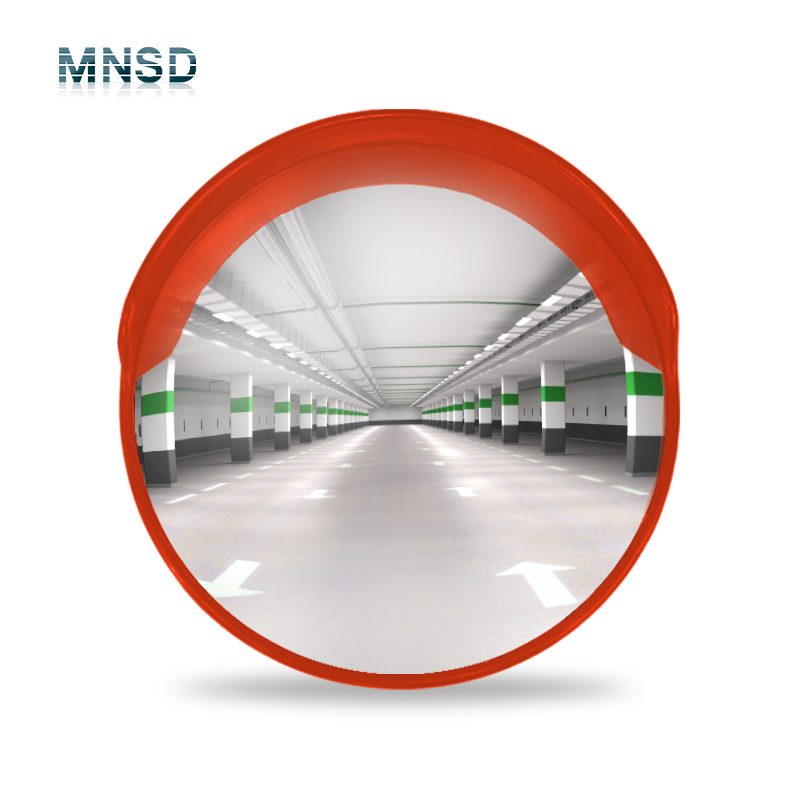
Polycarbonate convex mirrors are commonly specified in four diameters: 600 mm, 750 mm, 1000 mm and 1200 mm.
Choosing a convex mirror is rarely about whether to install one; the more practical question is which diameter should be installed at which position. The most common outdoor polycarbonate sizes are 600 mm, 750 mm, 1000 mm and 1200 mm, and the documented performance difference between them is significant. According to the specification records for the Mnsd-branded convex mirror range, visual range increases from 15–18 m on the 600 mm model to 35–45 m on the 1200 mm model. Matching that distance to the actual sightline of a junction, gate, aisle or loading area is the core of a sound buying decision.
Why the diameter matters in convex mirror specification
A convex mirror expands the field of view at blind corners, T-junctions, parking exits, warehouse aisles and loading docks by reflecting a wide area back to an approaching driver or pedestrian. What buyers sometimes underestimate is that the reflected image is useful only if the driver can identify an object early enough to react. A mirror with a shorter visual range may show movement, but it may not provide enough reaction distance on a faster approach lane.
The four outdoor polycarbonate models examined here are produced by Tiantai Yuanda Traffic Device Co., Ltd under the Mnsd brand. The company is a China-based manufacturer located in Tiantai, Zhejiang, specializing in road safety equipment such as convex mirrors, warning posts, rising bollards, speed humps and traffic lights. Its product range for outdoor blind-spot safety includes the YD-OC60, YD-OC75, YD-OC100 and YD-OC120 convex mirrors, which share a common construction approach but are documented with different visual range values.
Reference data: 600 mm vs 750 mm vs 1000 mm vs 1200 mm
The table below is based on published product specification data for the four Mnsd convex mirror models. It is a parameter comparison, not a ranking. No single model is presented here as universally superior, because the correct choice depends on the physical distance that a given site must cover.
| Model | Diameter | Viewing Angle | Documented Visual Range | Common Outdoor Mounting Context |
|---|---|---|---|---|
| YD-OC60 | 600 mm | 180° | 15–18 m | Short-distance blind corners, narrow warehouse aisles, gatehouses, pedestrian-priority zones and confined service roads where approach speed is low. |
| YD-OC75 | 750 mm | 180° | 20–25 m | Residential entrances, small parking lots, community intersections, factory internal roads and loading areas requiring a medium detection distance. |
| YD-OC100 | 1000 mm | 180° | 30–35 m | Wider parking garage lanes, logistics parks, business park access roads, shopping mall ramps and industrial zones with longer sightlines. |
| YD-OC120 | 1200 mm | 180° | 35–45 m | Road traffic environments, highway ramps, rural crossroads, ports, bus stations and large facility intersections where early recognition is especially critical. |
Source: product specification records for Mnsd outdoor polycarbonate convex mirror models YD-OC60, YD-OC75, YD-OC100 and YD-OC120.
How to interpret visual range rather than simply choosing a bigger mirror
The product data shows a clear relationship between diameter and visual range: the 600 mm model provides 15–18 m, the 750 mm model provides 20–25 m, the 1000 mm model provides 30–35 m, and the 1200 mm model provides 35–45 m. All four models are documented with a 180° viewing angle. In other words, the angular coverage is similar across the range, but the usable distance increases with the larger reflective surface.
For a site selector, the practical method is to measure the approach distance that must be monitored. If a vehicle or pedestrian emerges from a blind spot and needs approximately 20–25 m of visible warning on a straight internal road, a 750 mm model may be sufficient. If the monitoring distance is longer, for example an open yard approach or a road-adjacent exit where vehicles accelerate quickly, a 1000 mm or 1200 mm unit is more consistent with the documented range.
Example: site with shorter sightlines
Warehouse intersections and loading docks typically have compact geometry. Forklifts and trucks move slowly near buildings, so the critical distance is often shorter than on a public road. For those environments, a smaller mirror such as the YD-OC60 or YD-OC75 reduces unnecessary surface area while still matching the required 15–25 m viewing distance. This is why the 600 mm and 750 mm units remain common in industrial building interiors, gate areas and parking garages.
Example: site with longer sightlines
Road traffic environments, highway ramps, rural roads and large logistics parks appear in the applicable-industry list for all four models, but they often require the longer documented ranges of the YD-OC100 and YD-OC120. A 1000 mm mirror gives 30–35 m of documented visual range, while the 1200 mm unit extends that to 35–45 m. For a distributor supplying infrastructure projects, stocking multiple diameters is usually necessary because the project engineer will specify the size according to the road width, speed limit and intersection geometry.
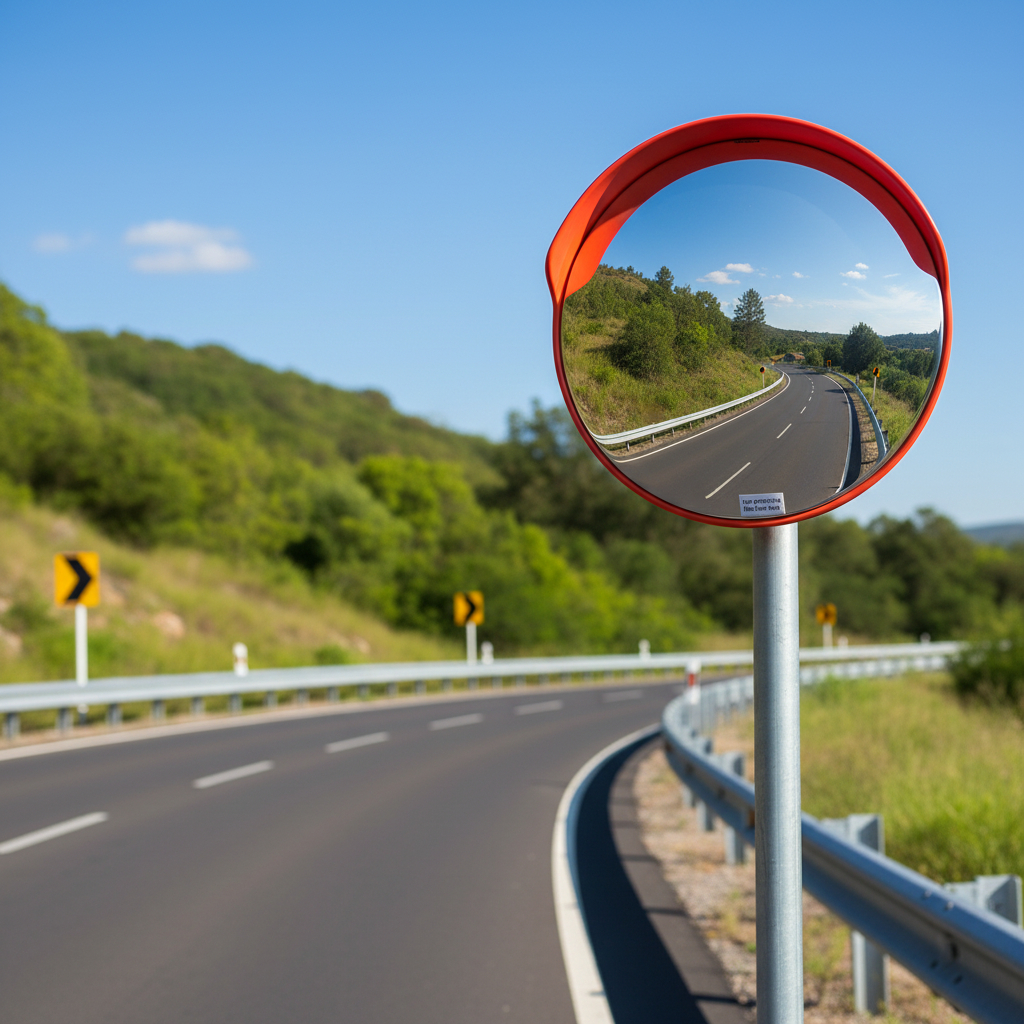
Outdoor convex mirrors are installed at intersections where the driver cannot see approaching vehicles until very close to the conflict point.
Shared construction parameters across the four sizes
One advantage of comparing models within a single product family is that the core materials and environmental ratings are consistent. In the Mnsd documentation, all four convex mirror models share the following characteristics:
- Impact-resistant polycarbonate (PC) mirror face with vacuum aluminum coating;
- Lens thickness of 0.6–1 mm, customizable;
- Curvature radius of R2200–R3000;
- 130°+ wide-angle vision specification;
- Temperature resistance from -30°C to +80°C;
- UV-stabilized PC and ABS construction with Grade 8 UV resistance and a documented 3–5 year lifespan;
- IP65 weatherproof rating for outdoor use;
- High-impact ABS plastic backing in bright orange for visibility;
- 2.0 mm back-plate wall thickness;
- Heavy-duty galvanized steel mounting bracket compatible with 60 mm or 75 mm poles;
- Vandal-resistant and self-recovery impact rating;
- Level 10 wind-load resistance rating;
- Engineering-grade reflective tape optional on the rim.
This shared specification base means the main differentiator between the models is not basic weather protection but rather the diameter and the resulting visual range. Buyers who compare quotations should verify that the same material and environmental parameters are present on every model, because a lower-cost mirror may use thinner polycarbonate or a standard ABS backing that reduces outdoor life.
Comparing the models on application suitability
YD-OC60: 600 mm convex mirror for short-range blind spots
The YD-OC60 is the smallest of the four compared models with a documented visual range of 15–18 m. Its compact size makes it practical for mounting where space is limited, such as narrow warehouse crossings, internal building corners, small parking garage pillars and pedestrian-priority zones. In these situations, the speed of approaching traffic is low and the object appears at a relatively short distance. Selecting a larger mirror would increase surface area without adding corresponding value to the sightline.
YD-OC75: 750 mm convex mirror for medium visual range
The YD-OC75 provides a documented 20–25 m visual range and is widely used for residential entrances, community intersections, small parking areas and factory internal roads. It offers a meaningful increase in distance over the YD-OC60 while still being manageable for pole or wall mounting in commercial and industrial settings. For many facility managers, the 750 mm size is the first choice when the approach road is straight but not excessively long.
YD-OC100: 1000 mm convex mirror for wider lanes and yard entries
The YD-OC100 extends visual range to 30–35 m. This size suits larger parking garage lanes, logistics parks, business park access points, shopping mall ramps and industrial zones where vehicles travel faster or where the mirror must cover a wider entrance. In practical terms, a 1000 mm mirror gives the approaching driver more time to detect a vehicle or pedestrian emerging from the blind side.
YD-OC120: 1200 mm convex mirror for long-distance road safety
The YD-OC120 has the longest documented range in this group at 35–45 m. It is intended for applications where early recognition is critical: road traffic routes, highway ramps, rural roads, ports, bus stations and large facility intersections. Because of its larger diameter and heavier construction, installation typically requires a sturdy pole and bracket system, which is consistent with the heavy-duty galvanized steel bracket specified for the model.
Traditional habits versus a visual-range-based sizing method
The traditional approach in many purchasing organizations is to choose the largest mirror that the budget allows, on the assumption that more reflective surface always means more safety. That habit is understandable, and for high-risk road locations a large mirror is often justified. However, it has a real limitation: the correct decision depends on the distance that the site actually needs to cover.
In a short warehouse aisle or a compact loading bay, a 1200 mm mirror may be unnecessary. It also carries more physical surface area, which increases wind load and places higher demands on the pole and mounting structure. Although the product family is rated at Level 10 wind-load resistance, the practical installation in an exposed location still needs to be engineered to support the specific diameter. A 600 mm or 750 mm mirror is often easier to position on existing walls, columns or low-height posts in confined areas.
The alternative and more rigorous method is to define the required visual distance first. A site survey should measure the approach length around the blind corner, the speed of the vehicles using the road, and the mounting position available. The mirror diameter is then matched to a model with a documented visual range that covers that distance. This does not mean that smaller is better; it means that specification should follow the measured requirement rather than a generic preference.
Market outlook influencing specification choices
Independent market research cited in mid-2025 valued the global convex mirror market at approximately USD 1.04 billion, with a projection of USD 1.73 billion by 2034. The same research attributed 42.5% of the 2025 market revenue to the Asia Pacific region and identified traffic and safety applications as the largest application segment, accounting for 38.2% of the market. These figures point to sustained demand for mirrors in road, parking, logistics and industrial safety programs, which in turn increases the importance of clear specification documentation.
For global distributors and facility buyers, the practical implication is that mirror selection will increasingly be evaluated against measurable site criteria such as visual range, mounting structure and environmental resistance. Products with clearly documented diameter-to-range relationships, like the Mnsd YD-OC series, are easier to integrate into engineering drawings, local acceptance processes and maintenance plans.
Supply and customization considerations when comparing models
Beyond the four diameters compared here, the Mnsd brand supports OEM/ODM manufacturing based at Tiantai Yuanda’s production facility. Documented capability information shows customization options for diameter from 45 cm to 120 cm, backing material choices including PP, ABS and fiberglass, and lens choices including PC and stainless steel. Monthly capacity is stated at 30,000 pieces, with a lead time of 15–20 days for a 20-foot container and a minimum order quantity of 100 pieces. Quality control is described as 100% impact and clarity inspection.
This matters to a buyer because the 600 mm, 750 mm, 1000 mm and 1200 mm models are not the only possible options. A project that needs a non-standard size or special backing material can be handled through an OEM process if the supplier has that capability. The lead-time and MOQ figures provide a baseline for evaluating whether the supplier can support a distributor’s inventory plan.
Known limitations and constraints of this comparison
This article compares the four models strictly on their documented product specifications. It does not claim that each model was tested at a specific independent laboratory, because no such test data was available in the reviewed corpus. Visual range values such as 15–18 m, 20–25 m, 30–35 m and 35–45 m are quoted from the supplier’s product records and should be verified during project design, especially where road speed, mirror height or curvature conditions differ from typical assumptions.
Another limitation is that real-world performance depends on installation height, pole position, mirror angle and environmental factors such as rain, frost, dust and direct sunlight. The material specifications indicate strong outdoor resistance, including an IP65 weatherproof rating, Grade 8 UV resistance and a 3–5 year lifespan, but site-specific conditions can still influence image clarity. Buyers should therefore treat the comparison table as an initial screening tool rather than a substitute for on-site validation.
Frequently asked questions about convex mirror sizing
What is the difference between 600 mm, 750 mm, 1000 mm and 1200 mm convex mirrors?
Based on the Mnsd YD-OC series documents, the primary difference is the documented visual range. The 600 mm YD-OC60 provides 15–18 m, the 750 mm YD-OC75 provides 20–25 m, the 1000 mm YD-OC100 provides 30–35 m, and the 1200 mm YD-OC120 provides 35–45 m. All four models are documented with a viewing angle of 180°.
Which convex mirror size should I choose for a warehouse intersection?
Warehouse intersections typically involve slow-moving forklifts and trucks with short sightlines. A 600 mm or 750 mm mirror is often sufficient when the required visibility distance is in the 15–25 m range. However, the final choice should be based on the actual distance between the blind corner and the point where the driver needs to stop or react.
When is a 1000 mm convex mirror more appropriate than a 750 mm model?
A 1000 mm mirror such as the YD-OC100 is documented with a 30–35 m visual range, while the 750 mm YD-OC75 is documented with 20–25 m. If the monitored approach is longer, such as a wide parking garage lane, logistics park road or business park access point, the 1000 mm size provides more usable detection distance.
Why would a site need a 1200 mm convex mirror?
The 1200 mm YD-OC120 is documented with the longest visual range in this comparison group at 35–45 m. It is suited to road traffic environments, highway ramps, rural roads, ports, bus stations and large facility intersections where early recognition is important because of higher approach speeds or longer sightlines.
Is a larger convex mirror always better for safety?
Not necessarily. Larger mirrors provide a longer documented visual range, but the correct size depends on the site’s actual distance and mounting constraints. In a confined area with a short sightline, a 600 mm or 750 mm mirror may fully cover the need. A larger unit adds surface area and wind load without improving visibility where it is not required.
What outdoor protection specifications should I check on a polycarbonate convex mirror?
The Mnsd outdoor polycarbonate models specify temperature resistance from -30°C to +80°C, IP65 weatherproof rating, UV-stabilized PC and ABS material, Grade 8 UV resistance, a documented 3–5 year lifespan, impact-resistant self-recovery construction and Level 10 wind-load resistance. Buyers should confirm that these parameters appear in the final quotation or product drawing.
Can convex mirrors be customized for special projects?
Yes. The documented capability for Mnsd convex mirror production includes OEM/ODM manufacturing with customization of diameter from 45 cm to 120 cm, backing material in PP, ABS or fiberglass, and lens material in PC or stainless steel. The stated monthly capacity is 30,000 pieces.
For distributors and facility buyers working across multiple project types, the practical conclusion is straightforward: match the documented visual range of the mirror to the distance the site must protect. The 600 mm, 750 mm, 1000 mm and 1200 mm models each have a clear role, and a well-structured product family makes those roles easier to understand during the specification phase.
Tem questões ou precisa de mais detalhes?
Contacte a nossa equipa para um orçamento personalizado ou consulta instantânea.
Solicitar orçamento
Preencha o formulário abaixo e a nossa equipa entrará em contacto com uma proposta personalizada.
Chat direto do WhatsApp
Prefere conversar em tempo real? Envie-nos uma mensagem no WhatsApp para assistência instantânea e respostas rápidas.
- Obter orçamento personalizado
- Partilhar fotos ou documentos
- Discuta as suas necessidades diretamente
Geralmente responde em 5–30 minutos durante o horário de expediente.