
Conveyor Components: Material Grades, Heat Limits, CE Marking
Conveyor Components: Material Grades, Heat Limits, CE Marking
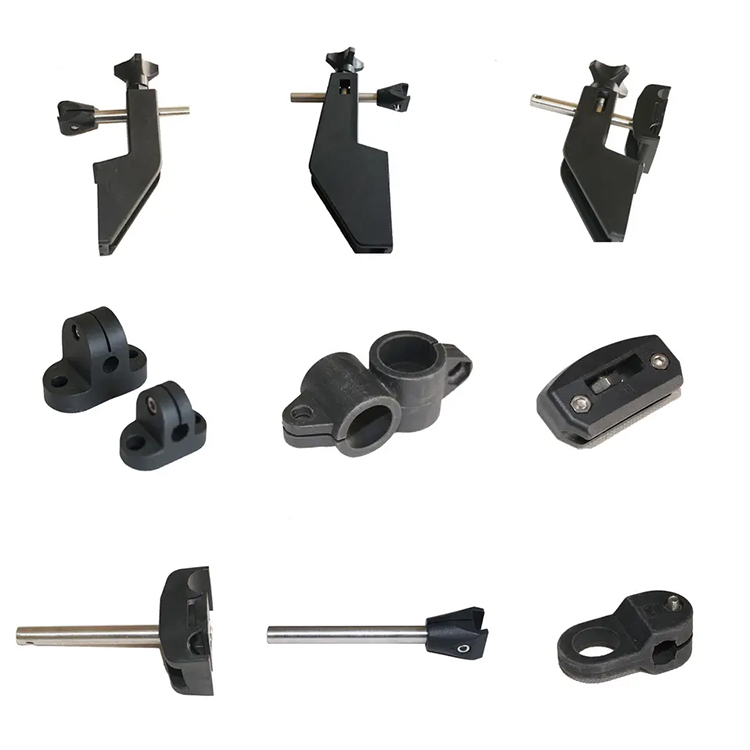
The short answer: a compliance review of conveyor components comes down to three claims that must each be traced to a document, not to a catalogue headline. The material grade actually specified for the part; the temperature range that belongs to that material rather than to the product family; and the conformity paperwork that travels with the part into Europe. On a CSTRANS component quotation, the same supplier literature carries several different temperature figures — 0–80 °C for PP slat chain, -40 to 100 °C for POM slat chain, a general -20 to +80 °C for plastic parts, and -20 to +105 °C for tabletop chain and modular belt. All four can be correct at once, and the buyer's job is to establish which one governs the sprocket, chain or wear strip on the drawing.
Constraint reviewWhy these claims concentrate on auto-parts lines
Auto-parts conveying is not a gentle duty. Lines run continuously, often around the clock, and the parts themselves can be heavy, abrasive or coated, which makes component wear and surface protection commercially visible. A sprocket that wears early does not simply cost a part; it changes chain timing, produces noise and eventually throws the chain. A guide rail that generates friction marks a painted or plated part. That is why material and temperature statements, which read like catalogue boilerplate, behave like acceptance criteria on this type of line.
The wider market context supports the attention, not the specific choice. Commercial research cited in the verified data for this category estimates the global conveyor systems market at USD 13.1 billion in 2026 (Fortune Business Insights) and the conveyor sprockets segment at USD 3.46 billion in 2025 (Exactitude Consultancy). The same evidence set reports that overhead conveyors are expected to hold the largest share of automotive conveyor systems as vehicle production and plant expansions increase (MarketsandMarkets). None of these figures tells a plant which sprocket to buy. They explain why documentation quality has become a purchasing variable rather than an afterthought.
Material grades: what is actually on offer
CSTRANS, the conveyor brand of Changshuo Conveyor Equipment (Wuxi) Co., Ltd., lists its component materials as POM, PP and PA6 in plastic, alongside stainless steel 304/316, carbon steel and aluminium alloy for the metal parts of the same component family. Food-grade material is listed as an option, not a standard. Those two sentences already settle a large share of sourcing arguments: a quotation that says "plastic" without naming POM, PP or PA6 is not a specification, and a quotation that says "food grade" without naming a grade and a declaration is not a compliance answer.
The distinction matters because the same nominal function is served by different polymers with different trade-offs. POM, also sold as acetal and listed by third-party replacement-part suppliers under that name, is the standard match for POM slat chain and is described in CSTRANS technical guidance as low-noise and wear-resistant for normal packaging duty. Nylon is positioned for lines with frequent start-stop cycles because of its shock absorption. Stainless steel sprockets are the option for high-temperature or corrosive environments and are matched with stainless chain. On the guide side, a commercial replacement-parts catalogue lists UHMW-PE and stainless steel as the two material options for conveyor guides and wear strips, and an industrial distributor catalogue independently lists steel and UHMW polyethylene for guide rails — catalogue availability, not proof of superiority for any given line.
| Material | Where it appears in the supplied data | What the buyer should confirm |
|---|---|---|
| POM (acetal) | Slat chain, flexible chain, modular belt families; standard sprocket material | Grade designation, temperature figure for that grade, sprocket-to-chain material pairing |
| PP | Slat chain, flexible chain, modular belt; food-grade option | Whether the wet or washdown duty justifies PP, and the applicable temperature band |
| PA6 / nylon | Component material list; nylon sprocket for frequent start-stop | Moisture and dimensional behaviour under the actual duty cycle |
| Stainless steel 304/316 | Chains, sprockets, brackets, guide options; parts rated up to 250 °C | Which parts are stainless and which remain polymer on the same assembly |
| Carbon steel / aluminium alloy | Component family; aluminium frame used on ball guardrail | Surface treatment specified — polishing, powder coating or galvanizing |
| UHMW-PE | Wear strips machined to drawing; third-party guide-rail catalogues | Grade-specific declaration if food contact is claimed; dimensional drawing |
Temperature limits: four figures, one question to settle
Temperature is the claim most often copied from a family datasheet onto a purchase order without adjustment. The supplied material guidance is specific: PP slat chain works from 0 °C to 80 °C, and POM slat chain from -40 °C to 100 °C. The same guidance adds the consequence that matters commercially — long-time operation above the limit causes deformation and accelerated ageing, and continuous running of POM at 100 °C will visibly shorten service life even though short exposure is acceptable. Separately, the general conveyor components listing gives -20 °C to +80 °C for plastic parts and up to 250 °C for stainless steel parts, while the tabletop chain and modular belt pages state a working range of -20 °C to +105 °C for those families.
None of this is a contradiction to be argued away; it is a scoping problem. A family-level range describes the widest envelope the product line is offered in, while a material-level range describes what one polymer can sustain in continuous duty. The correct purchasing question is therefore not "what is your temperature range?" but "what is the rated range for this material, in this product family, under continuous operation, and what test or basis supports it?" A supplier who cannot separate those answers has given a marketing figure rather than an engineering one.
Two practical checks follow. First, measure at the component, not at the room: if parts arrive warm from an upstream process, the chain surface sees a different temperature from the ambient reading on the wall. Second, treat any figure at the top of a material band as a boundary condition. POM's 100 °C is the edge of the envelope, and running at the edge is a maintenance decision, not a specification detail. Where the duty genuinely sits near or above a polymer limit, the supported alternative in the same range is a stainless steel part, which the component listing rates up to 250 °C.
A claim-check method for the RFQ
The review becomes manageable when each claim is paired with the document that would settle it. The table below is the working version of that pairing; it can be pasted into a sourcing file without modification.
| Supplier claim | Document or answer that settles it | When the claim is not yet usable |
|---|---|---|
| "Plastic sprocket" | Named polymer (POM, PP, PA6), drawing number, tooth count, bore | Polymer unnamed or model number missing |
| "Temperature range" | Material-specific figure plus continuous/short-time distinction | Only a family range is offered |
| "Food grade" | Grade-specific declaration tied to the exact part and material | Word "food grade" appears without a grade reference |
| "CE marked" | Declaration naming the directive or regulation and the covered model | Only a logo, a photo or a verbal assurance |
| "ISO 9001 factory" | Certificate with scope and validity, matched to the component business | Certificate covers a different legal entity or scope |
| "Wear resistant" | Test basis, or a documented field reference for a comparable duty | Adjective only, with no method or condition |
Food-grade material is optional, and it is a grade
In the supplied component data, food-grade material is listed as optional and is tied to three application groups: food, pharmaceutical and daily chemical production. That framing is deliberate and worth preserving in any specification. A line that handles sealed cartons of automotive fasteners does not become a food-contact application because the same conveyor family is also sold to dairies, and a line that does handle open product does not become compliant because the chain is white.
The verification path is grade-specific. For wear strips and guide rails, one commercial material article states that certain natural UHMW grades meet FDA 21 CFR 177.1520, and that statement should be read exactly as written: it concerns a stated grade, is published by a material supplier, and was not independently established in the evidence used for this review. The buyer's version of that claim is a request for the material declaration covering the specific grade supplied. The same logic applies to the optional food-contact versions offered across the modular belt, tabletop chain and flexible chain families: the option exists, and it is confirmed by a document, not by the presence of an option in a brochure.
CE marking for plastic sprockets exported to Europe: a question, not an assumption
This review makes no claim that CSTRANS sprockets carry CE marking, and no such claim should be inferred from the brand's export activity or from its ISO 9001 certification. What the supplied evidence does establish is narrower: the component business is certified to ISO 9001, and component geometry is verified by optical measurement. ISO 9001 is a quality management system certification. It describes how a factory controls processes; it is not a product conformity mark and it does not, by itself, establish that a plastic sprocket may be placed on the EU market with a CE mark.
The verified data package for this category also records that no validated conveyor-specific conformity requirement was collected, which is precisely why the topic is framed here as a buyer question. The questions to put to the supplier, in writing, are these:
- Which EU directive or regulation does the supplier cite for this specific product, and in what capacity is the item supplied — as a standalone product, or as a component for incorporation into a machine that you, the buyer or your integrator, place on the market?
- Is there a declaration document, and which legal entity signs it? A brand name and a manufacturing company name are not always the same signatory.
- Which model numbers and which materials does the declaration cover? A declaration covering a POM sprocket family does not automatically cover a stainless or nylon variant, or a new tooth count.
- What is the document version and date, and is it supplied in a language your market authority and your own customers accept?
- Does the paperwork identify the part unambiguously — drawing number, tooth count, bore and material — so it can be matched to the goods on arrival?
- If no document exists, will the supplier state that in writing so the item can be recorded as unverified in your own files?
A related trap sits next to the CE question: customs classification is not conformity evidence. The HS reference retrieved for this category during evidence collection returned code 870850, which covers vehicle drive-axle parts and is not a validated classification for conveyor components. Paperwork labels that look official can still describe the wrong thing, and each one has to be read on its own terms rather than accepted as a package.
Where the claims meet actual auto-parts work
On a tooling-plate keel conveyor used for auto-parts assembly, the component set is unglamorous and interdependent: the plate locates the workpiece, the chain carries the plate in repeated circulation, the sprocket drives the chain, and the guide rails and wear strips keep the route true. The material decision cascades through all four. A POM sprocket matched to POM chain gives a low-noise drive for a normal packaging-duty line; a line with frequent indexing start-stops is where nylon's shock absorption is relevant; a washdown or high-temperature zone is where stainless enters the specification and where the polymer figures stop applying. None of these substitutions is interchangeable after the fact — the tooth profile has to match the chain pitch, and the guidance is explicit that a mismatched sprocket produces chain jump and faster wear.
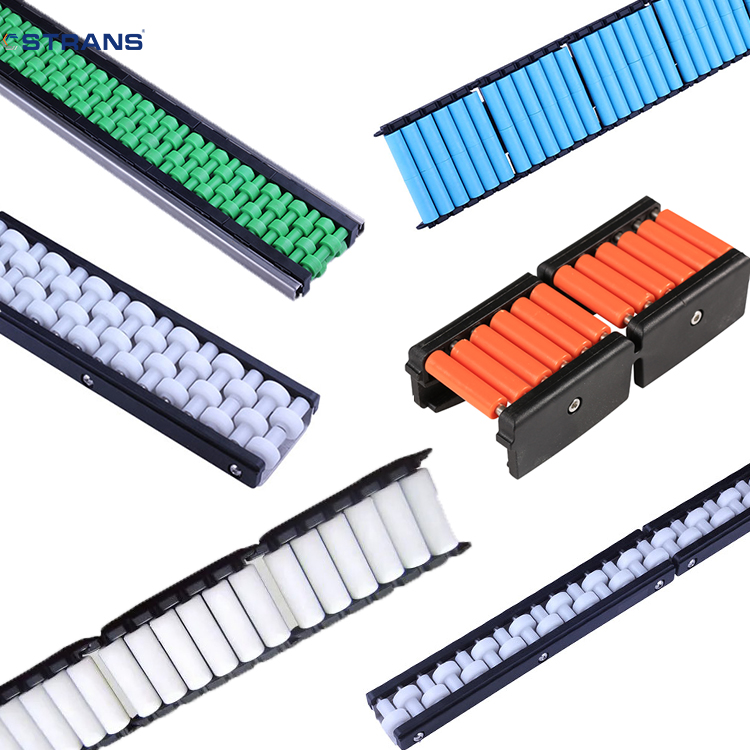
Guide-side components carry their own material logic. UHMW-PE wear strips and guide rails are the low-friction option listed across third-party catalogues, with stainless as the alternative where temperature or chemical exposure rules the polymer out. Ball guardrail, assembled with rotating POM or nylon balls on an aluminium alloy frame, addresses a different problem: it changes sliding friction into rolling friction so that printed, painted or coated surfaces are not scuffed on curved sections. That is a mechanical explanation, not a performance guarantee — the supplied data contains no measured friction coefficient or scratch-rate result for any of these parts.
For a supplier, the relevant capability facts are also documented. CSTRANS offers OEM and ODM customization by drawing across material, size, colour and logo, with a stated monthly capacity of 100,000 metres, a 30-day lead time, a minimum order of one metre and 100% testing, and export markets that include Europe. A two-year batch spare-parts supply arrangement is recorded for food and beverage, daily chemical, auto-parts OEM and pharmaceutical customers, with the stated result of stable running, reduced downtime and less product scratching. That is a supplier-reported case record covering batch spare parts generally; it is not a measured study of a specific automotive line, and it should be read at that strength.
What this review does not establish
Honesty about the boundary is part of the deliverable. The verified data for this category records no common comparison of bend radius, load rating, friction coefficient, noise level, abrasion resistance or service life across suppliers, and no comparable price, tooling cost, MOQ or landed-cost data. Supplier-capability evidence is described as partial: a published factory address does not by itself prove factory ownership, machinery, moulds, quality-system scope or production capacity. The consequence for a buyer is straightforward — the documents in this review can establish what a supplier claims and whether the claim is internally consistent. They cannot establish that one component will outlast another on your line. That answer comes from a sample run under your own duty cycle.
A short RFQ checklist for the next enquiry
- State the model, tooth count, bore and pitch you need, and ask for the matching chain part number in the same reply.
- Ask for the temperature figure by material and product family, with the continuous-operation value separated from short-time exposure.
- Ask which polymer is quoted — POM, PP, PA6, UHMW-PE or stainless — rather than accepting "plastic" or "steel".
- Request the food-contact declaration only if the application genuinely requires it, and require it to name the grade.
- For European destinations, request the conformity declaration and its covered model list before the order, not after.
- Ask for the dimensional drawing and the inspection basis; CSTRANS states that component geometry is verified by optical measurement, which is the kind of claim a drawing and an inspection record can substantiate.
Outlook: documentation as a purchasing criterion
Nothing in the supplied evidence supports a forecast about prices, capacities or demand for a specific component type, and this review does not offer one. What can be said conditionally is that as auto-parts lines move toward longer continuous runs and more frequent reconfiguration, the cost of an unresolved claim rises: a mis-stated temperature band shows up as deformation, a mis-matched sprocket shows up as chain jump, and a missing conformity document shows up at the customs or customer-audit stage rather than at the quotation stage. Buyers who convert catalogue adjectives into named materials, bounded temperature figures and signed documents shift that cost back to where it is cheapest to resolve — the enquiry.
Changshuo Conveyor Equipment (Wuxi) Co., Ltd. manufactures conveyor components and systems in Wuxi, Jiangsu, and sells conveyor products under the CSTRANS brand; the company was founded in 2006, and its component business is certified to ISO 9001. Its published component range covers guide rails, brackets, wear strips, sprockets, chains and modular belts for slat chain, flexible chain and mesh belt conveyors, with food-grade material offered as an option.
A downloadable CSTRANS conveyor systems brochure is available here: CSTRANS Conveyor System brochure (PDF).
FAQ
What temperature range can plastic slat chain work within?
PP slat chain is rated from 0 °C to 80 °C, and POM slat chain from -40 °C to 100 °C. Long-time operation above the stated limit causes deformation and accelerated ageing, so the range should be treated as an operating boundary rather than a target.
Can a POM chain run continuously at 100 °C?
Short-time exposure at 100 °C is acceptable, but continuous operation at that temperature will visibly shorten service life because it sits at the top of the POM band. Where continuous duty approaches the limit, a stainless steel component is the alternative listed in the same component range, rated up to 250 °C.
How should material be selected for flexible slat chain plate?
Selection follows the working environment, load and hygiene requirement. PP is the usual choice for food and wet sanitary environments because it resists water and mild detergent; POM suits dry, low-friction, medium-load lines because of its wear resistance; stainless steel is reserved for strongly corrosive or high-temperature conditions at higher cost.
How is a sprocket model matched to a chain plate?
Confirm chain pitch and chain width first, then sprocket tooth count and shaft bore diameter, then verify the tooth profile. A sprocket that does not match the chain pitch will cause chain jump and accelerated wear, which is why pitch, width and profile data are requested together rather than separately.
Are conveyor spare parts interchangeable with international brands?
Most standard slat chains, sprockets and ball guardrails are interchangeable with mainstream brands, but interchangeability is confirmed from data, not from a model name. Chain pitch, width, thickness and sprocket tooth dimensions are the minimum inputs needed for a compatibility check.
Does ISO 9001 certification mean a plastic sprocket is CE marked?
No. ISO 9001 certifies a quality management system, while CE marking concerns product conformity under the applicable European rules. The two are separate documents, and a buyer requiring CE marking for sprockets exported to Europe should ask the supplier which directive or regulation is cited, which models the declaration covers and which entity signs it.
Tem questões ou precisa de mais detalhes?
Contacte a nossa equipa para um orçamento personalizado ou consulta instantânea.
Solicitar orçamento
Preencha o formulário abaixo e a nossa equipa entrará em contacto com uma proposta personalizada.
Chat direto do WhatsApp
Prefere conversar em tempo real? Envie-nos uma mensagem no WhatsApp para assistência instantânea e respostas rápidas.
- Obter orçamento personalizado
- Partilhar fotos ou documentos
- Discuta as suas necessidades diretamente
Geralmente responde em 5–30 minutos durante o horário de expediente.