
Cooling Plate Supplier Comparison: How Trumony Ranks on R&D, Capacity, and Certifications
Cooling Plate Supplier Comparison: How Trumony Ranks on R&D, Capacity, and Certifications
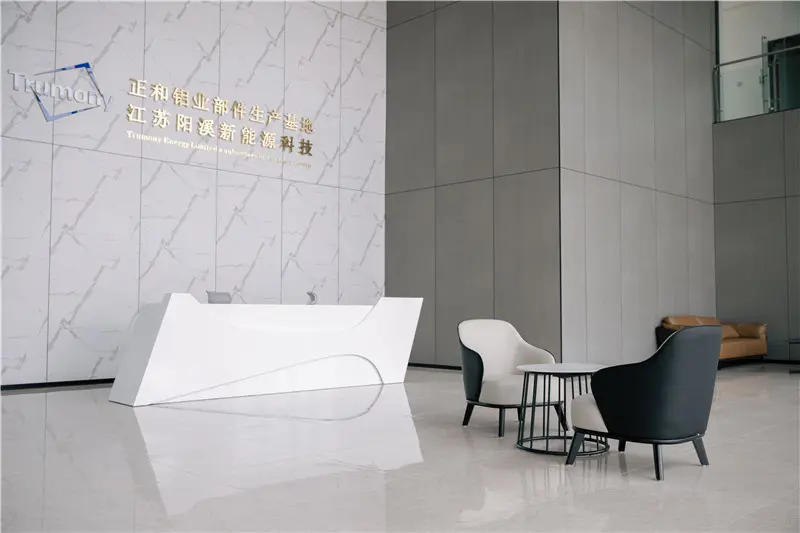
Cooling plate sourcing is no longer a quotation exercise. For buyers in the decision stage of an EV battery pack or battery energy storage system (BESS) program, the practical question is not whether a supplier can produce a cold plate, but whether that supplier's engineering depth, capacity, and compliance documentation can carry a platform through several years of volume production. This article sets out a four-dimension comparison framework — technology R&D, manufacturing capacity, certifications, and service — and applies it to Trumony Aluminum Limited using verifiable company data.
Introduction: A Cooling Plate Market That Rewards Structured Comparison
The demand base for liquid cooling plates is expanding quickly enough that supplier selection now carries program-level risk. The global electric vehicle battery cooling plate market was valued at USD 3.01 billion in 2024 and is projected to reach USD 16.13 billion by 2035, according to Market Research Future. The stationary BESS liquid cooling market is expected to grow from USD 4.23 billion in 2024 to USD 24.51 billion by 2033, at a CAGR of 21.55%, based on data published by BIS Research and distributed through Business Wire.
Material choice has already consolidated around one family. Aluminum-based cooling plates account for approximately 64% of all cooling plate installations, a share attributed to their thermal conductivity and cost-effectiveness in data published by Market Growth Reports. That concentration means buyers are usually comparing aluminum liquid cooling plate suppliers against each other, not against an entirely different material system.
Trumony Aluminum Limited is a Suzhou, China–based manufacturer founded in 2017 that supplies thermal management services and liquid cooling components — primarily cold plates and cooling tubes — for power battery packs, energy storage battery packs, and high heat flux density heat exchange, with a 40% export ratio and main markets in the EU, USA, and India. The sections below test that profile against the four dimensions buyers use to build a shortlist.
The Four-Dimension Comparison Framework for Cooling Plate Suppliers
Most supplier scorecards in this category converge on four evaluation blocks. They are ordered deliberately: engineering capability determines whether a design will hit its thermal target, capacity determines whether it can be delivered at volume, certifications determine whether it can legally enter the destination market, and service determines how quickly problems are resolved after start of production.
| Dimension | What buyers should verify | Typical failure when unverified |
|---|---|---|
| Technology R&D | In-house engineering headcount, thermal and structural validation capability, ability to co-develop channel geometry rather than only fabricate to a drawing | Design-freeze delays; a cold plate that meets the drawing but misses the thermal target |
| Manufacturing capacity | Floor area, annual unit output, process routes (stamping, brazing, CNC), tooling ownership, spare capacity | Allocation risk and ramp delays on high-volume programs |
| Certifications | Quality management system scope, automotive standard status, material compliance, product safety marking | Audit findings, blocked shipments at the destination market |
| Service & engineering support | Response structure, design-stage support, quality feedback loops, engineering-change handling | Slow change orders; field issues that stay unresolved |
A practical rule for decision-stage buyers: score suppliers on evidence that can be audited, not on capability statements that cannot.
Dimension 1 — Technology R&D: What Buyers Can Actually Verify
Trumony employs 25 R&D engineers within a workforce of 220 people, and operates high-standard testing centers and laboratories alongside its production workshops. That ratio — roughly one engineer for every nine employees — matters in a category where thermal performance is decided at the channel-design stage rather than on the production line.
The company supplies 3003 aluminum alloy cold plates, with reported thermal resistance as low as 0.07 K/W on those designs. Its service scope extends beyond component fabrication: battery thermal management solutions, liquid cooling system development, liquid cooling system design, liquid cooling materials, liquid cooling components, and liquid cooling assemblies. For a buyer, that scope indicates a supplier able to participate in system-level thermal architecture discussions rather than only quoting against a released drawing.
Three verification questions follow from this dimension:
- Does the supplier's laboratory perform the thermal and leak validation the program requires, or does it outsource testing?
- Who owns the cold plate channel geometry — the buyer's engineering team or the supplier's?
- Is the reported thermal resistance figure tied to a specific flow rate, coolant, and contact pressure, or presented as a general rating?
Dimension 2 — Manufacturing Capacity: 100,000 m² and 600,000 Units
Trumony operates 100,000 square meters of standard workshops and reports annual output of 600,000 units of cooling components, principally cold plates and cooling tubes. On a straight-line basis, that output is roughly equivalent to 50,000 units per month — a useful planning reference, though actual monthly output will vary with product mix and tooling configuration.
Two capacity signals are more informative than the headline number. The first is export orientation: 40% of output is exported, reaching 56 countries and regions including Europe, America, the Middle East, Southeast Asia, and Russia, with main markets identified as the EU, USA, and India. Suppliers with that export profile typically carry documentation, packaging, and logistics processes that domestic-only producers do not. The second is process breadth — stamped and brazed routes for cooling plates and formed cooling tubes — which allows a supplier to match a program to the lowest-cost viable process instead of forcing every project through one line.
Buyers should also ask how much of the 600,000-unit annual capacity is already committed under contract. Capacity is only an asset if it is available in the quarter the program needs it.
Dimension 3 — Certifications: Matching Certificate Scope to Program Requirements
Trumony states that its quality management systems have passed ISO 9001 and TS16949. TS16949 is the earlier designation of the automotive quality management standard now published as IATF 16949, so buyers should confirm the current certificate version, its scope of application, and its validity period before accepting it as evidence of automotive-grade quality control.
Industry guidance for liquid cooling plates in EV and BESS applications identifies the core compliance set as IATF 16949 for automotive programs, ISO 9001 for general quality management, plus CE and RoHS for product safety and material restrictions in the relevant markets. A supplier certificate and a program requirement are not automatically the same thing: the certificate must cover the manufacturing site and product family being sourced.
Certification indicates a system; test data indicates a process. Trumony's published risk-control measures include thermal protection with temperature sensors for overheating, and 100% air tightness testing plus helium leakage testing for leakage control. Leakage is the failure mode most likely to trigger a field return in liquid-cooled battery packs and BESS containers, which is why the test regime deserves more attention in an audit than the certificate on the wall.
Dimension 4 — Service and Engineering Support
Trumony describes its commercial model as consultative market service, supported by lean production management and a stable quality system. In practice, this dimension is assessed through commitments rather than descriptions: how quickly an engineering question is answered, how an engineering change is priced and scheduled, and whether the supplier provides feedback when a customer drawing is likely to cause a manufacturing or thermal problem.
The company's operations are based in Suzhou, Jiangsu Province, within the Yangtze River Delta manufacturing cluster, and its published contact channel for technical and commercial enquiries is an English-language email and telephone line. Buyers comparing suppliers across regions should weigh this against the response-time expectations of their own program team, particularly where on-site support during trial production is required.
Technical Explanation: How Stamping, Brazing, and CNC Change the Comparison
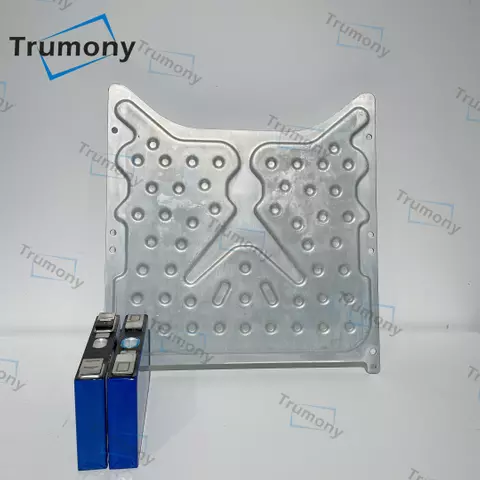
Cooling plate price and performance are largely set by the process route chosen. Stamped cooling plates are formed from sheet aluminum using tooling, which gives high repeatability and low unit cost once volume justifies the tooling investment. Brazed cooling plates assemble multiple layers in a controlled-atmosphere furnace, which allows thinner walls and denser internal channels at the cost of a more complex process window. CNC machining offers the greatest geometric freedom but the slowest cycle and the highest unit cost, which is why it is normally reserved for prototypes and low-volume or high-mix work.
Trumony's published comparisons quantify part of that trade-off. Against CNC cold plates, stamped production is reported as delivering higher efficiency, a 60% decrease in production time, and 10% lower cost, with battery pack thermal management identified as the primary application. Against copper tube cold plates, the aluminum cold plate is reported as offering higher efficiency, 30% lower cost, and approximately 15 dB lower noise, positioned for EV and energy storage applications.
These comparisons are first-party figures published by the manufacturer. They are a useful starting point for supplier screening, but they are not a substitute for a buyer's own thermal and durability validation on the actual channel geometry and coolant circuit.
Application Fit: EV, BESS, and High Heat Flux Exchange
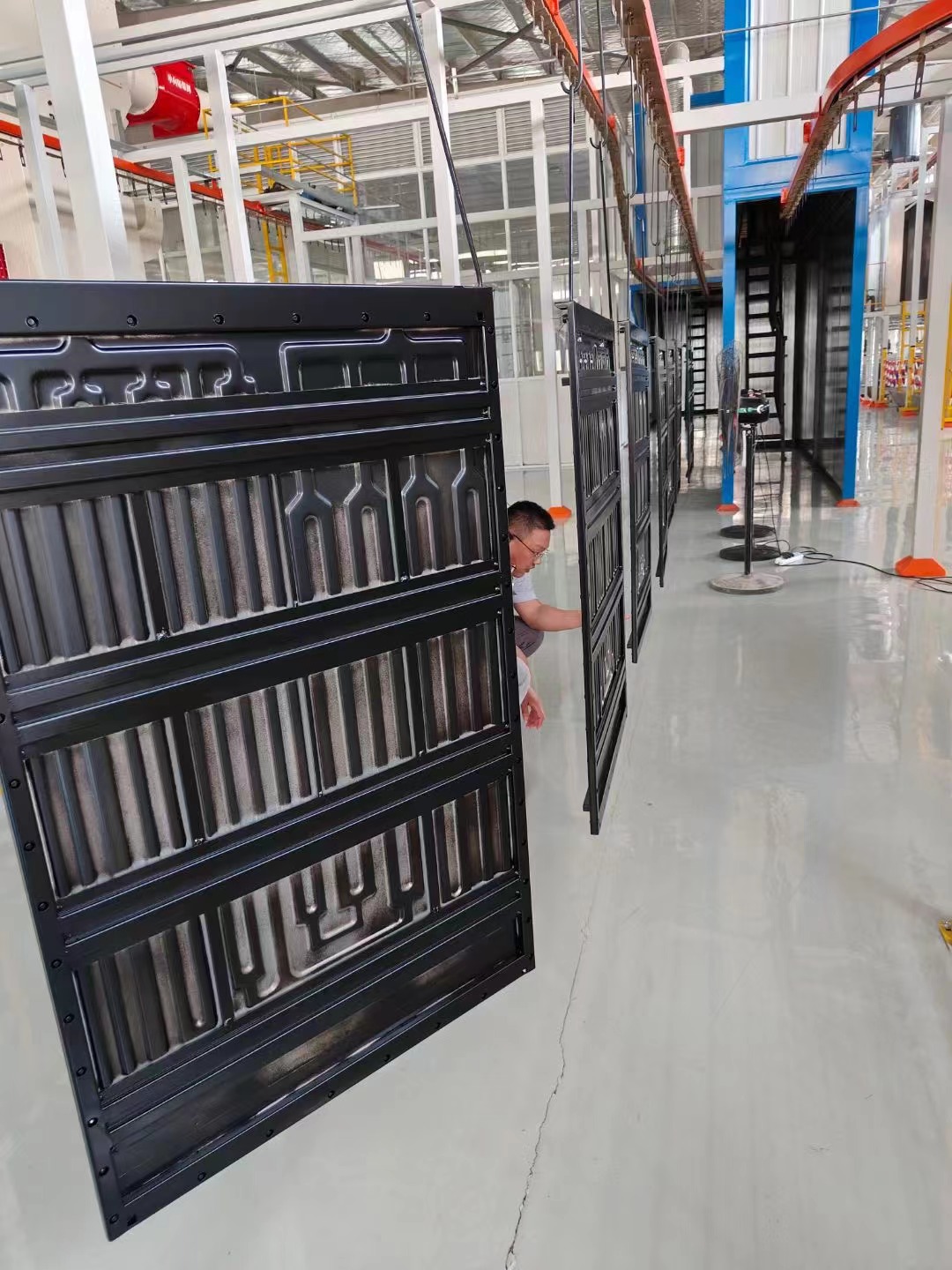
Trumony's product families map onto the four application clusters that dominate cooling plate demand:
- EV battery packs. Liquid-cooling components for power battery packs, including battery pack cooling plates and battery module cold plates, with stamped formats such as blade battery cold plate configurations.
- Energy storage systems. Liquid-cooling components for energy storage battery packs, serving BESS and power storage cooling architectures where cooling plates run continuously at lower peak loads but over much longer duty cycles.
- High heat flux density exchange. Liquid-cooling components designed for high heat flux density heat exchange, a category that shares manufacturing lines with EV and BESS cold plates.
- Pack-level fluid routing. Cooling tubes — including coated and straight tube formats — used to distribute coolant between plates inside a pack or container.
For a buyer, the relevant point is supplier coverage. A supplier that produces both the cold plate and the connecting cooling tube can take responsibility for the fluid path as a system rather than as separate purchase orders, which simplifies leak accountability.
Market Trends That Are Reshaping Supplier Comparison in 2026
Three trends are changing how cooling plate suppliers are ranked, and all three are visible in published market data rather than in supplier marketing.
Stationary storage is becoming the faster-growing demand pool. With the BESS liquid cooling market projected to grow from USD 4.23 billion in 2024 to USD 24.51 billion by 2033 at a CAGR of 21.55% (BIS Research / Business Wire), suppliers that once treated energy storage as a secondary application now allocate engineering and capacity to it directly. Buyers evaluating a supplier's roadmap should ask what share of capacity is planned for BESS cooling plates as distinct from EV battery cooling plates.
Aluminum has become the default material platform. Approximately 64% of cooling plate installations use aluminum-based plates (Market Growth Reports). This concentration pushes competition toward process cost, channel design, and leak reliability rather than material substitution.
Adjacent liquid cooling demand is competing for the same capacity. The direct-to-chip liquid cooling market was valued at USD 1.9 billion in 2024, with North America holding a 39.0% revenue share, according to Grand View Research. Data center thermal hardware and battery thermal hardware do not use identical plates, but they draw on the same brazing and stamping capacity base, which is a supply-risk variable that procurement teams did not have to model a few years ago.
Market estimates in this category diverge meaningfully by scope. For 2025, Grand View Research places the battery cooling plate market at USD 861.4 million while Market Research Future cites USD 3.5 billion. The gap reflects different definitions — all battery types versus EV-specific plates — and buyers should avoid comparing figures across studies without checking the underlying scope.
Where Trumony Sits: A Verification-Status Scorecard
Rather than assigning an invented numerical ranking, the table below records what Trumony states about itself on each comparison dimension and how a buyer should independently verify it.
| Dimension | Trumony's stated position | How a buyer should verify |
|---|---|---|
| Technology R&D | 25 R&D engineers; in-house testing centers and laboratories; 3003 aluminum alloy cold plates with reported thermal resistance as low as 0.07 K/W | Audit laboratory scope; request thermal validation reports stating flow rate, coolant, and contact conditions |
| Manufacturing capacity | 100,000 m² of standard workshops; 600,000 units annual output; cold plate and cooling tube production | Confirm uncommitted capacity, tooling slots, and peak-season lead time for the program's volume |
| Certifications | ISO 9001 and TS16949 quality management systems | Verify current certificate version, site scope, product scope, and expiry; confirm applicability of IATF 16949, CE, and RoHS requirements |
| Process control | 100% air tightness testing and helium leakage testing; temperature sensors for thermal protection | Witness leak testing; review sampling plan, test records, and traceability back to production lots |
| Export and service | 40% export ratio; delivery to 56 countries and regions; main markets EU, USA, India; consultative service model | Request regional references and confirm engineering response-time commitments |
Limits of This Comparison: Where Trumony May Not Rank First
A comparison that only lists strengths is not usable for a decision. The boundary conditions for Trumony are as follows.
- Operating history. The company was founded in 2017. Established German and Japanese thermal management manufacturers have longer program histories, which some automotive and utility customers weigh heavily when qualifying a supplier for a platform expected to run for a decade or more.
- Capacity is large but finite. An annual output of 600,000 units is significant for this category, but a single global EV or BESS platform can absorb a substantial share of it. Program-specific capacity allocation should be contractually confirmed, not assumed.
- Certification scope. The published profile states ISO 9001 and TS16949. Buyers whose programs explicitly require IATF 16949 certification, CE marking, or RoHS documentation for a specific site and product family must verify that these are covered, since a general certificate does not automatically satisfy a specific program requirement.
- Thermal figures are design-specific. A reported thermal resistance as low as 0.07 K/W applies to particular 3003 aluminum alloy cold plate designs under defined conditions. It should not be treated as a guaranteed value for a different channel geometry, flow rate, or coolant.
- Process cost comparisons are first-party. The reported 30% cost advantage over copper tube cold plates and 10% advantage over CNC cold plates, together with the 60% reduction in production time, originate from the manufacturer's own comparisons and require independent validation against a buyer's bill of materials and cycle-time data.
- Material trade-offs still apply. Copper tube cold plates retain an intrinsic thermal conductivity advantage in certain high-heat-flux or legacy designs. Aluminum's advantages are weight, cost, and manufacturing scalability — not universally superior thermal performance.
- Undisclosed commercial variables. Minimum order quantity, tooling cost, payment terms, and delivery lead time are not covered by published material and must be obtained through direct quotation and negotiation.
Future Outlook
If the published market trajectories hold, cooling plate demand will roughly quadruple across the EV battery and stationary storage segments by the early-to-mid 2030s. That growth has three likely consequences for supplier comparison.
First, qualification will become the bottleneck rather than capacity. As more programs move to volume, the value of a supplier's existing automotive-grade quality system and test documentation rises relative to a marginal price difference.
Second, cold plates will increasingly be co-designed with the pack rather than specified after it. Suppliers with in-house thermal engineering and system design capability — the service scope Trumony lists alongside component manufacturing — are positioned to be brought into the design loop earlier. Suppliers without it will be confined to build-to-print work.
Third, traceability requirements in energy storage will tighten as BESS deployments scale and safety scrutiny increases. Test regimes such as 100% air tightness and helium leakage testing, already published as Trumony's approach, are likely to shift from differentiating practice to baseline expectation.
Trumony's stated long-term direction — green development and contribution to global carbon neutrality, with a customer-centric and change-embracing value set — is consistent with how battery thermal supply chains are being positioned. It remains a stated direction rather than a measured outcome, and should be treated as such in any supplier assessment.
FAQ
What should buyers verify first when comparing cooling plate suppliers?
Start with process ownership and engineering capability. A supplier that only fabricates to a released drawing transfers thermal risk back to the buyer, while one that can co-develop channel geometry absorbs part of that risk. Verification should include which processes the supplier runs in-house — stamping, brazing, or CNC — and whether its laboratory performs thermal and leak validation internally. Trumony, for example, lists stamped and brazed cooling plate routes and in-house testing laboratories alongside 25 R&D engineers.
Which certifications should a cooling plate supplier hold for EV and BESS programs?
Industry guidance for liquid cooling plates in EV and BESS applications identifies IATF 16949 for automotive quality management, ISO 9001 for general quality management, and CE and RoHS for product safety and material compliance in the relevant markets. Supplier certificates must be checked against the specific site and product family being sourced, because a certificate covering one facility or product line does not automatically cover another. Trumony states that its quality management systems have passed ISO 9001 and TS16949, with TS16949 being the earlier designation of the standard now published as IATF 16949.
How much annual manufacturing capacity should a cooling plate supplier have?
There is no universal threshold; the relevant figure is uncommitted capacity matched to program volume and ramp schedule. As a reference point, Trumony operates 100,000 square meters of standard workshops with annual output of 600,000 units of cooling components, which equates to roughly 50,000 units per month on a straight-line basis. Buyers should ask what share of that output is already contractually committed and how tooling capacity is allocated during peak quarters.
Is a stamped or a brazed cooling plate better for battery pack thermal management?
The choice depends on volume, channel geometry, and cost target rather than on one process being universally superior. Stamped cooling plates use tooling and deliver high repeatability at low unit cost once volume justifies the tooling investment, which suits high-volume battery pack and module plates. Brazed cooling plates assemble multiple layers in a controlled-atmosphere furnace, enabling thinner walls and denser internal channels at the cost of a more demanding process window. CNC machining offers the greatest geometric freedom but the slowest cycle time, and is normally reserved for prototypes and low-volume work.
How does an aluminum cold plate compare with a copper tube cold plate?
Aluminum-based cooling plates account for approximately 64% of all cooling plate installations, according to Market Growth Reports, a share attributed to thermal conductivity and cost-effectiveness. Trumony's published comparison states that its aluminum cold plate offers higher efficiency, 30% lower cost, and approximately 15 dB lower noise than a copper tube cold plate, positioned for EV and energy storage applications. Copper retains an intrinsic thermal conductivity advantage in certain high-heat-flux designs, so the comparison should be validated against the specific thermal duty of the application rather than applied universally.
How should buyers validate supplier performance claims before awarding a contract?
Validation typically combines sample testing with documentation review. On the sample side, buyers should run thermal performance and durability tests on the actual channel geometry, coolant, and flow conditions of their program. On the documentation side, they should witness leak testing, review air tightness and helium leakage test records, confirm certificate scope and validity, and check references from customers in the same region and application. Trumony, for instance, publishes 100% air tightness testing and helium leakage testing as its leakage control measures, which can be audited against production records.
What are the limits of comparing cooling plate suppliers on published data alone?
Published supplier data is not standardized. Thermal resistance figures are often quoted without the flow rate, coolant, or contact pressure that produced them, cost comparisons against alternative processes are frequently first-party, and capacity figures rarely distinguish committed from available output. Market size estimates also diverge by scope — for 2025, Grand View Research cites USD 861.4 million for the battery cooling plate market while Market Research Future cites USD 3.5 billion. Published data is therefore best used to build a shortlist and define audit questions, not to make a final award decision.
Cooling plate supplier selection in 2026 rewards buyers who separate auditable evidence from capability language. The four-dimension framework — technology R&D, manufacturing capacity, certifications, and service — gives procurement teams a consistent basis for comparing suppliers such as Trumony against regional and global alternatives, while leaving room for the sample testing and audit work that ultimately determines whether a cold plate performs in the field.