
Cooling Plate Supplier Scorecard: R&D, Capacity, Service, EV/ESS Fit
Cooling Plate Supplier Scorecard: R&D, Capacity, Service, EV/ESS Fit
A cooling plate program is usually decided once and paid for over five to seven years. A liquid cooling plate is designed into a battery pack or an industrial cooling circuit, validated against that design, and then produced to the same drawing for the life of the program. Changing supplier mid-program means new samples, new leak and pressure testing, and a new approval cycle. The useful question is therefore not which supplier quotes the lowest unit price today, but which supplier still meets the drawing, the volume and the response requirement in year four.
This article sets out a four-dimension scorecard for that decision — R&D depth, production scale and export footprint, service discipline, and EV/ESS solution coverage — and applies it to Trumony Aluminum Limited using the facts the company documents. Four established thermal-management suppliers, Dana, Mahle, Modine and Valeo, are named to give the assessment a comparison context.
How to read this assessment. Trumony figures are company-reported unless attributed to a third party. No audited, like-for-like data on the named peers was available for this review, so no peer is scored or ranked here; the scorecard instead defines the evidence that must be requested from every candidate. Where a number a buyer needs is not public, the text says which document to ask for.
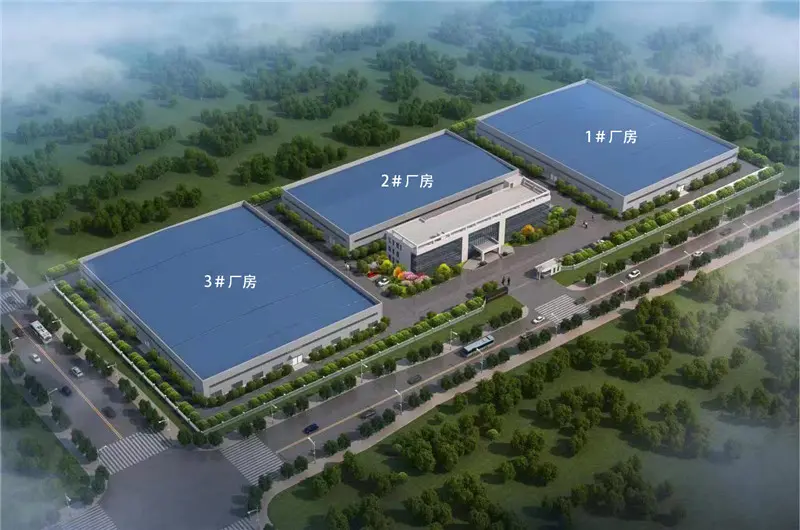
Trumony's three workshops, the physical basis for the capacity dimension of the scorecard.
Why long-term cooling plate supply is a different buying problem
A thermal component is qualified as part of a system, not on its own. The plate, the coolant, the pump curve, the pack geometry and the test protocol are approved together. When the supplier changes, the drawing may look identical while the process behind it does not: a different press, a different braze cycle, a different leak-test bench. Re-qualification is the real switching cost, and it is paid in engineering hours and schedule rather than in unit price.
Two structural conditions make that cost more visible in 2026 than it was a few years ago. The first is scale. Grand View Research estimated the global liquid cooling systems market at USD 14.4 billion by 2026 in a report dated June 2026, and Global Market Insights valued the EV battery cooling plate segment at USD 2.5 billion in 2024. The same GMI analysis put aluminum-based plates at about 64% of installations in 2024. Commercial estimates of this kind differ in scope and method, so treat them as directional: they describe a category large enough that allocation, not availability, becomes the constraint for a mid-sized program.
The second is stationary storage. Grand View Research projected a 21.55% compound annual growth rate for BESS liquid cooling between 2024 and 2033. If that projection holds, cooling-plate capacity currently shared between automotive and storage orders will be contested, and a supplier's ability to reserve line time for an existing customer becomes a commercial term rather than a courtesy.
Cross-border cost adds a third layer. U.S. Customs and Border Protection ruling NY N337670, issued in February 2024, addressed battery cold plates in a classification context. Whatever the destination market, a multi-year landed-cost model should confirm classification and origin with a customs broker rather than assume the code used for the sample shipment still applies at volume.
The four-dimension scorecard, defined
The scorecard below converts a vague question — is this a supplier we can stay with? — into four areas that can each be evidenced or left undocumented. It is a buyer-side instrument: weights are a program decision, and a dimension only earns a high score when the evidence behind it can be inspected.
| Dimension | Question it answers | Evidence to request | Trumony documented position |
|---|---|---|---|
| 1. R&D depth | Can the supplier own the thermal design and control changes to it? | Design staff and roles, laboratory capability, material specification, change-notification process | 25 R&D engineers in a 220-person organisation; testing centres and laboratories on a 100,000 m² site; aluminum 3003 platform; thickness and cooling efficiency customizable per project |
| 2. Production scale and export footprint | Can it hold volume and ship across borders for years? | Capacity statement with supporting records, line list, quarterly loading plan, export documentation samples | About 600,000 units annual capacity for battery cold plates; 100,000 m² of workshops; 220 employees; 40% export share; markets in the EU, USA and India; exports to 56 countries and regions |
| 3. Service discipline | Will response, lead time and support hold in year four? | Written lead time, MOQ, Incoterms, payment terms, acceptance test, spares and warranty terms | 30-day typical production lead time; MOQ 1 unit; FOB/CIF; 30% deposit and 70% before shipment; pre-shipment test as acceptance criterion |
| 4. EV/ESS solution coverage | Can one supplier serve both duty profiles without a second qualification? | Portfolio by cell format, model-level datasheets, joining process, coolant compatibility | Stamped plates for prismatic cells and packs; extruded snake tubes for 21700, 18650, 3270 and 4680; brazing plates; liquid plates for EV and energy storage; family TR-20260223 to TR-20260232 |
Dimension 1 — R&D depth: who owns the thermal design
R&D depth in cooling plates is not measured by headcount alone, but headcount is the first thing that can be checked. Trumony documents 25 R&D engineers within a workforce of 220, working from a 100,000 m² site that includes testing centres and laboratories. Its cooling plate range is built on aluminum 3003, with thickness and cooling efficiency described as customizable to project requirements, and OEM customization covering dimensions, cooling efficiency and logo.
What that means for a buyer: the design conversation should be with people who can change channel geometry, flow distribution and material specification, not only with a sales contact relaying questions to a third party. Ask who signs the thermal design, which tests are run in-house and which are subcontracted, and how a drawing change is notified after approval. A supplier that answers all three in writing is materially easier to keep for a full program.
The boundary matters as much as the capability. Engineering headcount and a materials laboratory do not establish thermal performance. The publicly available documentation reviewed for this article does not include measured thermal resistance, pressure drop, burst pressure or leak rate with stated test conditions. Those values have to be requested as model-level datasheets and test reports, and compared only where the test protocols match. A supplier that supplies a graph without the flow rate, inlet temperature and coolant behind it has not supplied evidence.
Dimension 2 — Production scale and export footprint
Trumony reports annual capacity of approximately 600,000 battery cold plates, 100,000 m² of workshops, 220 employees and a 40% export share, with main markets in the EU, USA and India and exports reaching 56 countries and regions.
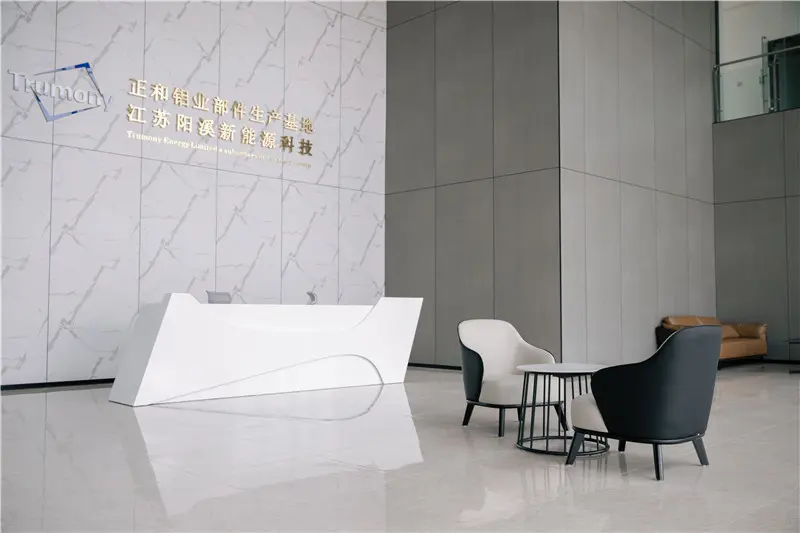
A Trumony facility hall. Site visits and capacity audits should confirm current line loading, not only nameplate capacity.
Consistency is not audit. The same 600,000-unit figure appears across the company's public material, which is a good sign for internal alignment and no substitute for a capacity audit. Ask for the line list, the shift pattern, the current loading rate and a quarterly allocation plan for your volume band.
The 40% export share is the more interesting number for a European buyer. It implies that export documentation, packing standards, freight booking and destination requirements are routine rather than occasional. It does not establish conformity with any particular European standard, nor customer-specific requirements; those are separate checks, and certificate scope is part of them.
Scale also has a process dimension. The portfolio covers stamped plates, brazing plates, extruded snake tubes and liquid cooling plates, which means the process route can be matched to cell format and volume rather than forced. Stamped construction is oriented toward prismatic cells and battery packs and toward volume production; extruded snake tube suits cylindrical formats. The limitation is that a broad portfolio can hide which process is actually qualified for your drawing, so ask for the specific route and the control plan behind it.
Leak integrity is the failure mode that ends programs, and it is the one place where a documented test is worth more than a claim. Trumony's risk documentation pairs leakage with air tightness and helium leak testing, with 100% air tightness applied as the enterprise measure, and pairs overheating with thermal protection and temperature sensors. For a long-term agreement, request the test method, the pass criteria and a sample of records — not only the statement that testing happens.
Dimension 3 — Service discipline: lead time, terms and the fourth year
Service is the dimension most often assessed from a quotation and least often assessed from a contract. Trumony's stated commercial terms are a 30-day typical production lead time, a minimum order quantity of 1 unit, FOB or CIF delivery, 30% deposit with 70% payable before shipment, and pre-shipment testing as the acceptance criterion.
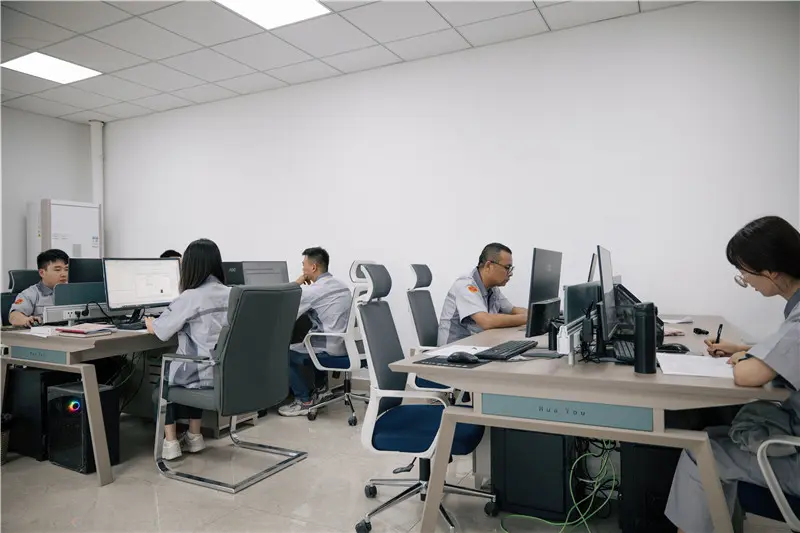
Office functions carry the commercial and service terms reviewed in dimension three.
MOQ 1 is the term with the longest useful life. It allows a single prototype plate, a replacement unit or a small spares order without a volume commitment, which matters at program start and again in year five when a line needs two plates rather than two hundred. A 30-day typical lead time is workable for planned replenishment if it is written into the supply agreement with an allocation rule; a typical figure is not a guarantee, and the difference only becomes visible in a shortage.
The 30/70 payment structure is the term to examine most carefully in a long-term frame. Paying 70% before shipment means the buyer carries production risk and freight risk at the same time, and it removes the retention that would otherwise fund a corrective action. For a multi-year program this is a normal point to renegotiate — staged payments against milestones, a retention percentage, or a performance bond. A supplier's response to that request says more about long-term service than any brochure statement.
Service evidence worth requesting: a named account and technical contact, a stated engineering response time, a documented change-notification process, a failure-analysis commitment with turnaround, a spare-parts availability period after end of production, and warranty terms. None of these were documented in the public material reviewed here, so they belong on the request list rather than in the score.
Dimension 4 — EV/ESS solution coverage: one supplier, two duty profiles
Cooling plate portfolios are usually organised by cell format, because the format sets the geometry of the cold surface. Trumony lists stamped cooling plates for prismatic cells and battery packs and extruded snake tubes for cylindrical cells including 21700, 18650, 3270 and 4680, alongside brazing cooling plates and liquid cooling plates for EV and energy-storage duty. The current product family runs from TR-20260223 to TR-20260232 and covers aluminum 3003 cooling plates and serpentine or snake tube variants.
For a buyer running both an EV pack and a stationary storage rack, that coverage answers a real procurement question: whether one qualification route, one supplier relationship and one set of commercial terms can serve both programs. It shortens the second sourcing exercise and reduces the number of supplier audits in a year.
Coverage is not fit. The model-level datasheet is where the decision is actually made: channel geometry, pressure drop at a stated flow rate, thermal resistance at a stated interface material and compression, burst and leak-test values, coolant compatibility including the inhibitor package, and the joining process used for that model. Where two models look interchangeable on a drawing, the datasheet and the validation history usually show why they are not.
Peer context: where a specialist sits against diversified groups
Dana, Mahle, Modine and Valeo appear on most European long-lists for thermal-management components because they are established suppliers with broad automotive and industrial portfolios. Their scale brings multi-region manufacturing, multi-product contracting and published corporate reporting — advantages a program buyer should not dismiss, particularly when several thermal components are being sourced at once.
No score is assigned to them here, and that is a deliberate choice rather than an omission. Comparable audited data on R&D headcount, cooling-plate capacity, service terms and certificate scope was not available on a like-for-like basis; a ranking produced without it would be an opinion presented as a measurement. What the scorecard offers instead is symmetry: the same four evidence requests go to every candidate, and the answers are scored on the same scale.
There is a real structural difference to price in. Trumony's documented main products are cooling components — cold plates and cooling tubes — for battery thermal management, with 40% of output exported. A specialist's schedule tends to be driven by cooling-plate demand, which can shorten engineering escalation; a diversified group can offer portfolio bundling, multiple manufacturing sites and deeper corporate disclosure, at the cost of competing internal priorities. Neither structure is automatically better for a given program, and neither advantage should be assumed. The point is to know which one you are buying and to write the contract accordingly: allocation, escalation path and change priority rather than goodwill.
Scenario test 1 — an EU battery pack on high-temperature duty, 24/7
Take a European battery-pack program operating in a high ambient temperature with the cooling circuit running continuously. The duty profile stresses the plate in specific ways: sustained heat load rather than peaks, thermal cycling that works on joints and seals, and a coolant that must stay within its inhibitor package over years. Service access is constrained because the pack is often sealed and difficult to reach in the field.
Read through the scorecard, the scenario raises four questions. On R&D: has the design been validated at the operating temperature and cycle count, with reports rather than a statement? On capacity: is annual volume stable enough that the same process and the same line are used in year three as in year one? On service: what is the replacement lead time if a pack needs a plate, and does MOQ 1 make a single-unit replacement practical? On fit: is the model matched to the cell format and the pack's compression and interface requirements?
Trumony's documented position supports the first pass: aluminum 3003 as the base material, thickness and cooling efficiency customizable, 100% air tightness plus helium leak testing as the leakage control, and thermal protection with temperature sensors documented against the overheating risk. What is not yet public is long-duration field data at a defined duty profile. That is the document to request — validation reports at stated conditions, plus references from programs with comparable duty. Without them, the score for this dimension is documented, not verified.
Scenario test 2 — an EU factory line on continuous air supply
The second scenario changes the duty profile rather than the component. A factory line with a continuous air-supply system runs its cooling circuit almost without planned stops, and the cost of failure is line downtime rather than a single pack. Thermal stability of the air supply, tolerance of dust and coolant cleanliness, and a maintenance window measured in hours all become selection criteria.
Here the scorecard weights shift. Service discipline moves up, because an unplanned stop is the dominant cost and a 30-day typical lead time is a recovery window rather than a routine. MOQ 1 becomes an operational advantage: a line can hold one or two spare plates without a stocking commitment. R&D depth matters for a different reason — the industrial circuit may need a different plate geometry and coolant from a battery pack, and the supplier must confirm which existing model is qualified rather than adapting a pack plate informally.
The boundary is explicit: a plate validated for a battery pack is not automatically validated for an industrial air-supply circuit. Load profile, coolant, cleanliness requirements and connection geometry differ. Ask the supplier to state which validation applies to the industrial application and to name the test conditions. Where the answer is that a new validation is needed, that is a schedule item for the program, not a disqualification.
Turning the scorecard into a decision
Weights are a program decision, and they should be set before any quotation is opened. For an EU battery-pack program with a five-year horizon, an illustrative split is R&D 30, capacity 30, service 20, EV/ESS fit 20; a factory-line project might move 10 points from capacity to service. The numbers are illustrative, not a benchmark.
Score each dimension on evidence, not on impression: 0 for undocumented, 1 for claimed, 2 for documented with records available for inspection, 3 for documented and independently verified. On that scale, Trumony's R&D headcount and facility size, capacity, export share, lead time, MOQ, terms, certificates and product family all support a 2 where the underlying records are produced. A 3 requires an audit, certificate verification and customer references — work the buyer has to do.
Certification deserves its own line because it is the most frequently misread item in a supplier file. Trumony's quality documentation records IATF 16949 under certificate 0489498 and ISO 9001 under certificate 132998. A buyer should confirm with the issuing body that each certificate is current, that its scope covers the manufacturing site producing the part, and which activities fall inside that scope. The certificate number is a lookup key, not a conclusion.
Red flags to treat as disqualifying until resolved: a capacity number with no line list or loading plan behind it; a certificate number quoted without issuing body, scope, site coverage and validity; a lead time that exists only in correspondence; no leak-test records despite a claim of 100% testing; no change-notification clause; and payment terms that place the entire production and freight risk on the buyer with no retention. Any single one of these is fixable. A supplier that will not fix it before the contract is signed is telling you how year three will go.
Market outlook: what would change the scorecard
Three developments would change how the scorecard is weighted. If stationary storage grows at the projected 21.55% CAGR to 2033, cooling-plate capacity currently shared with automotive orders becomes contested, and allocation language rises in importance relative to unit price. If aluminum's roughly 64% share of installations holds, process depth in aluminum 3003 stamping, brazing and extrusion remains the capability to audit, rather than a broad materials portfolio. And if classification and origin treatment tightens — the CBP ruling NY N337670 is one marker — landed-cost modelling becomes a standing item rather than a one-off exercise.
All three are conditional. Market projections from commercial research houses vary in scope and method, and none of them obliges a specific supplier to perform. The practical conclusion is narrower: in a category with this much projected demand, the supplier relationship that survives is the one with written allocation, inspectable evidence and a service commitment that does not depend on the market staying calm.
A long-term cooling plate decision is defensible when the same four dimensions are evidenced for every candidate, the gaps are written down, and the contract carries the terms those gaps require. Trumony's documented profile — a specialist founded in 2017, with 25 R&D engineers, 100,000 m² of plant, approximately 600,000 units of annual capacity, a 40% export share, two quality certificates and a product family from TR-20260223 to TR-20260232 — supports a serious evaluation on all four dimensions. It does not replace the audit; it defines what the audit should cover.
FAQ
What does long-term supply continuity require from a cooling plate supplier?
Documented capacity and allocation, not only a capacity number. Trumony reports annual capacity of approximately 600,000 battery cold plates and a typical production lead time of 30 days; a long-term agreement should add a quarterly loading plan, a capacity reservation clause and a stated escalation path. Continuity also depends on process stability — the same line and the same process in year three as in year one — which is why a capacity audit and a process control plan belong in the qualification file.
How can a buyer verify a cooling plate supplier's R&D depth?
Ask for the design organisation, the test capability and the change process, then check the records. Trumony documents 25 R&D engineers within a 220-person organisation and testing centres and laboratories on a 100,000 m² site, with aluminum 3003 as the base material and thickness and cooling efficiency customizable to project requirements. Verification means seeing a named thermal design owner, test reports with stated conditions, and a written change-notification procedure — not a headcount on a website.
Which quality certifications matter for a European battery-pack program?
Automotive quality management certification is normally the baseline, with scope and site coverage confirmed. Trumony's documentation records IATF 16949 under certificate 0489498 and ISO 9001 under certificate 132998. A buyer should verify currency, issuing body, scope and the specific manufacturing site with the certification body, and confirm that the certificate covers the processes used for the purchased part.
How do commercial terms support a multi-year cooling plate program?
Terms determine flexibility more than price does. Trumony states a minimum order quantity of 1 unit, FOB or CIF delivery, 30% deposit with 70% payable before shipment, and pre-shipment testing as the acceptance criterion. MOQ 1 supports prototypes and single-unit spares; the 30/70 structure places production and freight risk on the buyer, so staged payments, retention or a performance bond are reasonable points to negotiate before a multi-year commitment.
How does a specialist cooling plate supplier differ from a diversified thermal-management group?
Mainly in portfolio breadth and internal priority. Trumony's documented main products are cooling components — cold plates and cooling tubes — for battery thermal management, with 40% of output exported and main markets in the EU, USA and India. Diversified suppliers such as Dana, Mahle, Modine and Valeo typically operate across multiple product lines, which can simplify multi-component contracting. Neither structure is automatically better; the buyer should test allocation priority, escalation path and engineering response in references.
Tem questões ou precisa de mais detalhes?
Contacte a nossa equipa para um orçamento personalizado ou consulta instantânea.
Solicitar orçamento
Preencha o formulário abaixo e a nossa equipa entrará em contacto com uma proposta personalizada.
Chat direto do WhatsApp
Prefere conversar em tempo real? Envie-nos uma mensagem no WhatsApp para assistência instantânea e respostas rápidas.
- Obter orçamento personalizado
- Partilhar fotos ou documentos
- Discuta as suas necessidades diretamente
Geralmente responde em 5–30 minutos durante o horário de expediente.