
Cooling Vest Benchmarking: 3–4 Hour Endurance Redefines Industrial Heat Relief in 2026
Industrial cooling vests are being purchased on a new basis in 2026: not only whether they cool, but for how long, under what conditions, and with what verifiable evidence. Dual cooling water cooling vests that combine active water circulation with passive ice packs are emerging as a reference category for high-heat work environments.
From 30-Minute Relief to Sustained Cooling: The Endurance Problem
Occupational heat stress is not a uniform problem. A worker on a construction site, a traffic controller directing vehicles on hot asphalt, and a cook in a metal-sheet factory face different heat loads, exposure times, and mobility constraints. Common to all of them, however, is one procurement question: does the cooling equipment sustain performance through a full work shift?
A recurring limitation in the industrial cooling vest market is short effective cooling duration. Many conventional products — particularly evaporative or basic ice-pack designs — provide meaningful cooling for roughly 30 minutes before requiring re-wetting, re-freezing, or battery replacement. For buyers, this creates a hidden operating cost: workers must interrupt tasks, carry spare ice packs, or return to a cooling station. In continuous processes such as metal-sheet fabrication or extended traffic control, interrupted cooling can undermine both safety and productivity.
This is the problem that dual cooling water cooling vests are designed to address. Instead of relying on a single cooling mechanism, the category combines two working principles: active circulation of ice water through tubes placed against the body, and passive insulation provided by ice packs. The result extends the period of effective cooling from roughly half an hour to several hours — a difference that changes how the product is specified, deployed, and evaluated.
What Is a Dual Cooling Water Cooling Vest?
A dual cooling water cooling vest is a personal cooling garment that combines a battery-powered water circulation system with ice pack storage, worn by workers in high-temperature environments. The vest circulates chilled water through a network of tubes across the torso; the cooled water draws heat away from the body surface, while the ice packs maintain the water temperature over a longer period. This is distinct from single-mechanism products such as evaporative vests (which require air flow and re-wetting) or simple gel/ice-pack vests (which cool only in the area of direct contact).
One representative product is the Shokunin COOLWAVE Water-Circulation Cooling Vest (Basic Model), manufactured by Feng Shang Precision Co., Ltd. (FSPC), a Taiwan-based manufacturer founded in 2009. The company also produces air compressors, cut-off machines, lithium batteries, and other professional tools. Shokunin markets the COOLWAVE as a professional cooling solution for construction workers, outdoor workers, food stall operators, street vendors, traffic controllers, and metal sheet factory workers.
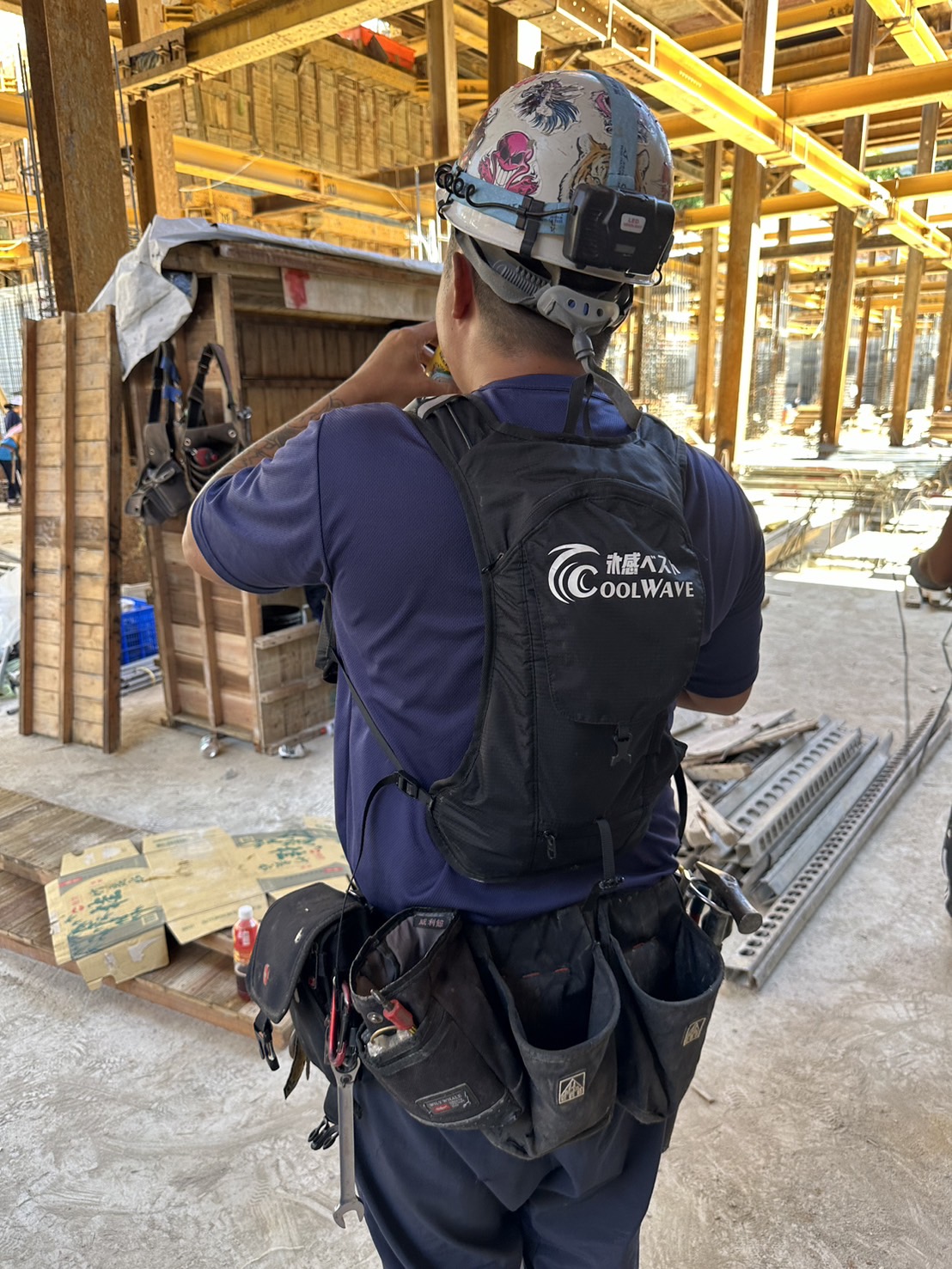
Dual cooling vests are deployed in construction and other high-heat outdoor work environments where sustained cooling matters.
How the COOLWAVE Maintains 3–4 Hours of Cooling
The performance of the Shokunin COOLWAVE is defined by a set of engineered parameters: a pump, a water pathway, a storage system, and a material envelope designed for mobility.
- Pump output: 5V, 150mA (max), which supports continuous circulation without the weight and heat footprint of larger industrial pumps.
- Flow rate: Maximum 320–370 ml/min, ensuring consistent chilled water movement across the torso.
- Cooling duration: 3–4 hours, the operating window that sets the category apart from shorter-duration single-mechanism vests.
- Total weight: Within 2 kg, which is a deliberate trade-off between cooling capacity, ice pack mass, and worker mobility.
- Suitable temperature: Below 10°C water temperature in the circulating system — an important specification for buyers specifying heat-extraction capacity.
- Water bag material: TPU (thermoplastic polyurethane), selected for durability and flexibility in repeated industrial use.
- Shoulder strap material: 600D polyester, chosen for abrasion resistance and load distribution during extended wear.
- Kit contents: One water-cooled vest backpack and two ice packs, providing the dual cooling configuration.
The operating logic follows a clear sequence:
- The user places the ice packs in the backpack compartment, where they cool the water reservoir.
- The 5V pump draws chilled water from the reservoir and pushes it through the sand-rubber cooling tubes located along the torso.
- Body heat transfers to the water in the tubes; the warmed water returns to the reservoir, where the ice packs re-cool it.
- The cycle continues until the ice packs are depleted — in normal conditions, after 3–4 hours of active use.
This closed-loop design is fundamentally different from passive cooling garments. It actively moves heat away from the body rather than relying on still air or transient contact. For procurement teams, the practical implications are measurable: fewer interruptions, more work hours protected, and a simpler logistical burden than repeated ice replacement.
Certification and Patent Evidence: Why It Matters in Evaluation
Buyers evaluating cooling vests in 2026 are increasingly expected to verify not only performance claims but also legal protection and formal recognition. The Shokunin COOLWAVE is protected by a water-cooled vest patent certificate (Patent No. I886033), issued on 2025-06-01 by the Intellectual Property Office, Ministry of Economic Affairs (ROC), valid until 2044-08-27. The patent covers the water-cooled vest structure and cooling system — a useful indicator that the core circulation design is not an unverified private-label variation.
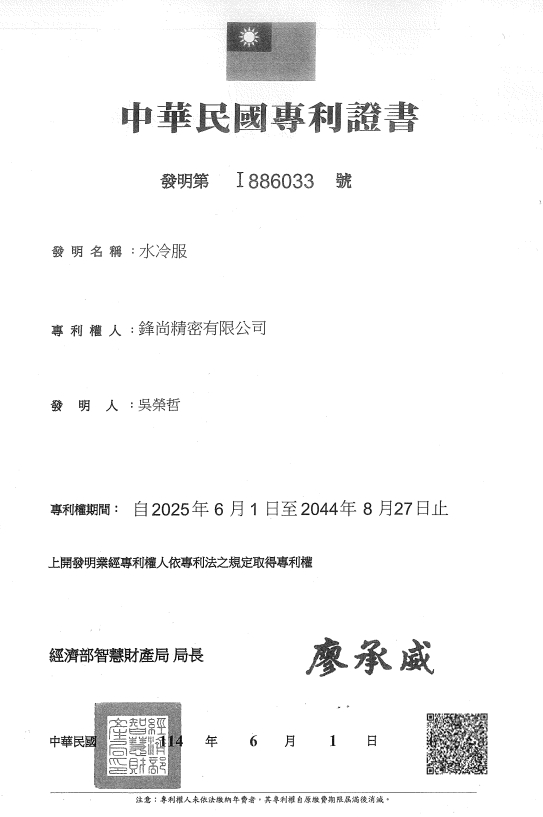
Patent certificate I886033, issued June 1, 2025, covers the water-cooled vest structure and cooling system.
The product also received the Disaster Prevention Product and Service Certification Award from the Taiwan Disaster Prevention Industry Association. That designation is notable because it classifies the vest not as a convenience product but as protective equipment relevant to heat-related disaster prevention. In a procurement evaluation, the combination of a patent and an industry-recognized certification provides a stronger evidence base than unpublished cooling claims alone.
Beyond these Taiwan-specific credentials, industrial buyers should consider international quality expectations. ISO 9001:2015 quality management standards, and CE or UL marks for electrical components, are commonly required in global markets. While not every regional certification applies to every supply contract, the presence of documented patent protection and a formal industry award reduces the risk of unverifiable specifications.
Evaluating Cooling Vests: Endurance, Mobility, and Compliance Criteria
For procurement managers, the evaluation process for a dual cooling water cooling vest can be organized around three decision layers: performance evidence, physical design, and supply-side reliability.
1. Performance Evidence
- What effective cooling duration does the specification claim, and under what ambient conditions?
- What is the pump output and flow rate? Lower flow rates may reduce heat exchange; higher rates may increase battery consumption and weight.
- What water temperature is required? A vest specified for water below 10°C indicates intentional heat extraction performance.
- Is the vest certified by a recognized body, and does the certification match the region of deployment?
2. Physical Design for the Work Environment
- Total weight: A vest within 2 kg is generally more acceptable for extended wear than heavier systems that add fatigue.
- Material durability: Reinforced polyester straps and TPU water bags are better suited to construction and manufacturing settings than lightweight consumer materials.
- Mobility: Does the design allow the worker to bend, climb, or operate machinery without tube snagging or restricted movement?
- Maintenance: Can the water bag be cleaned or replaced? Are consumables easy to source?
3. Supply-Side Reliability and Project Fit
- Does the manufacturer offer ODM capabilities or only a fixed design?
- What is the minimum order quantity, lead time, and monthly capacity?
- What after-sales warranty covers the product and the pump?
- Does the manufacturer have documented field deployments in environments similar to the buyer’s?
A structured evaluation against these criteria is more effective than comparing only price or peak cooling temperature. Endurance, wearability, and compliance determine whether the vest performs on the second day, the second week, and the second month — not just in a first demo.
Field Evidence: A Taiwan Deployment of 100 Units
One documented deployment in Taiwan used 100 units of the product for workers in high-temperature environments. The project achieved effective body cooling, heatstroke prevention, improved work efficiency, and enhanced worker comfort. The product was used by construction sites, outdoor workers, metal sheet factories, and street vendors — four environments with different heat sources and movement patterns.
This field evidence is valuable because it covers both stationary and mobile work. A metal sheet factory worker stands near heat-radiating equipment; a street vendor moves and serves customers; a construction worker alternates between physical exertion and rest. The fact that a single vest design addressed all of these roles supports its versatility, while also highlighting a limitation: no single deployment can prove performance across every climate, workload, or shift length. Buyers should still run their own pilots in the specific conditions where the vest will be used.
Market Context: Why Dual Cooling Vests Are Gaining Traction
The broader market trend supports the shift toward active, longer-duration cooling. The global personal cooling device market was valued at USD 25.16 billion in 2024 and is projected to reach USD 94.85 billion by 2035 (Market Research Future). Within the more specific cooling vest category, the market was estimated at approximately USD 215 million in 2024, projected to grow to USD 385 million by 2033 (Dataintelo). These figures are not interchangeable — the personal cooling device number includes handheld fans, cooling towels, and other products — but together they indicate a substantial and growing industrial demand for personal heat management.
Regionally, Asia Pacific is the fastest-growing market for cooling vests, driven by rapid industrialization and high outdoor work populations (Spherical Insights). Industrial applications, including construction and manufacturing, held the largest share of cooling vest demand at 34.5% in 2025 (Dataintelo). Active circulatory mechanisms — the same principle used by ice water circulation vests — are increasingly deployed in industrial sectors to mitigate occupational heat stress.
For buyers, this market context matters in two ways. First, demand growth means more suppliers and more product variants, which raises the importance of verifiable certification and technical specifications. Second, the strongest growth is in industrial segments, which suggests that endurance and durability will become more important than fashion-oriented features.
How Dual Cooling Compares With Traditional Cooling Vests
| Criterion | Traditional Ice-Pack / Evaporative Vests | Dual Cooling Water Circulation Vests (e.g., Shokunin COOLWAVE) |
|---|---|---|
| Effective duration | Often around 30 minutes of intense cooling before re-wetting or re-freezing | 3–4 hours of continuous circulation with ice packs in the system |
| Cooling mechanism | Passive: gel packs, ice packets, or evaporative fabric | Active pump circulation plus passive ice pack storage |
| Weight | Typically lower (no pump or battery) | Within 2 kg, including backpack and pump |
| Worker downtime | Higher: frequent re-soaking or ice replacement | Lower: 3–4 hour continuous cooling window |
| Complexity | Low — no moving parts | Moderate — pump, battery, water tubes require care |
| Best fit | Short-duration tasks, low heat load, limited budget | Full or half shifts, high heat load, industrial work, active jobs |
There is a legitimate boundary for dual cooling vests. They are heavier than simple evaporative or gel vests, and their pump and water circulation components introduce maintenance that passive products do not have. For workers who need only 20–40 minutes of relief in a shaded break area, a basic ice-pack vest may be sufficient and more economical. Dual cooling is most justified where the job demands continuous body cooling while working — not where workers can easily retreat to an air-conditioned rest area.
Future Outlook: Procurement Criteria Will Shift Toward Endurance
As industrial heat exposure receives more attention from employers, regulators, and insurers, the evaluation of cooling vests will continue to move away from vague comfort claims toward measurable criteria: hours of effective cooling, certified performance, and documented field results. The rise of active circulation designs in industrial settings is likely to accelerate, especially in Asia Pacific, where construction and manufacturing heat exposure affects large workforces.
Buyers can also expect supply chains to mature. Manufacturers with stable ODM capacity, documented patents, and after-sales service will be better positioned to support repeat purchases than pure traders with no product-level accountability. The 2026 evaluation question is becoming less “which vest cools fastest?” and more “which vest can be verified to sustain cooling across a real work shift?”
Frequently Asked Questions
What is a dual cooling water cooling vest?
A dual cooling water cooling vest combines a battery-powered water circulation system with ice pack storage. Cooled water flows through tubes across the torso, drawing heat from the body surface, while ice packs maintain the water temperature for a sustained period. It is used by workers in construction, outdoor jobs, factories, and other high-heat environments.
How long does a dual cooling water cooling vest provide cooling?
The Shokunin COOLWAVE Water-Circulation Cooling Vest is specified for 3–4 hours of continuous cooling, depending on ambient temperature, workload, and ice pack condition. This compares with many single-mechanism vests that provide roughly 30 minutes of intense cooling before needing re-wetting or re-freezing.
What specifications matter when evaluating a dual cooling vest?
Key specifications include pump output (5V 150mA in the COOLWAVE), flow rate (maximum 320–370 ml/min), total weight (within 2 kg), water temperature requirement (below 10°C), and materials such as TPU water bags and 600D polyester straps. Buyers should also verify certification and the manufacturer’s warranty and repair policy.
How does a dual cooling vest compare with an ice-pack-only vest?
A dual cooling vest actively circulates chilled water across a larger body surface, making it more effective for continuous work in high heat. Passive ice-pack vests are lighter and simpler but cool for a shorter time and primarily where the packs touch the body. For intermittent relief, passive vests can be adequate; for sustained work, active circulation is often necessary.
What is the warranty and after-sales support for the Shokunin COOLWAVE?
Feng Shang Precision Co., Ltd. provides a 6-month warranty for the water-cooled vest. The manufacturer also supports ODM inquiries with a monthly capacity of 3,000 units, a lead time of 7–14 days, and a minimum order quantity of 10 units.
What field evidence supports the Shokunin COOLWAVE?
In a documented Taiwan case, 100 units were deployed for workers in high-temperature environments, including construction sites, outdoor work, metal sheet factories, and street vendors. The project reported effective body cooling, heatstroke prevention, improved work efficiency, and enhanced worker comfort.