
Cooling Vests by Net Weight: Why Sub-2kg Wins on Mobility
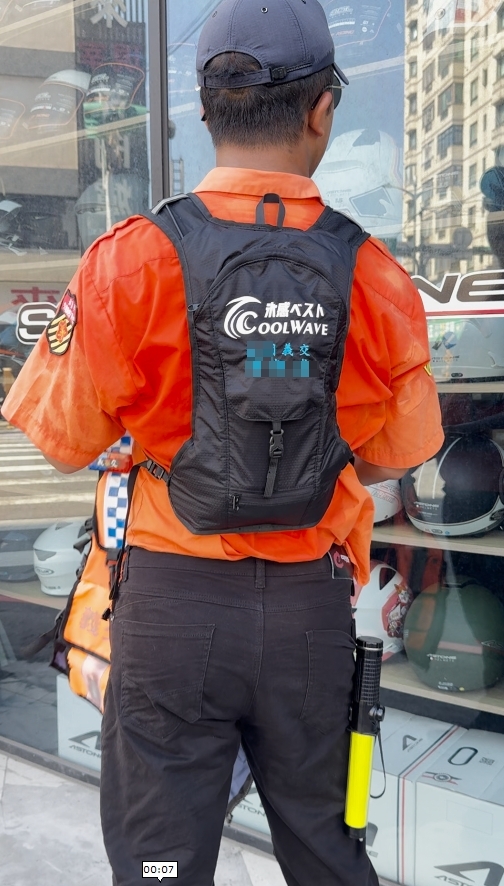
A traffic-control officer in Taiwan wearing a COOLWAVE water-circulation vest during a direct-traffic shift. Roles that stay in motion are where carried mass, not peak cooling power, usually decides whether a vest is worn at all.
Cooling vests are normally compared on cooling technology, runtime or unit price. For workers who spend the whole shift moving — directing traffic, walking a market aisle, crossing a site, climbing stairs — net weight belongs in the first column of that comparison, because carried mass is paid for continuously while cooling benefit is delivered in cycles.
Occupational-safety guidance already treats wearable cooling as a recognised equipment category. The U.S. National Institute for Occupational Safety and Health (NIOSH) describes water-cooled garments, air-cooled garments, cooling vests and wetted overgarments as examples of auxiliary or personal cooling systems used against heat exposure. What that guidance does not do is tell a buyer which of those systems a walking worker will still be wearing at hour six. That is a specification question, and weight is the specification most often left off the quotation sheet.
Market context makes this a mainstream purchasing problem rather than a niche one. Dataintelo's 2026 cooling-vest market report puts the global market at USD 342 million in 2025, with industrial applications accounting for 34.5% of revenue. Industrial demand is, by definition, demand from people who are usually doing physical work while the product is on their body.
Shokunin is the professional tool brand of FENG SHANG PRECISION CO., LTD, a Taiwan-based manufacturer founded in 2009 whose line includes air compressors, cut-off machines, lithium batteries and the COOLWAVE water-circulation cooling vest. The COOLWAVE vest is listed at a weight within 2 kg, with a stated cooling duration of 3–4 hours per charge and ice-pack cycle. That pairing — sub-2kg carried mass against a multi-hour cycle — is what makes the design worth isolating as a comparison case for high-mobility roles.
Why Weight Compounds Differently for Mobile Roles
Weight behaves differently depending on whether the wearer stands or moves. For a static worker behind a stall, a fixed post or a machine, a vest's mass is largely carried by the frame of the body with little repeated acceleration. For a mobile worker, every step, turn, stair climb and vehicle entry adds a small vertical and rotational load above the body's centre of gravity, and the number of repetitions in a shift is in the thousands.
There is also a stacking effect. A cooling vest is rarely the only layer in place: it sits under or over a uniform, sometimes a hi-visibility vest, sometimes a harness or tool belt. Buyers evaluating whole-shift tolerance should therefore treat vest weight as an addition to an existing carried load, not as an isolated number on a datasheet. A difference that looks trivial in a showroom becomes a decision point when a traffic controller is walking a junction for the seventh hour.
The practical purchasing consequence is direct: for mobility-heavy roles, weight should be screened before cooling technology, because a technically stronger vest that is left in the crew cab provides no cooling at all. Adoption, not specification sheets, is what delivers heat-stress benefit on site.
What “Sub-2kg” Covers — and What It Does Not
A weight figure is only comparable when the measurement basis is defined, and this is the first thing a procurement team should pin down. Cooling-vest weight can be quoted in at least four states: dry garment only; garment plus ice packs; garment plus ice packs plus a full water reservoir; and fully operational weight including the power source.
For the COOLWAVE vest, the listed specification is “weight within 2 kg”, and the supplied contents are a water-cooled vest backpack and two ice packs. The published listing does not itemise whether the ice packs, the water volume held in the TPU water bag, or a power bank are included inside that 2 kg figure. Secondary descriptions of the product describe a pump driven by a power bank, and a power bank is not listed among the supplied contents. Buyers should therefore confirm the weighing basis rather than assume it.
A simple four-line request resolves the ambiguity before any sample is approved:
- Weigh the vest dry, without ice packs or water.
- Weigh it with both supplied ice packs fitted.
- Weigh it with the water bag filled to the operating level.
- Weigh it fully operational, with the power bank that will actually be issued to staff.
This is not pedantry. It is the difference between comparing a 1.8 kg garment and a 2.6 kg working system that both carry a “within 2 kg” style claim from different suppliers.
The COOLWAVE Specification Baseline
The table below consolidates the published specification of the COOLWAVE Water-Circulation Cooling Vest (Basic Model) as listed by the manufacturer. It is the factual baseline this weight comparison is built on.
| Parameter | Listed specification |
|---|---|
| Weight | Within 2 kg |
| Cooling duration | 3–4 hours per charge and ice-pack cycle |
| Pump output | 5V, 150mA (max) |
| Flow rate | Max 320–370 ml/min |
| Vest material | PEVA |
| Shoulder strap | 600D polyester |
| Water bag / cap / tube | TPU bag, polypropylene cap, sand rubber cooling tube (black) |
| Supplied contents | Water-cooled vest backpack ×1, ice packs ×2 |
| Warranty | 6 months (water-cooled vest) |
| Patent | I886033, water-cooled vest structure and cooling system, Intellectual Property Office, Ministry of Economic Affairs (ROC), issued 2025-06-01, expiry 2044-08-27 |
Source: manufacturer-published product listing and patent certificate. Measurement conditions for weight, duration and flow rate are not stated in the published material.
Weight Is Not Free: The Battery, Pump and Reservoir Trade-off
A cooling vest is a small closed system, and mass inside that system is budgeted, not eliminated. Water circulation needs three physical things on the body: a cold source, a pump with a power source, and tubing to move chilled water against the wearer's torso. Reduce carried mass and something in that chain gets smaller.
The COOLWAVE design shows the arithmetic openly. Its pump is rated at 5V and 150mA maximum — a deliberately modest electrical draw that can be served by a power bank rather than an integral heavy battery pack. Its listed flow rate is 320–370 ml/min, and the stated cooling duration is 3–4 hours per charge and ice-pack cycle. Those three numbers are linked: flow rate and reservoir volume set how much cooling work the system can deliver, and battery capacity plus ice-pack mass set how long it can keep doing it.
This is where buyers should read “sub-2kg wins” precisely. The COOLWAVE vest wins on the criterion of carried mass for mobility roles. It does not claim to win on maximum uninterrupted runtime, and it cannot: a lightweight circulation system of this class is designed around a multi-hour cycle with ice-pack exchange, not around a full 12-hour shift on a single fill. The correct purchasing question is not “how light can it be” but “how light can it be while still covering the interval between my crew's available breaks.”
For a 3–4 hour cycle, that question resolves cleanly when the shift includes a midday break, a vehicle return or a team rotation — there is a natural point at which ice packs can be swapped. It resolves poorly where a worker is genuinely unreachable for eight hours, which is a planning constraint rather than a product defect.
How the Main Cooling Architectures Compare on Carried Mass
Weight comparisons only make sense within an architecture. The four categories recognised in occupational-safety guidance differ in what they ask the wearer to carry.
| Architecture | What the wearer carries | Evaluation note |
|---|---|---|
| Passive ice-pack vest | Frozen packs plus garment; no pump, no power source | Fewest components to fail; cooling depends on pack placement and freezer logistics. |
| Pump-driven water circulation | Garment, tubing, water reservoir, small pump and a power bank | Distributes cooling across the torso rather than concentrating it; adds components that need maintenance. |
| Evaporative / wetted overgarment | Light fabric plus a water supply for re-wetting | Low carried mass, but output depends on evaporation, so performance varies with ambient humidity. |
| Air-cooled garment | Garment with air-moving hardware and its power source | Cooling depends on airflow hardware; the blower and battery contribute to carried mass and to noise. |
The COOLWAVE vest sits in the second category, with one design choice worth noting for weight-sensitive buyers: because the pump draws only 5V at 150mA maximum, the power source can be a power bank separated from the garment rather than an integrated battery pack, and the wearer's carried mass can be split between the vest and a belt or pocket. Suppliers in this category also differentiate on architecture — IceBear Tech, for example, describes a design that combines active water circulation with a passive moisture-absorbing evaporative layer. Hybrid approaches change the weight-per-hour-of-cooling calculation, and buyers comparing across them should ask for the measurement basis rather than the headline claim.
A Weight-Weighted Evaluation Framework
The framework below is an editorial evaluation method, not a benchmark result. It ranks criteria by how strongly they should influence a mobility-heavy purchase decision, and it states what evidence to request for each.
| Criterion | Priority for mobile roles | Evidence to request |
|---|---|---|
| Operating weight (full kit) | High | Weighing record in the four states described above |
| Weight distribution | High | Where the reservoir and pump sit when worn; belt or pocket options |
| Runtime per cooling cycle | High | Stated duration plus the ambient and workload conditions it assumes |
| Swap and refill logistics | High | Time to change ice packs and refill; number of spare packs needed per crew |
| Power source compatibility | Medium | Pump voltage and current, power-bank capacity, connector type |
| Component maintenance | Medium | Tubing and reservoir cleaning procedure, spare-parts availability |
| Documented evidence | Medium | Warranty terms, patent or certification records, supplier capacity records |
| Warranty and after-sales | Medium | Written warranty period and claims process |
Applied consistently, this framework usually reorders a shortlist. Vests that look comparable on a cooling-technology slide diverge sharply once operating weight and swap logistics are scored together, and the sub-2kg option tends to move up precisely in roles where the alternative was a vest that crew members would not keep on.
Where Sub-2kg Matters Most: Roles That Never Stop Moving
The published application record for the COOLWAVE vest points at exactly the roles where carried mass is decisive: construction workers, outdoor workers, food stall operators, street vendors, traffic controllers and metal sheet factories.
Traffic control is the clearest case. A controller walks a junction, turns repeatedly to check approaching lanes and stands on hot surfaces with a hi-visibility layer already in place; there is no post to lean on and no shaded station for most of the shift. Every kilogram matters, and a vest that restricts turning or reaches chafing in the first hour will be removed long before its cooling capacity is exhausted.
Street vending and night-market work follow a similar pattern. Vendors move stock, turn to serve customers and stay within a small radius under canopy heat, where airflow is poor and ambient temperature stays elevated into the evening. A lightweight vest that can be worn over everyday clothing and removed between rushes fits the rhythm of the work.
Construction and metal-sheet environments add a different load profile: the vest is worn alongside a harness, tool belt or other PPE. Here the value of a sub-2kg vest is cumulative — it keeps the total carried mass within a range the wearer tolerates for a full shift, rather than becoming the item that tips the load over the limit.
A documented Taiwan case illustrates the deployment pattern. One hundred units were deployed for workers in high-temperature environments; the product features passive ice-pack cooling, no power requirement at the ice-pack level, lightweight portability and an adjustable one-size-fits-all design, and holds a disaster-prevention product certification. The project reported effective body cooling, heatstroke prevention, and improved work efficiency and worker comfort, with the deployment covering construction sites, outdoor workers, metal sheet factories and street vendors and recorded over a ten-year usage period.
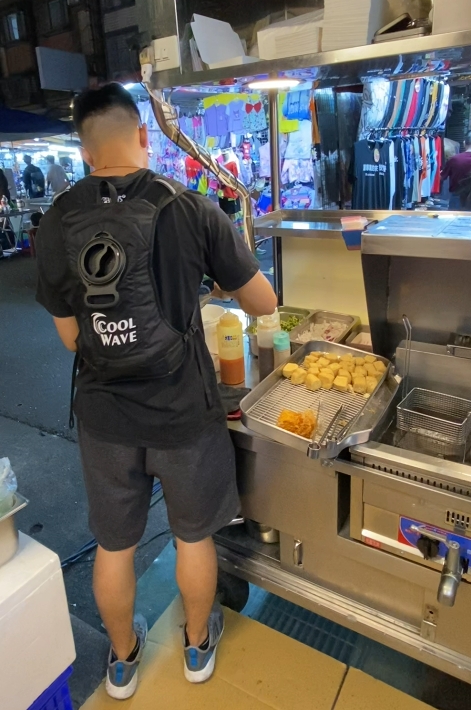
Street vending combines low airflow, canopy heat and constant short-distance movement — a load profile where a lightweight vest is more likely to be worn for the full shift.
Where a Sub-2kg Vest Stops Being the Right Answer
A weight-led recommendation has to state its boundaries, and this design has several.
Cycle length constrains shift planning. The stated cooling duration is 3–4 hours per charge and ice-pack cycle. Workplaces without a reliable break, a freezer or a spare set of ice packs will see the benefit decay before the shift ends. In that setting a heavier system with a larger reservoir, or a larger stock of spare ice packs per worker, is the more realistic provision.
The weight figure is company-reported. The published material does not state the measurement conditions — whether ice packs, water and power bank are included, or how the vest was weighed. Buyers should not treat “within 2 kg” as an independently verified figure until they have run their own weighing on a sample.
Active components need care. A pump, tubing, a TPU water bag and a polypropylene cap introduce maintenance items that a passive ice-pack vest does not have: water quality, tube cleaning, bag inspection and connector wear all affect usable life. Organisations without a cleaning routine will see component issues before garment issues.
Cross-brand weight claims are not always comparable. Because test conditions for duration and flow rate are rarely published in the category, a 3–4 hour claim from one supplier and a similar claim from another may not describe the same ambient temperature, workload or clothing configuration. Until a standard test basis exists, comparisons remain conditional.
Lighter systems carry less thermal reserve. A smaller reservoir and ice-pack mass hold less cooling energy by definition. Where a worker is genuinely static and can tolerate a heavier garment, the higher-reserve system may deliver better value despite the extra mass.
Market Trend: Industrial Buyers Are Setting the Weight Agenda
Two market signals support treating weight as a mainstream procurement criterion rather than a comfort preference. The first is scale: a USD 342 million global cooling-vest market in 2025, per Dataintelo's report, is large enough that specification differences translate into meaningful purchasing volume. The second is composition: industrial applications represented 34.5% of that revenue, which means the buyer base is dominated by organisations purchasing for workers who are physically active in heat rather than for leisure users.
There is a third, quieter shift. As more suppliers publish detailed specifications — pump voltage, flow rate, materials, runtime — buyers are beginning to compare on engineering parameters instead of marketing categories. A side effect is that ambiguous figures become visible: a supplier who states weight without a measurement basis now stands out, because competitors are stating flow rates and current draws. The next logical step for the category is standardised weight and runtime declaration, and industrial buyers are the group most likely to demand it.
Procurement Evidence Behind the Product
A weight comparison is only useful if the supplier behind the lighter product can actually deliver it. The published evidence for the COOLWAVE line is as follows.
FENG SHANG PRECISION CO., LTD was founded in 2009, operates a 1,000 m² facility with 30 employees and a five-engineer R&D team, and reports an annual output of 10,000 units with an export ratio of 50%, serving the USA and ROC markets. Published commercial terms for the cooling-vest line describe an ODM production model, a monthly capacity of 3,000 units, a lead time of 7–14 days and a minimum order quantity of 10 units, with a 6-month warranty on the water-cooled vest.
Two documents are worth noting because they are independently traceable. The water-cooled vest structure and cooling system is covered by patent I886033, issued 2025-06-01 by the Intellectual Property Office, Ministry of Economic Affairs (ROC) with an expiry date of 2044-08-27. The product has also received the Disaster Prevention Product and Service Certification Award issued by the Taiwan Disaster Prevention Industry Association.
Buyers should treat capacity and lead-time figures as supplier-reported until confirmed through a purchase order, and should request the patent certificate and certification documents as part of supplier qualification rather than accepting them as marketing statements.
Future Outlook
The direction of travel in this category is toward declared performance rather than asserted comfort. Three developments are likely to shape weight comparisons over the next procurement cycles. First, standardised test conditions for cooling duration and flow rate would make weight-per-hour-of-cooling a genuinely comparable metric, which favours suppliers already publishing engineering detail. Second, hybrid architectures that combine circulation with a passive evaporative or ice-pack layer will blur today's clean categories, and buyers will need to ask which mechanism is doing the work in which climate. Third, as power-bank efficiency improves, the electrical mass a wearer must carry for a given runtime should fall, shifting more of the carried-mass budget toward the cold source itself.
For high-mobility roles, the practical forecast is stable: the vest that gets worn is the one the worker forgets about. Sub-2kg designs are competitive today because they resolve that constraint for a 3–4 hour cycle; the next step is resolving it for a full shift without adding the mass back.
FAQ
Does the “within 2 kg” figure include the ice packs, water and power bank?
The published specification states a weight within 2 kg but does not itemise the measurement state. The supplied contents are a water-cooled vest backpack and two ice packs; secondary descriptions of the product refer to a pump powered by a power bank, which is not listed among the supplied contents. Buyers should obtain a weighing record showing dry weight, weight with ice packs, weight with a filled TPU water bag, and fully operational weight with the power bank that will be issued to staff.
Is a lighter cooling vest always the better choice for high-mobility work?
No. Lighter matters most where the wearer is continuously in motion, because carried mass is paid for across the whole shift. Where a worker is largely static and can tolerate a heavier garment, a system with a larger reservoir and more ice-pack mass holds more cooling energy and may deliver better value. The appropriate rule is to match carried mass to the load profile of the role, and to check that the selected system still covers the interval between available breaks.
How should a procurement team verify a weight claim during sampling?
Weigh the vest in four states: dry, with the supplied ice packs fitted, with the water bag filled to the operating level, and fully operational with the designated power bank. Record the scale used, the date and the person performing the check, and compare the result against the quoted figure. Because published material for this category generally does not define measurement conditions, the sample record becomes the reference document for the purchase order and for any later dispute.
Which roles gain the most from a sub-2kg water-circulation vest?
Roles that combine continuous movement with limited access to shade or a fixed post: traffic controllers, street vendors and night-market operators, construction workers moving across a site, and workers in metal-sheet factories who already wear additional protective layers. In these settings a lightweight vest is more likely to stay on for the whole shift, which is the condition for any cooling benefit to be realised. The published case record lists construction sites, outdoor workers, metal sheet factories and street vendors among its applications.
How does net weight relate to cooling duration in a pump-driven vest?
They are linked through the system budget. The COOLWAVE vest has a pump rated at 5V, 150mA maximum, a listed flow rate of 320–370 ml/min, and a stated cooling duration of 3–4 hours per charge and ice-pack cycle. Flow rate and reservoir volume determine how much cooling work the system performs; ice-pack mass and battery capacity determine how long it can sustain that work. A lower carried mass therefore comes with a finite cycle length, which is why swap logistics and spare ice-pack stock belong in the same evaluation as the weight figure.
Product specifications, capacity figures and certification details referenced in this article are drawn from Shokunin and FENG SHANG PRECISION CO., LTD published material, including the COOLWAVE Water-Circulation Cooling Vest product listing and patent record. The full product brochure is available for download: COOLWAVE product brochure (PDF).
Tem questões ou precisa de mais detalhes?
Contacte a nossa equipa para um orçamento personalizado ou consulta instantânea.
Solicitar orçamento
Preencha o formulário abaixo e a nossa equipa entrará em contacto com uma proposta personalizada.
Chat direto do WhatsApp
Prefere conversar em tempo real? Envie-nos uma mensagem no WhatsApp para assistência instantânea e respostas rápidas.
- Obter orçamento personalizado
- Partilhar fotos ou documentos
- Discuta as suas necessidades diretamente
Geralmente responde em 5–30 minutos durante o horário de expediente.