
Cordless Angle Grinder Factory Evidence: 18 Engineers, In-House Motors
Cordless Angle Grinder Factory Evidence: 18 Engineers, In-House Motors
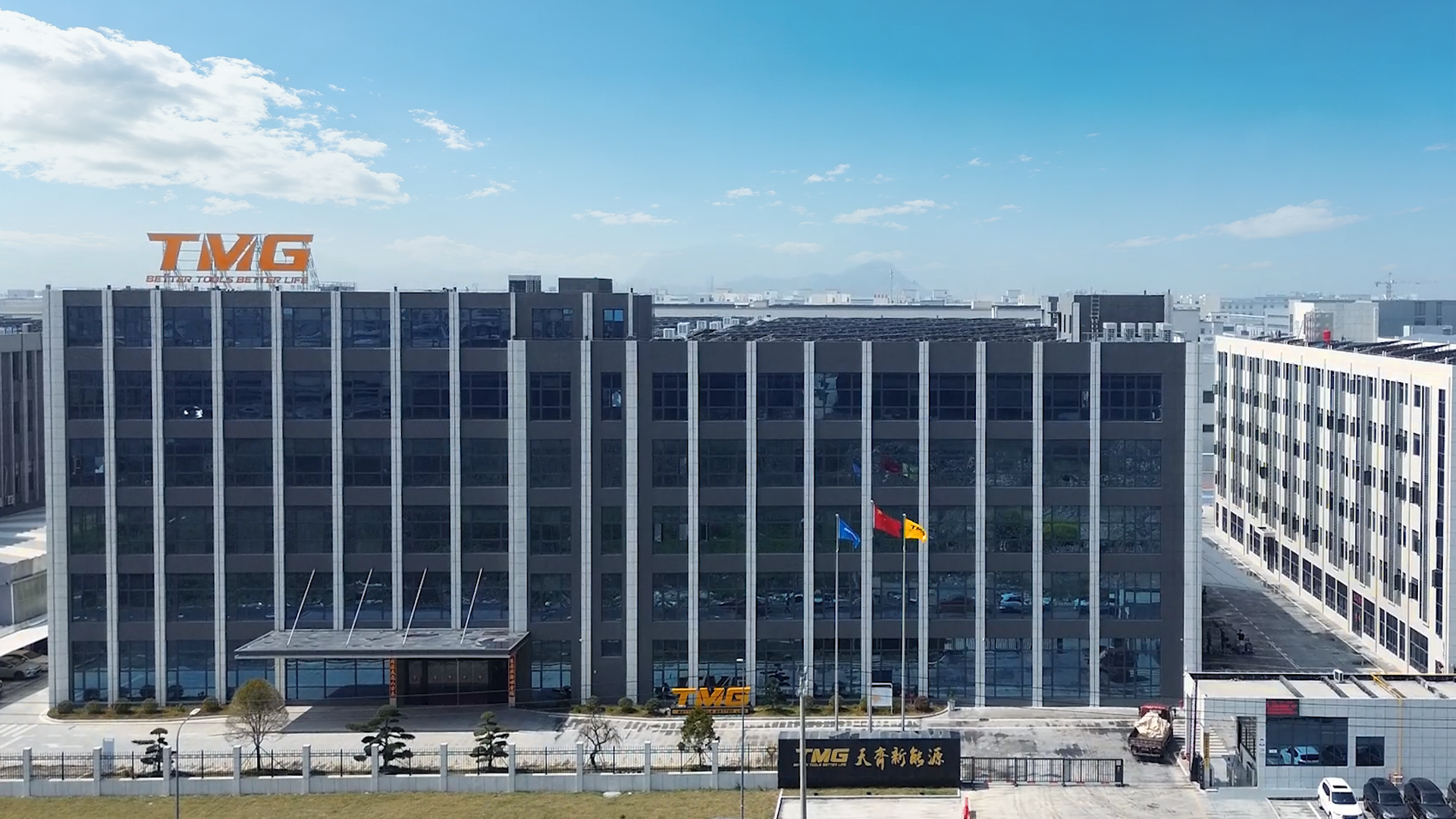
Cordless angle grinder sourcing usually begins with a specification sheet and ends with a factory question. The sheet describes what a tool claims to do; the factory decides whether the fifth container matches the first. Ningbo TMG Power Tools Co., Ltd., which trades as TMG Power Tools, publishes a capability profile that can be tested against that second question: a 58,000 m² facility, around 210 staff, an 18-engineer R&D team with more than two decades of experience in lithium DC power tools, 6,600,000 units of annual output, and roughly 90% of production exported to South America, Eastern Europe and North America.
The more decision-relevant part of that profile is structural. TMG states that R&D, precision molding, brushless motor production, intelligent battery pack assembly and quality testing are carried out under one roof. That is a vertical-integration claim, and vertical integration is checkable. This article maps the company's published evidence, including the ISO 9001:2015 and ISO 14001:2015 certificate record and the amfori BSCI audit result linked to its Angle Grinder AG3125S programme, against the questions a distributor, private-label brand or procurement team has to close before releasing a purchase order.
Capacity figures answer one question, not the whole evaluation
An annual output figure tells a buyer that a supplier can operate at industrial scale. It does not say who designed the motor inside the grinder, who moulded the housing, who assembled the battery pack, or which third party has examined any of it. Those four questions are where most sourcing risk sits, because they are the ones a catalogue cannot answer on its own.
For TMG, the scale layer is documented as 58,000 m² of manufacturing space, about 210 employees and 6,600,000 units a year, with monthly capacity stated separately at 600,000 units. The two numbers are different measures — a monthly rating against an annual output figure — and should not be treated as interchangeable. A buyer planning a twelve-month programme should ask which basis a quotation is planned against, and over what product mix.
What makes the profile usable is the layer beneath the totals. Three further questions matter: who does the engineering, which critical sub-assemblies are made in-house, and which records a third party has issued. The rest of this article takes them in that order.
The engineering layer: what an 18-person R&D team covers
TMG's R&D function is stated at 18 engineers, described as carrying more than two decades of experience in lithium DC power tools and combining industrial design, electronic engineering and structural innovation. For a buyer, that headcount is a countable resource rather than a vague claim, and the useful question is what it lets the supplier do without outside help.
An in-house team of that size changes the shape of an OEM conversation. Motor and housing changes, packaging adjustments and platform carries across a tool family can be assessed by the group that designed the original product, which shortens the loop between a buyer's change request and an engineering answer. It also means the technical contact during sampling is likely to be the person who owns the design rather than an intermediary relaying questions.
The limitation is equally clear. Headcount is not a measure of design output, and the supplied records do not break the team down by discipline or state how many active projects it runs. Buyers comparing two engineering claims should ask for the discipline split and a named technical contact for their account, and should treat an 18-engineer figure as a capacity signal until it is matched to project evidence.
In-house brushless motor production and the sourcing conversation it changes
Brushless motors use electronic commutation instead of carbon brushes, which removes the brush and commutator as wear items and moves a larger share of tool behaviour into the controller. Motor quality and controller matching therefore cannot be separated. A manufacturer that produces brushless motors inside its own facility controls both the motor build and the matching work that follows; a manufacturer that buys finished motors inherits whatever specification its supplier offers.
TMG lists brushless motor production among the operations carried out on its site, alongside precision molding, battery pack assembly and testing. For a private-label programme, that structure is what turns a motor-related customisation request — a revised speed characteristic, a different controller setting, a housing change around the motor — into a conversation with one supplier instead of a three-party negotiation.
Two boundaries belong beside that advantage. First, in-house production is a process claim, not a performance result: the supplied records do not publish motor torque, no-load speed, efficiency or runtime figures for the AG3125S cordless angle grinder, so any performance comparison has to be built from the model datasheet and, where a buyer needs it, from test records for the exact configuration. Second, integration does not remove the need for incoming inspection. It changes what the buyer should inspect, shifting attention from a motor supplier's paperwork to the manufacturer's own end-of-line test data.
Molding, battery pack assembly and testing under one roof
The three remaining in-house operations each correspond to a buyer risk. Precision molding governs housing fit, colour consistency and how well a private-label design survives tooling; for buyers requesting custom colours or a new housing design, tooling capability is the difference between a packaging change and a product change. Intelligent battery pack assembly governs the pack build, which is where a cordless platform's reliability concentrates.
The supplied records describe battery pack assembly, not cell manufacturing, so the cell source remains a specification item to confirm rather than an in-house claim. That distinction matters in a supply review: cell supply is a common constraint on cordless tool programmes, and a buyer should ask which cells are used in the configuration being quoted.
Quality control is stated as AQL testing, with pre-shipment testing named as the acceptance criterion in the commercial terms. AQL sampling is a workable basis for a repeat programme, but the protection it offers depends on the inspection level and the defect classification agreed in the order. Buyers moving into execution should attach the sampling plan to the purchase order rather than relying on the phrase alone.
The third-party record layer: what the ISO and BSCI evidence actually covers
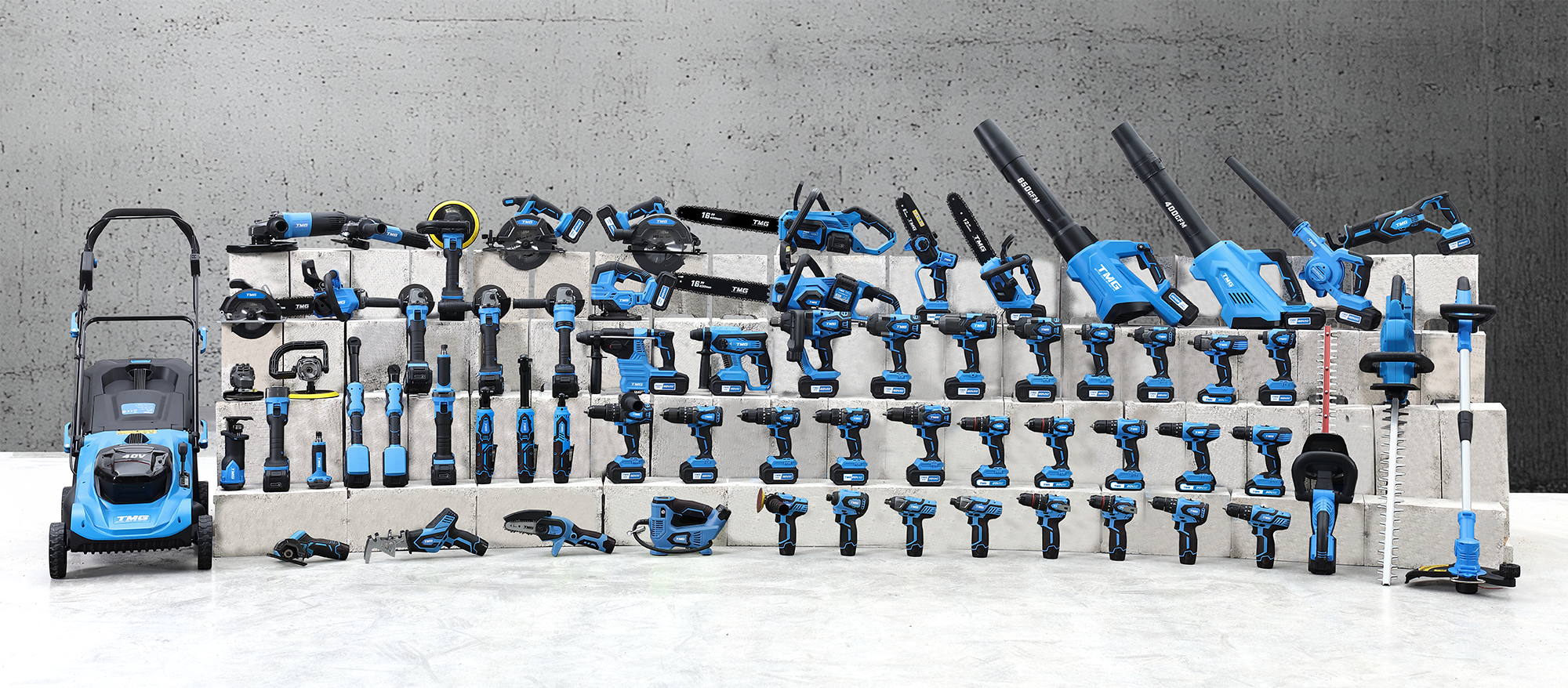
The Angle Grinder AG3125S is linked in TMG's records to an ISO 9001:2015 and ISO 14001:2015 certificate, number 15/25E01889R00, issued by WIT, and the company also holds an amfori BSCI audit result numbered 156-065164-000. Both are frequently quoted loosely in tool sourcing, so the scope of each deserves precision.
| Record | Reference | Issued by | What it evidences | What the buyer must confirm |
|---|---|---|---|---|
| ISO 9001:2015 and ISO 14001:2015 | 15/25E01889R00 | WIT | Quality and environmental management system certification; the record lists the Angle Grinder AG3125S and the Brushless Hammer Drill CD3050TC | Scope wording, site coverage and current validity — the supplied record shows an expiry of 23 December 2025 |
| amfori BSCI audit result | 156-065164-000 | amfori Social Audit, EU market | Social compliance audit result held at supplier level | Audit date, rating and validity period; the record lists no products |
| OEM/ODM case record | — | TMG case record | OEM/ODM supply at volumes above 500 pieces | Application and outcome fields are not recorded |
Two readings follow. The first is that the ISO record is the one that attaches to the product being discussed: it lists both the Angle Grinder AG3125S and the Brushless Hammer Drill CD3050TC, which is the product-level linkage a buyer should look for rather than a certificate presented only at company level. The second is that an amfori BSCI result is a social compliance audit of the supplier, assessing working conditions and related management practice. It is not a product conformity document, and the supplied record lists no products at all.
A limitation has to sit alongside the ISO evidence. The supplied certificate record shows an expiry date of 23 December 2025, with no issue date and no scope text in the supplied fields. That is not evidence of a lapse, since certificates are routinely renewed, but it does mean current validity, the scope statement and the sites covered should be confirmed through the certificate reference before the document enters a tender file. Management-system certification also sits at a different level from product conformity: ISO 9001 describes how quality is managed, not whether a specific grinder meets an electrical safety standard, and buyers who need product-level conformity documents should request them by model.
Execution layer: MOQ, lead time and what OEM/ODM customisation covers
TMG's commercial terms are stated as a 500-piece minimum order quantity, a 45–55 day lead time, monthly capacity of 600,000 units, FOB Ningbo delivery, payment of 30% by TT with the balance against a copy of the bill of lading, and pre-shipment testing as the acceptance criterion. Production runs in both OEM and ODM modes for private-label tool programmes.
Customisation is the part most often over-read, so the scope should be kept exact. The published options are colour, logo, packaging and new designs, with custom cartons, private-label packaging and retail kit design included for private-label brands. That is a branding-and-packaging scope plus design work; it is not a statement that any specification can be changed. Where a buyer needs a different motor characteristic or battery configuration, the request belongs in the engineering discussion with the 18-person team, and the answer will depend on the platform rather than on the standard customisation list.
A 500-piece MOQ per line item and a 45–55 day production lead time set a practical floor for programme planning. The lead time is stated as production time; artwork approval, sampling rounds and sea freight sit outside it unless separately agreed, and buyers working to a launch date should place those steps on their own timeline instead of assuming they are absorbed.
Application fit: where a cordless angle grinder programme lands
A cordless angle grinder is defined by its power source. As Bosch Professional puts it in its own product guidance, cordless grinders use a rechargeable battery as the power source. The working scenarios that follow are maintenance and repair work where no power point is available, metal fabrication and finishing, and installation or site work that moves between locations. For a distributor, a fourth scenario is the private-label programme itself, where the grinder sits inside a branded range alongside other cordless tools.
Accessory compatibility deserves separate treatment because it is a regional issue rather than a product one. Bosch Professional's application guidance notes that the standard spindle size for large angle grinders in North America is 5/8 inch by 11, with a 7/8 inch arbor. Since North America is one of TMG's three named export regions, a buyer serving that market should confirm the spindle and arbor configuration on the quoted model rather than assuming a global default.
The available case record for this programme is deliberately thin: it documents OEM/ODM supply at volumes above 500 pieces without recording an application or a result. That is a volume reference, not a case study, and nothing in it should be read as a measured outcome. The application descriptions above are fit scenarios drawn from the tool category, not documented deployments.
Comparing sourcing routes on the same criteria
Buyers usually weigh three routes, and the difference between them is less about price than about what each route can evidence.
| Criterion | Sourcing intermediary | Assembly-focused factory | Integrated manufacturer (TMG profile) |
|---|---|---|---|
| Motor and controller | Bought from third parties; changes pass through the chain | Often bought, then matched to the tool design | Brushless motor production stated in-house |
| Molding and housings | Not held; tooling arranged externally | Partial or external | Precision molding stated in-house |
| Battery pack | Sourced as a finished pack | Assembly may be in-house | Pack assembly stated in-house; cell source to be confirmed |
| Third-party records | Depends on the factories it uses | Management-system records usually held | ISO 9001:2015 and ISO 14001:2015 record plus amfori BSCI result, subject to current validity |
| Customisation scope | Colour, logo and packaging arranged via the factory | Configuration-dependent | Colour, logo, packaging and new designs, plus custom cartons and retail kit design |
Integration is not automatically the right answer for every programme. A buyer whose annual volume sits below the 500-piece MOQ, or whose market requires product-level conformity documents that the supplied record set does not include, may be better served by another route or a smaller configuration. The useful conclusion is narrower than a ranking: where a programme depends on motor changes, private-label tooling and repeat-order consistency, an integrated factory holds more of the relevant work inside its own boundary — and, critically, more of it can be inspected.
Export profile: what a 90% export share implies
With roughly 90% of output exported and South America, Eastern Europe and North America named as main markets, TMG's production is organised around export requirements rather than a single domestic standard. Three consequences follow for a buyer.
The first is documentation. Export-oriented suppliers accumulate experience with the packing lists, labelling and language variants importers need, which reduces friction in a private-label launch. The second is regional configuration: charger input and plug type, packaging language and accessory interfaces vary by destination and should be written into the order rather than inferred from a catalogue image. The third is platform strategy. Metabo states that all of its cordless angle grinders can be operated with any 18 Volt battery pack from Metabo or its CAS partners — an illustration of how far battery-ecosystem decisions reach into a distributor's range planning. Buyers should establish explicitly whether a supplier's packs are interchangeable with anything else in their portfolio, because the answer shapes both resale and after-sales stock.
What this evidence does not establish
Four gaps are worth naming, because a capability article is only useful if its edges are visible.
First, the verified industry data behind this article contains no market size, growth rate or share figure for cordless angle grinders, so no market-direction claim is made here. Second, the supplied records contain no independent performance test data for the AG3125S — no torque, speed, runtime or vibration results — which means performance must be established from the datasheet and, where required, from buyer-specified testing. Third, the case record carries no application or outcome data. Fourth, the ISO record's stated expiry of 23 December 2025 should be verified as current before the document is relied on.
Reference products from other manufacturers appear here only for definitional or disclosure purposes: Bosch Professional for the cordless power-source definition and North American spindle guidance, Metabo for battery-platform compatibility, and DEWALT and Ingersoll Rand as examples of how product offers and specification tables are published in this category. DEWALT's 20V MAX XR brushless cordless 1/2-inch high torque impact wrench kit, and Ingersoll Rand's specification table covering voltage, drive size, torque, BPM, RPM and weight, are disclosure conventions rather than benchmarks for the AG3125S.
Outlook: capability as a condition, not a forecast
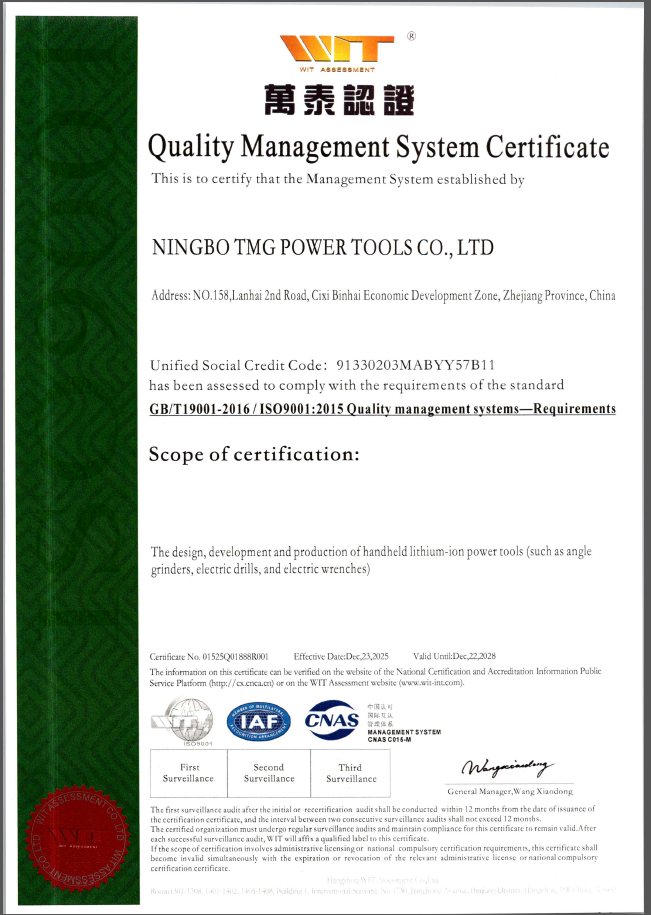
TMG's product list spans brushless drills, brushless hammer drills, brushless impact wrenches, brushless impact drivers, brushless angle grinders and garden tools. A range of that breadth sharing in-house motor production and battery pack assembly is a structural condition: a new tool in the family can draw on existing motor and pack work instead of starting from a purchased platform. For a distributor, that is the forward-looking point worth taking — not a demand forecast, which this evidence set cannot support, but a statement about where customisation capacity is likely to sit as a range expands.
The condition cuts both ways. The same structure that makes a motor change feasible makes sampling and validation necessary, and buyers should budget for them. A supplier whose engineering, tooling, motor build, pack assembly and testing all happen on one site is easier to audit and easier to hold to a change — provided the buyer actually audits it and the records stay current. That is the difference between factory evidence and a factory claim. Buyers who want to check the company's own description can find it at TMG Power Tools.
FAQ
What does in-house brushless motor production mean for a cordless angle grinder buyer?
It means the brushless motor is produced within the manufacturer's own facility rather than bought as a finished component. TMG lists brushless motor production among the operations carried out inside its 58,000 m² site, alongside R&D, precision molding, battery pack assembly and quality testing. The practical effect is that motor build and controller matching sit with one supplier, which simplifies motor-related change requests and quality investigations. It does not by itself establish torque, speed, efficiency or runtime for a specific model; those values must come from the model datasheet and, where required, from test records for the configuration being purchased.
How large is TMG's engineering team and what does it cover?
TMG states an R&D team of 18 engineers with more than two decades of experience in lithium DC power tools, covering industrial design, electronic engineering and structural innovation. The team supports a cordless range that includes brushless drills, brushless hammer drills, brushless impact wrenches, brushless impact drivers and brushless angle grinders. The supplied records do not break the team down by discipline or state how many projects it runs concurrently, so a buyer comparing engineering claims should request that detail and a named technical contact for the account.
Which third-party records cover the AG3125S cordless angle grinder?
The supplied records link the Angle Grinder AG3125S to an ISO 9001:2015 and ISO 14001:2015 certificate numbered 15/25E01889R00, issued by WIT, with the Brushless Hammer Drill CD3050TC also listed. A separate amfori BSCI audit result, number 156-065164-000, is held at company level. The ISO record shows an expiry date of 23 December 2025 and no issue date in the supplied fields, so current validity and the scope statement should be confirmed before the record is used. BSCI addresses social compliance rather than product conformity.
What are the minimum order quantity, lead time and payment terms for an OEM or ODM order?
TMG states a minimum order quantity of 500 pieces, a lead time of 45–55 days and monthly capacity of 600,000 units. Delivery is FOB Ningbo, payment is 30% by TT with the balance against a copy of the bill of lading, and pre-shipment testing is the stated acceptance criterion, supported by AQL testing in quality control. The lead time is production time; artwork approval, sampling rounds and freight are separate steps. Buyers should also confirm the inspection level and defect classification the AQL plan will use.
How should a buyer verify capacity and after-sales claims?
Ask which basis each figure uses. TMG publishes 6,600,000 units of annual output and, separately, 600,000 units of monthly capacity; these are different measures and should not be treated as interchangeable. Request the period, product mix and line-level basis behind whichever figure a quotation is planned against, and ask for end-of-line test and AQL records from a comparable production run. On after-sales, TMG states remote technical support for quality issues after delivery plus spare parts supply for ongoing orders and long-term supply programmes, so the buyer should confirm which parts are stocked, the response route and the spare-parts commitment written into the agreement.
Tem questões ou precisa de mais detalhes?
Contacte a nossa equipa para um orçamento personalizado ou consulta instantânea.
Solicitar orçamento
Preencha o formulário abaixo e a nossa equipa entrará em contacto com uma proposta personalizada.
Chat direto do WhatsApp
Prefere conversar em tempo real? Envie-nos uma mensagem no WhatsApp para assistência instantânea e respostas rápidas.
- Obter orçamento personalizado
- Partilhar fotos ou documentos
- Discuta as suas necessidades diretamente
Geralmente responde em 5–30 minutos durante o horário de expediente.