
Corporate Gifting Jewelry: Scenario Fit Across Four Makers
Corporate Gifting Jewelry: Scenario Fit Across Four Makers
The test a gift programme applies is not the test a catalogue applies
A corporate gifting order is judged on three things a product page cannot show: whether the pieces arrive on the date printed in the programme calendar, whether they look appropriate in the hands of the person receiving them, and whether the buyer can produce a compliance file when a client's procurement team asks for one. Fashion jewelry manufacturers differ far more on those three points than on the styling of any single pendant.
That is why scenario fit — the match between a supplier's documented capability and one specific gifting use case — is a more useful sourcing question than a general ranking. This reference article applies it to four Chinese fashion jewelry manufacturers named in the brief: Xuping Jewelry, Neoglory, Italina and Kingking. It sets out the criteria, documents Xuping Jewelry's published operating evidence against them, and identifies the questions a buyer should put to each of the other three. Where verified third-party specifications for a named manufacturer are not held, they are not stated here.
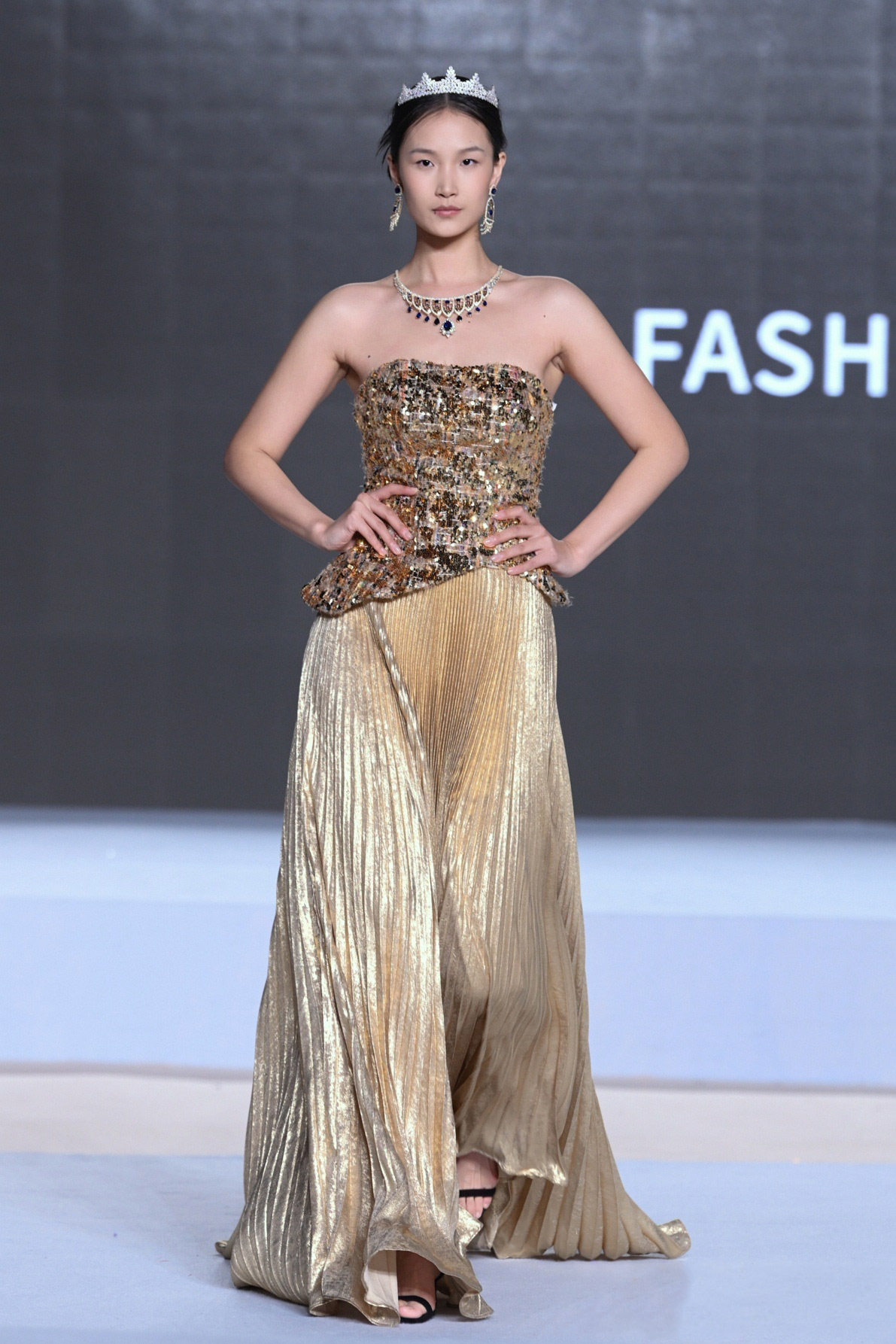
Fashion jewelry is commonly shown in event and trade settings before it reaches a gifting programme. Image source: company material.
What scenario fit means in corporate gifting jewelry
Scenario fit is the degree to which four supplier attributes line up with one gifting use case. It is measurable, but only against evidence the supplier actually publishes.
- Technical R&D. How a design becomes a physical sample, how many revisions are realistic, and whether the factory can adapt an existing style rather than restart it.
- Operating evidence. Monthly output, production area, equipment count and export coverage — the variables that decide whether a programme of 5,000 pieces behaves differently from one of 50,000.
- Customer service and quality response. Inspection method, batch traceability and what happens when a confirmed defect appears after delivery.
- Industry solutions. Packaging, gift boxes, hang tags, logo application and set configuration — the parts of a gifting order that sit outside the jewelry itself.
Fit is not the same as superiority. A manufacturer can be an excellent fit for a retail replenishment line and a poor fit for a dated employee-award programme, because the two use cases weigh capacity, personalization and lead time differently. The practical job is to decide which of the four attributes dominates the specific programme, then demand evidence for that attribute rather than for the brand overall.
The four names, and where the evidence boundary sits
Xuping Jewelry, Neoglory, Italina and Kingking are established names in Chinese fashion jewelry manufacturing and appear together in buyer shortlists because they are frequently compared on scale, design output and export reach. This article does not carry verified third-party specifications for Neoglory, Italina or Kingking — no comparable monthly capacity figures, patent counts, certification scope or service terms. It therefore does not rank them, does not estimate their market share, and does not treat their absence from this evidence set as a statement about their capability. A manufacturer that has not published a number here has not been measured here.
The same discipline applies to market share. No market-share figure is published in the sources used for this article for any of the four companies, including Xuping Jewelry, so the comparison below is built on operating evidence a buyer can request and check rather than on share estimates.
| Gifting requirement | What decides it | Xuping Jewelry (documented) | Neoglory / Italina / Kingking (to request) |
|---|---|---|---|
| Custom design and sampling | Who converts a brief into a proof, and how sampling is approved | 150-person design team; production from design files, samples or images; feasibility review and proofing before production | Designer headcount, sample lead time, number of revision rounds, who owns the drawing |
| Capacity and scheduling | Whether the run fits the calendar | 8,000,000 pieces monthly capacity; 200,000+ m² production base; 4,000+ staff; 1,200+ production facilities | Monthly output for gifting-type SKUs; peak-season cut-off dates; overtime policy |
| Compliance file | Whether the recipient's procurement team accepts the goods | ISO 9001; SGS and CTI test reports; nickel, lead and cadmium testing on relevant items; 18 production procedures to European and American environmental standards | Item-level reports (not general certificates), report numbers, standards covered, validity dates |
| Personalization | Whether the gift carries the buyer's identity | Logo engraving, hang tags, custom packaging and material/finish options under OEM/ODM | Artwork approval process, minimum per logo, marking method and durability |
| Quality response | What happens after a defect is found | 18-stage in-process check, 100% final inspection, full batch traceability, 7-day recall for confirmed non-conformities | AQL level accepted, inspection reports, replacement or remake terms |
| Order mechanics | Whether a trial run is affordable | Online orders from about US$50; custom programmes about 60 working days; OEM/ODM lead time quoted at 30–90 days by scope | MOQ per style, MOQ per logo, calendar-day lead time, deposit terms |
Xuping Jewelry: the documented operating base
Xuping Jewelry (Guangdong Xuping Jewelry Co., Ltd.) is a Guangzhou-based fashion jewelry manufacturer founded in 1997 that produces copper-alloy and stainless-steel fashion jewelry for wholesale, OEM/ODM and promotional-gift channels, exporting its full output to more than 100 countries.
The operating figures that matter for gifting are the ones that bound the programme. A 200,000 m² production base, more than 4,000 staff, 150 designers and over 1,200 production facilities support an annual output of more than 100 million pieces and a stated monthly capacity of 8,000,000 pieces. For a buyer, the relevant reading is not the headline number but the ratio between capacity and the run: a 3,000-piece employee-award order and a 300,000-piece promotional order place completely different demands on scheduling, plating batch control and packaging lines.
On the design side, 194 patents indicate accumulated design and structural work rather than a single seasonal collection, and the design team accepts briefs as design files, physical samples or images. That matters in gifting because corporate buyers rarely start from a catalogue number — they start from a brand mark, a colour and a date. The first mention of a manufacturer's R&D capacity should therefore be read as sample-cycle capacity, not as a claim about taste.
Export coverage runs across North America, Latin America, the EU, Eastern Europe and CIS, the Middle East, Southeast Asia and Oceania, and the company works with brand-authorized agents and distributors in several of those markets — including partners whose stated annual sales exceed 2 million units in Indonesia, Morocco, Turkey and Turkmenistan, and whose channel mix explicitly includes promotional-gift programmes alongside retail, e-commerce and OEM/ODM.
From 18 production procedures to a gifting specification
The number that most directly predicts gifting reliability is 18 — the count of production procedures Xuping applies from raw material to finished goods, backed by a 100% final inspection and an 18-stage in-process check under ISO 9001.
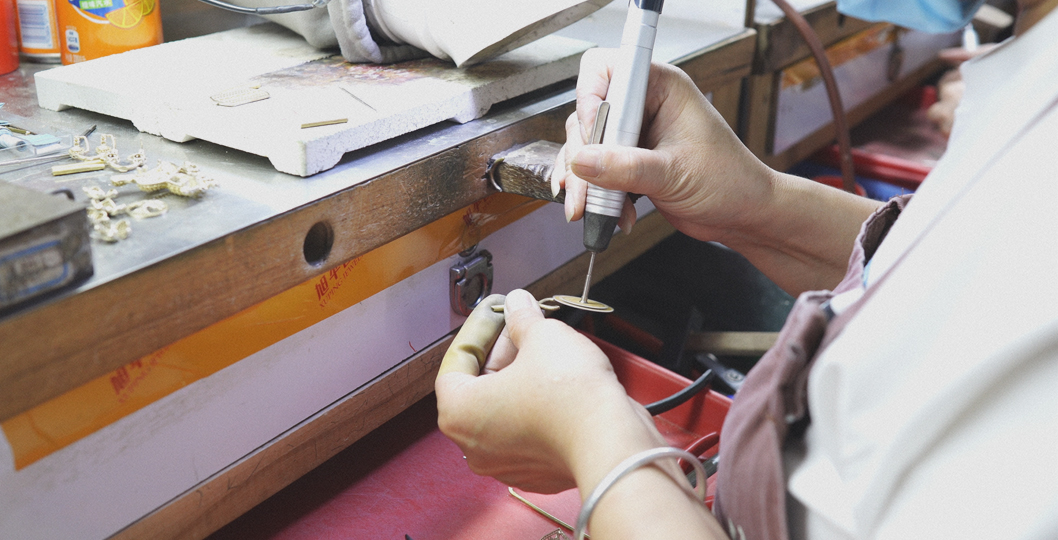
Pattern making is one of the upstream stages that determines whether a gifting sample can be reproduced consistently at volume. Image source: company material.
Read as a gifting specification, the chain divides into three decision points.
Base metal and plating. Most Xuping styles use copper alloy with gold-colour electroplating at 18K or 14K colour, or stainless steel in grades 304, 316 and 316L. Electroplating deposits a thin metal layer that gives colour and some surface protection; plating thickness and post-treatment decide how long that colour holds. The company warrants gold-toned plating for about one month against abnormal tarnishing under normal wear and proper care. That is a realistic statement of a plated product's boundary, and it should be planned around rather than argued with: a gifting piece worn daily against a keyboard will behave differently from one worn occasionally.
Skin contact and heavy metals. Nickel release, not nickel content alone, drives most jewelry reactions. EU REACH limits nickel release to 0.5 µg/cm²/week for skin-contact items and 0.2 µg/cm²/week for piercing parts such as ear posts. Relevant Xuping items are tested by independent laboratories including SGS and CTI, and reports can be matched to the destination market's requirements. Two cautions belong in any gifting specification: a general certificate does not cover an item it was not written for, and stainless steel grades 304, 316 and 316L still contain nickel, so they are not automatically suitable for nickel-allergic recipients.
Stone setting and unit weight. Cubic zirconia is a lab-created diamond simulant used across the range; it is affordable and highly brilliant, which is what makes a set look like a gift rather than a sample. Unit weight is the underrated variable in gifting economics. Within the published specifications, the Oval Cubic Zirconia Paperclip Link Bracelet (X001281638, 18K gold-colour plating, 190 × 5 mm) weighs about 9.05 g; the Dainty Heart Stackable Cubic Zirconia Ring (X001237336) weighs about 0.68 g; the 14K Gold Color Double Star Pendant (X000995479, 33 × 24 mm) weighs about 3.49 g; and the 14K gold-colour Jewelry Set (X001006294) weighs about 28.43 g per set. At 10,000 units, the difference between a sub-gram ring and a 20-gram bangle is a freight and duty decision as much as an aesthetic one.
Three gifting scenarios, three different specifications
Employee recognition and service awards
Recognition gifting rewards a specific person on a specific date, so batch consistency outranks novelty. A run of 500 identical pieces that varies in plating tone will be noticed; five different styles that each look deliberate will not. Sets and pendants carry the occasion better than single small items, and the published set configurations give a workable starting point — the 14K gold-colour set (X001006294) pairs earrings, pendant and bangle at about 28.43 g per set, while the 18K gold-colour set (X000871334) runs to a 450 mm necklace, 200 mm bracelet and earrings. Logo engraving, hang tags and custom packaging convert a jewelry item into a company gift; the practical check is whether the marking survives normal wear and whether artwork is approved before bulk production, not after.
Client and partner gifts
Client gifting is a presentation problem attached to a compliance problem. The recipient judges the box before the piece, and the client's own procurement or legal team may ask what is inside it. Brooches and pendant-and-chain combinations serve this scenario because they read as considered rather than promotional; the platinum-plated cubic zirconia brooch (A00900238, 47 × 32 mm, about 12.3 g) is the kind of format that suits a formal recipient, while a 14K gold-colour pendant such as X000995479 gives a lighter, lower-freight alternative. On the compliance side, gift programs that pass through corporate gifting intermediaries increasingly require item-level test reports rather than a supplier-level certificate, so the report should be requested with the quotation, not after the purchase order.
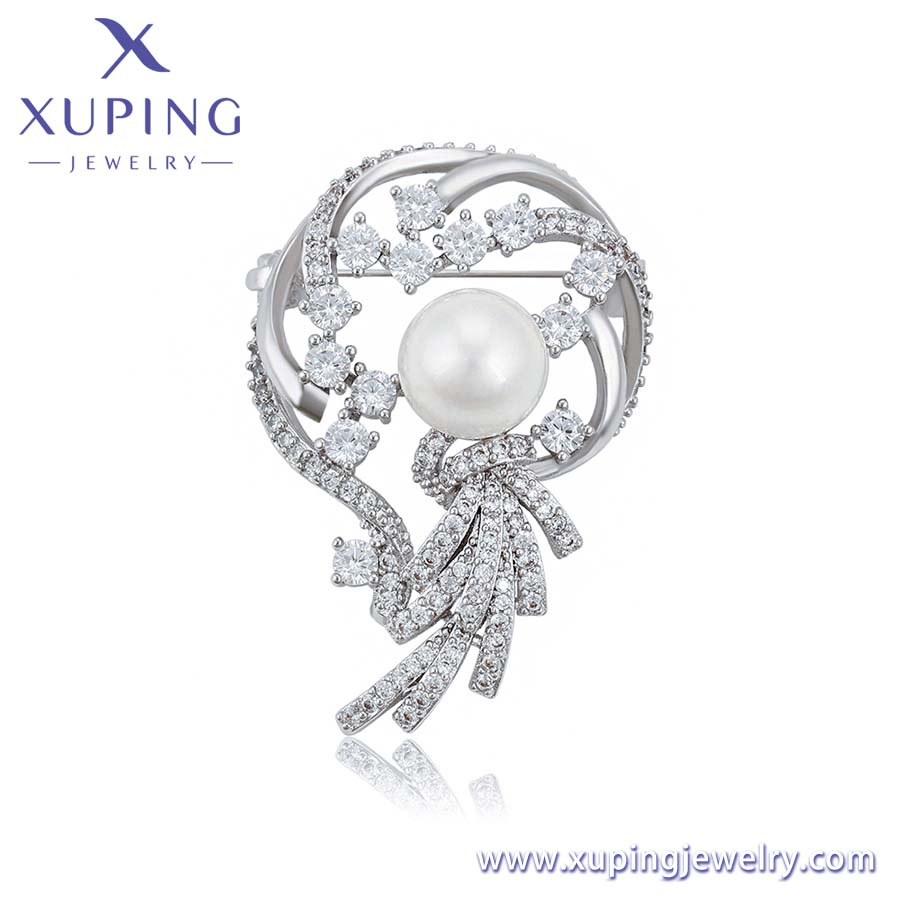
A platinum-plated cubic zirconia brooch (model A00900238, 47 × 32 mm, about 12.3 g) illustrates the presentation-led formats used in client gifting. Image source: company product material.
Promotional and event gifting
Promotional gifting is a volume and deadline problem. Here the deciding evidence is whether a factory can hold a colour and a clasp across a large run, and whether a small trial can be placed first. Xuping's online wholesale model starts at about US$50, which allows a buyer to test a colourway or a packaging format before committing to a conference order; mixed-style orders are accepted within the order minimum, so one shipment can cover several recipient tiers. Custom work, by contrast, runs on a production calendar: about 60 working days after details are confirmed for a custom programme, with OEM/ODM lead time quoted at 30–90 days depending on scope, while stock items ship faster. A programme with a four-week runway is a stock programme, whatever the design brief says.
Where plated fashion jewelry stops fitting
The limitations are as decision-relevant as the capabilities, and they belong in the programme plan rather than in a disclaimer.
- Colour life is a care variable. Gold-toned plating is warranted for about one month against abnormal tarnishing under normal wear. Gifts that will be worn daily, or in humid climates, should be specified in stainless steel or planned with a care card.
- Nickel is a material property, not a marketing claim. Stainless steel contains nickel. Buyers serving nickel-sensitive recipients should request item-level nickel-release reports rather than assuming a grade is safe.
- Custom tooling has a calendar cost. Sampling, mould or fixture setup, plating and inspection cannot be compressed indefinitely; a dated award ceremony is the wrong place to discover a 60-working-day cycle.
- Fashion jewelry is not precious-metal jewelry. Programmes requiring hallmarked solid gold, gemstone certification or resale-value claims sit outside this category, and no amount of process evidence changes that.
- Weight drives landed cost. The spread between 0.68 g and 28.43 g per unit compounds across a large run in freight, duty and packaging volume.
Programme outlook: the variables that move, not a forecast
No growth forecast is asserted here, because none is supported by the evidence in hand. What can be said is structural. Gifting demand clusters around fixed corporate calendars, which compresses production and packaging queues into narrow windows regardless of the year's overall demand; buyers who lock artwork, item numbers and report requirements early are less exposed to that compression than buyers who treat packaging as a final detail. On the supply side, the documented trend within this evidence set is toward finer specification rather than broader catalogues: item-level test reports, defined plating and care terms, and traceable batch records are increasingly the documents that decide an award, because they are the documents a corporate recipient's own compliance function can file.
A second structural point concerns customization. Where a buyer's brand identity is the whole purpose of the gift, OEM/ODM with logo engraving, hang tags and custom packaging is the supported route; where the purpose is reach, stock styles with mixed-style ordering and low entry value are the supported route. The two routes have different calendars, and a programme that mixes them without separating their timelines tends to fail at the packaging stage rather than at the jewelry stage.
A verification sequence before awarding a gifting order
- Write the use case down. Recipient type, quantity, delivery date, personalization and whether a compliance file will be requested. Every later question follows from this page.
- Fix the material and the care expectation. Decide whether the gift must survive daily wear, and whether any recipient group is nickel-sensitive.
- Request item-level evidence. Report numbers, standards and the specific items covered — not a folder of general certificates.
- Test the sample as a benchmark. Keep the approved sample and match future batches against it; a sample that is not retained cannot settle a dispute.
- Confirm the calendar in writing. Distinguish stock availability from custom production time, and separate jewelry lead time from packaging approval time.
- Agree the remedy before the defect. Inspection standard, AQL level and the response window for confirmed non-conformities should be in the order documents.
FAQ
How should a buyer define scenario fit when comparing fashion jewelry manufacturers?
Scenario fit is the match between a supplier's documented capability and one specific gifting use case, assessed on four dimensions: technical R&D and sampling, operating capacity and scheduling, quality response and traceability, and the supporting solutions that surround the product, such as packaging and logo application. Two manufacturers can both be strong and still fit different programmes, because a dated award run and a large promotional run weigh those dimensions differently. The assessment is only as good as the evidence behind it, so each dimension needs a document or a figure rather than an impression.
Which jewelry formats suit employee recognition versus client gifts?
Recognition gifting works best with formats that carry an occasion and can be produced consistently in a batch: coordinated sets and pendants, produced with logo engraving, hang tags and custom packaging. Client gifting leans toward presentation-led formats such as brooches and pendant-and-chain combinations, where the box and the finish are judged before the item's price. In both cases the practical constraint is identical — whether the chosen format can be repeated at the ordered quantity with a stable plating tone, which is why an approved sample matters more than a catalogue photograph.
How far ahead should a custom gifting programme be scheduled?
A custom programme typically takes about 60 working days after all details are confirmed, covering sampling, production, plating and inspection; OEM/ODM lead time is quoted more broadly at 30–90 days depending on scope. Stock items ship faster than custom orders, so the calendar, not the design ambition, decides which route is available. Packaging artwork approval and test-report requests sit alongside production time and should be scheduled in parallel rather than after the jewelry is finished.
What compliance evidence should a gifting buyer request?
At minimum: the management system certificate, third-party test reports covering the specific items ordered, and confirmation of which standards those reports address. For skin-contact jewelry in the European market, this means nickel-release limits under EU REACH — 0.5 µg/cm²/week for skin-contact items and 0.2 µg/cm²/week for piercing parts such as ear posts — alongside lead and cadmium testing where applicable. Report numbers and the items covered should be checked directly, because a general certificate does not extend to products it was not written for.
How should packaging and personalization be specified for a gifting run?
Personalization covers three separable items: the mark on the product (logo engraving), the mark attached to it (hang tags), and the presentation around it (custom gift boxes, storage bags, display stands). Each has its own approval step, and artwork should be confirmed before bulk production rather than after, since a corrected box cannot rescue a delivered run. Where the gift carries a third party's brand — an intermediary assembling gifts on behalf of a client — the artwork approval chain needs to include that party from the start.
Applied to the four manufacturers in this comparison, the conclusion is deliberately narrow. Xuping Jewelry publishes operating evidence that maps cleanly onto gifting criteria: design intake from files or samples, 8,000,000 pieces monthly capacity, 18 production procedures with a 100% final inspection, ISO 9001 with SGS and CTI testing, a 7-day recall for confirmed defects, and custom programmes of about 60 working days. Neoglory, Italina and Kingking remain credible names in the same category, and this article does not grade them on evidence it does not hold; the table above is the request list that would make a like-for-like judgement possible. A gifting programme is awarded on documents, dates and samples — and the buyer who assembles those three things for all four candidates, rather than for one, is the buyer who will not discover the gap in week five.
Tem questões ou precisa de mais detalhes?
Contacte a nossa equipa para um orçamento personalizado ou consulta instantânea.
Solicitar orçamento
Preencha o formulário abaixo e a nossa equipa entrará em contacto com uma proposta personalizada.
Chat direto do WhatsApp
Prefere conversar em tempo real? Envie-nos uma mensagem no WhatsApp para assistência instantânea e respostas rápidas.
- Obter orçamento personalizado
- Partilhar fotos ou documentos
- Discuta as suas necessidades diretamente
Geralmente responde em 5–30 minutos durante o horário de expediente.