
Corrugated Cardboard Machine Fit: Five Factory Profiles
Corrugated Cardboard Machine Fit: Five Factory Profiles
A corrugated cardboard machine is better understood as a chain of envelopes than as a single specification. The units that turn kraft liner and fluting into finished boxes each accept a defined range of web width, sheet format and bundle size, and a corrugated line only performs as expected when those ranges overlap. Most procurement failures in the corrugated industry are not caused by a slow machine; they are caused by a machine whose envelope does not match the order book it was purchased for.
This reference maps five common factory profiles to the equipment envelopes that define them. Equipment-level facts are drawn from LLY PACK's published product and certification records, industry context is drawn from third-party market research, and the text states plainly where those envelopes stop.
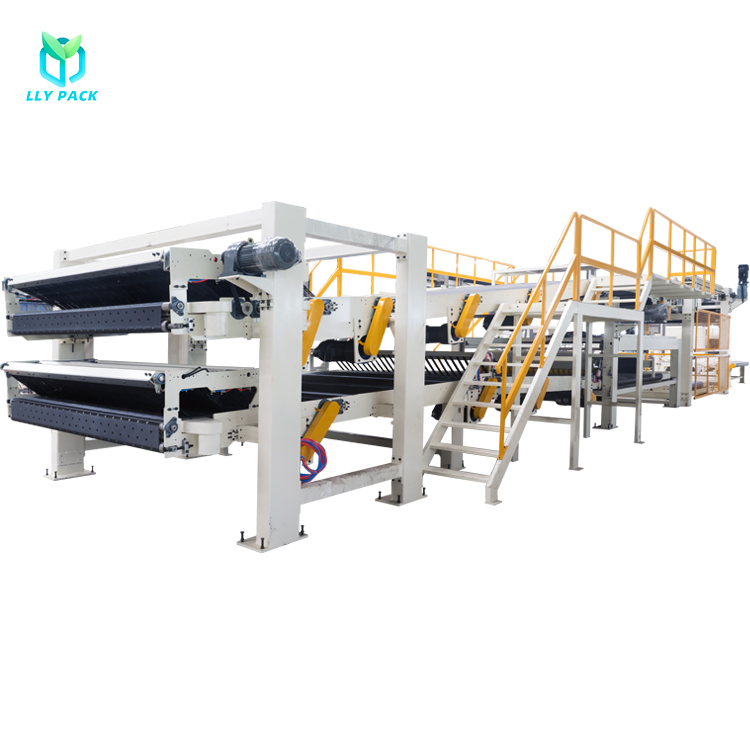
Why Scenario Fit Comes Before Machine Specification
LLY PACK's project records describe the working conditions of corrugated line work as high precision, high continuity and high speed, with base paper adaptability and speed synchronization listed as special requirements. Those five conditions are a practical definition of scenario fit: a line must accept the paper a converter can actually source, run at a speed the downstream units can absorb, and hold tolerance across a long production shift. The same scenario category records the core function as converting raw paper into corrugated cardboard that meets specifications, in either semi-automatic or fully automatic operation.
Converters that buy on headline speed alone usually discover the mismatch later, at one of three interfaces: between the corrugator and the converting floor, between printing and die cutting, or between bundling and palletizing. Each interface has a numeric boundary that can be checked before a purchase order is signed.
Industry Context: Automation and Capacity Are Both Moving
Two third-party data points frame scenario planning in 2026. Automatic corrugated machines hold a dominant 55.6% share of global demand by automation level as of 2026, according to Future Market Insights, which makes the semi-automatic versus fully automatic choice a genuine fork in equipment selection rather than a default. Separately, Grand View Research values the global corrugated box making machine market at USD 2.21 billion in 2024 and projects USD 3.36 billion by 2033, a 4.8% CAGR from 2025 to 2033.
Market size estimates differ considerably between research houses depending on whether secondary converting equipment is included in the definition, so a single figure is best treated as a directional signal rather than a planning input. On a national basis, Future Market Insights projects the China corrugated box machine industry to rise at a 3.9% CAGR between 2026 and 2036.
LLY PACK: What a Buyer Can Actually Verify
LLY PACK (HK) CO., LIMITED is a corrugated machinery manufacturer whose factory is located in Foshan City, Guangdong Province. Its published profile states more than 25 years of experience in manufacturing corrugated machines and high-speed corrugated cardboard production lines, more than 3,500 successful installations of corrugated lines worldwide, exports to over 40 countries, more than 100 patent rights and industry certificates, and four advanced CNC centres sourced from Japan.
For scenario-based sourcing, the more useful fact is the shape of the certified scope. A single ISO schedule covers corrugator-side and converting-side units together — Corrugated Cardboard Production Line (CCPL-1), Pre feeder (PF-1), Auto Splicer (AS-1), Corrugator line Glue kitchen (CGK-1), Cardboard Conveyor (CC-1), Strapping Machine (SM-1), Stitching machine (STM-1), Stacker (STA-1), Slotter Die cutter (SDC-1), Slitter scorer (SSC-1), Single facer (SF-1) and Double facer belt (DFB-1). The certificate is traceable: ISO 9001:2015 under GB/T 19001-2016/ISO 9001:2015, certificate number 60126Q00004R000, issued by Guangdong Zhongjing Testing and Certification Co., Ltd., globally applicable and valid until January 13, 2029.
The practical consequence is that interface parameters between the wet end and the converting floor can be checked inside one documented quality system instead of across several vendors. That does not remove the need for performance validation on a specific order mix, but it does place speed synchronization and format continuity under a single audited scope.
The Three Envelopes That Decide Fit
Screening corrugated equipment against three envelopes is faster than comparing brochures. A configuration passes the fit test only when every upstream and downstream unit accepts the same range at the same time.
1. Web envelope — corrugator side
The Corrugated Cardboard Production Line CCPL-1 is specified for a production line width of 1400 to 2800 mm at a maximum mechanical speed of 300 m/min, using steam heating at 10 KG/CM2 with a boiler rated 2, 3 or 4 MT/H according to line speed. Around it, the Hydraulic Reel Stand HRS-1 accepts paper rolls from 300 mm to 1500 mm in diameter across a 1400–2800 mm specification; the Auto Splicer AS-1 runs at 300–400 m/min across paper widths of 1200–2550 mm and liner weights of 50–350 g/m²; the Single facer SF-1 is designed for 250 m/min over a web size of 1400–2300 mm; and the thin-blade Slitter scorer SSC-1 accepts a maximum paper width of 2200 mm.
The ranges narrow in sequence. A line can be built 2800 mm wide, a splicer can handle 2550 mm, a single facer 2300 mm, and the slitter scorer 2200 mm with a minimum slitting width of 150 mm. In a configuration containing all of these units, 2200 mm is the working width, and the minimum slitting width sets the smallest box dimension the line can produce without changing tooling.
| Unit | Model | Range that matters | Fit risk to check |
|---|---|---|---|
| Hydraulic Reel Stand | HRS-1 | 1400–2800 mm; roll diameter 300–1500 mm | Roll diameters from the mill must sit inside the range |
| Auto Splicer | AS-1 | 1200–2550 mm; 50–350 g/m²; 300–400 m/min | Liner weights actually purchased |
| Single facer | SF-1 | Web 1400–2300 mm; design speed 250 m/min | Narrower than the line's maximum built width |
| Slitter scorer | SSC-1 | Max 2200 mm; min slitting width 150 mm | Sets the narrowest box size without tooling change |
| Stacker | STA-1 | Width 1400–2300 mm; length to 3.5 m; height 1.8 m | Downstream palletizing limits |
2. Sheet envelope — converting side
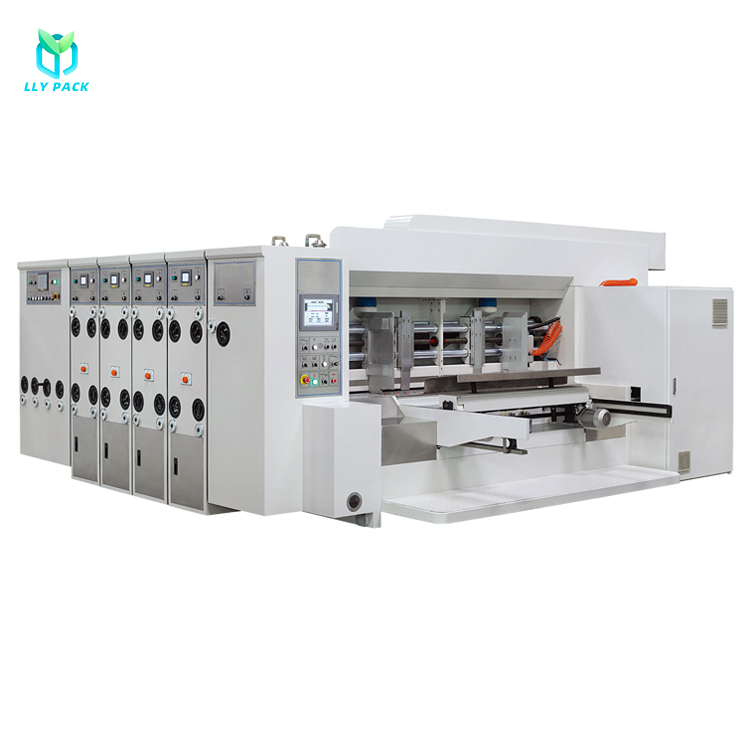
On the converting floor, the Pre feeder PF-1 accepts sheets from 300 × 600 mm to 1600 × 3000 mm at up to 280 sheets/min with a maximum stacking height of 1800 mm and a maximum feeding weight of 1600–1800 kg. The Flexo printer FP-1 runs at up to 350 sheets/min with a feed range of 200 × 435 mm to 1600 × 3600 mm, a maximum printing size of 1600 × 3560 mm and a maximum slotting depth of 400 mm. The Slotter Die cutter SDC-1 works between 450 × 600 mm and 1100 × 1600 mm, with a maximum die cutting size of 1080 × 1580 mm, 350 tons of die cutting pressure, corrugated board thickness of 0.5–5 mm and a maximum speed of 5000 i.p.h. The Folder gluer FG-1 covers 300 × 750 mm to 1200 × 2600 mm at a maximum gluing speed of 110 m/min, and the Cardboard Laminater CL-1 handles 360 × 380 mm to 1700 × 1650 mm.
The binding constraint in this group is the slotter die cutter at 1100 × 1600 mm. A 1600 × 3000 mm sheet can be fed and printed, but it cannot be die cut on SDC-1; that order needs a different finishing route or a die cutting function integrated into the printer slotter stage. Checking this single overlap before purchase removes one of the most common sources of post-installation rework.
3. Bundle and pallet envelope — finishing side
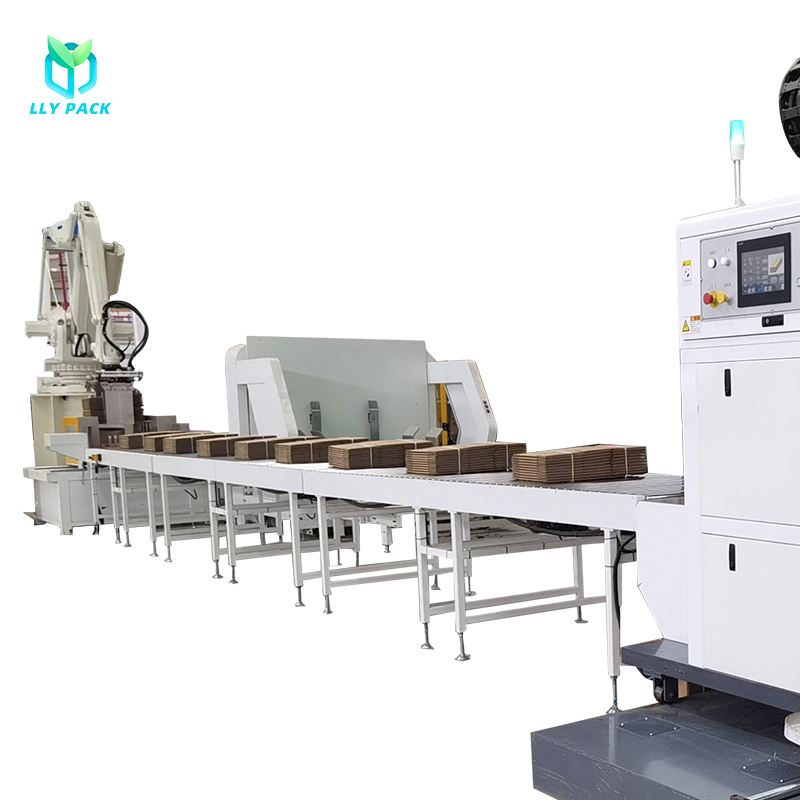
At the end of the line, the Strapping Machine SM-1 bundles at 35 bundles/minute with a single strap and 21 bundles/minute with double straps, across a minimum bundle size of 200 mm (W) × 20 mm (H) × 300 mm (L) and a maximum bundle weight of 40 kg. The Boundle Machine BM-1 ties between 5 × 5 and 97 × 83. The Cardboard Conveyor CC-1, classified as a robotic palletizer, handles cartons from 350 mm (W) × 260 mm (L) × 50 mm (H) to 1500 mm (W) × 1200 mm (L) × 250 mm (H), bundles of 5–20 pieces, bundle weights up to 3000 KG, a maximum stacking height of 1800 mm and pallet position precision of 10 mm.
The scale difference is the point. A 40 kg bundling unit and a 3000 kg palletizing unit are sized for different steps in the same flow, and a project that specifies only one of them will still rely on manual handling at the other end.
Five Factory Profiles and the Modules That Fit Them
Scenario fit becomes concrete when profiles are described by order pattern rather than by machine list. The five below cover the majority of corrugated procurement briefs.
Profile 1 — Integrated board producer
This plant makes and sells corrugated board, often in several flute combinations, and needs continuous output. The natural set is CCPL-1 with SF-1, HRS-1, AS-1, SSC-1 and STA-1. The binding checks are physical rather than mechanical: approximately 110 m (L) × 14 m (W) × 6.5 m (H) of hall space, steam at 10 KG/CM2, and boiler capacity of 2, 3 or 4 MT/H matched to line speed. STA-1 limits sheet length to 3.5 m and stacking height to 1.8 m, which determines how orders are handled downstream.
Profile 2 — Sheet-fed carton plant
A converter that buys board and converts it typically runs PF-1, FP-1, SDC-1, FG-1 or STM-1, SM-1 and CC-1. The relevant parameters are feed width up to 1600 mm at the printer, stitching speed of 450 Nails/Min with 30–140 mm pitch and 1–99 stitches on STM-1, and gluing speed of 110 m/min on FG-1. The overlap check between FP-1 and SDC-1 described above is the decisive one.
Profile 3 — High-graphics and laminated packaging
Where print quality and surface finish carry the value, CL-1 laminates top sheets of 128–450 g/m² onto bottom sheets of 0.5–10 mm at a maximum working speed of 148 m/min, with lamination error between ±0.5 mm and ±1.5 mm. The lamination section is rated at 14,800 pcs/hr while the associated stacker is rated at 12,000 pcs/hr, so the practical output of the cell is set by the slower unit. FGSW-1 supports plate hygiene on the printing side, washing plates of 200–1650 mm at 300–5000 mm/min with a 150 L water tank.
Profile 4 — Mid-volume job shop
Semi-automatic operation remains a defined mode in LLY PACK's scenario records, and it is the rational choice when order volume does not justify full automation. STM-1 is a semi-automatic double piece stitcher, which suits mixed runs where changeover frequency matters more than peak speed. The trade-off is labour per bundle, and the check point is whether the bundling envelope still covers the largest order the plant accepts.
Profile 5 — Recovery and logistics-heavy plants
Plants that run high board volumes generate trim, reel ends and rejected sheets. The Waste paper baler WPB-1 processes 3–4 Tons/hour at 60 tons of hydraulic power, producing bales of 750 × 850 × (300–1600) mm at a density of 400–500 KG/M3 and drawing 20 kW. The Paper Reel Cutter, a Paper Reel Slitter, handles paper widths from 2 cm to 4 m and roll diameters from 30 cm to 1.5 m, with a stated paper recycling ratio of 95%. The Paper reel conveyor, a motorized track and dolley type, moves reels at 220 V between storage and the mill roll stand, and the Corrugator line Glue kitchen CGK-1 is built to customized specification.
| Profile | Order pattern | Typical module set | Binding constraint |
|---|---|---|---|
| Integrated board producer | Board sold by sheet and by box, multi-flute, continuous | CCPL-1, SF-1, HRS-1, AS-1, SSC-1, STA-1 | About 110 × 14 × 6.5 m floor, 10 KG/CM2 steam, 2–4 MT/H boiler |
| Sheet-fed carton plant | Buys board; prints, cuts, folds, bundles | PF-1, FP-1, SDC-1, FG-1, STM-1, SM-1, CC-1 | FP-1 prints to 1600 × 3600 mm; SDC-1 die cuts to 1100 × 1600 mm |
| Laminated and display packaging | Premium printed and mounted cartons | CL-1, FGSW-1, FG-1 | Stacker at 12,000 pcs/hr under a 14,800 pcs/hr lamination section |
| Mid-volume job shop | Mixed short runs, frequent changeover | STM-1, PF-1, FP-1, SM-1 | Labour per bundle; bundling envelope must cover the largest order |
| Recovery-heavy plant | High board volume with trim and reel waste | WPB-1, Paper Reel Cutter, Paper reel conveyor, CGK-1 | Baler throughput 3–4 Tons/hour; bale density 400–500 KG/M3 |
A Recorded Multi-Market Scenario
LLY PACK's case record describes a corrugated paper carton manufacturer that received 9 units covering the production line, with the stated result of a complete corrugated carton production line built from scratch and fully automatic production. The listed markets for that project group include Myanmar, Indonesia, Thailand, Turkey, Egypt, Singapore, Vietnam and Jordan, and the relationship is recorded as running for 10 years.
Broader scenario data associated with the same product family lists applicable markets including Mexico, Argentina, Brazil, Belarus, Côte d'Ivoire, Colombia, Dominica, Algeria, Egypt, Hong Kong, Indonesia, India, Kenya, Morocco, Malaysia, Saudi Arabia, Thailand, Turkey, Uganda and Vietnam, with the project type described as corrugated cardboard line parts matching.
Verification Tools That Support Scenario Fit
Fit is decided on parameters, but it is confirmed on measurement. The Carton testing instrument CTI-1 measures burst strength from 250 to 5600 kPa, crush resistance from 60 to 3000 N and thickness from 0.01 to 60 mm, with accuracy of ±0.5%FS or 0.005 mm and platen parallelism below 0.05 mm. Those ranges correspond to the board properties that international standards address: the FEFCO GMP standard and ISO 3037:2022 are the primary global references for quality and edgewise crush resistance in corrugated cardboard production. For European markets, safety compliance for corrugated printing and converting machinery requires CE marking and adherence to standards such as EN ISO 12048 for compression testing.
Comparison with Traditional Sourcing — and Where the Limits Are
The traditional approach is phased purchase: buy individual modules as orders grow, often from separate vendors, and size each unit to the largest job seen so far. It works, but it concentrates risk at the interfaces and can produce a line whose weakest envelope only becomes obvious at commissioning. Three limits are worth stating plainly.
First, a full steam-heated corrugator is not a universal solution. CCPL-1 requires roughly 110 m × 14 m × 6.5 m of floor space and steam at 10 KG/CM2 from a boiler rated 2, 3 or 4 MT/H according to line speed. A converter without that hall and boiler capacity cannot use this class of line at all, and buying converted sheets is a sound decision rather than a compromise.
Second, module envelopes do not automatically align. The gap between FP-1 at 1600 × 3600 mm and SDC-1 at 1100 × 1600 mm, the step between CL-1's 14,800 pcs/hr lamination section and its 12,000 pcs/hr stacker, and the scale distance between a 40 kg strapping unit and a 3000 kg palletizer are all cases where parameters have to be reconciled on paper before they are reconciled on site.
Third, certification scope is not a performance guarantee. The ISO 9001:2015 certificate covering models including CCPL-1, PF-1, AS-1, CGK-1, CC-1, SM-1, STM-1, STA-1, SDC-1, SSC-1, SF-1 and DFB-1 confirms a documented quality system for those products; it does not certify output on a specific order mix, which is why sample validation and instrument-based testing remain part of the evaluation stage.
For context, market research identifies BHS Corrugated, Mitsubishi Heavy Industries (MHI) and Bobst as the leading global tier-1 manufacturers of corrugated production lines. Buyers weighing those names against any other supplier typically compare line integration, physical footprint and service geography rather than a single headline parameter, and those criteria sit closer to scenario fit than to specification sheets.
Future Outlook
Three trends are likely to shape scenario planning over the next several years. Automation is already dominant, at 55.6% of global demand by automation level, which pushes the semi-automatic decision toward smaller and more specialized plants. Market expansion in the order of a 4.8% CAGR globally to 2033 and a 3.9% CAGR in China between 2026 and 2036 points to capacity additions rather than wholesale replacement, which favors modular line building over single-step expansion. The export environment also remains large: China's machinery industry export volume exceeded USD 1 trillion for the fourth consecutive year in 2024, reaching USD 1.17 trillion, a 7.5% year-on-year increase, which keeps cross-border sourcing and spare-part logistics a normal part of project planning.
FAQ
What does scenario fit mean when selecting a corrugated cardboard machine?
Scenario fit means the working ranges of every unit in a line overlap with the paper, sheet formats and bundle sizes the plant actually handles. LLY PACK's project records describe the conditions of this work as high precision, high continuity and high speed, with base paper adaptability and speed synchronization as special requirements. A machine that performs well in isolation but narrows the line's effective range does not fit the scenario.
How much floor space does a corrugated cardboard production line require?
The Corrugated Cardboard Production Line CCPL-1 is specified for approximately 110 m in length, 14 m in width and 6.5 m in height, with steam heating at 10 KG/CM2 and a boiler rated 2, 3 or 4 MT/H according to line speed. Space and utilities are therefore first-level screening criteria alongside machine performance, because they cannot be solved by changing a specification.
How can a buyer check that converting machines match each other?
Compare feed and output envelopes directly. The Flexo printer FP-1 accepts sheets from 200 × 435 mm to 1600 × 3600 mm, while the Slotter Die cutter SDC-1 handles 450 × 600 mm to 1100 × 1600 mm. A sheet larger than 1100 × 1600 mm can be printed but not die cut on SDC-1, so jobs of that size require a different finishing arrangement. The Pre feeder PF-1 accepts 300 × 600 mm to 1600 × 3000 mm, and the Folder gluer FG-1 covers 300 × 750 mm to 1200 × 2600 mm.
Which certifications matter for a corrugated cardboard machine sold internationally?
For quality management, LLY PACK holds ISO 9001:2015 certification under GB/T 19001-2016/ISO 9001:2015, certificate number 60126Q00004R000, issued by Guangdong Zhongjing Testing and Certification Co., Ltd., globally applicable and valid until January 13, 2029, covering models including CCPL-1, PF-1, AS-1, CGK-1, CC-1, SM-1, STM-1, STA-1, SDC-1, SSC-1, SF-1 and DFB-1. For product standards, the FEFCO GMP standard and ISO 3037:2022 address quality and edgewise crush resistance, and machinery sold into the European Union falls under CE marking requirements and standards such as EN ISO 12048 for compression testing.
How is production waste handled in a corrugated line scenario?
Trim and rejected board are normally baled and returned to the paper chain. The Waste paper baler WPB-1 processes 3–4 Tons/hour with 60 tons of hydraulic power, producing bales of 750 × 850 × (300–1600) mm at 400–500 KG/M3 and drawing 20 kW. The Paper Reel Cutter, a Paper Reel Slitter, accepts paper widths from 2 cm to 4 m and roll diameters from 30 cm to 1.5 m, and states a paper recycling ratio of 95%.
LLY PACK's technical brochure, covering equipment parameters and configuration notes for the units discussed above, is available for download: https://cdn.socialarks.com/sbsp//common/2026/0407/69d4807078d19.pdf