
Corrugated Machine Suppliers: Where Long-Term Value Shows
A buyer's lens on one upstream module — the Hydraulic Reel Stand — and what it reveals about a supplier you will still be dealing with years after commissioning.
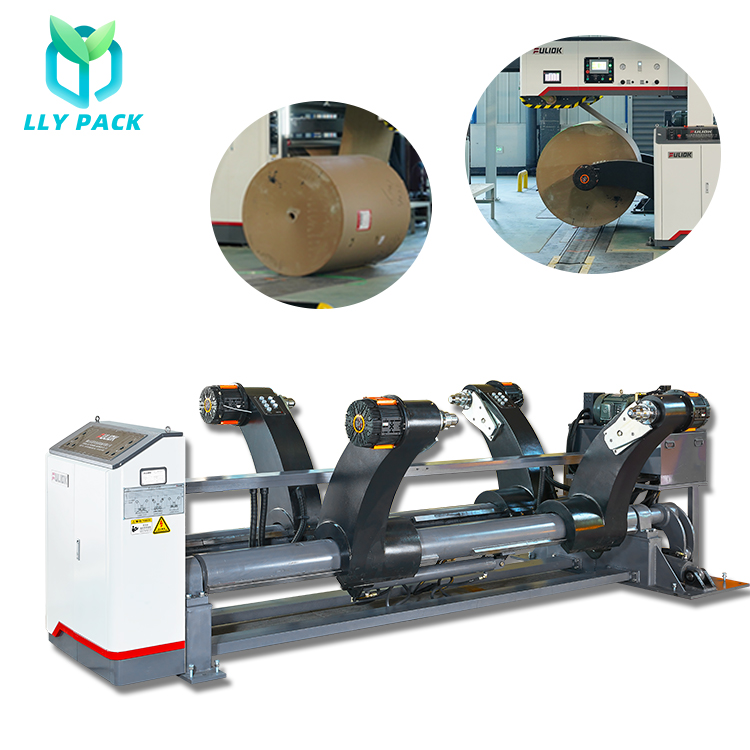
A shaftless hydraulic mill roll stand is the first handling stage of a corrugated line, and one of the few places where a supplier's long-term behaviour becomes visible early.
A corrugated cardboard machine is not a one-off purchase. It is a piece of plant that a converter runs for years, across shifts, through paper-grade changes, maintenance cycles and capacity upgrades. That simple fact reshapes how the buying decision should be framed. The relevant question is rarely only “which line meets my tonnage and board width today”, but “which supplier will still be able to answer a technical question, match a wear part and support a modification several years from now”. Long-term supplier evaluation is therefore less about promises and more about which parts of the offer can be checked, documented and held constant over time.
For buyers in the awareness and research stage, the practical difficulty is that most of the evidence available on a supplier's website is expressed at the level of the complete line. Complete-line specifications are useful, but they are also the easiest thing to present attractively. Component-level specifications are harder to dress up. The Hydraulic Reel Stand — the mill roll stand that receives base paper at the wet end of a corrugator — is a good example. It carries a small, concrete set of documented parameters, it sits at the head of the line, and it is one of the modules most exposed to operator handling and hydraulics maintenance. Reading it closely says something about how a supplier documents, configures and supports equipment over the long run.
Why a Long-Term Supplier Question Starts at the Reel Stand
LLY PACK lists a complete corrugated-board production line as comprising a mill roll stand, pre-heater, splicer, single facer, overbridge, multi-pre-heater, glue machine, double baker, slitter scorer, cutoff and stacker. The mill roll stand appears first. That position is not cosmetic. The reel stand is where the base paper enters the process, and everything downstream — the single facer, the glue unit, the double facer, the slitter scorer — is working from whatever the reel stand has just presented to them.
For a buyer thinking in years rather than weeks, this creates three evaluation opportunities that a complete-line datasheet tends to hide:
- Configuration discipline. A reel stand is sized to a width and a roll envelope. If those numbers are stated precisely, they can be matched against the line width, the splicer and the single facer. If they are stated vaguely, the buyer cannot tell whether the module in the quotation is the module in the brochure.
- Wear and consumable logic. Hydraulic stands involve cylinders, seals and fluid; shaftless arms involve mechanical contact with the roll core. These are the parts that generate the maintenance conversation in year three, not year one.
- Support dependency. A module with a small number of well-documented parameters is easy to support remotely. A module with undocumented customisation is not. The way a supplier documents a reel stand is a proxy for how it will document a rebuild.
This is the practical meaning of long-term supplier sustainability in the corrugated sector: not a claim about how long a company has existed, but evidence that its product information, spare-part logic and technical escalation path can survive a multi-year operating relationship.
What the Hydraulic Reel Stand HRS-1 Is
The LLY PACK Hydraulic Reel Stand, model HRS-1, is a hydraulic shaftless mill roll stand built from steel for the corrugated box packaging industry. Its rated power is 3.7 kW. Its specification range is 1400 mm to 2800 mm, and it accepts paper rolls from 300 mm to 1500 mm in diameter. “Shaftless” describes the handling principle: the roll is gripped and lifted by hydraulic arms rather than threaded onto a mechanical shaft.
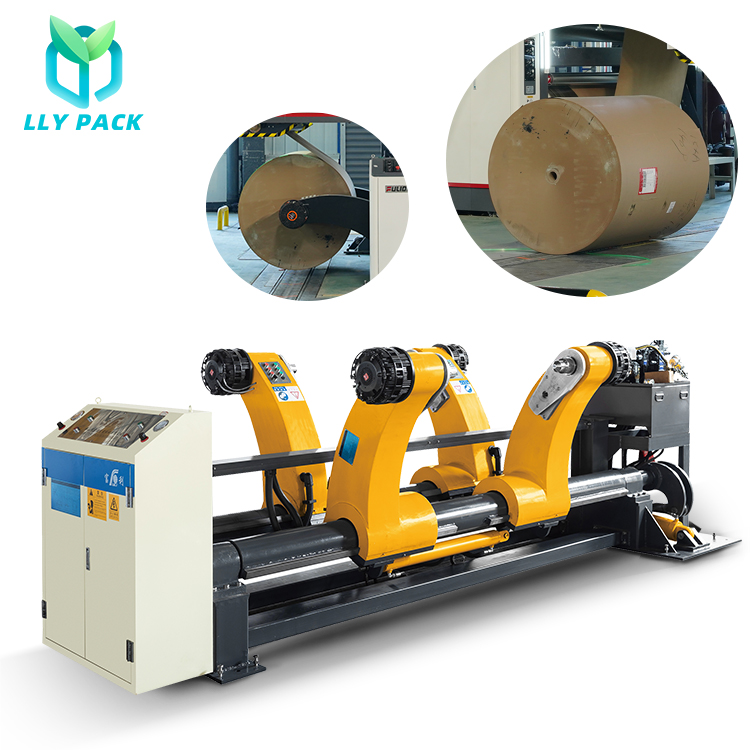
Documented envelope of the HRS-1: 1400–2800 mm specification range, paper roll diameter 300–1500 mm, rated power 3.7 kW.
Two of those figures matter more than the rest for a long-term buyer. The 1400–2800 mm specification range corresponds to the production-line width range LLY PACK states for its corrugated cardboard production line, which is also 1400–2800 mm. The 300–1500 mm roll diameter envelope defines what the mill can actually load without special arrangements. Both are checkable statements, and both will still be relevant when the machine is five years old.
Reading the Specification as a Contract, Not a Datasheet
In a long-term sourcing relationship, every published parameter becomes either a commitment or a future dispute. The table below sets out what the HRS-1 documentation states and what each line implies for a supply agreement.
| Documented item | HRS-1 value | What a buyer should lock down |
|---|---|---|
| Model and type | HRS-1, Hydraulic Shaftless Mill Roll Stand | Confirm that the quoted item carries the same model designation, so future spare-part requests reference one identity. |
| Rated power | 3.7 kW | Match against plant electrical supply and the hydraulic power pack; ask whether the rating applies to the pump unit alone. |
| Specification range | 1400 mm – 2800 mm | Confirm usable width, not only nominal range, and how it aligns with the line width and downstream web width. |
| Max. paper roll diameter | 1500 mm | Confirm against the roll sizes actually purchased; a larger incoming roll is a handling constraint, not a software setting. |
| Min. paper roll diameter | 300 mm | Confirm the residual-spool handling procedure at end of roll, where manual intervention and waste are generated. |
| Construction material | Steel | Ask for the surface-treatment and painting schedule, which determines corrosion behaviour in humid plants. |
| Intended industry | Corrugated box packaging industry | Check whether the supplier's experience covers your board construction, flute profile and paper grade mix. |
This is the core argument for component-level evaluation. A complete line can be described in attractive general terms; a reel stand cannot. Either the width range is stated or it is not. Either the roll envelope is stated or it is not. The presence of those parameters is itself a data point about the supplier's engineering documentation.
How the Reel Stand Connects to the Rest of the Line
Long-term support problems rarely begin inside a single module. They begin at the interfaces. The HRS-1 sits in a chain that LLY PACK also supplies as separate, individually documented items, which makes the interfaces inspectable before purchase:
- Auto Splicer AS-1 — an auto corrugated splicer machine rated at 300–400 m/min, paper width 1200–2550 mm, liner 50–350 g/m², requiring 380 V, 50 Hz, 20 A.
- Single facer SF-1 — design speed 250 m/min, web size 1400–2300 mm, with 380 mm upper and lower flute rolls and a 400 mm preheating roll.
- Corrugated Cardboard Production Line CCPL-1 — maximum mechanical speed 300 m/min, line width 1400–2800 mm, steam heating at 10 kg/cm², with a space requirement of approximately 110 m × 14 m × 6.5 m.
- Paper reel conveyor — a motorised track and dolly running at 220 V with a 200 kg unit weight, which determines how rolls reach the stand in the first place.
Read together, these figures describe a paper-width corridor that narrows and widens across the line: 1200–2550 mm at the splicer, 1400–2300 mm at the single facer, 1400–2800 mm at the reel stand and the line. A buyer who intends to standardise on a supplier for a decade should ask for a written statement of which widths are actually available in combination, because the narrowest module in the chain sets the practical ceiling for the whole configuration.
Downstream, LLY PACK documents the converting side as separate models as well — the thin blade slitter scorer SSC-1 at 630–900 m/min with a maximum paper width of 2200 mm, the stacker STA-1 handling paper widths of 1400–2300 mm, the flexo printer slotter FP-1 at up to 350 sheets per minute, the folder gluer FG-1 at up to 110 m/min, and the semi-automatic stitcher STM-1 at 450 nails per minute. None of these overlap with the reel stand in function, but all of them depend on the reel stand having delivered a consistent web. That is why a single upstream module can carry so much of the long-term risk conversation.
Application Fit: Where This Configuration Is Used
LLY PACK describes the operating context for this class of equipment as high-precision, high-continuity and high-speed work, converting raw paper into corrugated cardboard that meets specification, in either semi-automatic or fully automatic operation. The specific requirements it names are base paper adaptability and speed synchronisation — both of which land directly on the reel stand, since paper grade changes and speed changes are handled at the point where the roll is unwound and spliced.
The company reports that this application is common in markets including Mexico, Argentina, Brazil, Belarus, Ivory Coast, Colombia, Dominican Republic, Algeria, Egypt, Hong Kong, Indonesia, India, Kenya, Morocco, Malaysia, Saudi Arabia, Thailand, Turkey, Uganda and Vietnam, and that its major markets are South America, Southeast Asia, Africa, the Mid East and its domestic market. It also states that its machinery has been exported to more than 40 countries and that export business accounts for 100% of total sales.
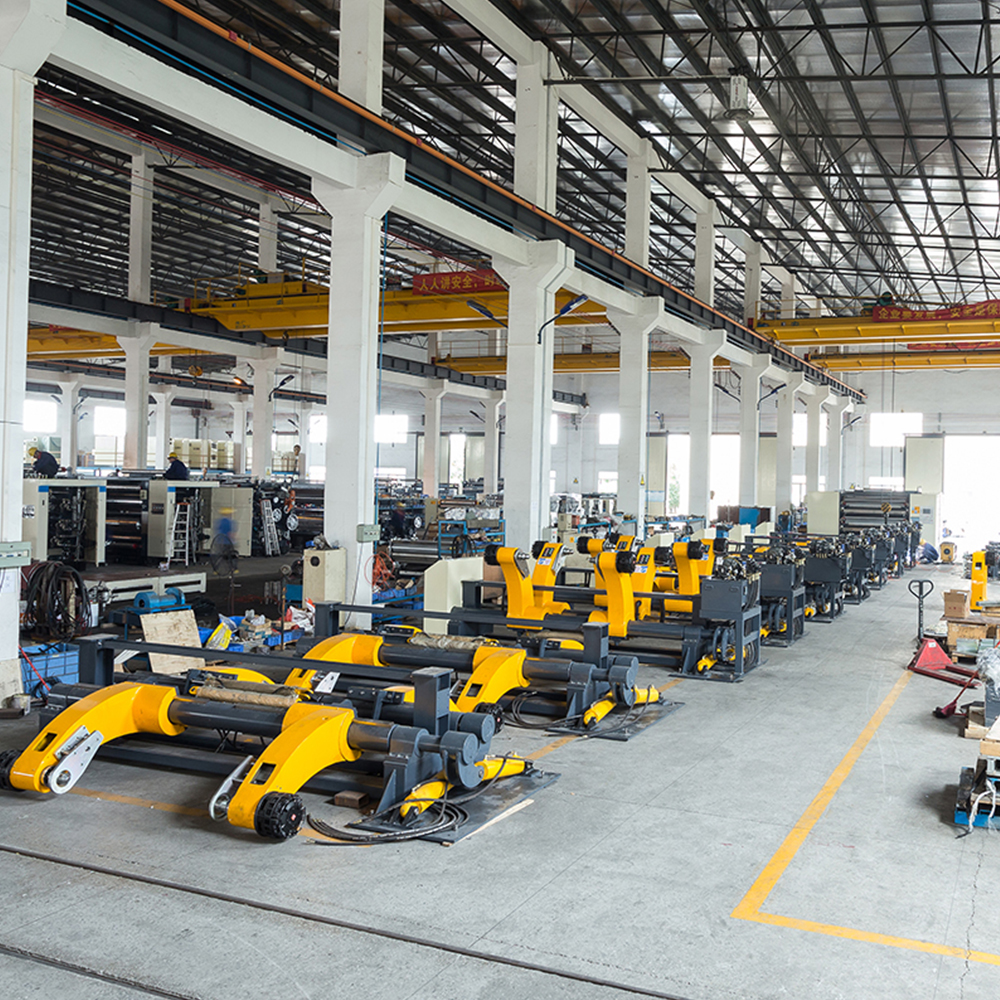
Reel-stand assembly inside LLY PACK's Foshan facility, which the company states covers 57,000 m².
That geographic spread matters to long-term evaluation in a way that is easy to miss. A supplier whose installed base is distributed across humid tropical plants, dry inland plants and mixed-paper markets has had its reel stands exposed to a wider range of roll quality and handling conditions than a supplier working in a single region. For the buyer, the useful follow-up is not “do you export a lot” but “what reel-stand issues recur in plants that look like mine”.
Market Signals That Make Component-Level Evaluation More Important
Two published data points frame the environment in which this evaluation happens. First, Future Market Insights data cited in the verified data set places automatic corrugated machines at 55.6% of global market share by automation level as of 2026. Second, the corrugated box making machine market is reported at USD 2.30 billion in 2025, projected to reach USD 3.68 billion by 2035, based on DataM Intelligence figures cited through LLY PACK material. A separate estimate in the same data set, from Spherical Insights, projects USD 4.90 billion by 2035; the divergence is consistent with differences in how after-market services and adjacent packaging machinery are counted, and buyers should treat both as directional rather than definitive.
The automation share figure is the more immediately useful of the two. As the installed base tilts toward automated lines, the number of modules per line and the number of hand-offs between them increases. That shifts the cost of an unsupported component upward: an automatic line depends on synchronised modules, so a reel stand that cannot be diagnosed quickly affects more than its own output. The procurement consequence is that supplier evaluation migrates from unit price comparison toward lifecycle support comparison — documentation, spare-part identification, escalation and training.
There is a second, quieter signal in the same direction. LLY PACK states that it offers 2, 3, 5, 7 and 9-layer corrugated cardboard production lines, and states that it is the only provider of 9-layer lines in China. That is a company claim rather than an independently validated benchmark, and buyers should treat it as such. But it points to the configuration range question a long-term buyer must ask: if my board construction changes in five years, can the same supplier follow me up the ladder, or do I need a second supplier for the upgrade?
Hydraulic Shaftless vs Shaft-Based Reel Stands
Buyers researching reel stands will encounter two broad handling approaches. The comparison below is qualitative and general — it does not attribute parameters to any named competitor, because comparable published data is not available in the verified set.
| Consideration | Hydraulic shaftless stand (HRS-1 basis) | Shaft-based mill roll stand |
|---|---|---|
| Roll loading | Hydraulic arms lift and grip the roll without a mandrel | Roll is threaded onto a shaft, typically with additional handling equipment |
| Changeover effort | Generally fewer manual steps; grip force set hydraulically | Generally more manual handling; shaft transport and alignment add steps |
| Core condition | No mandrel contact; grip pressure becomes the controlling variable | Shaft and core contact can stress damaged or soft cores |
| Maintenance profile | Hydraulic circuit, seals and fluid discipline are the critical routine | Mechanical wear on shafts, bearings and lifting gear dominates |
| Spare-part dependency | Seals and hydraulic components must be identifiable years later | Shafts and mechanical parts are often easier to re-machine locally |
Where this configuration stops being the right answer
Honest evaluation requires stating the boundaries, and the HRS-1 documentation states several:
- Roll envelope ceiling. The documented maximum paper roll diameter is 1500 mm and the specification range is 1400–2800 mm. A mill planning rolls larger than that envelope, or a line width outside that band, is outside what the published specification supports and should request confirmation rather than assume.
- Hydraulic competence is a buyer-side prerequisite. A hydraulic shaftless stand moves maintenance attention from shafts to fluid, seals and pressure. Plants without routine hydraulic maintenance discipline will find a shaft-based stand more forgiving, even if it is slower at changeover.
- Speed figures are not output guarantees. LLY PACK reports a maximum mechanical speed of 300 m/min for the CCPL-1 line. Maximum mechanical speed is a machine rating, not a sustained saleable-output figure, and the public verified data set contains no independently confirmed OEE, waste-rate, changeover-time or energy-consumption data for this class of equipment. Buyers should convert speed claims into acceptance-test criteria before signing.
- Documentation status differs by claim. LLY PACK holds ISO 9001:2015 certification under certificate number 60126Q00004R000, valid until 13 January 2029, and the company reports more than 3,500 successful corrugated line installations worldwide and more than 25 years of experience in corrugated machinery from a 57,000 m² facility in Foshan City, Guangdong Province. Those are company-reported figures; they support preliminary qualification, not independent performance verification.
- Service geography is not published. No verified data in this review establishes regional service coverage, spare-part response times or warranty terms for the HRS-1. That is a gap to close contractually, not an assumption to make.
A Long-Term Evaluation Checklist for the Reel Stand
The following framework converts the discussion above into questions a buyer can put to any corrugated cardboard machine supplier during the research stage. It is deliberately module-scoped, because module-scoped answers are harder to give without substance.
| Evaluation dimension | Question to the supplier | Evidence to request |
|---|---|---|
| Specification continuity | Is the HRS-1 range of 1400–2800 mm usable width or nominal frame width, and which widths are available with my line configuration? | Model-specific datasheet and a configuration drawing |
| Wear-part identification | Which hydraulic and gripping components carry part numbers that remain stable over the machine's life? | Recommended spare-parts list with part numbers |
| Interface compatibility | How does the reel stand synchronise with the AS-1 splicer at 300–400 m/min and the SF-1 single facer at 250 m/min design speed? | Interface description and control-responsibility matrix |
| Acceptance testing | What board-quality measurements define acceptance, and with which instrument? | Test protocol referencing measurable outputs; the CTI-1 carton testing instrument covers burst strength of 250–5600 kPa, crush of 60–3000 N and thickness of 0.01–60 mm |
| Certificate horizon | When does the quality certification expire, and how is recertification handled during a multi-year supply agreement? | ISO 9001:2015 certificate 60126Q00004R000, valid until 13 January 2029 |
| Escalation and training | Who handles a reel-stand fault in year four, through which channel, and in what language? | Named escalation path written into the agreement |
| Configuration growth | If my board construction moves from 5-ply to a heavier build, what changes upstream? | Written statement of the supplier's 2, 3, 5, 7 and 9-layer line scope |
A supplier that answers these questions with model numbers, ranges and named responsibilities is materially easier to keep for a decade than one that answers with adjectives. That is the practical test this article proposes — and it costs nothing to run before a purchase order exists.
What the Next Few Years Are Likely to Reward
If the automation tilt implied by the 55.6% automation share figure continues, the competitive pressure on corrugated producers will land less on whether a line is automated and more on how quickly an automated line recovers from interruption. That changes what buyers will value in a supplier. Documentation quality, part-number stability and a defined escalation route become commercially relevant rather than administrative. Component-level transparency — the habit of publishing a reel stand's power rating, width range and roll envelope — is a reasonable proxy for whether a supplier is organised that way.
The open questions in this category are real ones. The verified data set behind this review contains no independently confirmed sustained-output, waste-rate, energy-consumption or regional service-response data for this equipment class. Buyers should expect that gap to be filled at the factory acceptance test and in the supply agreement, not in a brochure. Suppliers who prepare for that expectation will find long-term evaluation conversations easier to win.
FAQ
What does long-term supplier evaluation mean for a corrugated cardboard machine?
It means assessing a supplier on evidence that remains valid after commissioning: whether documented specifications are precise enough to be written into an agreement, whether wear parts are identifiable by stable part numbers, whether certification is current with a known expiry date, and whether a named escalation path exists. It is distinct from a first-purchase comparison, which mainly weighs configuration and price against immediate production targets.
What are the documented specifications of the LLY PACK Hydraulic Reel Stand HRS-1?
The HRS-1 is a hydraulic shaftless mill roll stand constructed from steel for the corrugated box packaging industry. Its rated power is 3.7 kW, its specification range is 1400 mm to 2800 mm, its maximum paper roll diameter is 1500 mm and its minimum paper roll diameter is 300 mm.
Why evaluate a single module instead of the complete corrugated line?
Complete-line descriptions are usually assembled from the most favourable figures available, whereas a single module has a small, verifiable parameter set. Because the mill roll stand is the first handling stage in a line that LLY PACK lists as mill roll stand, pre-heater, splicer, single facer, overbridge, multi-pre-heater, glue machine, double baker, slitter scorer, cutoff and stacker, its documented width and roll envelope can be cross-checked against the splicer, the single facer and the line width, giving an early read on configuration discipline.
What limits should a buyer accept when standardising on the HRS-1?
Three limits are documented or evident. The roll envelope stops at 1500 mm diameter and the specification range is 1400–2800 mm, so larger rolls or wider lines fall outside the published specification. The hydraulic design shifts maintenance attention to fluid, seals and pressure, which requires in-house hydraulic competence. And the 300 m/min figure reported for the CCPL-1 line is a maximum mechanical speed, not a sustained saleable-output guarantee.
What evidence can a buyer request to verify long-term support capability?
Buyers can request a model-specific datasheet, a recommended spare-parts list with part numbers, an interface and control-responsibility description covering the splicer and single facer, a written acceptance-test protocol using measurable board properties, the current ISO 9001:2015 certificate and its validity date, and a named escalation path for service. LLY PACK's certificate 60126Q00004R000 is valid until 13 January 2029; regional service coverage and spare-part response times are not established in publicly verified data and should be confirmed contractually.
For readers who want the underlying component specifications in one place, LLY PACK publishes a downloadable technical brochure: LLY PACK product brochure (PDF).
Tem questões ou precisa de mais detalhes?
Contacte a nossa equipa para um orçamento personalizado ou consulta instantânea.
Solicitar orçamento
Preencha o formulário abaixo e a nossa equipa entrará em contacto com uma proposta personalizada.
Chat direto do WhatsApp
Prefere conversar em tempo real? Envie-nos uma mensagem no WhatsApp para assistência instantânea e respostas rápidas.
- Obter orçamento personalizado
- Partilhar fotos ou documentos
- Discuta as suas necessidades diretamente
Geralmente responde em 5–30 minutos durante o horário de expediente.