
Corrugated Machinery Safety Certifications: A Buyer's Compliance Checklist
Corrugated Machinery Safety Certifications: A Buyer's Compliance Checklist
Corrugated machinery purchased for regulated markets is judged by its documentation as much as by its output. A line that runs flawlessly but cannot produce a coherent compliance file will stall at the customs desk, at the plant insurer, or at the end-customer's audit.
In the European Union, safety compliance for corrugated printing and converting machinery requires CE marking and adherence to standards such as EN ISO 12048 for compression testing. Board quality and structural performance rest on instruments including ISO 3037:2022, which defines edgewise crush resistance testing, alongside the FEFCO GMP framework for good manufacturing practice in corrugated production. These are not marketing labels. They are the reference points that import authorities, insurers and brand-owner auditors use to decide whether a production line is fit to operate. For buyers currently in the research and evaluation stages, the real test is narrower: can a supplier's compliance claim survive independent checking, and does the machine itself carry the measurable characteristics that make compliance credible?
Why the Gap Between Claims and Verification Persists
A supplier stating that a corrugated cardboard machine is "CE compliant" tells the buyer almost nothing on its own. CE marking is a declaration by the manufacturer that the equipment meets the applicable directives, and it is supported by a technical file, a Declaration of Conformity, and — for certain equipment categories — test reports. When a buyer cannot see those documents, or when the standard numbers cited do not match the machine's actual configuration, the claim is fragile.
Three recurring problems create the gap:
- Declaration without documentation. The CE mark appears on the machine plate, but no technical file or Declaration of Conformity accompanies the shipment.
- Standard drift. The supplier cites a standard that has since been superseded, or cites a standard that covers a different function than the one claimed.
- Configuration mismatch. The machine is rated for one voltage and grid frequency, but is installed in a market with a different supply, invalidating part of the safety assessment.
Each of these is a documentation and configuration issue rather than an engineering failure, which means it is solvable — but only if the buyer asks for the right evidence at the right stage. A compliance checklist converts a vague reassurance into a set of verifiable items.
A Certification Roadmap for Corrugated Cardboard Machines
Compliance for corrugated equipment is not a single certificate. It is a stack of instruments, each covering a different layer of the machine's fitness. A practical roadmap groups them into market-entry safety, board-performance standards, process practice, organizational quality, and electrical configuration.
| Compliance layer | Instrument / standard | What it covers | Where it matters |
|---|---|---|---|
| Market-entry safety | CE marking, EN ISO 12048 | Machine safety and compression testing requirements | EU market access |
| Board performance | ISO 3037:2022 | Edgewise crush resistance of corrugated board | Output quality verification |
| Process practice | FEFCO GMP | Good manufacturing practice for corrugated production | Production process discipline |
| Organizational quality | ISO 9001 | Quality management systems | Supplier qualification |
| Electrical configuration | Nameplate voltage and power ratings | Grid compatibility and safety margins | Installation market |
| Traceability | Declaration of Conformity, technical file, test reports | Documented evidence of conformity | Procurement due diligence |
ISO 3037:2022 and the FEFCO GMP framework are widely referenced as the primary global standards for ensuring quality and edgewise crush resistance in corrugated cardboard production. In the EU, the machinery layer is governed by CE marking together with standards such as EN ISO 12048. Buyers should treat these as a sequence rather than a menu: market-entry safety decides whether the machine can legally enter the country; board-performance and process standards decide whether the products it makes meet the customer's specification; electrical configuration decides whether the installation is safe and stable on site.
Reading Machine Parameters as Compliance Evidence
Compliance discussions become concrete when they are grounded in the machine's rated parameters. Voltage, power, dimensions and operating speeds are not just performance figures — they are the engineering facts that a conformity assessment or a site acceptance test will confirm. Two modules illustrate how this works in practice.
SSC-1 Slitter Scorer
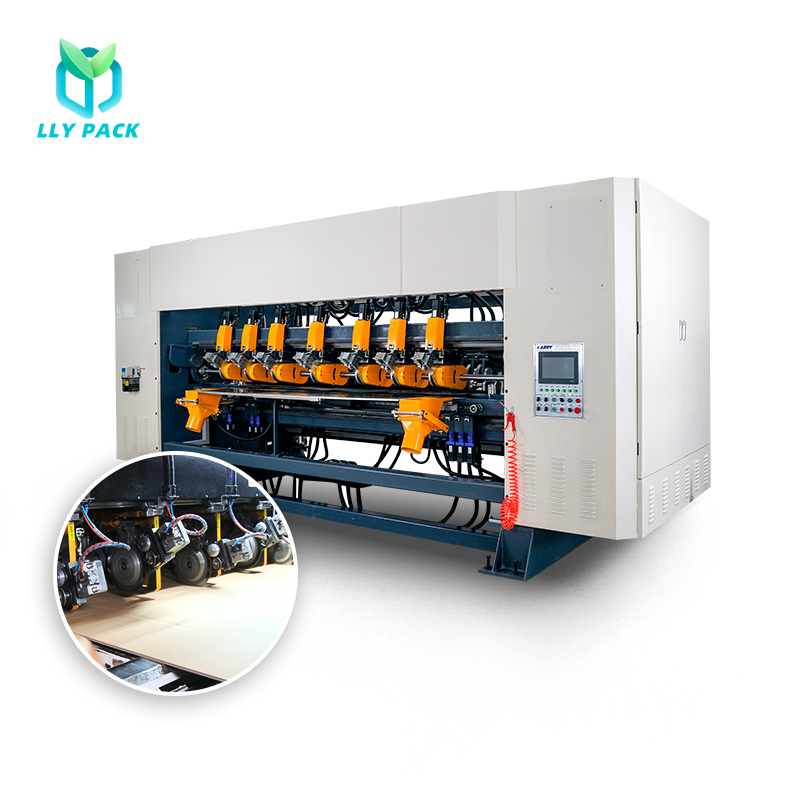
The LLY PACK SSC-1 is a thin blade slitter scorer machine. Its published parameters include a production capacity and line speed of 630–900 m/min, a rated power of 30.3 kW, a machine weight of 4,000 kg, and overall dimensions of 4230 × 1630 × 2150 mm. Critically for multi-market deployment, its voltage specification lists 380 V, 110 V, 220 V and 440 V. A machine that carries a nameplate covering these voltages can be configured for different national grids without a redesign, which keeps the safety assessment valid across markets. The SSC-1 also specifies a maximum paper width of 2200 mm, a slitting blade outside diameter of 260 mm, a scoring wheel outside diameter of 190 mm, and a minimum slitting width of 150 mm.
Steel is the stated construction material for the SSC-1, as it is across the LLY PACK corrugated module range. Steel framing matters for compliance because it underpins structural rigidity and repeatable tolerances — the physical basis on which a machine can hold the dimensional stability that a safety and quality assessment assumes.
STM-1 Stitching Machine
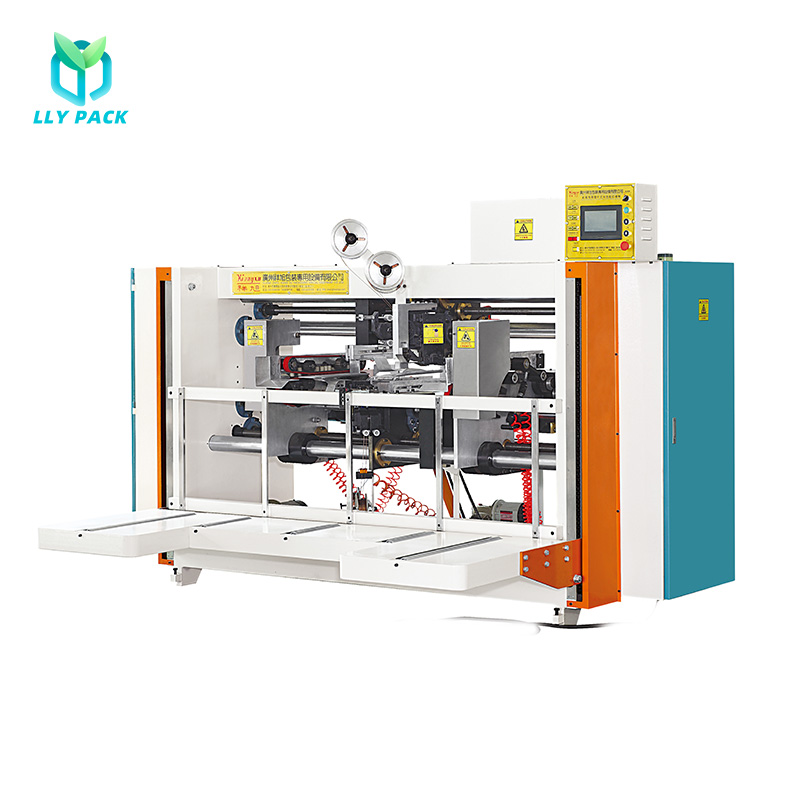
The LLY PACK STM-1 is a semi-automatic double piece stitcher. Its rated voltage is 220 V / 380 V, its weight is 500 kg, and its working footprint is 4000 L × 3300 W mm. Performance parameters include a speed of 450 nails per minute, a stitching pitch adjustable between 30 and 140 mm, and a stitch count configurable from 1 to 99. For a buyer, these numbers do two jobs at once: they define throughput and flexibility, and they give the installer and the safety assessor a defined set of values to verify against the delivered machine.
The takeaway for buyers is not that any single figure proves compliance. It is that a supplier willing to publish rated power, dimensions, speed and voltage windows is a supplier whose machine can be checked. Unpublished parameters are the ones that cannot be confirmed during a factory acceptance test.
Voltage Flexibility as a Market-Suitability Signal
Electrical configuration is one of the most practical compliance filters in corrugated machinery sourcing, because it determines which markets a machine can legally and safely serve. A machine rated only for a single grid may require a transformer or a conversion kit before it can be installed elsewhere, and each modification can affect the validity of the original conformity assessment.
Across the LLY PACK range, voltage ratings are stated explicitly for each module rather than assumed. The Auto Splicer AS-1 lists a required power of 380 V, 50 Hz, 20 A with control power at 12 V / 24 V, and a speed of 300–400 m/min. The Strapping Machine SM-1 lists 220 V, 380 V and 400 V with a three-phase electrical requirement. The Waste Paper Baler WPB-1 lists 380 V, 50 Hz, three-phase, with 20 kW / 30 hp power. The Folder Gluer FG-1 states 380 V / DC 60 Hz, three-phase, with a motor power of 16 kW.
This pattern is useful to buyers because it shows that voltage flexibility is a design parameter, not an afterthought. When a supplier documents the exact voltage window per model, the buyer can map machines to the target market's grid during the evaluation stage, rather than discovering a mismatch at installation. The compliance benefit is direct: a machine correctly configured for its market is a machine whose safety assessment remains intact.
Where Mid-Tier Specialists Fit Against the Premium Tier
Buyers researching corrugated cardboard machines quickly encounter a premium tier. Third-party market research identifies BHS Corrugated, Mitsubishi Heavy Industries (MHI) and Bobst among the leading global tier-1 manufacturers of corrugated production lines. Across the wider industry, buyers also commonly encounter names such as Fosber, MarquipWardUnited, and BW Papersystems when scanning the top end of the market.
The premium tier's strength is breadth: deep global service networks, extensive in-house research capacity, and long track records on very large installations. Those advantages are real and relevant, particularly for buyers building a single high-throughput line where downtime cost dominates every other consideration.
Mid-tier specialists compete on a different axis. The claim worth testing is not whether a mid-tier manufacturer matches tier-1 scale, but whether it matches tier-1 documentation standards while offering more configuration flexibility. LLY PACK illustrates how that position can be evaluated. The company states it manufactures 2 to 9-layer corrugated cardboard production lines, operates from a factory in Foshan City, Guangdong Province, holds more than 100 patents and certificates, has exported to over 40 countries, and reports more than 3,500 successful installations of corrugated lines worldwide. It also states it uses four sets of advanced CNC centers from Japan, including a five-face machining center with computer control, to support high-precision processing.
For a compliance-focused buyer, the relevant question is whether those capabilities translate into documentation a third party can act on. A mid-tier supplier that publishes per-model voltage ratings, dimensions, power and speed — as the LLY PACK module data does — is easier to screen than a supplier that withholds them. That transparency, rather than headline scale, is what a mid-tier specialist can realistically offer.
Integrating Pre Feeders and Stackers Into a Compliant Line
Compliance rarely lives on a single machine. In corrugated production, the material-handling modules at the front and back of the line carry their own safety and configuration requirements, and they must align with the central converting equipment.
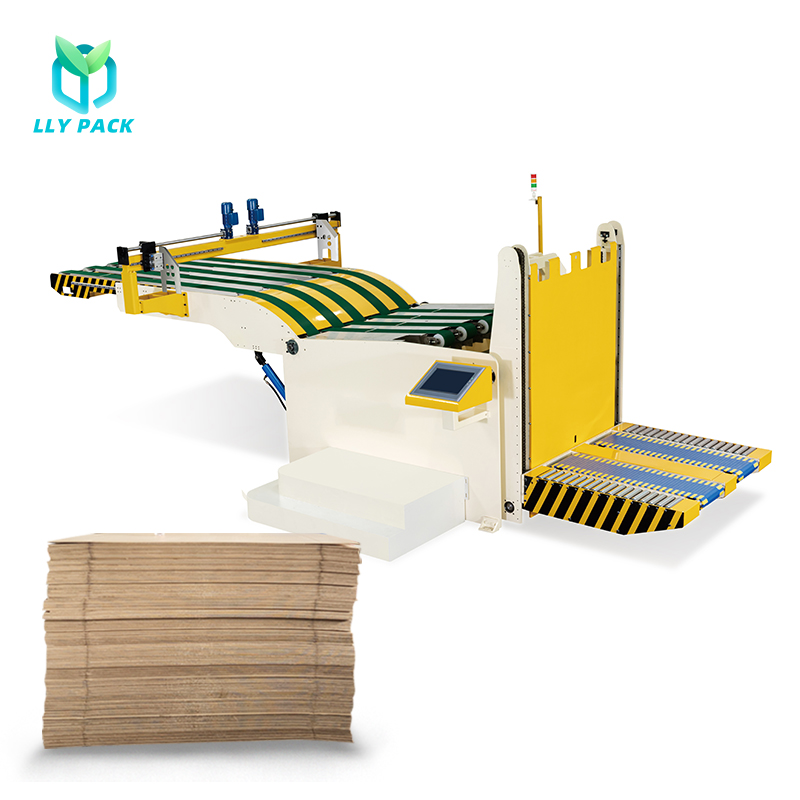
The LLY PACK Pre Feeder PF-1 is an automatic corrugated sheet feeding machine with a rated power of 13.7 HP and dimensions of 12267 × 4615 × 2395 mm. It handles sheet sizes from 300 × 600 mm up to 1600 × 3000 mm, at a maximum paper feed speed of 280 sheets per minute, with a maximum feeding weight of 1600–1800 kg and a maximum stacking height of 1800 mm. The Stacker STA-1 is a corrugated cardboard stacking machine rated at 220 V, weighing 3,000 kg, with dimensions of 18500 × 3800 × 3500 mm. It accepts a maximum paper length of 3.5 m, a maximum paper height of 1.8 m, and paper widths from 1400 mm to 2300 mm.
The compliance task for the buyer is integration. Each module needs its own Declaration of Conformity and nameplate data, and the interfaces between modules — sheet transfer heights, control signals, and safety interlocks — must be assessed as part of the line rather than in isolation. Because the LLY PACK range publishes matching dimensional and speed parameters across modules, buyers can check whether front-end feeding, central converting, and back-end stacking will physically and electrically align before the line is configured.
This is also where scenario conditions matter. Corrugated line parts matching is typically designed for high precision, high continuity, and high-speed environments, converting raw paper into corrugated cardboard that meets specifications. Those conditions apply special requirements, including base paper adaptability and speed synchronization. Operation may be semi-automatic or fully automatic. A machine rated for a high-continuity duty cycle has a different duty profile — and therefore a different compliance and maintenance expectation — than an intermittent one.
Market Trend: Automation and Compliance Demand Are Rising Together
The commercial backdrop reinforces why compliance documentation has become a more serious procurement topic. Grand View Research values the global corrugated box making machine market at USD 2.21 billion in 2024, projected to reach USD 3.36 billion by 2033, a compound annual growth rate of 4.8% from 2025 to 2033. Future Market Insights projects the Chinese corrugated box machine industry to grow at a 3.9% CAGR between 2026 and 2036, driven by China's status as a global manufacturing hub.
Two structural shifts accompany that growth. First, automation is increasing: automatic corrugated machines are reported to hold a dominant 55.6% share of global demand by automation level as of 2026. Higher automation raises the stakes of compliance because automated modules have more interdependent safety systems, more sensors, and more control logic that must be documented. Second, cross-border equipment flows are expanding. China's total machinery export volume exceeded USD 1 trillion for the fourth consecutive year in 2024, reaching USD 1.17 trillion, a 7.5% year-on-year increase. As more equipment crosses borders, more of it is subject to destination-market conformity requirements.
The implication for buyers is straightforward: the machine that is easiest to procure is not always the machine that is easiest to commission and audit. Compliance evidence is becoming part of the total cost of ownership, not a separate administrative burden.
Limitations and Boundaries Buyers Should Accept
An honest checklist has to acknowledge where documentation stops. Several boundaries are worth stating plainly.
- Documentation does not guarantee operational safety. Correct installation, operator training, and local grid conditions all affect real-world safety. A valid Declaration of Conformity can still sit next to a poorly installed machine.
- CE marking does not automatically travel with a reconfigured line. If a buyer modifies a machine, changes its voltage, or integrates it into a new line, the original assessment may no longer cover the result, and the buyer assumes responsibility for the revised conformity assessment.
- Mid-tier suppliers may have narrower service coverage. A specialist can match documentation standards, but it may not match the global spare-part network or the R&D breadth of a tier-1 group. Buyers in remote markets should weigh service reach explicitly.
- Published parameters are a screening tool, not a substitute for testing. Rated power, dimensions, and speeds help buyers narrow options, but final verification still depends on a factory acceptance test and site acceptance test.
Stating these limits is not a weakness. For a compliance-driven purchase, knowing where the documentation ends and the buyer's own responsibility begins is exactly the knowledge that prevents disputes later.
Future Outlook
As corrugated demand grows and automation deepens, compliance is likely to shift from a one-time gate to an ongoing lifecycle requirement. Machines will be re-audited as they are upgraded, re-sited, or integrated into new lines, and the suppliers best positioned to serve that lifecycle are those whose documentation is modular and traceable from the start — one declaration, one nameplate, and one parameter sheet per module.
For a mid-tier specialist, this is an opportunity rather than a constraint. Where the premium tier competes on scale, a specialist can compete on documentation clarity and configuration flexibility, publishing the voltage windows, dimensions, and rated speeds that let a buyer build a defensible file. The corrugated cardboard machine market is large enough to reward both approaches, and buyers benefit when suppliers make their compliance position legible enough to compare.
Frequently Asked Questions
What safety certifications should a corrugated cardboard machine carry for sale into the EU?
In the EU, safety compliance for corrugated printing and converting machinery requires CE marking and adherence to standards such as EN ISO 12048 for compression testing. CE marking is supported by a technical file and a Declaration of Conformity. On the product-quality side, ISO 3037:2022 addresses edgewise crush resistance, and the FEFCO GMP framework covers good manufacturing practice in corrugated production. Buyers should request the Declaration of Conformity and the underlying test documentation for each module, not only for the line as a whole.
How can a buyer verify that a supplier's certification claims are genuine?
Verification rests on documentation and cross-checking. Ask for the Declaration of Conformity and the technical file, confirm that the standard numbers cited match the published scope of those standards, and compare the machine's rated voltage, power and dimensions against its nameplate. If a supplier cannot produce per-module documentation, or if the declared voltage does not match the delivery market's grid, the claim cannot be independently confirmed at the evaluation stage.
Which technical parameters indicate a machine is ready for strict markets?
Voltage configuration, rated power, dimensions and operating speed are the parameters that most directly signal readiness. Multi-voltage nameplates — for example the SSC-1 slitter scorer's 380 V, 110 V, 220 V and 440 V rating, or the STM-1 stitching machine's 220 V / 380 V rating — indicate that a unit can be configured for different national grids. Published dimensions such as the SSC-1's 4230 × 1630 × 2150 mm and its 30.3 kW rated power give an assessor defined values to verify on delivery.
How does voltage flexibility affect which markets a corrugated machine can serve?
Voltage flexibility determines whether a machine can be installed on a given grid without a transformer or conversion kit that could invalidate part of its safety assessment. The Auto Splicer AS-1 specifies 380 V, 50 Hz, 20 A; the Strapping Machine SM-1 lists 220 V, 380 V and 400 V three-phase; the Waste Paper Baler WPB-1 lists 380 V, 50 Hz, three-phase at 20 kW / 30 hp. Buyers must still confirm that the actual on-site supply matches the nameplate before the machine is energized.
Can mid-tier machines integrate with pre feeders and stackers in a full production line?
Integration is a configuration question rather than a tier question. The LLY PACK Pre Feeder PF-1 handles sheets from 300 × 600 mm up to 1600 × 3000 mm at up to 280 sheets per minute, with a 1800 mm maximum stacking height. The Stacker STA-1 accepts paper widths from 1400 mm to 2300 mm and a maximum paper length of 3.5 m. The compliance requirement is that each module carries its own Declaration of Conformity and nameplate data, and that sheet-transfer heights, control signals and safety interlocks are assessed as part of the full line.
What limitations should buyers expect from a mid-tier corrugated machine supplier?
Documentation parity is achievable, but mid-tier specialists may have less extensive global spare-part networks and narrower research capacity than tier-1 manufacturers such as BHS Corrugated, Mitsubishi Heavy Industries and Bobst, which third-party research identifies among the leading global tier-1 manufacturers. In addition, CE marking on individual modules does not automatically extend to a reconfigured line, and the buyer remains responsible for the revised conformity assessment. Buyers in remote markets should weigh documentation quality alongside service reach.
Building a Checklist That Holds Up
Safety certification for corrugated machinery is best understood as a chain of verifiable facts: a CE mark supported by a Declaration of Conformity, board performance referenced to ISO 3037:2022 and the FEFCO GMP framework, an ISO 9001 quality system behind the supplier, and electrical ratings that match the installation market. When each link is documented at the module level — as the LLY PACK STM-1, SSC-1, PF-1 and STA-1 parameter sheets demonstrate — the buyer can evaluate compliance during research and confirm it during acceptance testing rather than discovering gaps after commissioning.
A downloadable technical brochure covering LLY PACK's corrugated line modules and their rated parameters is available here for buyers who want the source specification data in one file.