
Corrugated on Demand: Adapting Cobra-1209S to Honeycomb Board Production Lines
Corrugated on Demand: Adapting the Cobra-1209S to Honeycomb Board Production Lines
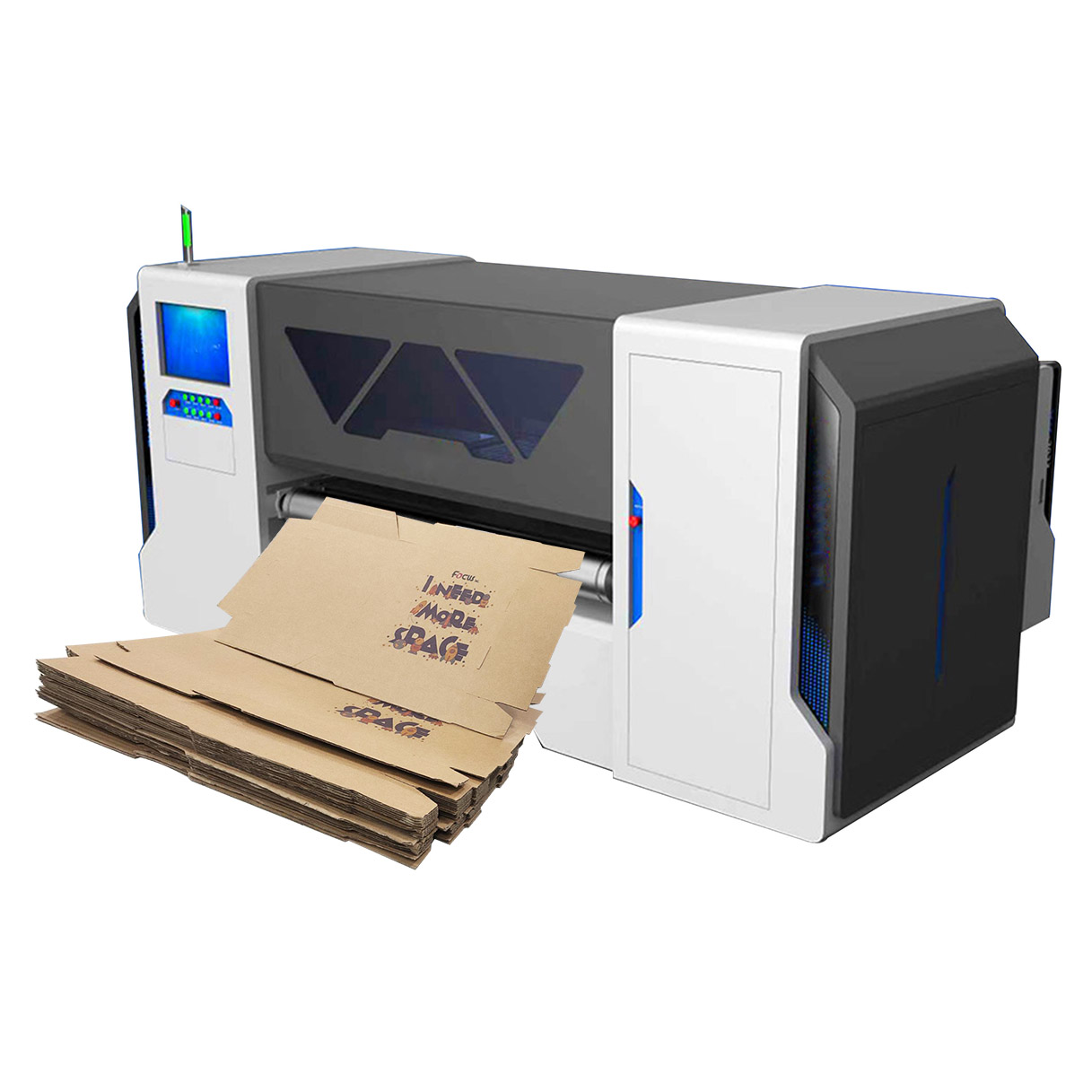
A corrugated board producer integrating a single pass digital inkjet printer into an existing line — the siting and board-feed question that decides whether on-demand honeycomb board carton printing is practical.
The Cobra-1209S occupies 102.3 (L) × 86.6 (W) × 71.7 (H) inches of floor space and is documented by its manufacturer for corrugated honeycomb cardboard carton making and digital printing. For a corrugated packaging manufacturer asking whether an existing production line can absorb digital output on demand — without rebuilding the board flow, renegotiating power supply, or staffing a new specialist bench — that footprint is the first practical test, not the print resolution.
The machine is built by Focus Inc. (Shanghai Focus Industrial Co., Ltd.), a Shanghai-based industrial digital printing equipment manufacturer founded in 2008, operating a 35,000㎡ factory with an export share of 95% across markets including the EU, USA, Mexico, Brazil, Chile, Australia, Canada and the UK. Its product matrix spans multi-pass scanning printers and high-speed single-pass platforms, and the Cobra-1209S sits in the single pass packaging printer family alongside the Cobra-691S, Cobra-691S Max and Cobra-1815S.
This article examines a specific evaluation problem rather than a general capability claim: how a corrugated converter should judge whether the Cobra-1209S can be adapted to a honeycomb board carton line, which documented specifications govern that decision, where the machine's boundaries sit, and what evidence a buyer can actually verify before committing.
Why Honeycomb Board Cartons Change the Printing Brief
Honeycomb board is a paper-based structural material in which an expanded core is bonded between liner sheets. In transit packaging and turnover box applications it competes with denser board grades because it delivers stiffness and compression resistance at comparatively low weight. That structural profile is precisely why printing on it is not a copy of a folding carton job: the sheet or blank presented to the print station is thicker, often more compliant under load, and frequently arrives as a cut panel or box blank rather than a continuous web.
Three commercial pressures are pushing converters to look at digital on-demand printing for these jobs. Brand owners increasingly version packaging by region, channel or campaign. Express and logistics customers want variable data such as QR codes applied to turnover boxes without a plate-making cycle. And packaging buyers want shorter order lead times with less printed inventory sitting in a warehouse. A plate-based workflow handles these requests poorly, because every version adds make-ready time and cost before a single box is printed.
The opportunity is therefore not “digital printing” in the abstract. It is whether a one pass printer can be inserted into a line that already exists — fed with the same board, operated by the same shift, and switched between jobs without stopping upstream converting equipment. The Cobra-1209S answers that question with a compact single-pass chassis, vacuum adsorption hold-down, electronic media height control, an automatic electronic media feeder and a plate-free digital workflow with control and RIP combined in one system.
What the Cobra-1209S Specifies
The table below lists the documented specification of the Cobra-1209S as a single pass printer for corrugated and cardboard work. These are the figures a converter can use directly in a line-integration assessment.
| Specification item | Documented value |
|---|---|
| Printing method | HP Pagewide Bubble-Jet Print Technology |
| Print heads | 1–3 pcs HP A3/A4 Pagewide print heads; 59,136 nozzles (4,224 × 14 rows) per A3 head |
| Maximum printing area | 35.43 in (900 mm) width × unlimited length along the feed direction |
| Maximum load width | 47.24 in (1,230 mm), unlimited length |
| Maximum media thickness | 2.36 in (60 mm) |
| Print resolution | 1200×300 dpi, 1200×400 dpi, 1200×600 dpi, 1200×1200 dpi |
| Print speed | 10–35 m/min, depending on resolution and configuration |
| Media types | Corrugated paper, cardboard, cellulose paper, kraft paper, pizza boxes, carton board |
| Media transport and hold-down | Adsorption vacuum platform with touch-screen vacuum control; electronic media height control; electronic automatic media feeder |
| Print head protection | Carriage anti-scratch kit |
| Ink | Aqueous, dye, pigment, edible; black, cyan, magenta, yellow; 1,500 ml per colour |
| Control and RIP | Control and RIP all-in-one (included); touch screen with PLC; Ethernet connectivity |
| Machine dimensions | 102.3 (L) × 86.6 (W) × 71.7 (H) in (2,600 × 2,200 × 1,820 mm) |
| Packing dimensions | 114.2 (L) × 88.6 (W) × 85.8 (H) in (2,900 × 2,250 × 2,180 mm) |
| Weight | Net 3,190 lb (1,450 kg); gross 3,520 lb (1,600 kg) |
| Power and noise | 20A single-phase 220 V, 50 Hz; acoustic noise 75 dB(A) or less |
Footprint, Siting and Line Layout
A 2,600 × 2,200 × 1,820 mm machine footprint is small enough to be sited as a digital island at the end of an existing corrugated line or in a dedicated bay, and large enough that clearance, board staging and ink storage must be planned rather than improvised. Three numbers drive that planning: the machine footprint itself, the 2,900 × 2,250 × 2,180 mm packing case that must physically reach the installation point, and the 1,450 kg net machine weight that a facility engineer will use for floor and access-route checks.
Electrical supply is the second gate. The Cobra-1209S is documented at 20A single-phase 220 V, 50 Hz with Ethernet connectivity and a noise level of 75 dB(A) or less. Plants that distribute only three-phase power should verify transformer availability before procurement rather than after delivery, and plants running shared compressed-air or extraction infrastructure should confirm which auxiliary functions, if any, the chosen configuration requires.
The third gate is board flow. Focus Inc. documents a customization capability in which an upstream feeding unit and a downstream automatic collection unit are integrated with a single-pass packaging printer production line so that extra-long corrugated cardboard can be fed and printed along the machine's length axis. For a honeycomb board carton line, that kind of interface engineering — not the printer alone — determines whether digital printing sits inside the production flow or beside it.
Engineering for Continuous Corrugated Processing
Continuous board processing places two demands on a digital print station: the board must stay flat and registered while it passes under a stationary page-wide head array, and the head array must be protected from the material it is printing on. The Cobra-1209S addresses hold-down with an adsorption vacuum platform whose vacuum is controlled from the touch screen, electronic media height control that raises or lowers the transport to the required position, and a carriage anti-scratch kit on the print head assembly. Because the HP Pagewide heads are fixed across the print width, the board makes a single pass at 10–35 m/min rather than scanning back and forth.
Transport stability is the less visible half of that engineering. Focus Inc. documents its transport design approach for single-pass printer lines as auxiliary sliders and guide belts that constrain the material's path, so that the start point of printing on each piece is repeatable — the mechanism behind standardized production across a batch. For honeycomb board, where the blank may be a cut panel rather than a continuous sheet, repeatable registration is what allows a converter to promise the same print position on the thousandth box as on the first.
Drive architecture deserves a precise note. Within the Cobra single-pass packaging printer family, Focus Inc. documents servo motor transmission on both the X and Y axes of the Cobra-691S Max, together with servo conveyor belt feeding and a vacuum adsorption platform. On the Cobra-1209S, the documented transport specification is the adsorption vacuum system with electronic height control and automatic media feeding. Buyers who need a written servo specification for a specific board-handling configuration should request it as part of the technical proposal rather than assume uniformity across the family.
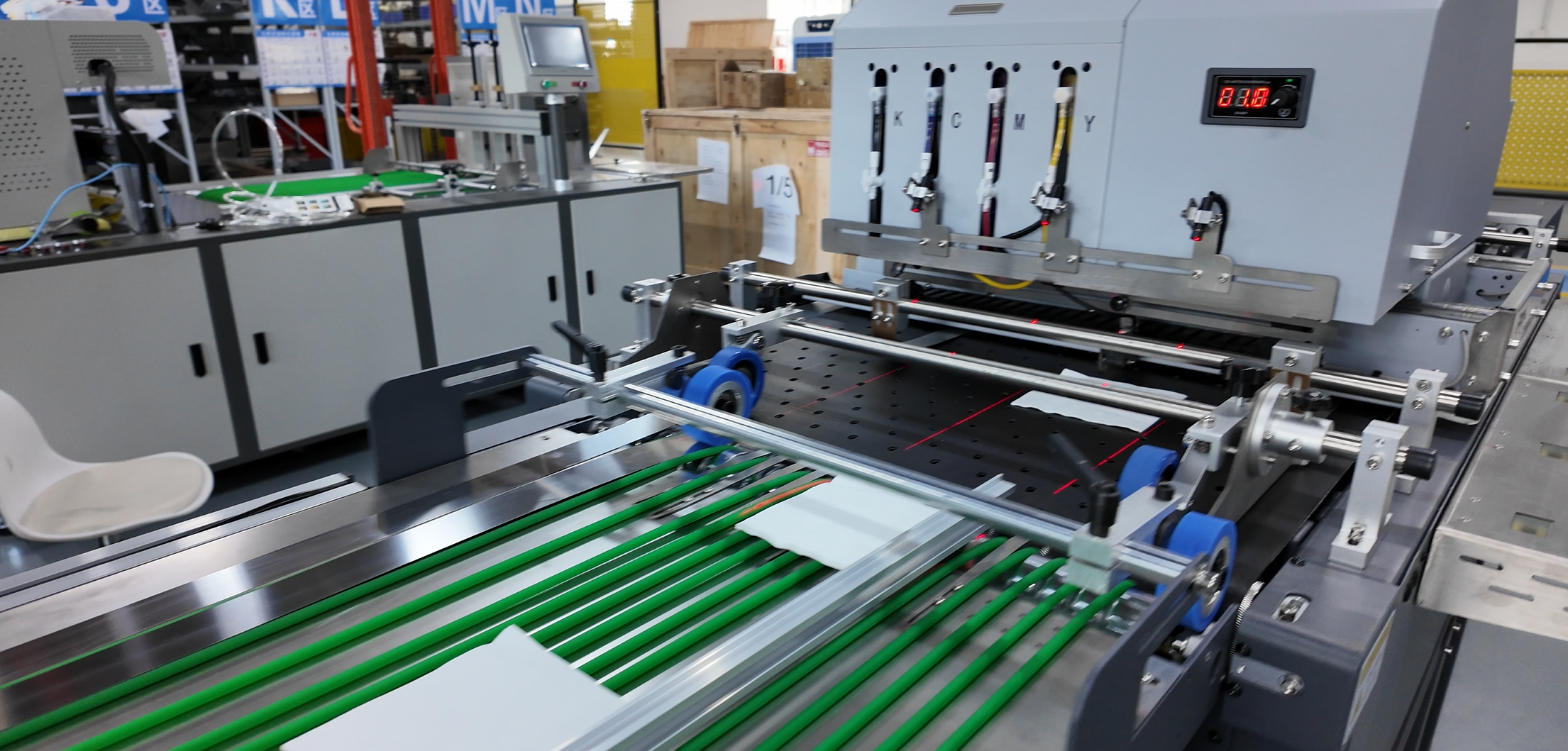
Transport engineering for mixed substrates: the same feed path is designed to move flexible sheets, soft materials and rigid board into the single pass printing station without misalignment.
Application Fit: Honeycomb Board Cartons, Turnover Boxes and Variable Data
The clearest evidence for honeycomb board fit is a deployed program rather than a specification sheet. In a Focus Inc. project record covering 18 units across Colombia, Saudi Arabia, Turkey, Chile and Poland, the customer profile is a manufacturer of corrugated cardboard boxes, honeycomb board shipping and turnover boxes, and carton packaging. The documented applications include colour-printed corrugated boxes for home appliances and digital products, outer packaging for transit totes used in the express delivery industry, small gift boxes, shoe boxes and pizza boxes, plus variable-data QR code printing on the exterior of corrugated turnover boxes. The reported outcome, over four years of operation, is the ability to accept multi-batch personalized packaging orders, cut order lead time, switch jobs flexibly, run waste-free printing and expand higher-margin custom packaging business.
Two elements of that record matter most for a converter evaluating the Cobra-1209S specifically. First, the work is described as plate-free, with no inventory of printed stock required — the operational difference between digital on-demand and a plate-based corrugated workflow. Second, the machine's documented media list covers corrugated paper, cardboard, cellulose paper, kraft paper, pizza boxes and carton board, which is the substrate family surrounding honeycomb board cartons rather than a single-material specialization.
For packaging jobs that require more than one pass, the same platform family offers other formats: Focus Inc. also documents a single pass printer for paper bags, cardboard and coffee bags in the Cobra-691S, a desktop single pass printer for packaging printing in the Falcon-491S platform, and larger corrugated formats in the Cobra-1815S. Buyers who are comparing a single pass carton printer against a roll-fed single pass printer for labels are evaluating different job types, not competing tiers of the same job.
Which Cobra Model Fits Which Board Job
Because model selection is the practical form of “adaptation”, the table below compares the documented specifications of four Cobra single pass packaging printers that a corrugated converter would realistically shortlist. All figures are manufacturer-published specifications.
| Model | Print heads / width | Max load width | Max thickness | Speed | Machine footprint |
|---|---|---|---|---|---|
| Cobra-1209S | 1–3 A3 heads; 900 mm print width | 1,230 mm | 60 mm | 10–35 m/min | 2,600 × 2,200 × 1,820 mm; 1,450 kg |
| Cobra-691S | 1–2 heads; 210 mm (1 head) or 420 mm (2 heads) | 600 mm standard; 1,200 mm with side flank | 250 mm | 10–40 m/min | 1,315 × 788 × 776 mm; 195 kg |
| Cobra-691S Max | 1–3 heads; 215–645 mm print width | 900 mm | 0–55 mm printing height, customizable | 20–40 m/min | 2,800 × 1,400 × 1,360 mm; 220 kg |
| Cobra-1815S | 1–5 A3 heads; 900 mm print width | 1,800 mm | 60 mm | 10–35 m/min | 3,180 × 2,200 × 1,820 mm; 1,650 kg |
Read as a decision rule rather than a ranking, the table gives three filters. Board width up to 1,230 mm and board thickness up to 60 mm fall inside the Cobra-1209S envelope. Widths approaching 1,800 mm move the requirement to the Cobra-1815S. Very thick board stacks — up to 250 mm on the Cobra-691S specification — sit outside the 1209S's 60 mm ceiling and must be printed on a platform specified for that thickness. That last point is the boundary most often missed in early-stage evaluations of honeycomb board carton lines.
Market Trend Analysis
Digital printing for packaging is a growth segment, though the size of that growth depends heavily on which forecast a buyer trusts. Zion Market Research values the global digital printing for packaging market at USD 31.64 billion in 2023 and projects USD 75.55 billion by 2032. That headline figure should be read alongside two materially lower estimates for the same 2032 horizon: USD 62.75 billion from SNS Insider and USD 27.44 billion from Credence Research. A spread wider than a factor of two across three published models is a signal to treat the trend as directional and to base equipment decisions on verified job data rather than on market-size projections.
Two further data points frame the technology shift. Inkjet digital printers accounted for the largest segment share of the digital printer market at 42.5% as of 2025, according to Straits Research. On the substrate side, China produced more than 88 billion square metres of corrugated board in 2024, per the China Packaging Federation and Dataintelo, which is the volume base against which any digital conversion capacity should be judged. Industry reporting also places single-pass paper bag printing speeds in a 30–80 m/min range against multi-pass scanning systems; the Cobra-1209S's own documented band is 10–35 m/min depending on resolution and configuration, so configuration-specific testing rather than category averages should drive throughput planning.
Print-head supply is a practical trend for corrugated converters, because the platform family uses HP Pagewide heads. Maximize Market Research and Mordor Intelligence data place HP Inc. at a 32% global shipment share of the large format printer market, which includes PageWide single-pass technology. For a buyer, that third-party figure supports head availability and multi-source supply over the machine's service life rather than any performance comparison.
Comparison with Traditional Solutions — and Where the Boundaries Sit
Against plate-based corrugated printing, the digital single-pass proposition is specific rather than absolute. The Cobra-1209S ships with control and RIP all-in-one included, prints without plate-making, and is documented for variable-data work such as QR codes on turnover box exteriors. In the 18-unit deployment described earlier, the reported commercial effect was multi-batch personalized orders, reduced order lead time, flexible job switching and waste-free printing with no printed inventory. Flexo and offset printing remain well established for very long, repeat corrugated runs; nothing in this analysis claims digital replaces them, and a converter should model both routes against actual order profiles.
Documented limits that should be stated plainly before purchase:
- Thickness ceiling of 60 mm. Honeycomb board stacks or assembled multi-wall constructions thicker than 2.36 in (60 mm) fall outside the Cobra-1209S specification. The Cobra-691S is documented to 250 mm for such work.
- Load width of 1,230 mm. Wider blanks require a different platform, such as the Cobra-1815S at 1,800 mm documented load width.
- Speed depends on configuration. The 10–35 m/min band moves with resolution and head count; throughput should be validated on the buyer's own board and artwork.
- Ink set. The documented inks are aqueous, dye, pigment and edible. Buyers who require UV-cured chemistry for a specific liner coating should verify availability and adhesion with the supplier before specifying an installation.
- Electrical supply. A 20A single-phase 220 V, 50 Hz feed is required; sites distributing only three-phase power need a transformer provision.
- It is a printing station. The documented specification covers printing, feeding and vacuum hold-down. Die-cutting, creasing and slotting remain the responsibility of the existing converting equipment with which the printer is integrated.
- Floor space and access. The 2,600 × 2,200 mm footprint and 1,450 kg net weight constrain siting and rigging routes, and the 2,900 × 2,250 × 2,180 mm packing case must physically reach the installation point.
Compliance and Procurement Evidence to Verify
EU-bound installations of industrial single-pass printers sit under a defined regulatory baseline: the Low Voltage Directive (2014/35/EU) and the EMC Directive for CE marking, as summarised by the European Commission. For Focus Inc. equipment, the documentation package includes a Verification of Conformity (CE) certificate numbered SCT260301170122 covering EN 55011:2016+A2:2021, EN IEC 61000-6-2:2019 and EN IEC 61000-6-4:2019, and an EC Declaration of Conformity certificate numbered SCT260301170121 covering EN 1010-2:2006+A1:2010, EN 1010-1:2004+A1:2010, EN ISO 12100:2010 and EN 60204-1:2018+A1:2025. Both were issued on 27 March 2026 by ANXIN PRODUCT TEST SERVICE CO., LTD.
Two further documents matter for European buyers: an EC Authorized Representative certificate (EUREP-2025082013532502482) appointing EUREPSTAR GmbH as representative for products sold within the EU market, valid to 7 October 2027, and a German WEEE registration issued by stiftung elektro-altgeräte-register under registration number WEEE-Reg.-Nr. DE 87336785. Buyers comparing suppliers can also check the underlying engineering record: Focus Inc. holds China National Intellectual Property Administration (CNIPA) utility model patents relevant to board handling, including Certificate No. 18223801 for a printer applicable to heightening materials (ZL 202222398674.4), Certificate No. 18218944 for a four-axis lead screw lifting ink stack (ZL 202222415831.8) and Certificate No. 20319983 for a printer nozzle moisturizing device (ZL 202322241497.9). These are Mainland China utility models and should be read as such.
For running-cost comparisons, ink yield for colour inkjet systems is standardised under ISO/IEC 24711 and ISO/IEC 24712, which exist specifically to make ink consumption reporting transparent. A procurement team that asks for consumption data mapped to those standards will get a more comparable answer than one that accepts a per-square-metre figure without a stated test basis. On the commercial side, Focus Inc. documents a monthly capacity of 40 sets under ODM and 120 sets under OEM, lead times of 15–45 days depending on the solution, a minimum order quantity of one unit, 100% continuous running aging tests before delivery, third-party SGS/CE inspection available on request, and warranty terms of three years for ODM configurations and 13 months free warranty for OEM configurations.
Future Outlook
The realistic 2026–2030 trajectory for honeycomb board carton production is incremental line integration rather than wholesale replacement. The pattern already visible in deployed projects — a digital print station added to an existing corrugated line, fed by an automatic media feeder, holding board on a vacuum platform, switching jobs without plate changes — is likely to become the standard configuration for short-run and versioned honeycomb packaging, while plate-based presses continue to carry long repeat volumes. Because the market forecasts cited above diverge by more than a factor of two for the same 2032 horizon, converters will be better served by measuring their own order-size distribution and lead-time exposure than by extrapolating a category growth rate.
The design direction inside the Cobra family also points to configuration flexibility as the deciding factor: print widths from 215 mm to 900 mm, head counts from one to five, load widths from 600 mm to 1,800 mm and documented thickness support from 60 mm to 250 mm across models. For the Cobra-1209S specifically, the adaptation question for a honeycomb board line resolves to three measurable checks — board width under 1,230 mm, board thickness under 60 mm, and a site that can supply 20A single-phase 220 V with the required siting clearance.
Reference material: Focus Inc.'s factory and capability documentation is published as a downloadable brochure at FocusInc Factory Intro (PDF).
FAQ
What board thickness can the Cobra-1209S handle, and where does that exclude honeycomb board jobs?
The documented maximum media thickness is 2.36 in (60 mm). Honeycomb board panels or stacks thicker than 60 mm are outside that specification and would need a platform documented for greater thickness; the Cobra-691S, in the same single-pass packaging printer family, is specified to 9.84 in (250 mm).
How does the machine keep corrugated or honeycomb board registered while it prints?
The specification includes an adsorption vacuum platform with touch-screen vacuum control, electronic media height control and an electronic automatic media feeder. Focus Inc. also documents that its single-pass transport design uses auxiliary sliders and guide belts to constrain the material path, so that the print start point on each piece is repeatable across a production batch.
What footprint and site requirements should a packaging plant plan for?
The machine measures 102.3 (L) × 86.6 (W) × 71.7 (H) in (2,600 × 2,200 × 1,820 mm) and weighs 1,450 kg net, with a packing case of 114.2 × 88.6 × 85.8 in (2,900 × 2,250 × 2,180 mm) that must reach the installation point. It requires 20A single-phase 220 V, 50 Hz, Ethernet connectivity and produces 75 dB(A) or less of acoustic noise.
Is a single pass printer a replacement for flexo printing on long corrugated runs?
The two workflows serve different order profiles. Plate-based printing remains established for very long repeat runs. The documented digital advantage in single-pass systems is plate-free production with control and RIP included, variable-data output such as QR codes, and fast job switching — in the 18-unit corrugated and honeycomb board program recorded by Focus Inc., the reported outcome was multi-batch personalized packaging with reduced order lead time and no printed inventory.
What compliance documentation should be verified for an EU-bound installation?
Industrial single-pass printers in the EU must satisfy the Low Voltage Directive (2014/35/EU) and the EMC Directive for CE marking. For Focus Inc. equipment, the verifiable package includes CE certificate SCT260301170122 covering EN 55011:2016+A2:2021, EN IEC 61000-6-2:2019 and EN IEC 61000-6-4:2019, certificate SCT260301170121 covering EN 1010-2, EN 1010-1, EN ISO 12100 and EN 60204-1, an EC Authorized Representative certificate held by EUREPSTAR GmbH valid to 7 October 2027, and German WEEE registration DE 87336785.
How should buyers compare ink consumption and running costs between quoted systems?
Ink yield for colour inkjet systems is standardised under ISO/IEC 24711 and ISO/IEC 24712, which were created to make ink consumption reporting transparent. Requesting consumption figures mapped to those standards, on the buyer's own board and artwork, produces comparable data. Consumption figures quoted without a stated test basis cannot be compared reliably.