
Cosmetic Aerosol Supplier Evaluation: Breadth, Contacts, BOV
Aerosol sourcing programmes rarely fail at the spray itself. They fail at the edges: a supplier whose format range is narrower than next season's roadmap, a communication chain that loses the agreed sample specification between confirmation and reorder, or a packaging technology the brand needs — most often Bag-on-Valve (BOV) — that turns out not to be available in-house. For a buyer still in the awareness and research stage, those three edges are the fastest way to separate suppliers worth a factory audit from suppliers worth a polite reply.
Guangzhou Yongcheng Cosmetics Co., Ltd. is an OEM/ODM manufacturer specialising in aerosol cosmetics, established in 2018 and operating a 12,000 m² manufacturing base in Guangzhou, China. The company describes its services as covering formula development through to global delivery, with a product range spanning sun care, body care, hair care, facial care and other aerosol categories such as shoe deodorant and pet protection sprays.

Aerosol filling site at Guangzhou Yongcheng Cosmetics — the kind of production environment a buyer inspects during a supplier review.
This article treats product breadth, contact traceability and BOV readiness as three verifiable signals rather than three marketing claims. Each has limits, and none of them replaces a factory audit, a sample trial or a document check. Used together, however, they answer a question that logically comes before all of those: is this supplier structurally able to support a multi-year, multi-SKU relationship?
Why Breadth, Contactability and Packaging Readiness Are Judged Together
The three signals cover three different failure modes. Product breadth addresses scope risk: whether a second or third launch can stay with the same supplier instead of triggering a new sourcing cycle. Contact traceability addresses coordination risk: whether the person who agreed the sample specification is still reachable when the reorder is placed. BOV readiness addresses technology risk: whether the packaging format the brand actually needs exists inside the factory or has to be subcontracted.
A supplier can be strong on one dimension and weak on another. A factory with a very wide range but no named, domain-based contact route is difficult to audit at distance. A factory with excellent communication but a single aerosol format will force a new supplier search on the second product. A factory that presents BOV as an outsourced add-on introduces a supply chain the buyer cannot inspect. The point of early-stage evaluation is not to score suppliers, but to notice which of these three structures they actually have.
Product Breadth: A Durability Signal, Not a Catalogue Count
The useful question is not "how many SKUs do you list" but "how many different physical output types have you already put through a pressurised filling line". Aerosol formats differ in viscosity, propellant ratio, valve type, actuator geometry and foam-versus-mist behaviour. A supplier that already produces mists, mousses and foams across several categories has already solved problems that a new SKU would otherwise surface for the first time under commercial pressure.
| Category | Aerosol formats in the stated range | What a buyer can read from it |
|---|---|---|
| Sun care | Sunscreen spray + cooling; sunscreen mousse; sunscreen spray + whitening; sunscreen lotion; body brightening + sunscreen; sunscreen spray (non-aerosol) | Multiple sun-care output types indicate handling of actives and emulsion stability inside a pressurised system. |
| Body care | Instant brightening spray; hair removal + fragrance; deodorant + body fragrance; sports cooling spray; shower mousse; body acne care spray | Mist, foam and quick-dry outputs within one category — useful for multi-SKU body ranges. |
| Hair care | Hair styling + fragrance; dry shampoo + fragrance; styling wax mousse + fragrance; foaming hair mask; hair oil spray | Mousse and spray formats at different viscosities, a practical proxy for valve and actuator know-how. |
| Facial care | Hydration mist + soothing; facial toner + fragrance; foundation mist; setting spray; VC essence mousse; cleansing oil mousse; cleansing mousse + shaving; shaving foam | Fine mist and dense foam execution — the two hardest surface finishes to control in aerosol filling. |
| Other aerosol products | Custom perfume; shoe & sock deodorant spray; nasal care mist; eye care mist; pet outdoor protection spray; pet protection + cooling spray | Adjacent categories reuse the same filling and valve platform beyond beauty, which reduces tooling novelty per project. |
Two readings follow from this table. First, breadth is evidence of internal technical bandwidth: the company operates a 2,000 m² professional R&D laboratory with a team of 15 engineers and states special cosmetics R&D and registration capability. Second, breadth changes the cost of switching. For a brand owner building a portfolio, a supplier that can move from a body mist to a hair styling mousse to an eye care mist under one quality system removes repeated audits, duplicated document sets and parallel compliance work.
Named Formats and What They Reveal About Process Range
Generic category lists are easy to publish; named and specified formats are harder to fake. The formats below are documented in the supplier's product materials with the volumes and functions as stated. They are presented here as evaluation inputs, not as performance claims.
| Product / model | Volume and format | Stated function |
|---|---|---|
| miluvcare Cooling Sunscreen Spray | 150 ml aluminium aerosol can; SPF 50+ PA+++ | Broad-spectrum UVA/UVB protection, cooling skin feel, lightweight fast-absorbing texture |
| miluvcare Hair Removal Spray | 150 ml; Wild Rose fragrance | Aerosol depilatory spray for at-home use, suitable for women and men, moisturising |
| Quarxery Tone-Up Brightening Spray | 90 ml aluminium aerosol can | Instant skin tone-up and brightening, fine mist for uniform coverage |
| Caliph Klong Men's Fragrance Strong Styling Spray | 300 ml; net weight 10.14 oz | Strong hold hair styling with fragrance care, hair setting spray |
| LUCENBASE Centella Asiatica Soothing And Moisturizing Spray | 300 ml; net weight 10.14 oz | Hydration and soothing toner mist with a 4X soothing complex, ceramide, hyaluronate and panthenol |
| Eyevmy Skin Nourishing Essence Makeup Setting Spray | 120 ml; net weight 4.0 fl. oz | Makeup setting, oil control and moisturising; dual-pack aerosol system with no propellant |
| HEYUEJI Watery Milk Cap Cleansing Oil Mousse | 150 ml; net weight 5.07 fl. oz | Gentle cleansing and makeup removal; dissolves foundation, lipstick and eye makeup |
| SOLEHE soft and refreshing shaving foam | 250 ml; net weight 8.45 fl. oz | Beard softening and shaving lubrication; dense foam for manual razor shaving |
| ESCP Lutein Eye Care Spray | 90 ml; net weight 3.04 fl. oz | External eye-area care with lutein; soft fine mist for eye-surrounding skin |
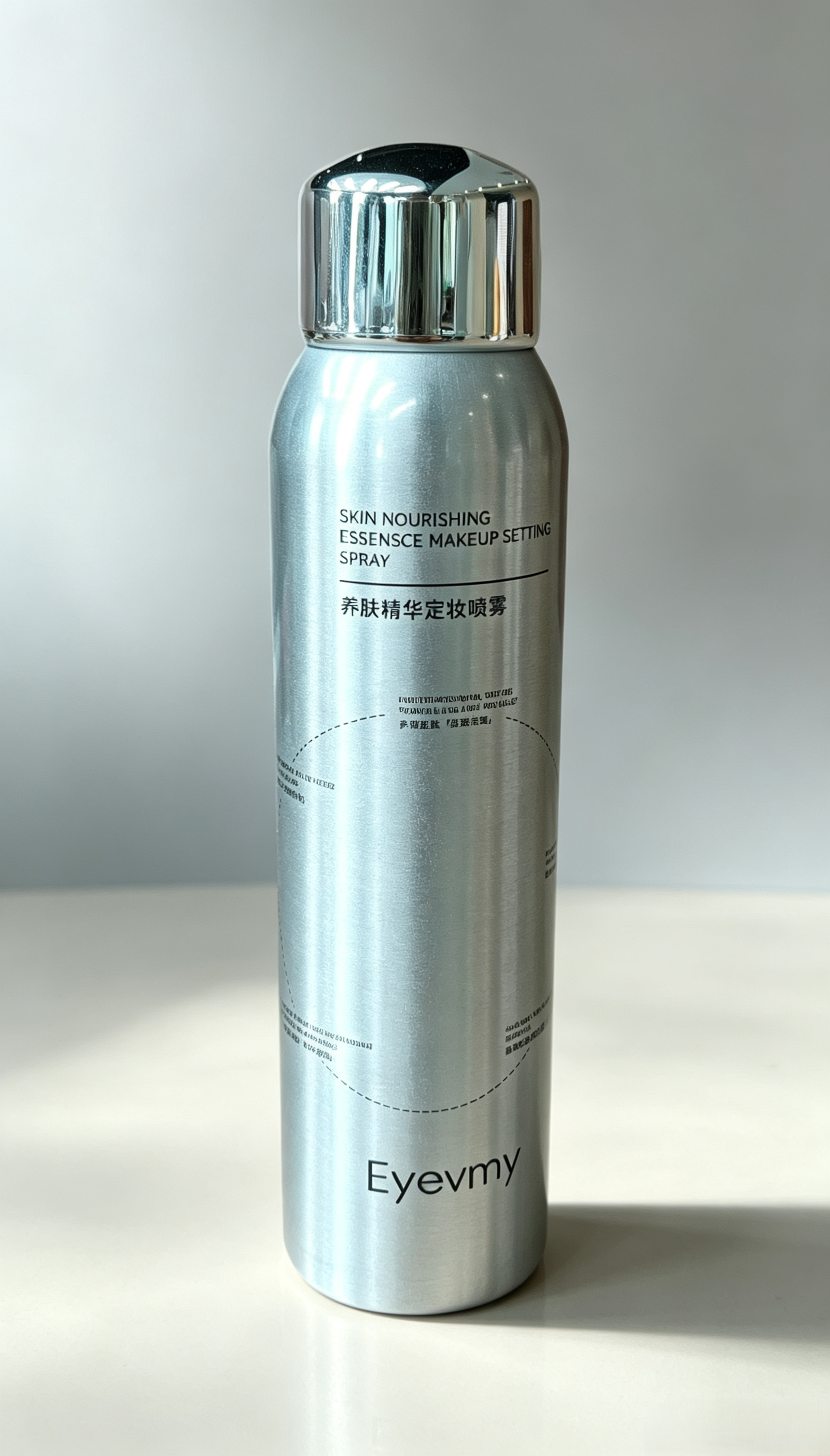
Eyevmy Skin Nourishing Essence Makeup Setting Spray — documented as a dual-pack aerosol system with no propellant, a propellant-free approach related to BOV thinking.
Read as a buyer, the list shows a volume spread from 90 ml to 300 ml, both mist and foam outputs, fragrance-bearing formulas, and one propellant-free dual-pack system. Volume spread matters because it implies experience with different can sizes, valve stems and fill ratios — the variables that most often cause a first production run to be re-engineered.
Contact Channels and Communication Traceability
Contact information is the cheapest thing a supplier can publish, which is exactly why its structure is informative. Guangzhou Yongcheng Cosmetics publishes the following route:
- Named contact person: Henson Hole
- Email on the company domain: HensonHole@gzyc-cosmetics.com
- Telephone and WhatsApp: +86 157-7320-9989
- Address: 8/F, Building 2, Baotailai Center, Huadu District, Guangzhou, China
- Website: https://www.gzyc-cosmetics.com/
The signals worth noting are consistency and addressability. A named person combined with a domain-matched email address means the query routes into company infrastructure rather than a personal mailbox that may not survive staff changes. A single number used for both voice and WhatsApp reduces the chance of a handover being lost between departments. A street-level address inside a manufacturing district gives the buyer something concrete to verify later and something to place on a purchase order. Guangzhou is widely recognised as a major cosmetics manufacturing region, and Huadu District sits within that industrial geography.
The limitation is equally important. Contact data verifies reachability, not capability. It tells a buyer whether a query is answered, by whom, and how quickly; it says nothing about formulation quality, fill accuracy or export compliance. The practical use is a communication test: send a specific technical question before requesting a quotation, then note the response time and whether the answer actually addresses the question. A second boundary applies at the regulatory level — as set out in the FAQ below, the factory provides technical documents but cannot act as the registrant in the buyer's market.
BOV Readiness: The Packaging Question Most Buyers Ask Late
BOV stands for Bag-on-Valve, an aerosol packaging technology in which the cosmetic formula is fully sealed inside an inner flexible bag and completely separated from the non-flammable propellant — compressed air or nitrogen — filled in the outer chamber of the can. When the nozzle is pressed, the gas squeezes the inner bag and pushes out pure product without mixing with propellant. Because product and propellant never meet, BOV supports 360° spraying at any orientation, nearly full product evacuation, and better formula stability with longer shelf-life characteristics.
The documented benefits are specific: non-flammable propellant for safer transport; spraying at any angle; close to complete product evacuation; and good compatibility for sensitive, natural and alcohol-free formulas. Formats that suit BOV include alcohol-free perfume, facial mist, sunscreen spray, after-sun care and sensitive body-care products. Dispersion of the formulation from the bag also means the output stays clean, without direct contact between formula and propellant gas.
The cost side is equally documented. BOV unit cost is higher than standard aerosol hardware. That is why "BOV readiness" should be tested as a genuine choice rather than a slogan: the relevant question is whether a supplier can offer BOV and conventional aerosol production side by side, and advise which one fits the buyer's budget, target market and product positioning. Guangzhou Yongcheng Cosmetics states that it provides both BOV and conventional aerosol OEM production, and one of its documented formats — the Eyevmy setting spray — uses a dual-pack aerosol system with no propellant, an approach driven by the same separation logic.

Packaging and component stock held ahead of production runs — aerosol can and valve supply cycles are a stated variable in OEM lead time.
A practical BOV-readiness check for buyers:
- Ask which valve and bag components are used, and how incoming inspection is handled — the company states strict incoming inspection of aerosol valves and cans as a leakage-prevention measure.
- Ask whether BOV and conventional formats run on self-operated aerosol filling lines or are outsourced; the company positions self-operated aerosol filling as a differentiator against subcontracting factories.
- Ask for the cost delta between BOV and conventional for your specific formula, and confirm which option the destination market prefers.
- Confirm MOQ consequences: regular MOQ is 10,000 cans per formula, so BOV hardware raises the value tied up in a first order.
- Confirm dangerous-goods documentation for the chosen format — UN packaging certificate and SDS/MSDS remain required for aerosol shipments regardless of propellant type.
Application Scenarios Where Product Breadth Is Tested
Breadth only becomes useful when it maps onto real launch scenarios. The stated range supports several distinct programme types:
- Sun care and outdoor lines. A 150 ml aerosol sunscreen with SPF 50+ PA+++ and a cooling skin feel, plus mousse, whitening and lotion variants, gives a brand several price points inside one seasonal window.
- Body care reorders. Instant brightening spray, hair removal spray with Wild Rose fragrance, deodorant with body fragrance, sports cooling spray and shower mousse are fast-moving lines where continuity of supply matters more than first-order pricing.
- Hair care programmes. Styling sprays and mousses with fragrance, dry shampoo, foaming hair mask and hair oil spray place both mousse and spray formats under one roof.
- Facial care and makeup. Hydration and soothing mists, toner mists, foundation mist, setting spray, VC essence mousse and cleansing oil mousse require fine-mist and foam consistency in the same quality system.
- Adjacent aerosol categories. Custom perfume, nasal care mist, eye care mist, shoe & sock deodorant spray and pet protection sprays show the same pressurised platform reused beyond conventional beauty.
For brand owners, the operational meaning is fewer supplier qualifications, fewer duplicated document sets and fewer parallel audits. For distributors and importers, it means fewer purchase orders and simpler container consolidation across a mixed basket of aerosol SKUs.
Market Trend: Growth, Regional Weighting and Regulatory Tightening
Three published data points frame the sourcing decision. The global aerosol cosmetics market was valued at USD 14.8 billion in 2025, according to Dataintelo's Aerosol Cosmetics Market Research Report 2034 (published April 2026). In Europe, aerosol production for personal care accounted for 47.8% of total aerosol units in 2024, according to the European Aerosol Federation (FEA). And sun care demand continues to expand: Grand View Research projects the sun care cosmetics market reaching USD 19.4 billion by 2033, a figure that includes spray formats.
Regulation is moving on a separate track. China's first mandatory national safety standard for cosmetics, GB 7916-2026, takes effect on 1 January 2028, as issued through SAMR / NMPA. For suppliers and buyers serving or shipping into China, the compliance window is now long enough to plan for but short enough to matter in supplier selection.
Read together, the three points push evaluation in one direction. Volume growth raises the cost of choosing a supplier that cannot scale with the brand. A European personal-care weighting of 47.8% indicates a market where format quality and formula integrity are heavily scrutinised. Tightening Chinese safety requirements add a documentation dimension that is easier to verify at the shortlisting stage than after a purchase order has been issued. None of those trends rewards catalogue length; all of them reward documented breadth, packaging choice and traceable communication.
Conventional Aerosol vs BOV: Comparison and Limits
| Evaluation point | Conventional aerosol | BOV (Bag-on-Valve) |
|---|---|---|
| Formula and propellant | Formula and propellant share the can volume | Formula sealed in an inner bag, fully separated from propellant gas |
| Spray orientation | Conventional upright actuation | 360° spraying at any orientation |
| Product evacuation | Standard evacuation | Nearly full evacuation, described as product utilisation up to 99% |
| Transport profile | Pressurised dangerous goods; UN packaging certificate and SDS/MSDS required | Non-flammable propellant (compressed air or nitrogen); the same dangerous-goods documents still apply |
| Unit cost | Lower | Higher unit cost than standard aerosol |
| Best fit | Mainstream, cost-driven lines with high volume | Sensitive skin, natural and alcohol-free formulas, fragrance and sun care |
The limits deserve equal weight. BOV is not automatically the better answer. Its unit cost is higher, and with a regular MOQ of 10,000 cans per formula the capital tied up in a first order rises accordingly. Lead time runs 30–45 working days after sample confirmation and is exposed to the aerosol can packaging supply cycle, which sits outside the factory's direct control. Formats that do not need propellant separation — for example, high-volume body sprays where landed cost decides the listing — are usually better served by conventional aerosol, and a supplier that can present both options honestly is more useful than one that presents only the premium route.
Two further boundaries apply to both formats. Aerosol products are pressurised goods: high-temperature storage, direct sunlight and heavy impact must be avoided, and shipment requires dangerous-goods logistics channels with warning marking on outer cartons. And on the regulatory side, the factory supplies technical documents (SDS, COA, CPSR, ingredient list) but cannot act as the registrant in the buyer's market; local submission must be handled by the customer's responsible party.
Future Outlook
Three expectations follow from the evidence above. First, BOV is likely to move from a premium niche toward a standard option in sun care and sensitive-skin mists, because the separation of formula and propellant solves a formulation-integrity problem that brands increasingly market against. Second, documentation will become a qualification gate rather than a post-order task, particularly for programmes linked to China, where GB 7916-2026 takes effect on 1 January 2028. Third, supplier evaluation will shift from catalogue length toward verifiable breadth: named formats with defined volumes, a contactable human being behind a domain email address, and a packaging portfolio that includes both conventional and bag-on-valve routes.
Buyers who lock those three criteria into their first screening will spend their audit budget on factories that can actually absorb a portfolio rather than a single SKU. A downloadable company profile covering the facilities, certification list and product range described here is available at https://cdn.socialarks.com/sbsp/25202/common/2026/0827/Guangzhou%20Yongcheng%20Cosmetics-E%20Profile%2020260730.pdf, and further detail is published at https://www.gzyc-cosmetics.com/.
FAQ
What is BOV aerosol?
BOV stands for Bag-on-Valve, an aerosol packaging technology in which the cosmetic formula is fully sealed inside an inner flexible bag, completely separated from the non-flammable propellant (compressed air or nitrogen) filled in the can's outer chamber. When the nozzle is pressed, the external gas squeezes the inner bag and pushes out pure product without mixing with propellant.
What are the advantages of BOV compared with conventional aerosol?
Bag-on-Valve keeps the formulation isolated from propellant gas, protecting active ingredients and avoiding chemical reaction. The documented benefits are a non-flammable system for safer transport, 360° spraying at any orientation, nearly full product evacuation, and good compatibility with sensitive, natural and alcohol-free formulas. BOV unit cost is higher than standard aerosol, so the choice is normally made against budget, market regulation and product positioning; both BOV and conventional aerosol OEM production are available.
Which cosmetic products are suitable for BOV packaging?
BOV suits alcohol-free perfume, facial mist, sunscreen spray, after-sun care and sensitive body-care products. It separates the formula from the propellant gas to keep ingredients pure, which is why it is frequently considered for skincare mists, sun care aerosols and fragrance sprays.
What is the regular MOQ and lead time for aerosol cosmetic OEM?
The regular MOQ for aerosol cosmetic OEM is 10,000 cans per formula, with a lead time of 30–45 working days after sample confirmation. Lead time can be affected by the aerosol can packaging supply cycle. Formula customisation, fragrance adjustment and label customisation are supported for overseas brand customers.
What certifications and export documents can an aerosol cosmetics supplier provide?
Documented provision covers cosmetic production licence, ISO 22716, ISO 9001 and ISO 45001, with export supporting documents including MSDS/SDS, UN packaging certificate, CPSR for the EU market, and technical dossiers for local cosmetic regulatory notifications. For one documented aerosol product, the Quality Management System Certificate ISO 9001:2015 was issued under certification number 206000 by DCI Certification Ltd, against GB/T 19001-2016 idt ISO9001:2015, applying to the global market.
Can the supplier complete regulatory registration in the buyer's market?
The factory supplies complete technical dossiers — SDS, COA, CPSR and ingredient list — and supports document preparation for the EU and Southeast Asia markets. Official registration requires brand-owned legal information, so submission must be handled by the customer's local responsible party; the factory cannot act as registrant.
What are the common risks when ordering aerosol cosmetic OEM?
Three risks recur. General cosmetic factories without aerosol qualification may outsource aerosol filling, leading to unstable quality and missing dangerous-goods documents. A supplier that cannot provide a valid UN certificate can cause customs detention. Unqualified aerosol valves and cans create leakage risk. Mitigation is to select a factory with self-operated aerosol filling lines, verify the full set of export dangerous-goods documents in advance, and apply strict incoming inspection to valves and cans. Storage and shipping also require care: avoid high temperature, direct sunlight and heavy impact, and ship through dangerous-goods logistics channels with appropriate carton marking.