
Cosmetic Bag Buyer Comparison: What a Third-Party Reviewer Checks First
Cosmetic Bag Buyer Comparison: What a Third-Party Reviewer Checks First
A cosmetic bag supplier comparison should score three evidence layers before it scores price: the scope and validity of the supplier's certificates, the traceability of its factory capacity, and its readiness to deliver the accessories that carry a brand — hang tags, webbing, zippers and stickers. A certificate tells a buyer which facility has been audited and for what. It does not tell the buyer what that facility can ship in week fourteen of a promotional programme, or whether a logo printed on a PVC front panel will still be legible after handling. A third-party reviewer separates those questions instead of averaging them into one "certified supplier" label.
This comparison uses Zhejiang Hansun Arts & Crafts Co., Ltd. (Hansun) — a bag and gift manufacturer based at NO.8388, Century Road, Longgang City, Wenzhou, Zhejiang, China — as a worked baseline, because the company publishes named certificate numbers and factory figures that can be checked line by line. The purpose is not to declare a winner. It is to show which evidence earns a point, which evidence is merely present, and which questions convert a supplier's own statements into something a purchase order can enforce.
Why a Certificate Stack Is Not a Comparison
Most cosmetic bag RFQs are compared by counting documents. One supplier returns five PDFs, another returns two, and the buyer with the thicker file is shortlisted. That method measures administrative effort, not capability. It also rewards the common practice of attaching a group-level certificate to a specific factory, or of sending a report whose stated validity window has already closed.
For a decision-stage buyer — an importer, retail buyer, promotional-gift distributor or brand owner preparing a repeatable programme — the comparison has to answer four different questions that documents answer only partly:
- Which legal entity and which site does the evidence actually cover, and does that match the factory that will produce the order?
- What can the site deliver in the quantity and calendar window requested, expressed as a plan rather than an annual total?
- Which components are ready — the bag body, the zipper closure, the webbing, the hang tag, the brand sticker — and which still depend on a second supplier?
- What happens when the first shipment is wrong: which defect classes are defined, who inspects, and against what criteria?
Marketing language rarely addresses these points, because a claim such as "large capacity" or "premium material" cannot be accepted or rejected at goods-in. A comparison framework has to translate every supplier statement into either a document a reviewer can check or a clause a buyer can enforce.
The Three Lenses a Third-Party Reviewer Scores
An independent reviewer typically splits the evaluation into certificate scope, factory capability and accessory readiness, then applies the weights the buyer's own compliance gate requires. The weights below are an editorial default for a general promotional-gift or retail accessory order; a Disney-licensed programme or a supermarket private-label launch would move weight toward the certificate lens, while a short-deadline reorder would move weight toward accessory readiness.
| Evaluation lens | Evidence that earns a point | Evidence that earns nothing | Default weight |
|---|---|---|---|
| Certificate scope | Named document, named holder, named site, current validity, scope covering the product being bought | A logo wall; a certificate held by a trading company or a different factory; a report whose validity has ended | 30% |
| Factory capability | Capacity figures convertible into a delivery schedule; engineering headcount for sampling and custom logo work; export experience in the destination market | Unspecified "huge capacity"; brochure renderings; annual totals with no line allocation | 40% |
| Accessory readiness | Accessory bill of materials; in-house versus subcontracted trim; the production stage where trim is applied | Loose accessory samples with no source, colour standard or lead time | 30% |
The lens structure matters because the three areas fail in different ways. Certificate problems surface at customs, at a retail compliance desk or at a licensor review. Capability problems surface as a slipped delivery date. Accessory problems surface as a shipment that is complete but unsellable, because the hang tag arrives a week after the bags.
Lens 1: Certificate Scope, Holder and Validity
Hansun publishes four documents that a reviewer can treat as checkable references rather than badges: Disney FAMA DSN-FAMA-2026-001, Sedex 4-Pillar (SMETA) SEDEX-2026-0123 referenced for EU, UK, North America and Australia programmes, BSCI BSCI-2026-4567 stated as valid until 2026-09-09, and ISO 9001:2015 ISO-2026-7890 covering design, production, quality control and delivery.
| Document | Reference | What the scope covers | First check a reviewer makes |
|---|---|---|---|
| Disney FAMA | DSN-FAMA-2026-001 | Facility authorization for producing Disney-branded merchandise at the named site | Whether the site and product category on the authorization match the factory and item in the RFQ; FAMA is only relevant when the order touches Disney intellectual property |
| Sedex 4-Pillar (SMETA) | SEDEX-2026-0123 | Four-pillar social audit covering labour standards, health and safety, environment and business ethics, cited for EU, UK, North America and Australia buyers | Whether the audited site is the production site, and which modules were in scope for the destination market |
| BSCI | BSCI-2026-4567 | Social compliance audit of the production facility | The stated validity ends 2026-09-09; in a review written after that date, the current renewal record — not the original report — is the document that scores |
| ISO 9001:2015 | ISO-2026-7890 | Quality management system covering design, production, quality control and delivery | Certificate holder name, certification body, and whether the listed activities include the specific product family being sourced |
The BSCI entry illustrates why a reviewer reads dates before logos. A report valid to 9 September 2026 is not evidence of current audit status in a comparison conducted later that year; it is evidence of audit history. The correct treatment is to score the historical report for continuity, then request the renewal report or corrective-action closure before the certificate lens is marked complete. Presenting the original document as current would fail a competent review even though nothing on the page is factually wrong.
Two further checks apply to all four documents. First, the holder: a certificate held by a trading company, an affiliate or a group parent does not automatically cover the manufacturing site that will sew the order. Second, the product: a quality management certificate covering gift packaging does not by itself establish process control for a transparent PVC cosmetic bag with heat-sealed seams. Both points are routinely skipped, and both change the score.
Lens 2: Factory Capability That Converts Into a Delivery Plan
The published Hansun baseline is a 25,000 m² facility, 200 employees, 25 R&D engineers, an annual output of 20,000,000 units and a 70% export share. For a buyer, each figure answers a different question — provided it is tested rather than accepted.
Floor area indicates room for material storage, cutting, sewing, printing and packing under one roof, which reduces the coordination risk of a multi-vendor order. It does not indicate how much of that area is committed to cosmetic bags in the month your order falls. Workforce size indicates the scale of the labour base; it says nothing about how many lines would be assigned to a 30,000-piece travel cosmetic bag run. Twenty-five R&D engineers is the figure most relevant to custom logo and OEM work, because sampling, artwork adaptation and structural changes such as an internal zip pocket or a foldable base consume engineering time rather than production time. Annual output of 20,000,000 units describes total throughput across the product range, not cosmetic-bag capacity. A 70% export share suggests familiarity with destination documentation and packaging requirements, not a guarantee of performance in any single market.
That distinction is the core of the lens. An annual total is a company-level number; a delivery plan is an order-level commitment. The reviewer's question is not "how much can you make" but "what is reserved for me, on which line, from which start date, with which inspection points." A defensible answer names the production slot, the material arrival date, the sampling date and the pre-shipment inspection date. A weak answer restates the annual figure.
The same test applies to the supplier's own commercial claims. Hansun's comparison material states 10–15% lower unit cost on bulk orders, no extra mould cost for custom designs, a 3–5 day sample turnaround, a 30% longer service life than disposable alternatives, and a 99.8% on-time delivery rate against an industry average of 95% that the material cites. A reviewer records these as supplier claims with a named source and assigns points only where the buyer receives the underlying basis: the quotation structure, the sample booking terms, the definition of service life, and the delivery data behind the on-time rate. Company-reported performance is legitimate input; it is not independent verification.
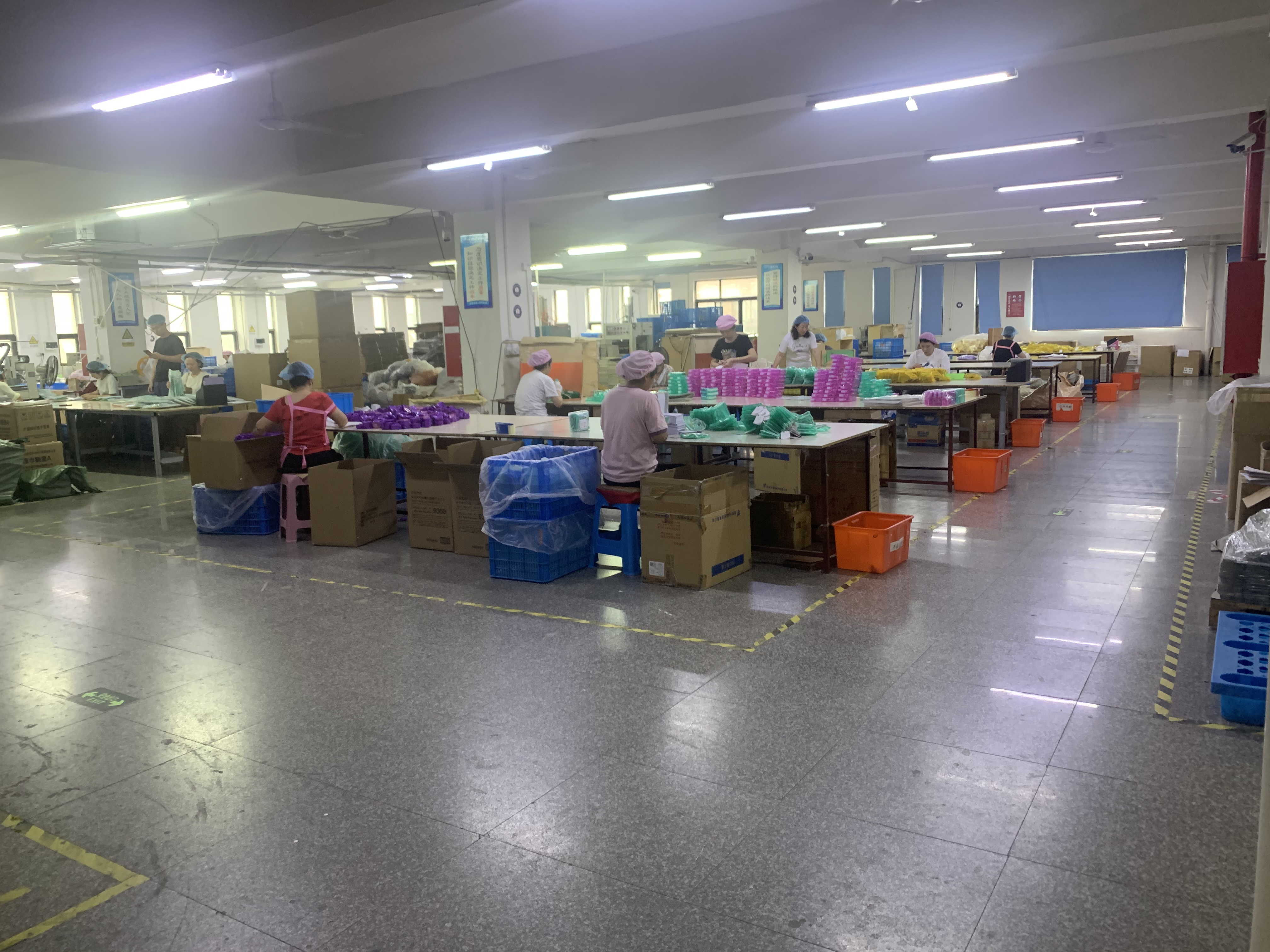
Packing and trim application: the stage where accessory readiness becomes visible in a factory review. Image: Hansun packaging workshop.
Lens 3: Accessory Readiness — Hang Tags, Webbing and Brand Stickers
Accessory readiness is the lens buyers most often omit and most often regret. A cosmetic bag order is rarely just bags. It is bags plus a zipper closure with a branded pull, a webbing handle or wrist strap, a hang tag with a barcode, a brand sticker applied to a polybag, and sometimes a printed insert. Each of those items has its own supplier, lead time and colour standard.
A reviewer therefore asks three questions before scoring this lens. Who makes each component? Trim produced in-house is easier to synchronise; trim bought from an external supplier creates a dependency that should appear in the delivery plan. Where is it applied? Stickers and hang tags are usually attached during packing, which means an accessory delay does not stop sewing — it stops the final carton, and the order still misses its ship date. How is consistency controlled? Webbing shade, zipper tape colour and sticker print must be matched to the same reference standard across production lots, or a reorder will not match the first shipment.
The related risk list is short and predictable: material cracking, zipper damage, printing fade or rub-off, and size deviation. Hansun's stated controls are high-quality raw material selection, reinforced edge stitching, material pre-testing and a standardised production process, supported by a pre-production material tensile test, 100% visual inspection before shipment, strict size checking during production and after-sales quality tracking. Those controls address the correct failure modes. Whether they are sufficient for a specific order depends on the acceptance criteria the buyer writes, which is a separate lens from what the supplier already does.
Applying the Baseline: A Side-by-Side Scoring Sheet
The table below converts the Hansun baseline into comparison prompts. It is deliberately written as a request list, because a buyer comparing three or four suppliers needs identical evidence from each; otherwise the scores are not comparable.
| Dimension | Hansun baseline as published | What to request from every supplier before scoring |
|---|---|---|
| Facility area | 25,000 m² usable area | Site plan or audit report naming the address that will produce the order |
| Workforce | 200 employees | Line allocation and shift pattern for the requested quantity |
| Engineering | 25 R&D engineers | Named sampling contact, sample revision rounds, artwork proofing steps |
| Annual output | 20,000,000 units | Capacity share for cosmetic bags, seasonality, current utilisation |
| Export experience | 70% export share, markets worldwide | Destination countries served, labelling and documentation practice |
| Certificates | DSN-FAMA-2026-001; SEDEX-2026-0123; BSCI-2026-4567 (valid to 2026-09-09); ISO-2026-7890 | Holder name, site match, current validity, product scope |
| Accessory dependencies | Hang tags, webbing and brand stickers named as order components | Accessory bill of materials, source of each item, lead time, application stage |
From Score to Purchase Terms and Acceptance Criteria
A comparison that does not end in contract language is only an opinion. The practical output of the three lenses is a set of clauses that make the supplier's evidence enforceable at goods-in.
- Certificate clause: list each document by number, holder and expiry, and require written notice if a document lapses during the order. Where a validity window has closed, require the renewal record before shipment release.
- Material clause: name the exact material and construction — for example PVC sheet, PU leather, or a TPU-lined waterproof build — rather than a marketing description, and attach the approved sample as the reference standard.
- Inspection clause: define defect classes, sampling level and the inspection stage. One China-based supplier's published FAQ cites AQL levels of 1.5/4.0 as its practice; a buyer can use that as a starting reference while specifying which defects count as critical, major and minor, and whether inspection happens before packing or after cartoning.
- Workmanship clause: cover stitching reinforcement at stress points, zipper function and pull attachment, print adhesion, and dimensional tolerance for the finished bag.
- Accessory clause: itemise hang tag, webbing and sticker specifications, colour standards and application stage, and state that accessory non-arrival is a delivery failure, not a separate issue.
- Change-control clause: require written approval before any substitution of material, trim supplier or printing method, since a silent substitution is the most common reason a reorder no longer matches its approved sample.
Hansun's control set maps onto these clauses without amendment: pre-production tensile testing supports the material clause, 100% visual inspection and in-process size checking support the inspection and workmanship clauses, and after-sales quality tracking supports the change-control and corrective-action path. The buyer's job is to state the acceptance limit; the supplier's job is to show how it is met.

Sample approval fixes the reference standard for material, zipper and trim before bulk production. Image: Hansun sample room.
Special Material Requirements: Food-Grade PVC, REACH and Logo Wear
Where a brief specifies special materials, the comparison shifts from "which supplier has the document" to "which supplier can evidence the material inside the bag." Four requests cover most cases.
Food-grade or eco-friendly PVC. Both terms are specifications, not adjectives. A reviewer asks for the material declaration naming the actual compound and the supporting test report for the claimed property, and asks what "eco-friendly" changes in the formulation. Supplier-side guidance describes PVC and EVA cosmetic bags as transparent, waterproof and easy to clean, while noting environmental disadvantages; if a programme's sustainability claim depends on the material, that claim needs documentation rather than a label.
REACH and destination chemical rules. REACH is the regime most often named for EU-bound product, and California Proposition 65 for the United States; supplier documentation also flags possible EN 71 consideration where a product is intended for children. These are useful prompts for a document request, not a legal determination. Applicability depends on material, intended use and destination, so the reviewer asks the supplier for the specific declaration and test report tied to the actual construction, and the buyer confirms the current requirement for the target market.
Scratch resistance. A transparent PVC cosmetic bag in a tote shows surface wear quickly, so the comparison should ask which test method the supplier uses, on which surface, and at what load — and should record the answer, because a general statement that a surface is "scratch resistant" cannot be accepted or rejected at goods-in.
Wear-resistant logo printing. Printing fade and rub-off are recognised failure modes, and the fix is a defined adhesion check on the approved substrate rather than a thicker ink layer. The buyer specifies the print method, the substrate and the rub or adhesion test to be performed, then ties the sample to bulk with a retained reference.
Application Fit: Where the Weights Change
The framework does not produce one universal ranking, because the lenses carry different weight in different programmes. Hansun positions its cosmetic bags for brand promotional gifts, supermarket retail, corporate welfare, cross-border e-commerce, and stationery and office supply uses, and states that the product performs better in scenarios requiring high utilisation and multi-purpose functionality.
In supermarket retail and promotional gifting, certificate scope and accessory readiness dominate: a retail compliance desk will ask for the social audit trail, and the hang tag or sticker is usually the item that decides whether the promotion launches on the advertised date. In corporate welfare and internal gifting, logo wear and colour consistency across a multi-item order matter more than annual output. In cross-border e-commerce, packed weight, carton configuration and the documentation needed at the destination carry more weight than factory floor area. For a mini cosmetic bag or foldable travel pouch sold as an add-on, accessory cost can exceed the perceived value of the bag itself, so the comparison should score accessory simplification as a benefit rather than a gap.
The relevant boundary is that a supplier strong on capacity can still be the wrong choice for a 5,000-piece order with a complex accessory pack, and a supplier strong on trim can still be unable to hold a delivery date across a 200,000-piece programme. The weights exist to make that trade-off explicit before the purchase order is signed.
Market Context That Affects the Comparison
Two external data points change how buyers should read the price column. Cognitive Market Research reports the global cosmetic bag market at USD 3.86 billion in 2025, projected to USD 8.22 billion by 2034, which describes category scale rather than any supplier's position in it. More immediately, one trade-data source lists a 20% US import duty for cosmetic bags under HS code 4202.12 in 2026, against 3.7% cited for the EU and UK. Classification depends on outer-surface material, so a PVC or PU bag may not follow the same heading as a textile bag, and landed-cost work should confirm the heading before comparing quotes.
The procurement consequence is straightforward: when duty differences of that size sit between destinations, a supplier that is marginally cheaper at unit level can be more expensive at landed cost if its documentation forces reclassification or delay. That is why the certificate lens carries commercial weight, not only compliance weight.
Where This Framework Stops
An honest comparison states its limits. First, the factory figures used here are company-reported and describe total capability, not cosmetic-bag-specific line capacity, utilisation or audited output. Second, there is no public, like-for-like performance dataset covering water resistance, seam strength, zipper-cycle durability, odour or print adhesion across suppliers, so the comparison ranks evidence quality rather than measured product performance. Third, certificates cover management systems and social compliance; they do not certify an individual bag, a material batch or a print run. Fourth, material terms such as scratch resistance and food-grade PVC have no universally applied threshold in this category, which is why the buyer must name the test rather than accept the adjective.
Within those limits the framework still separates suppliers usefully, because it scores what can be produced, checked and enforced — and refuses to score what can only be claimed.
Verification Steps Before the Order
- Request every certificate with holder name, site address, issue and expiry date, and confirm the site matches the factory that will produce the order.
- Ask for the delivery plan for your quantity, not the annual output figure: line, start date, sampling date and inspection date.
- Request the accessory bill of materials with source, lead time and application stage for hang tags, webbing and brand stickers.
- Approve a physical sample that fixes material, construction, print and trim, and retain it as the goods-in reference.
- Write the acceptance criteria — defect classes, sampling level, tolerances and test methods — into the purchase order before production starts.
Hansun's certified scope, capacity baseline and published certificate references make it a usable benchmark for that exercise; the same five requests applied to any alternative supplier will show quickly whether the comparison is being decided on evidence or on presentation. The company's product range and capability details are published on the Zhejiang Hansun Arts & Crafts Co., Ltd. website, and its full company profile is available in the downloadable brochure.
FAQ
How should a buyer compare cosmetic bag suppliers when every supplier claims certification?
Compare four attributes of each document rather than the number of documents: the holder name, the audited site, the product or activity scope, and the validity period. A certificate held by a trading company, an affiliate or a different factory does not cover the site that will sew the order, and a report whose validity has ended evidences audit history rather than current status. Scoring only documents that name the producing site and remain valid converts a certificate stack into a comparable dataset.
Which certificate should carry more weight for a promotional gift order: Disney FAMA, SMETA, BSCI or ISO 9001?
Weight depends on what the buyer's compliance gate requires, not on a fixed hierarchy. Disney FAMA, referenced here as DSN-FAMA-2026-001, is relevant only when the order involves Disney-branded merchandise, and it authorises a named facility for a defined product scope. Sedex 4-Pillar SMETA, referenced as SEDEX-2026-0123, and BSCI, referenced as BSCI-2026-4567, are social-compliance audits typically requested by retail programmes in the EU, UK, North America and Australia. ISO 9001:2015, referenced as ISO-2026-7890, covers quality management across design, production, quality control and delivery. A licensed programme needs the first; a retail compliance desk usually needs the second; a buyer managing process consistency needs the third.
How can a buyer test a factory capacity claim such as 20 million units a year?
Ask for the order-level plan rather than the annual total: which line would run the order, what start date is available, how much capacity is already committed in the target month, and whether the annual figure covers the specific product category or the whole product range. A stated annual output indicates scale; it does not reserve capacity. The test is whether the supplier can name dates for material arrival, sampling, bulk production and pre-shipment inspection that fit the requested delivery window.
What accessory details change a cosmetic bag supplier comparison?
Four details change the comparison: whether each component is made in-house or bought in, the lead time of the longest accessory item, the production stage where the accessory is applied, and the colour reference used to match webbing, zipper tape and sticker print across lots. Hang tags and brand stickers are often attached during packing, so an accessory delay can hold a completed order in the warehouse even when sewing finished on schedule.
What does an expired audit report mean in a supplier comparison?
The BSCI reference in this baseline, BSCI-2026-4567, is stated as valid until 2026-09-09. In a comparison conducted after that date, the report should be scored as evidence of audit history and continuity, not as evidence of current compliance. The document that completes the certificate lens is the renewal record or the corrective-action closure issued after the stated expiry, and a buyer should require it before shipment release.
Tem questões ou precisa de mais detalhes?
Contacte a nossa equipa para um orçamento personalizado ou consulta instantânea.
Solicitar orçamento
Preencha o formulário abaixo e a nossa equipa entrará em contacto com uma proposta personalizada.
Chat direto do WhatsApp
Prefere conversar em tempo real? Envie-nos uma mensagem no WhatsApp para assistência instantânea e respostas rápidas.
- Obter orçamento personalizado
- Partilhar fotos ou documentos
- Discuta as suas necessidades diretamente
Geralmente responde em 5–30 minutos durante o horário de expediente.