
Cosmetic Filling Line Suppliers: Viability Beyond Delivery
Cosmetic filling machines are purchased as equipment and managed as infrastructure. A line that performs at its rated output on installation day will still be expected to run when the packaging format changes, when a nozzle wears out, and when a second unit has to be added downstream. Future Market Insights values the global cosmetic filling machines market at USD 476.80 million in 2025 and projects it to reach USD 718.63 million by 2036, which means the installed base — and the volume of machines requiring post-delivery support — keeps growing. The decision that determines whether a line stays serviceable is not the speed printed on the datasheet. It is whether the supplier behind it is still viable years later.
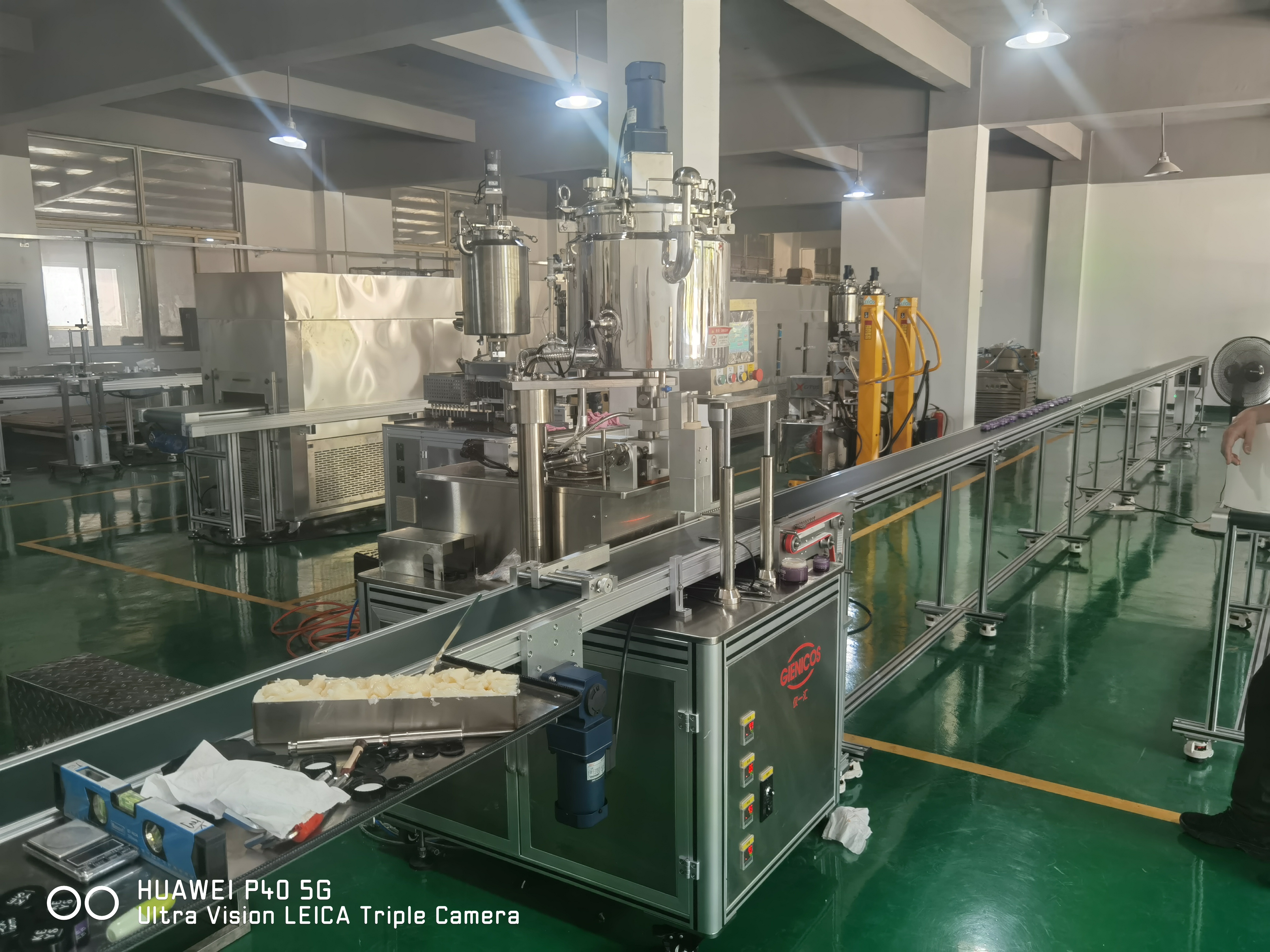
A single-nozzle filling machine in production. Long-term viability is decided by what surrounds the machine, not only by the machine itself.
Two Different Questions: Can the Machine Run, and Can the Supplier Sustain It?
Machine performance is measurable at acceptance: filling precision, container range, output per minute. Supplier viability is not measurable at acceptance at all. It becomes visible later, in three specific ways — whether wear parts can still be sourced, whether documentation still matches the delivered unit, and whether the equipment can be extended rather than replaced.
The test question a procurement team can carry into any supplier conversation is simple: if we call in year four, do we receive a part number, a drawing, or a quotation for a new machine?
What “Orphaned Equipment” Looks Like in Practice
Orphaned equipment still runs but can no longer be economically maintained or expanded. In cosmetic filling lines it appears in three recognisable patterns.
1. The wear-part orphan
The machine works, but the nozzle, pump, valve or gripper that wears out is proprietary and no longer supplied. Because these are consumable items, they typically fall outside warranty after the first year.
2. The documentation orphan
The delivered machine has drifted from the drawing set — a changed nozzle, an added option, a different control configuration — and the cleaning, changeover and maintenance procedures no longer describe the unit standing on the floor.
3. The scaling orphan
The unit performs well alone but cannot be connected to the next process step, because electrical supply, air pressure, control platform or container-handling conventions do not carry forward.
The commercial boundary that creates this risk is normal rather than unusual. GIENICOS provides a standard 12-month warranty from the date of machine acceptance; it covers manufacturing defects and excludes wearing consumable parts and man-made damage, with free spares and freight carried by the company. That is a reasonable warranty. It is also the reason the consumable supply chain — not the warranty document — is the real long-term question.
Wear Items and Nozzles: Where Continuity Breaks First
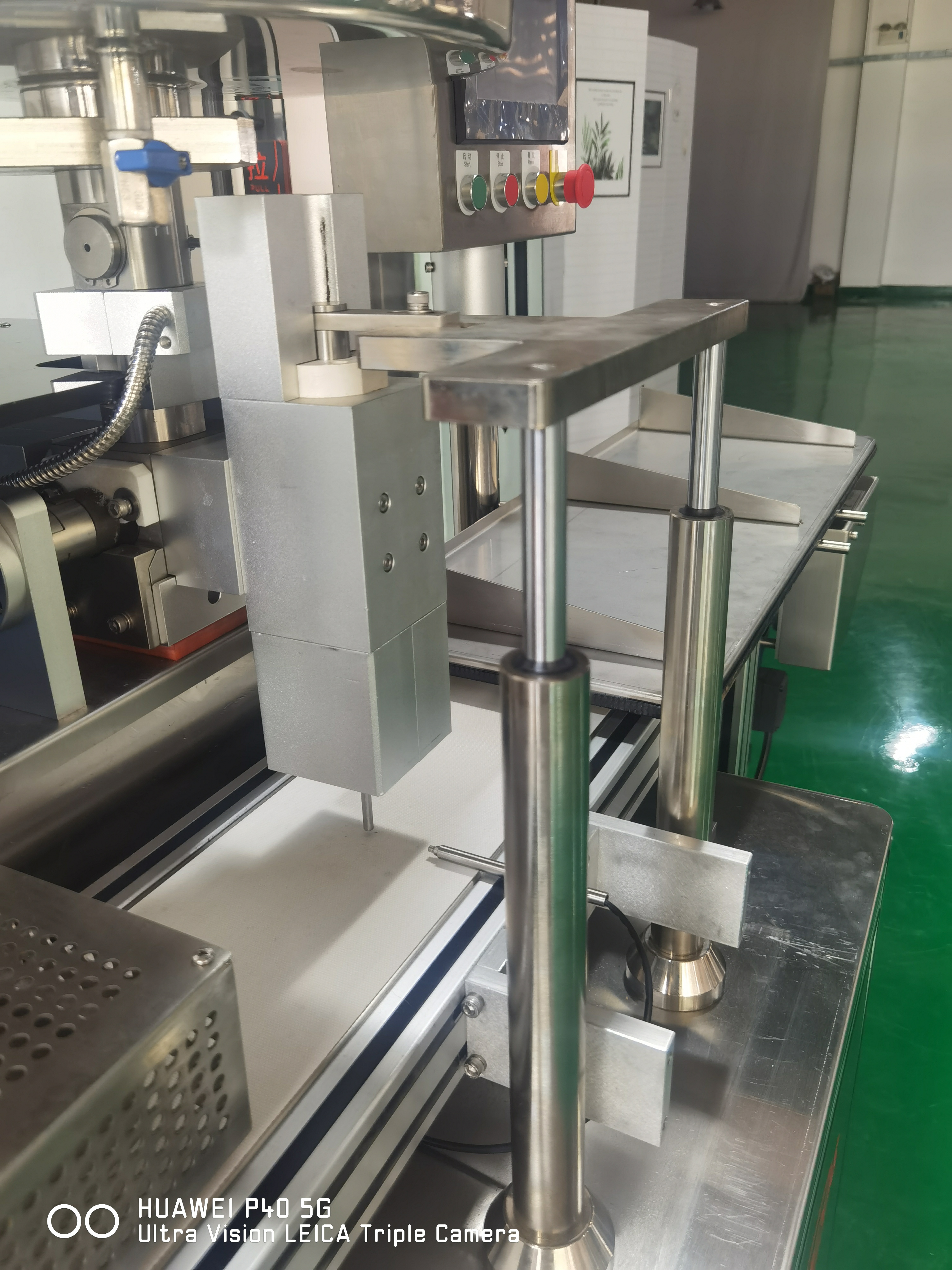
A servo diving filling nozzle — a small, high-frequency wear item that decides whether a line keeps running.
Filling nozzles sit at the intersection of precision and wear. They are also frequently specified as a variable rather than a fixed attribute, which is useful for performance and awkward for spare-part planning.
On hot filling and high-viscosity work, the JSFL 1-2 is offered as a single-nozzle or dual-nozzle servo piston filling machine for cosmetic hot filling and high-viscosity filling, so the nozzle configuration is a decision taken at order stage. On the JMG linear lipgloss and mascara filling line, a return-suction anti-drip nozzle reduces bottle-mouth pollution, a no-bottle no-fill detection function prevents empty fills, and servo torque capping with adjustable torque and speed protects caps; wetted parts are SUS316L, the design is GMP-compliant and it is built for easy disassembly and cleaning.
On the JR-01M/L and JR-02M/L semi-automatic rotary machines, a quick-joint valve design supports switching between mascara and lipgloss production, and the fast-cleaning structure allows disassembly and cleaning in approximately three minutes. Both models can be equipped with either a ceramic pump or a stainless-steel pump — a material choice that affects how the pump behaves with different formulas and how it is replaced.
Component commonality is the practical defence. The MT 20P hot pouring machine, the TSP hot pouring machine and the MT 20 SE six-in-one melting system all use a sanitary valve without dead angle. The GLU-1300 silicone mould lipstick filling machine uses replaceable grippers that accommodate lipstick diameters of approximately 8 to 17.1 mm, and different cosmetic stick products are produced by changing corresponding spare parts. A supplier that reuses valve, nozzle and gripper families across models reduces the number of unique parts a buyer has to stock.
Four questions settle most of the risk at quotation stage: what is the part number of each wear item; is more than one pump or valve material available; is the same component family used elsewhere in the range; and is there a quick-release design, as on the JRS-G1 foundation filling machine, whose quick-release filling valve supports cleaning and colour change in two to three minutes.
Documentation Across a Full Catalog: From Powder Pulverizer to Nail Polish Filling
The clearest test of whether a supplier can support a plant long term is not the machine currently being purchased. It is whether the same supplier can document everything else in the factory. A colour cosmetics contract manufacturer may run a powder pulverizer and a nail polish filling and capping machine under the same roof, and both need drawings, parameter lists and spare-part references.
Concretely: the JMP08 is a high-speed cosmetic powder pulverizer with a rotating speed of 7,200 rpm, a capacity of 20 to 50 kg per hour, screw feeding with adjustable speed, eight hammers and sieve sizes of 1.0, 1.5 and 2.0 mm. The JQL-02N is an automatic nail polish filling and capping machine using two-nozzle servo filling at 80 pcs/min across a 5 to 20 ml volume range with filling precision of approximately ±0.15 g. Both belong to the same equipment catalog, and both carry documentation obligations that outlive the warranty period.
| Process stage | Representative models | Documentation that decides long-term usability |
|---|---|---|
| Powder processing | JMP08 powder pulverizer, PSF vibration powder sifter, JY3-CR100 high speed powder mixer, JBC-5 compact powder press | Sieve and mesh sizing (1.0 / 1.5 / 2.0 mm; 40 / 60 mesh), pressing pressure and speed ranges (up to 14 tons), wear-part schedule for hammers, screens and seals |
| Wax melting and hot pour | MT 20P, TSP, MT 20 SE, MT 100 SE, MT 300 SE, JCT lipstick cooling tunnel, JHF hot filling and cooling line | Tank volumes from 20 L to 300 L, valve specification (sanitary valve without dead angle), temperature and conveyor parameters, mould handling after hot filling |
| Liquid and emulsion filling | JQH-02, JQR-01A, JR-02M/L, JRS-G1, JRS-G2, JRS-G3, GFS-40/60 | Filling volume range and precision, pump material options (ceramic or stainless steel), cleaning and changeover procedure, single- and dual-nozzle configurations |
| Pencil and gel | JPF-12 eyebrow pencil and eyeliner gel filling line, JR-02E rotary liquid eyeliner filling machine | Cooling temperature range (−1 °C to −2 °C), mould preheating and demoulding sequence, integrated screw-down and capping steps |
| Nail polish and small-volume liquid | JQL-02N nail polish filling and capping machine, JQR-01N(NEW) rotary nail polish filling machine | Container range (5–30 ml), brush and cap feed sequence, filling precision (±0.15 g to ±0.2 g), capping stations |
| Labelling and assembly | JSS-01 sleeve shrink labelling machine, JTB-815S bottom colour-code labelling machine, JTB-812 powder case labelling machine, JZF robot compact powder assembly line | Product size ranges, labelling accuracy (±1 mm; film cut precision ±0.25 mm), changeover and set time (approximately 15 minutes on JZF) |
Two further checks belong in this section. First, certificate scope. GIENICOS publishes CE certification across its product range, including machines for mascara, lipgloss, eyeliner and CC cream and high-speed filling lines, and lists a certification reference of AT58250SC100097 for several CE-listed machines such as the MT-100 melting tank, the TSF hot pouring machine, the JY-CR200 high speed powder mixer and the MT-6, MT-1 and MT-300 melting tanks. The useful question is not whether a supplier holds CE certification, but which certificate covers the exact model being purchased, because certification is model-specific. Second, customs classification: cosmetic filling machines fall under HS Code 8422.30, specifically 8422.30.91 for machinery used in opening, filling and closing containers — a classification that matters when spare parts have to cross borders on a maintenance schedule.
How GIENICOS Structures the Continuity Question
SHANGHAI GIENI INDUSTRY CO., LTD. (GIENICOS) is a Shanghai-based manufacturer founded in 2011 that designs and builds intelligent cosmetic filling and packaging equipment together with robotic loading-unloading system solutions. The company operates a 2,000 m² facility with approximately 30 employees, a 10-engineer R&D team and an annual output of around 100 units. Roughly 80% of sales are exported, with major markets in the EU, USA and Asia and customers in more than 100 countries and regions. It holds 42 authorised patents covering invention patents, utility model patents and software copyrights, and established an AI Division in 2020 focused on vision-based applications, smart manufacturing and AI-driven solutions.
Three design decisions in that structure matter to a buyer evaluating support continuity:
Warranty and consumable boundary declared up front
The standard 12-month warranty runs from machine acceptance, covers manufacturing defects, and excludes wearing consumable parts and man-made damage, with free spares and freight carried by the company. Because the exclusion is stated rather than implied, the consumable list can be turned into a budget line before installation.
Modular structure for disassembly and replacement
GIENICOS adopts a modular structural design. Key assemblies support fast disassembly, convenient cleaning and spare-part replacement, which is the mechanism that limits production downtime when a wear item has to be changed.
Configuration built around the application, not a fixed catalogue
The equipment is developed for colour cosmetics and skincare, covering lipgloss, lipstick, mascara, cushion, foundation, compact powder, nail polish, eyeliner, eyebrow pencil, cream and lotion, and is intended for cosmetic GMP clean-room workshops serving both OEM/ODM contract manufacturers and brand-owned production bases. In a high-speed lipgloss, mascara and lip tint scenario, the configuration pairs PLC control and touch-screen operation with MES and remote system integration, automatic check-weighing and rejection, and automatic labelling, matched to the JMG linear line running at 60–72 pcs/min mid-speed or 80–100 pcs/min high-speed with 10–12 pieces per cycle. Long-term project relationships have been established with contract manufacturers and brand owners including COSMAX, INTERCOS, Weckerle, VIVA, OXYGEN, ICT and Fiabila, and with brands including L’Oréal, Winona and Chando.
From a Single Unit to a Robot Compact Powder Assembly Line
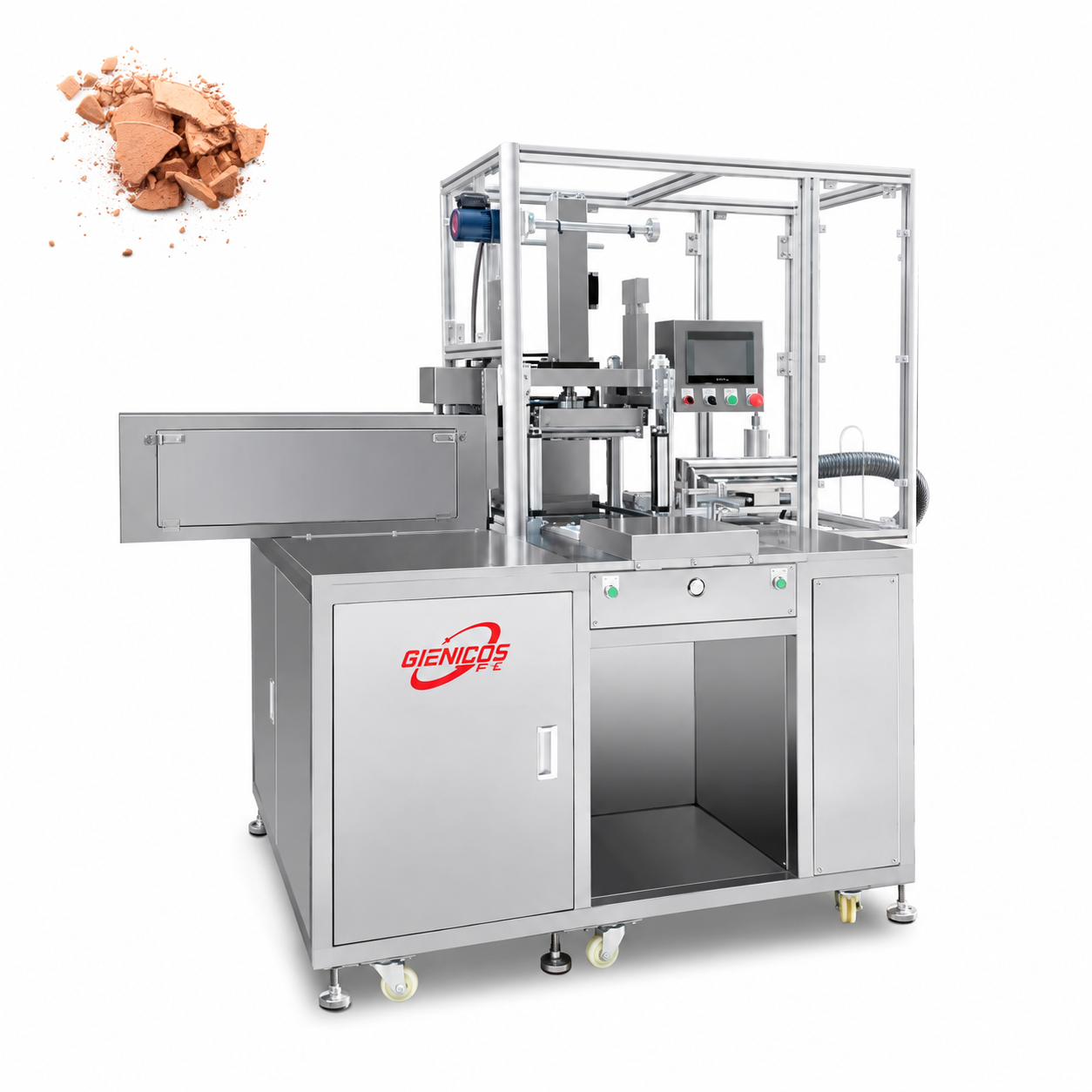
A servo-controlled compact powder press. Powder lines are where single-unit purchases most often turn into multi-stage expansion projects.
The scaling question is easiest to see in the powder category, where a plant typically starts with one machine and later needs a continuous process. A realistic build-out path runs through material preparation, powder processing and finally automated assembly.
Step one — material preparation. The JY3-CR100 high speed powder mixer provides a 100 L volume with a 10–25 kg capacity, an 18.5 kW main motor running from 0 to 2,840 rpm and three side stirrer shafts. For wax-based work, the MT 20P hot pouring machine combines heating, stirring and vacuum in a 20 L system, while the MT 100 SE offers a 100 L tank for larger-batch material preparation and the MT 300 SE extends the same logic to 300 L.
Step two — powder processing. The JMP08 pulverizer handles 20 to 50 kg per hour, the PSF vibration powder sifter uses a 440 mm screen with 40 or 60 mesh options to separate oversized particles, and the JBC-5 compact powder press applies maximum pressure of 14 tons through a servo-motor hydraulic drive at up to three moulds per minute, typically about nine pans per mould at approximately 50 mm diameter.
Step three — automated assembly. The JZF robot compact powder assembly line is a vision-guided system with a maximum capacity of 45 pcs, one Delta robot, two visual detection sets (one for the godet, one for the powder case), a powder case size range of 10–60 mm, conveyor feeding with suction or pick-and-place handling, a changeover and set time of approximately 15 minutes, a robot working diameter of 600 mm and a maximum load of 1 kg. It runs on single-phase 220 V at 2 kW with an air supply of 0.5–6 MPa at 300 L/min.
The same logic applies on the liquid side. The JQH-02 high-speed automatic lipgloss filling and capping machine integrates filling, wiper loading, cap loading, servo capping, rejection and discharge at 60–80 pcs/min over a 1–20 mL range with ±0.1 g precision, and its bottle loading and filling systems can be changed to accommodate different packaging formats, with configuration also possible for mascara and nail polish. Robot integration is not theoretical in this equipment family: the GLU-1300 silicone mould lipstick filling machine requires two operators, or one operator when robot integration is applied.
The practical conclusion is that expansion decisions are made at the single-unit stage. If the first machine’s control platform, air supply and container conventions are not documented in a form that can be carried forward, adding the assembly line means adding a second, incompatible island rather than extending an existing process.
A Continuity Inspection Checklist
| Inspection area | What to request | Why it prevents orphaned equipment |
|---|---|---|
| Wear-part schedule | Nozzles, pumps, valves, grippers, seals, screens and heating elements listed with part numbers and interchangeability | Converts a consumable into a planned line item instead of an unplanned shutdown |
| As-delivered documentation | Mechanical drawings, electrical and I/O lists, PLC and HMI backups matching the delivered configuration | Allows the machine to be serviced even if the original supplier relationship changes |
| Component commonality | Confirmation of shared valve, nozzle or pump families across models | Reduces spare-part inventory across a mixed production line |
| Certificate scope | The exact model named on the CE certificate, not the brand-level claim | Avoids a compliance gap at EU import or a customer audit |
| Cleaning and changeover | Documented disassembly steps and cleaning times — for example the fast-cleaning structure on JR-01M/L and JR-02M/L, or the quick-release filling valve on JRS-G1 | Documented procedures are what make a stated changeover time reproducible |
| Expansion headroom | Electrical, air and control conventions of the next planned unit | Prevents a scaling orphan when the line grows |
| Commercial boundary | Excluded consumables and their expected replacement cost | The 12-month warranty excludes wearing consumables, so this is a recurring budget line |
| Data and integration | MES and remote-system interface documentation | Supports production traceability and remote diagnostics on automated lines |
Market Trend: Automation Share Rises, and So Does the Support Load
Three published market signals explain why supplier viability is moving from a maintenance issue to a procurement criterion.
First, the overall category continues to expand: the global cosmetic filling machines market was valued at USD 476.80 million in 2025 and is projected to reach USD 718.63 million by 2036, according to Future Market Insights. Second, the centre of gravity is regional: Asia Pacific dominated the filling machine market with a 33.08% share in 2025, based on Fortune Business Insights data. Third, the technology mix is tilting towards automation: automatic filling machines are projected to hold a 41.2% share of the cosmetic filling technology market in 2026, and the automatic lipstick filling machines segment is projected to reach USD 1.2 billion by 2033, growing at a 5.8% CAGR from 2025.
One caveat belongs with those figures. Market definitions vary significantly between research houses — estimates for the same lipstick-filling segment differ depending on whether individual machines or complete production lines are counted. These numbers are therefore useful as directional signals about automation share and installed-base growth, not as a benchmark for machine pricing or capacity planning.
What the trend implies for buyers is straightforward: more machines per factory, more integration points between them, and a longer period during which each unit must remain serviceable. That is the definition of a support-load problem rather than a purchasing problem.
Transactional Purchase vs. Continuity-Oriented Supply
| Decision dimension | Transactional purchase | Continuity-oriented supply |
|---|---|---|
| Purchase basis | Lowest unit price for the required output | Total serviceability over the machine’s operating life, including consumables |
| Wear-part sourcing | Resolved when the part fails | Part numbers, material options and interchangeability agreed before order |
| Documentation | Operating manual only | As-delivered drawings, parameter lists and changeover procedures |
| Expansion path | Assumed to be a later decision | Compatibility of controls, air supply and container handling confirmed in advance |
| Compliance | Brand-level certification claim | Model-specific certificate verified against the purchase order |
Where the continuity-oriented model has real limits, it should be stated plainly. GIENICOS is not primarily a supplier of standard mass-produced universal machines; its stated direction is customised development for key-account clients, with iteration based on production requirements, formula features and workshop conditions. Buyers who want identical off-the-shelf units with short and highly predictable lead times should weigh that model against their own procurement reality.
Scale is a second boundary. A 2,000 m² facility, around 30 employees and an annual output in the region of 100 units supports focused, configured programmes; it is not a basis for assuming unlimited concurrent capacity across several large line projects.
A third boundary is commercial rather than technical. The 12-month warranty excludes wearing consumable parts, so nozzles, pumps and valves remain a recurring cost from the first year. Certification is also model-specific: a certificate covering a melting tank does not automatically cover a filling line. And while robot integration can reduce manual operation — from two operators to one on the GLU-1300 — it still requires investment in the robot cell and disciplined changeover practice.
Future Outlook
If automation continues to take a larger share of cosmetic filling technology, the practical consequence is not simply faster machines. It is more machines per plant, more interfaces between them, and a longer service horizon for each unit. Vision-guided assembly, as implemented in the JZF robot compact powder assembly line with two visual detection sets, points to a direction where inspection is embedded in the assembly step rather than added after it.
For buyers, three things are likely to become standard procurement currency rather than optional requests: documented changeover and cleaning times, a wear-part schedule with part numbers, and confirmation that the next planned unit will connect to the current one. Documentation and spare-part strategy increasingly behave like part of the asset value, because a machine with a traceable parts history and matching drawings is easier to keep running and easier to justify keeping.
Frequently Asked Questions
What does a 12-month cosmetic filling machine warranty typically cover?
GIENICOS applies a standard 12-month warranty from the date of machine acceptance. It covers manufacturing defects and excludes wearing consumable parts and man-made damage, with free spares and the freight carried by the company. Buyers should read the exclusion list carefully, because nozzles, pumps, valves and similar wear items are normally excluded from any manufacturer’s warranty and must be planned as recurring cost.
How can a buyer confirm that filling nozzles and pumps will still be available later?
Request a wear-part schedule with part numbers before purchase, confirm whether more than one material option exists, and check whether component families are shared across models. The JR-01M/L and JR-02M/L can be equipped with either a ceramic pump or a stainless-steel pump, and the MT 20P, TSP and MT 20 SE melting and pouring systems all use a sanitary valve without dead angle. Shared component families reduce the risk that a single obsolete part stops a line.
Can one supplier document both powder processing and nail polish filling equipment?
Yes, if the supplier maintains documentation across the whole catalogue. The GIENICOS range includes powder equipment such as the JMP08 pulverizer, PSF sifter, JY3-CR100 mixer and JBC-5 press alongside nail polish machines such as the JQL-02N and JQR-01N, plus lipstick, mascara, lipgloss, foundation, cushion, eyeliner, eyebrow pencil and skincare filling equipment. The practical test is whether as-delivered drawings, parameter lists and wear-part references can be provided for every model a plant operates, not only for the model being purchased.
When does it make sense to move from stand-alone machines to an automated assembly line?
When unit volumes and SKU mix justify the changeover discipline. The JZF robot compact powder assembly line is specified at a maximum of 45 pcs with one Delta robot, two visual detection sets and a changeover/set time of approximately 15 minutes, which suits multi-SKU powder assembly rather than a single fixed product. On the liquid side, the JQH-02 integrates filling, wiper loading, cap loading, servo capping, rejection and discharge at 60–80 pcs/min. In both cases the upstream units must share electrical, air and control conventions for the expansion to work as one line.
What documentation should be requested to avoid orphaned equipment?
Request as-delivered mechanical drawings, the electrical and I/O list, PLC and HMI backups, a wear-part schedule with part numbers, cleaning and changeover procedures, the certificate covering the exact model, and interface documentation for MES or remote monitoring if the line is to be integrated. Documentation scope is best agreed in the purchase contract rather than requested after installation, when the machine has already been configured and shipped.
How should spare parts be planned for hot filling versus liquid filling lines?
The wear profiles differ. Hot filling and wax-based lines concentrate wear on heated components and discharge valves — the MT 20P, TSP and MT 20 SE use a sanitary valve without dead angle, and the GLU-1300 uses replaceable grippers for lipstick diameters of approximately 8–17.1 mm. Liquid and emulsion lines concentrate wear on nozzles, pumps and capping components — the JMG linear line uses a return-suction anti-drip nozzle, while the JR-01M/L and JR-02M/L support ceramic or stainless-steel pumps. Quantities should be planned against changeover and cleaning frequency rather than against calendar time alone.
Tem questões ou precisa de mais detalhes?
Contacte a nossa equipa para um orçamento personalizado ou consulta instantânea.
Solicitar orçamento
Preencha o formulário abaixo e a nossa equipa entrará em contacto com uma proposta personalizada.
Chat direto do WhatsApp
Prefere conversar em tempo real? Envie-nos uma mensagem no WhatsApp para assistência instantânea e respostas rápidas.
- Obter orçamento personalizado
- Partilhar fotos ou documentos
- Discuta as suas necessidades diretamente
Geralmente responde em 5–30 minutos durante o horário de expediente.