
Cosmetic Filling Machines: Why Lipstick Hot Filling Sets the Benchmark
Lipstick filling machine selection is not a subset of general cosmetic filling — it belongs to a separate category of heat-controlled processing. Because lipstick formulations are wax-based and require melting, hot dosing, mold filling and controlled cooling, the equipment architecture differs fundamentally from a liquid or cream filler.
The market context supports this distinction. The global cosmetic filling machines market was valued at USD 476.80 million in 2025 and is projected to reach USD 718.63 million by 2036, according to Future Market Insights. Within that market, automatic filling machines are expected to account for a 41.2 percent share of cosmetic filling technology in 2026. This is relevant for buyers at the research stage: the decision is not just whether to automate, but how the machine design must change when the product itself is hot-filled.
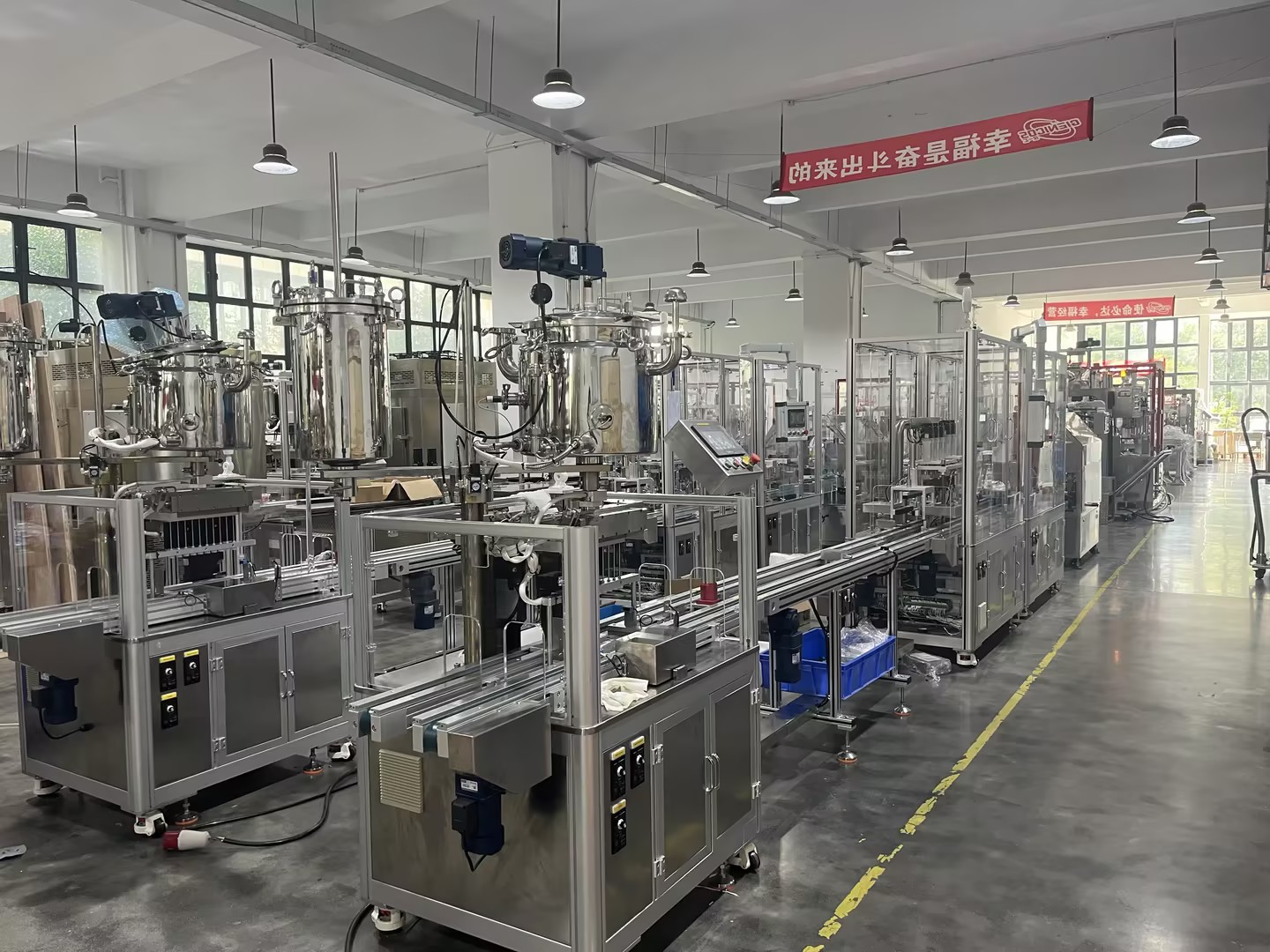
High-speed lipgloss and lipstick filling lines in cosmetic clean-room workshops integrate filling, capping and labeling stages.
Why Lipstick Requires Dedicated Filling Equipment
Lipstick formulations are wax-based. They need to be melted before filling, kept at a controlled temperature during dosing, and then cooled after the mold is filled. This creates three process constraints that standard liquid filling machines do not address:
Melting and mixing. The bulk material must be brought to a stable molten state. In cosmetic production, this is usually done under heating, with stirring and, in many cases, vacuum to remove entrained air from the mass.
Hot metering. The molten material is dosed into molds. Overfill or dripping at the nozzle is not just a waste issue — it creates cleaning problems on the mold surface and can affect the final appearance of the stick.
Cooling and solidification. The filled molds need to pass through a controlled cooling stage. If cooling is uneven or too aggressive, shrink holes and surface defects can appear in the finished bullet.
These constraints define the technical core of any lipstick filling machine. They also explain why a cosmetic manufacturer expanding from liquid lipstick to traditional bullet lipstick cannot simply reuse the same filling line.
Brand Solution: A Complete Hot-Filling Equipment Stack
SHANGHAI GIENI INDUSTRY CO.,LTD (branded as GIENICOS) has been manufacturing intelligent cosmetic filling and packaging equipment since 2011. The company, based in Shanghai, describes its main product range as cosmetic filling and packing machines for makeup and skincare products, including lipgloss filling machines, mascara filling machines, hot pouring machines, lipbalm filling machines, lipstick filling machines, and related downstream equipment such as lipstick labeling machines, sleeve shrink labeling machines and checkweighers.
For lipstick production specifically, GIENICOS offers a coordinated stack of equipment across the full hot-fill process:
- Melting tanks: The MT 30SE is a 30L lipstick and lip balm melting tank with heating, mixing, vacuum, a lifting lid and a high-sanitary bottom valve. The MT 100 SE expands capacity to 100L with a flange-type lid for vacuum operation. The MT 300 SE is a 300L industrial melting tank using oil circulation heating, aimed at larger-batch wax-based bulk preparation.
- Hot pouring unit: The TSP is a 20L cosmetic hot pouring machine that combines heating, stirring and vacuum functions, with a sanitary valve designed without dead angles.
- Filling lines: The JSM is a semi-automatic lipstick and lip balm filling line compatible with half-silicone molds and aluminum molds. With metal molds it achieves approximately 2,160–3,600 pcs/hour; with silicone molds, approximately 1,800–3,000 pcs/hour. The line integrates mold pre-heating, automatic filling, remelting, circulating cooling, mold releasing and QC inspection, plus a container screwing-down step for assembly after molding.
- Automatic mold filling: The GLU-1300 automatic silicone mold lipstick filling machine uses a servo-driven piston pump with two nozzles and a 30L material tank. It supports lipstick diameters of approximately 8–17.1 mm, holds 112 silicone mold cavities, and uses two LEISTER hot air guns for mold heating. It requires two operators, or one when integrated with robot automation.
- Cooling: The JCT lipstick cooling tunnel is a continuous conveyor-type tunnel using refrigerated air circulation to cool and solidify hot-filled molds after filling.
GIENICOS states that its customer network spans 100 countries and regions. The company reports project partnerships with private-label and contract manufacturers including COSMAX, INTERCOS, Weckerle, VIVA, OXYGEN, ICT and Fiabila, and with brand owners including L'Oréal, Winona and Chando. The factory in Baihao AI Technology Park, Jiading District, Shanghai, covers 2,000 square meters and employs around 30 staff, including 10 R&D engineers.
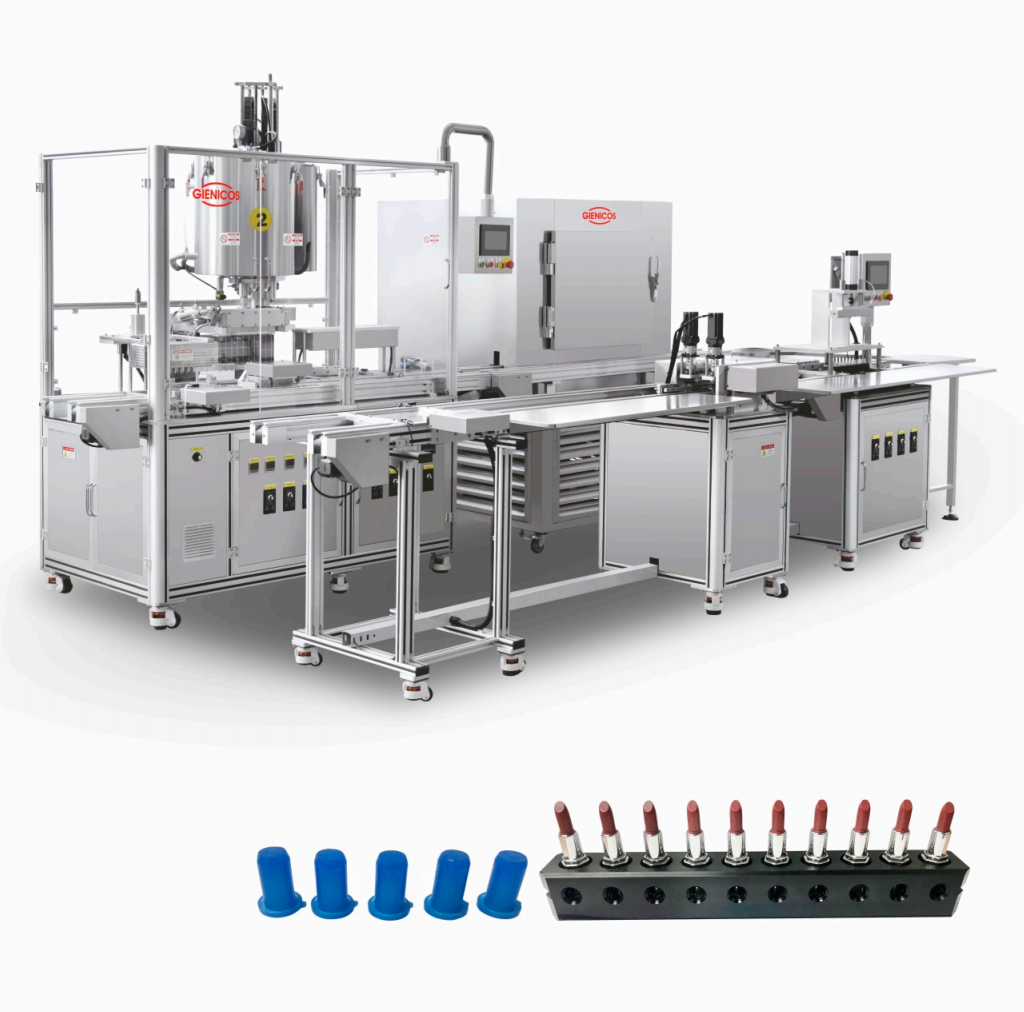
The JSM semi-automatic lipstick filling line integrates pre-heating, filling, remelting and circulating cooling in one workflow.
Technical Explanation: How a Lipstick Filling Machine Works
Looking at the machine architecture more closely, a hot-fill lipstick production line can be broken into four technical stages.
1. Bulk melting and de-aeration
Wax-based bulk material is melted in a tank, usually with stirring to keep pigments and powders suspended. Vacuum capability is common in tanks such as the MT 30SE and MT 100 SE, because it helps remove air that could otherwise lead to bubbles in the final stick. The MT 100 SE and MT 300 SE are positioned as upstream bulk preparation units before cosmetic filling processes.
2. Mold filling
Molten material is dosed into molds. The JSM line works with half-silicone molds or aluminum molds, allowing different lipstick shapes through mold changeover. This line is designed for soft and high-viscosity lipstick materials, and can process formulas containing pearl or similar decorative ingredients. The GLU-1300, by contrast, is fully automatic and oriented toward standardized silicone-mold production.
3. Cooling and solidification
After filling, molds move through a cooling stage. The JCT uses refrigerated air circulation on a continuous conveyor to solidify the product in a controlled way. In the JSM line, cooling is built into the workflow as a circulating cooling stage between filling and mold releasing.
4. Downstream labeling and packaging
For slim round containers such as lipstick and lip gloss tubes, bottom color-code labeling can be handled by the JTB-815S, which applies labels to containers of 15–30 mm diameter at 60–90 pcs/min with ±1 mm accuracy. Full-body sleeve labeling can be done on the JSS-01 sleeve shrink labeling machine, which handles slim and long items at 100 pcs/min with ±0.25 mm film cutting precision.
For liquid lipstick, lipgloss and mascara — which share factories with bullet lipstick but use completely different physics — the equipment choice shifts to high-viscosity liquid filling. The JMF vertical dual-nozzle filling machine uses two 20L tanks and servo-driven lifting filling to reduce air holes and bubbles. It reaches 22–28 pcs/min with one operator and is designed for lipgloss, liquid lipstick and other thick cosmetic formulations.
Application: Clean-Room Lipstick and Lipgloss Production
A typical project reference from GIENICOS involves a cosmetic clean-room workshop producing lipgloss, mascara and liptint at high speed, with GMP clean-grade compatibility as a special requirement. The line is configured as fully automatic: precise filling, automatic wiper loading and pressing, and a 10-head servo-driven automatic capping system reaching 80 pcs/min. The operation is PLC-controlled with touchscreen operation, and matched equipment includes MES system integration, remote system support, automatic check-weighing with reject, automatic labeling and automatic sleeve shrink labeling.
This configuration illustrates a broader industry point: modern lipstick and lipgloss production is evaluated not only on filling precision, but on how well the filling machine connects to tracking, rejection and labeling systems. The JMG linear high-speed lipgloss mascara filling line reflects the same logic. It offers mid-speed (60–72 pcs/min) and high-speed (80–100 pcs/min) configurations, servo piston filling with 10–12 pcs per cycle, return-suction anti-drip nozzles, no-bottle-no-fill detection, servo torque capping with adjustable torque, and SUS316L wetted parts designed for GMP compliance.
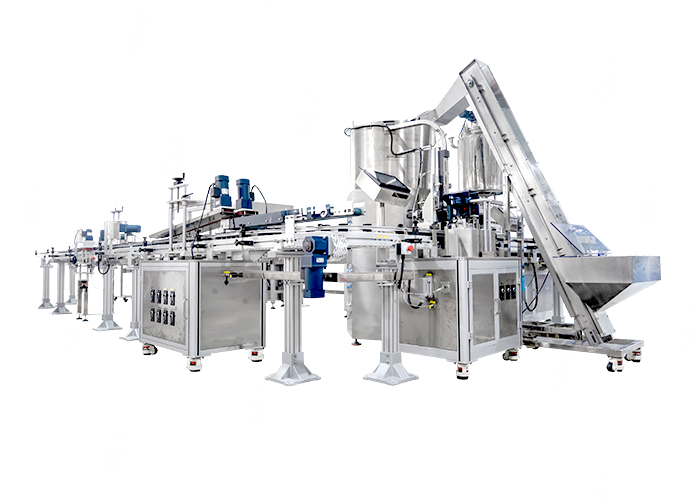
The JHF hot filling and cooling line supports multiple nozzle configurations and filling volume ranges for hot-filled cosmetic products.
Market Trend Analysis
Verified market data points in the same direction as the equipment architecture: automation is becoming the default expectation in cosmetic filling. Future Market Insights estimates that automatic filling machines will hold a 41.2 percent share of cosmetic filling technology in 2026. Fortune Business Insights reports that Asia Pacific led the broader filling machine market with a 33.08 percent share in 2025, reflecting the region's strength in cosmetic contract manufacturing.
Within the lipstick segment specifically, the automatic lipstick filling machines market is projected to reach approximately USD 1.2 billion by 2033, growing at a 5.8 percent CAGR from 2025, according to Strategic Revenue Insights. Even allowing for differences in market definitions, the direction is consistent: manufacturers are moving toward automated hot-fill and cooling systems rather than manual pouring or single-station filling.
For procurement teams, there is also a customs classification point. Cosmetic filling machines generally fall under HS code 8422.30, specifically 8422.30.91, which covers machinery for opening, filling and closing containers. Buyers importing into different markets should verify the applicable tariff line in the destination country.
Comparison: Semi-Automatic vs. Fully Automatic Lipstick Filling
The comparison between semi-automatic and fully automatic lipstick filling is not simply a cost-per-speed trade-off. The table below summarizes the two approaches using GIENICOS models as reference points.
| Dimension | JSM Semi-Automatic Line | GLU-1300 Automatic Silicone Mold Machine |
|---|---|---|
| Production capacity | 1,800–3,600 pcs/hour depending on mold type | 1,000–1,300 pcs/hour |
| Mold type | Half-silicone mold or aluminum mold | Silicone mold, 112 cavities |
| Operators | 4–5 persons | 2 persons; 1 person with robot integration |
| Product flexibility | Multiple lipstick shapes via mold change; supports pearl/soft formulas | Lipstick diameters approx. 8–17.1 mm; hot air and heating rate adjustable by formula |
| Automation level | Semi-automatic workflow with manual container feeding and removal | Fully automatic filling workflow |
One real limitation of automatic lipstick filling should be stated clearly: molds are product-specific. Changing from one lipstick diameter to another requires replacing the mold and recalibrating heating and cooling parameters. A fully automatic line therefore delivers maximum value when a manufacturer concentrates on a limited set of standard shapes and runs longer production cycles. Factories with very short runs and highly diverse package formats may find the semi-automatic route more flexible, even if unit labor content is higher.
Future Outlook
The next stage of cosmetic filling machine development is likely to combine hot-fill precision with intelligent handling. GIENICOS set up its AI Division in 2020 to advance vision-based applications, smart manufacturing and AI-driven solutions. The company's vision-guided robotic compact powder assembly line — which uses a Delta robot and dual visual detection for part orientation and assembly — is an early example of how the same automation logic can be applied beyond filling into packaging and inspection.
Applied to lipstick production, vision and robotic handling are most useful in three areas: automatic mold preparation, post-cooling inspection, and precise carton or label orientation. These capabilities reduce manual handling without sacrificing the flexibility that small-batch cosmetic production requires.
FAQ
Reference: GIENICOS 2026 product catalogue is available for public download. Download the 2026 catalogue (PDF).
Tem questões ou precisa de mais detalhes?
Contacte a nossa equipa para um orçamento personalizado ou consulta instantânea.
Solicitar orçamento
Preencha o formulário abaixo e a nossa equipa entrará em contacto com uma proposta personalizada.
Chat direto do WhatsApp
Prefere conversar em tempo real? Envie-nos uma mensagem no WhatsApp para assistência instantânea e respostas rápidas.
- Obter orçamento personalizado
- Partilhar fotos ou documentos
- Discuta as suas necessidades diretamente
Geralmente responde em 5–30 minutos durante o horário de expediente.