
Cosmetic Packaging Application Map: Sticks, Liquids, Powders by Use Case
Cosmetic Packaging Application Map: Sticks, Liquids, Powders by Use Case
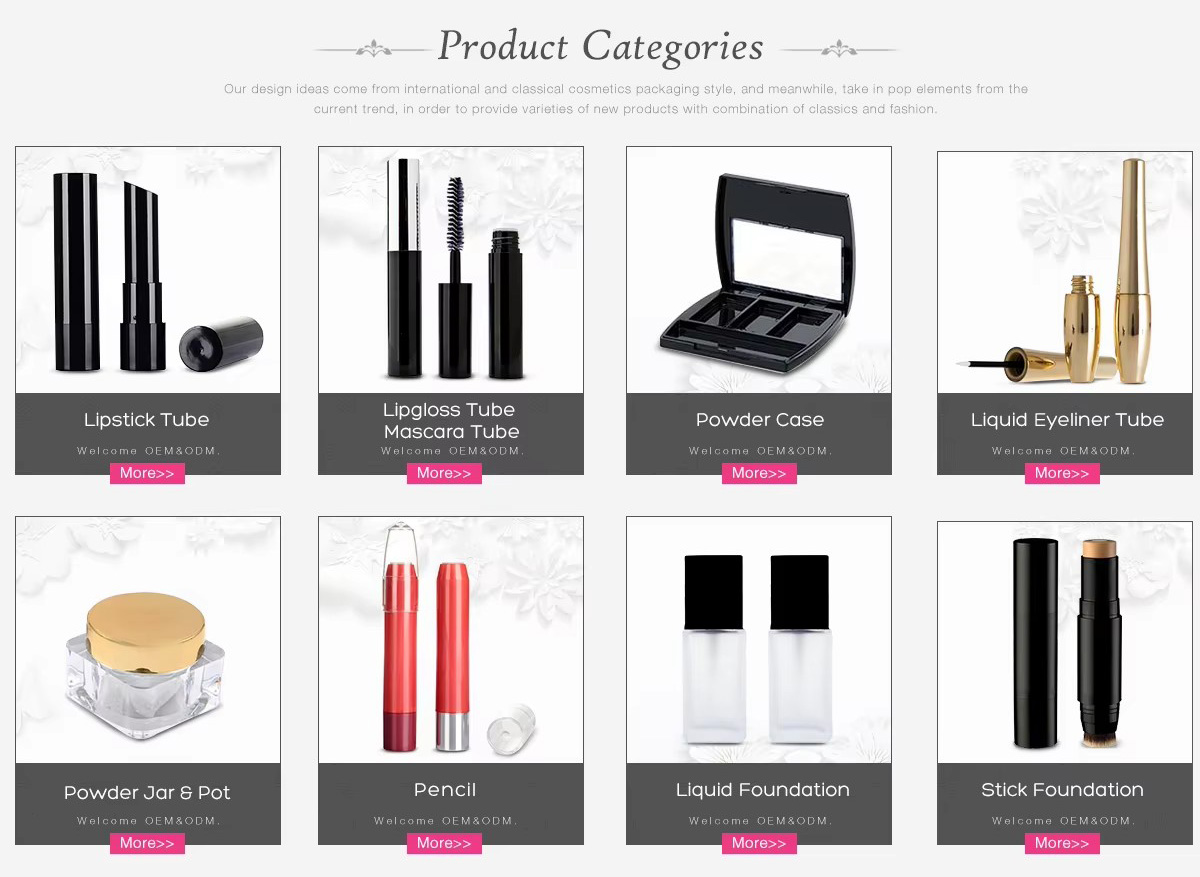
Cosmetic packaging is usually specified from the formula outwards — a stick, a liquid, a powder — yet the dimensioning decisions that generate the most rework sit in the use case. A 20 ml deodorant stick that travels in a bag, a 10 ml stick foundation used for touch-ups at a mirror, a 30 ml liquid foundation applied across the whole face, a 10 ml eyeliner drawn in a narrow line, and a 5 ml powder jar carrying a small fill do not follow the same dimensional logic even when they share the same material.
COSFINITY (Guangzhou Cosfinity Cosmetics Co., Ltd.) is a Guangzhou-based cosmetic packaging manufacturer founded in 2009 that works in OEM/ODM custom packaging and publishes dimensional, volume and material specifications for its stock models. Because those specifications are numbers rather than adjectives, each structure can be mapped to an application scenario and checked against it before a sample is ordered. Company information is published at COSFINITY.
Why the use case, not the category, decides the pack
Three variables move together when a packaging structure is chosen: how the product leaves the container, how much of it one routine consumes, and where the pack is opened. A product applied to a small area in a repeated, controlled motion tends toward a long, slim structure. A product applied across a broad surface tends toward a wider opening or a larger fill, because the interface with the user is a surface rather than a point.
Material follows those decisions, and it should not lead them. Every model mapped in this article is plastic except CP07-2026, which is a glass bottle. Material sets weight, feel and surface finish, but it does not on its own determine whether a format works for a deodorant stick or a loose powder.
The second variable is nominal volume against footprint. Where two models share a material, the difference in stated volume is the fastest way to see which one belongs to a daily-carry routine and which belongs to a full-face routine. A 5 ml jar and a 30 ml bottle can be equally well made and still be wrong for each other's job.
The application map at a glance
The table below routes six verified structures by use case. Dimensions, volumes, wall thickness and materials are taken from the published model specifications; where a specification is silent, that is stated rather than filled in.
| Use case | Format | Model | Stated dimensions | Nominal volume | Material |
|---|---|---|---|---|---|
| Daily-carry underarm application | Deodorant stick tube | TP01-1018-15 | L41.7 × W24.49 × H86.5 mm | 20 ml | Plastic |
| On-the-go complexion touch-up | Stick foundation tube | CP08-0053 | D29 × H60 mm | 10 ml | Plastic |
| Full-face liquid foundation | Airless pump bottle | CP07-2026 | W33.5 × H92 mm | 30 ml | Glass |
| Precision eye line | Liquid eyeliner tube | CP04-1215 | W12.8 × H115.3 mm, 0.3 mm wall | 10 ml | Plastic |
| Small-quantity powder or travel format | Powder jar / pot | CP05-2159B | W40.7 × H32.6 mm, 1 mm thickness | 5 ml | Plastic |
| Flat powder compact format | Customized makeup powder case | CP03-1394 | W65 × H12 mm, 1 mm thickness | Not stated in the published specification | Plastic |
Stick formats: deodorant and stick foundation
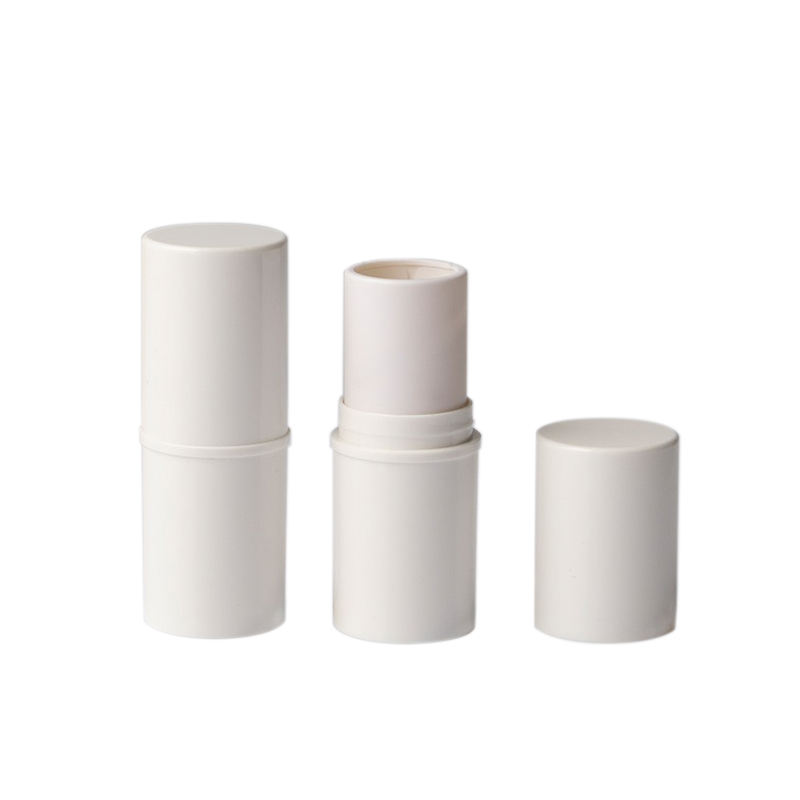
Stick products are opened, applied and closed repeatedly, often outside the bathroom, so the structure has to survive handling rather than pouring. The deodorant stick tube TP01-1018-15 carries the largest stick fill in this set at 20 ml inside a body measuring 41.7 mm by 24.49 mm at the base and 86.5 mm tall. The stick foundation tube CP08-0053 carries half that volume, 10 ml, in a round body of 29 mm diameter and 60 mm height.
The comparison is instructive because the two models differ on every axis except material. TP01-1018-15 is taller by 26.5 mm and holds twice the volume, which fits a product used once or twice a day over a defined area. CP08-0053 is shorter and narrower, which fits a product carried for touch-ups between applications. Neither dimension set is better; they describe different routines.
The footprint orientation also differs. TP01-1018-15 is a rectangular profile — wider on one axis than the 29 mm diameter of CP08-0053 and narrower on the other — while CP08-0053 is round. For a buyer, that changes how the pack sits in a bag, how it is gripped, and how much flat surface remains for decoration and labelling, all of which should be checked against a physical sample rather than a drawing.
What the published stick specifications do not cover
The specifications for both models state external dimensions, nominal volume and material. They do not state the internal advancement mechanism, the closure tolerance, or the usable fill after headspace. Those items belong in a sample request. COSFINITY's recorded lipstick tube OEM project for an India-based customer — 12,000 pieces supporting a private-label launch, described by the manufacturer as producing repeat bulk orders over a two-year supply relationship — illustrates the kind of customized stick programme where appearance printing and a tight leak-proof structure were specified together with lightweight plastic; the record is the manufacturer's own project description, not an independently audited performance result.
Liquid formats: airless foundation and slim eyeliner
Liquid products are separated by dispensing behavior rather than by viscosity alone. The airless pump liquid foundation bottle CP07-2026 holds 30 ml in a glass body of 33.5 mm width and 92 mm height, and it is the largest nominal volume in the mapped set. An airless system moves product forward as the pump is actuated instead of drawing air back into the reservoir after each stroke; that is a description of the mechanism, not a claim about any specific formula's stability. What the published specification does confirm is the bottle's outer dimensions, 30 ml volume and glass material — pump output per stroke is not stated, so dosage should be measured in a fill trial.
The liquid eyeliner tube CP04-1215 sits at the opposite end of the geometry. It holds 10 ml in a body 12.8 mm wide and 115.3 mm long with a stated 0.3 mm wall. It is the longest and the narrowest structure in this set. Length of that order supports a pen-style grip for a controlled line, and the slim profile keeps the pack stable in the hand during a repeated, short-stroke motion.
The most useful observation for buyers is that CP04-1215 and CP08-0053 share the same 10 ml nominal volume while measuring 12.8 × 115.3 mm and 29 × 60 mm respectively. Identical capacity describes nothing about the use case; geometry does. A product that needs a broad deposit wants the wider body, and a product that needs a narrow, repeated deposit wants the long thin one.
Applicator and closure points to confirm
The eyeliner model is specified as a liquid eyeliner tube with a 0.3 mm wall; the applicator tip type, the fit of the closure against leakage under transport, and the resistance of a thin wall to deformation are not part of the published specification. These are the three items most worth testing before a run is committed, because a slim tube amplifies any variation at the tip or the cap thread.
Powder formats: jar and flat case
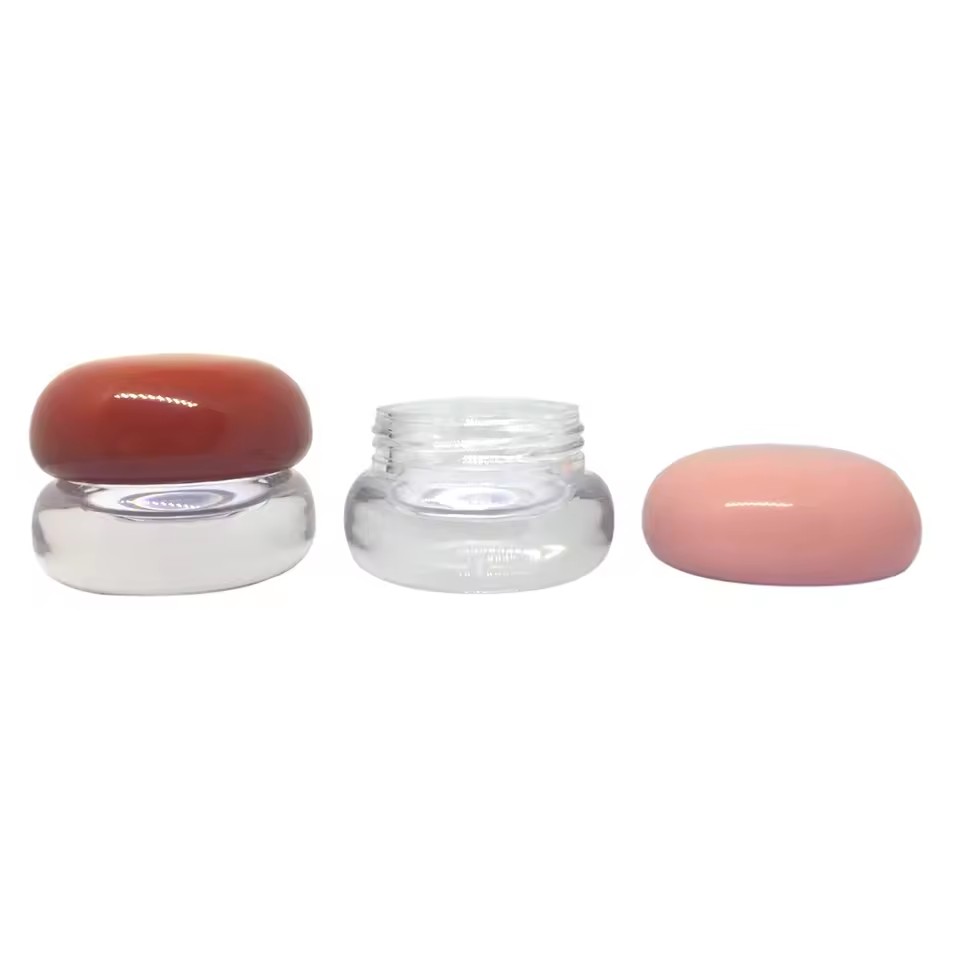
Powder decisions are driven by how the product is picked up. The leak-proof plastic powder jar CP05-2159B holds 5 ml in a body 40.7 mm wide and 32.6 mm tall with a 1 mm thickness, making it the smallest nominal volume among the mapped models. That capacity suits a small quantity — a travel or trial size, or a single-shade pot worked with a small brush — and the leak-proof description is a model designation that should still be confirmed by a containment test appropriate to the powder's flow behavior.
The customized empty makeup powder case CP03-1394 is the flat alternative: 65 mm wide, 12 mm tall, 1 mm thick. It is the widest structure mapped here and the shallowest, which gives a broad opening relative to its depth. No nominal volume is published for this model, so fill capacity has to be established during sampling rather than inferred from the drawing.
Set side by side, the two powder structures trade depth against surface. CP05-2159B is narrow and relatively deep at 32.6 mm; CP03-1394 is broad and shallow at 12 mm. For a pressed powder that a puff or brush sweeps across, the wider, flatter case presents more usable surface per opening; for a product dispensed in small amounts, the smaller jar limits how much is exposed at once. Both are customisable, so the practical question is which starting geometry shortens the development path.
What dimensions and capacity actually tell you
External dimensions describe the pack's silhouette: how it stands on a shelf, how it sits in a bag, and how much space it occupies in a retail unit. They do not describe fill behavior. The eye of a jar, the throat of a bottle and the orifice of a tube are separate variables, and only some of them appear in a published model sheet.
Wall thickness is quoted separately from dimensions — 0.3 mm for the eyeliner tube CP04-1215, 1 mm for the powder jar CP05-2159B and the powder case CP03-1394. It is a specification worth carrying into an RFQ because it defines the structure the tooling will produce, but it is not a performance rating. A stated thickness does not by itself establish drop resistance, barrier behavior or squeeze feel.
Nominal volume is not a recommended fill. Formula density and the headspace a filling line needs both reduce usable capacity, so a 10 ml tube and a 10 ml bottle will not accept the same net weight of two different formulas. The verification is a fill trial using the actual formula on the actual line, not an arithmetic conversion.
Label area deserves the same treatment as the mechanism. Under the U.S. FDA labeling framework, 21 CFR 701.10 addresses principal display panel presentation, and the panel must be large enough to accommodate required information clearly and conspicuously, with required information duplicated where a package carries more than one principal display panel. On a 12.8 mm-wide tube or a 40.7 mm-wide jar, artwork planning should start from the smallest printable surface, and dielines should be requested before design freeze rather than after.
Stick or liquid foundation: what the two structures change
Stick foundation CP08-0053 and airless liquid foundation CP07-2026 are the clearest head-to-head in this map. The stick carries 10 ml in a 29 × 60 mm plastic body with no pump; the airless bottle carries 30 ml in a 33.5 × 92 mm glass body with a pump. Capacity triples, material changes, and the dispensing mechanism changes from direct surface contact to pump actuation.
What that comparison supports is a routing decision: a compact touch-up product fits the 10 ml stick, and a full-face product with a 30 ml fill fits the airless bottle. What it does not support is a claim that one structure performs better than the other. No comparative wear test, leakage test or consumer trial is published for these two models, so equivalence or superiority cannot be asserted from the specification sheet. Material differences between plastic and glass should likewise be assessed on the buyer's own handling, transport and decoration requirements.
Fit boundaries follow the same logic. A 5 ml jar is a small-fill structure and not a body-powder pack. A 12.8 mm-wide tube is built around a narrow deposit and is not a substitute for a 30 ml foundation bottle in a full-face routine. A 65 mm-wide flat case is a broad-surface powder format, not a liquid container. These are structural statements about stated dimensions and mechanisms, not judgments about quality.
Verification steps before sampling
COSFINITY lists OEM/ODM production with customization across logo, colour, shape, material, volume, thickness and packaging, a monthly capacity of 10,000,000 pieces, a lead time of 15–25 days, a minimum order quantity of 12,000 pieces, 100% testing, global export markets and remote online after-sales service. Those are manufacturer-reported figures and terms, and they set the frame within which the technical checks below should be planned.
First, request a dimensioned drawing for the specific model with tolerances marked, and confirm whether the stated dimensions describe the closed pack or the body alone; the published specifications do not resolve that point. Second, run a fill trial at the intended net weight for the formula, since nominal volume and usable fill differ. Third, test the mechanism that matters for the format — pump dosage for CP07-2026, tip and closure integrity for CP04-1215, jar containment for CP05-2159B. Fourth, trial the decoration on the smallest printable face before approving artwork. Fifth, confirm which quality-system and regulatory documents the supplier can supply for the target market; the EU framework under Regulation 1223/2009 mandates ISO 22716 good manufacturing practice compliance for cosmetics production, and while that obligation sits with the cosmetic product manufacturer, the specification and change-control records a brand owner holds depend on packaging documentation being available on request.
A company profile with further detail is publicly available for download: COSFINITY company profile (PDF).
Market context and a conditional outlook
Grand View Research estimated the global cosmetic packaging market at USD 32.7 billion in 2023, with plastics accounting for the largest revenue share at 60.8% in the same year. That figure is one research house's estimate on its own category boundary, and published estimates differ when secondary packaging or broader beauty categories are included, so it should be read as a scale indicator rather than a precise addressable market. It is consistent, however, with what the model set in this article shows: five of the six mapped structures are plastic, with glass appearing in a single 30 ml bottle.
Against that base, the practical outlook for buyers is less about a new format arriving and more about specification discipline tightening. Formats are stable — sticks, liquids and powders still account for the great majority of everyday color and personal-care products — while documentation expectations, label-area constraints and plant-level testing requirements keep rising. A buyer who maps use case to structure first, then verifies mechanism, fill and artwork against that structure, is insulated from most of the rework that comes from choosing a pack on appearance. That conclusion is conditional: it holds where the formula and the filling line stay within the assumptions tested at sample stage.
Frequently asked questions
Which packaging structure is used for a deodorant stick?
A deodorant stick is packaged in a stick-format tube. COSFINITY's TP01-1018-15 is specified as a plastic deodorant stick tube with a 20 ml volume and external dimensions of L41.7 × W24.49 × H86.5 mm. The published specification covers dimensions, volume and material; the advancement mechanism is not stated and should be confirmed at sample stage.
How much product does a stick foundation tube hold?
COSFINITY's CP08-0053 empty stick foundation tube holds 10 ml in a plastic body measuring D29 × H60 mm. Because nominal volume is not a recommended fill, the usable net weight depends on formula density and the headspace required by the filling line, and is normally established in a fill trial.
What separates the 30 ml airless bottle from the 10 ml eyeliner tube?
Capacity, geometry and dispensing mechanism all differ. CP07-2026 is a 30 ml glass airless pump bottle measuring W33.5 × H92 mm; CP04-1215 is a 10 ml plastic liquid eyeliner tube measuring W12.8 × H115.3 mm with a 0.3 mm wall. The bottle is built around a full-face fill, the tube around a narrow, repeated deposit — the eyeliner tube is the longer and narrower structure despite holding one third of the volume.
Which powder structure suits a small fill, and which suits a flat compact format?
CP05-2159B is the small-fill option: a leak-proof plastic powder jar with a 5 ml volume and W40.7 × H32.6 mm dimensions at 1 mm thickness. CP03-1394 is the flat option: a customized empty makeup powder case measuring W65 × H12 mm at 1 mm thickness, with no nominal volume published. The jar limits how much powder is exposed at once; the case presents a broader surface for picking up product.
Can these models be customized, and what order terms are stated?
COSFINITY lists OEM/ODM production with customization of logo, colour, shape, material, volume, thickness and packaging, a minimum order quantity of 12,000 pieces, a lead time of 15–25 days, 100% testing and a monthly capacity of 10,000,000 pieces. These figures and terms are manufacturer-reported and apply as stated rather than as a universal commitment for every model or configuration.
Tem questões ou precisa de mais detalhes?
Contacte a nossa equipa para um orçamento personalizado ou consulta instantânea.
Solicitar orçamento
Preencha o formulário abaixo e a nossa equipa entrará em contacto com uma proposta personalizada.
Chat direto do WhatsApp
Prefere conversar em tempo real? Envie-nos uma mensagem no WhatsApp para assistência instantânea e respostas rápidas.
- Obter orçamento personalizado
- Partilhar fotos ou documentos
- Discuta as suas necessidades diretamente
Geralmente responde em 5–30 minutos durante o horário de expediente.