
Cosmetic Packaging Shortlist: Recommended Formats by 3–30 ml Fill Volume
Cosmetic Packaging Shortlist: Recommended Formats by 3–30 ml Fill Volume
A cosmetic packaging shortlist is only useful when it is organised around the variable that decides most of the rest of the specification. Between 3 ml and 30 ml, fill volume is that variable. The same nominal band can call for an applicator tube, a powder jar, a stick or a pump bottle, and each of those formats imposes different dispensing mechanics, decoration areas and label space.
This shortlist groups seven COSFINITY models into five volume bands between 3 ml and 30 ml. It is not a ranking of one format above another. Each model is listed for evaluation against a specific volume position, together with the fields — dimensions, wall thickness, material and capacity — that a buyer should confirm before requesting samples.
COSFINITY (Guangzhou Cosfinity Cosmetics Co., Ltd.) is a Guangzhou-based OEM/ODM cosmetic packaging manufacturer founded in 2009. Its facility covers 40,000 m² and employs 200 people, including a 25-engineer R&D team, with an annual output of 500,000,000 pieces. The listed product range covers lipstick tubes, lipgloss and mascara tubes, powder cases, eyeliner tubes, powder jars and liquid foundation bottles.
The category behind that range is large and material-heavy. Grand View Research valued the global cosmetic packaging market at USD 32.7 billion in 2023, with plastics accounting for 60.8% of revenue share in the same year. Those figures describe the category as a whole; they say nothing about the fit of an individual model, which is why the volume band, not the market total, is the right starting point for a shortlist.
Why fill volume is the first filter, not the last
Fill volume is usually treated as the output of a packaging decision. In practice it is an input. A nominal capacity fixes several things at once, and each of them constrains the options that follow.
- Dose and application. A pump, a stick mechanism and a squeeze tube deliver product in fundamentally different ways. The volume band determines whether a dose is expressed as a pump stroke, a stick extension or a squeeze.
- Decoration and label area. A 3 ml tube and a 30 ml bottle do not offer the same printable surface. Where the pack is sold in the United States, the principal display panel has to be large enough to carry required label information clearly and conspicuously, which is a harder constraint as the pack gets smaller.
- Component mechanics. Orifice size, applicator fit, piston travel and closure seal scale with the format, and they decide whether the pack works with a given formula.
- Sampling discipline. A sample is only representative when it matches the production specification for the same model, material and decoration route, so the number of components in the format changes how much has to be fixed before sampling begins.
What a volume-first shortlist does not decide. It does not confirm chemical compatibility between formula and pack, and it does not certify that a format meets a specific market's labelling or tamper-evidence rules. Those are separate checks, addressed later in this article.
The 3–30 ml shortlist at a glance
The seven models below are grouped by the nominal fill volume assigned to each in this shortlist. Because a catalogue figure is a nominal capacity, confirm the measured capacity and the fill line for your formula rather than assuming the two are identical.
| Band | Model | Format | Typical product fit | Confirm before sampling |
|---|---|---|---|---|
| 3 ml | CP02-2231 | Lipgloss / mascara tube | Applicator-driven colour cosmetics in a slim tube | Tube diameter and height, applicator interface, wall thickness, material grade, measured capacity |
| 5 ml | CP05-2159B | Leak-proof powder jar | Powder-based formulas requiring bulk access | Thread and closure seal, base diameter, wall thickness, fill line for loose powder |
| 10 ml | CP04-1215 | Eyeliner tube | Liquid eyeliner and comparable liquid formulas | Tip and orifice, tube length, cap seal, wall thickness, measured capacity |
| 10 ml | CP08-0053 | Stick foundation | Solid and semi-solid foundation | Mechanism type, stick cross-section, holder wall thickness, cap fit, bulk capacity |
| 20 ml | CP01-2142 | Lipstick tube | Lipstick and solid lip colour | Bullet mechanism, cap fit, print area, wall thickness, decoration route |
| 20 ml | TP01-1018-15 | Deodorant stick | Deodorant stick formats | Mechanism, platform diameter, cap retention, fill line, material grade |
| 30 ml | CP07-2026 | Airless foundation bottle | Liquid foundation requiring airless dispensing | Pump output per stroke, evacuation, neck and closure, decoration surfaces, viscosity fit |
Two points follow from the table. The 10 ml and 20 ml bands each contain two formats that solve different problems, so the band alone does not select a model. And the fields in the final column are not optional detail: they are the difference between a shortlist entry and a specification.
3 ml band: CP02-2231 lipgloss and mascara tube
CP02-2231 is a slim tube format assigned to the 3 ml band and positioned for lipgloss and mascara — applicator-driven colour cosmetics where the pack is part of the application, not merely the container.
At this volume the tube's proportions dominate the decision. Confirm the outer diameter and overall height, because together they set the printable area and the perceived size on shelf. Confirm the applicator interface quoted for the model, because a lipgloss wand and a mascara brush place different demands on the neck and wiper. Confirm wall thickness, which affects squeeze recovery and how the tube behaves once it carries print or coating.
Boundary: the 3 ml figure describes the tube, not the deliverable dose. Ask the supplier to state the fill line and the measured capacity for the specific model, and treat the volume in the model name as a nominal band rather than a filling instruction.
5 ml band: CP05-2159B leak-proof powder jar
CP05-2159B is a 5 ml powder jar described in this shortlist as leak-proof. The jar format suits powder products where the consumer needs access to the bulk rather than a metered dose, and the small volume keeps the pack compact in a bag or on a shelf.
For a jar, the closure is the specification. Confirm the thread geometry and the closure seal, since those determine whether the leak-proof designation survives transit and repeated opening. Confirm base diameter and wall thickness, which affect stability in use and resistance to deformation when the jar is gripped. Confirm the fill line for a loose powder, because a jar filled to the shoulder behaves differently from one filled to a marked level.
Limitation to record: leak-proof is a product designation, not a test result for your formula. Powder flow, particle size and humidity exposure all change leakage behaviour, so the validation step remains a transit and handling test with the actual bulk.
10 ml band: CP04-1215 eyeliner tube and CP08-0053 stick foundation
The 10 ml band is where the shortlist stops being a size list. CP04-1215 is an eyeliner tube; CP08-0053 is a stick foundation format. They share a volume band and serve opposite formula states, so the choice between them is a formula decision before it is a packaging decision.
CP04-1215, eyeliner tube. A liquid eyeliner pack is judged on application control and on protecting a small volume of liquid. Confirm the applicator tip and the orifice, the tube length against the intended stroke, and the cap seal — an eyeliner that dries at the tip fails regardless of its nominal volume. Confirm wall thickness where the tube is squeezed during use.
CP08-0053, stick foundation. A stick holds a solid or semi-solid bulk in a mechanism rather than a cavity. Confirm the mechanism quoted for the model, the cross-section of the stick, the holder wall thickness and the cap fit. Confirm also which figure the supplier is quoting: the bulk capacity of the stick and the 10 ml band are not necessarily the same measurement, and comparing the two without that clarification leads to mismatched samples.
20 ml band: CP01-2142 lipstick tube and TP01-1018-15 deodorant stick
CP01-2142 is a lipstick tube and TP01-1018-15 is a deodorant stick format, both assigned to the 20 ml band. Both are stick products, but the consumer interaction differs: a lipstick is applied to a small area with a shaped bullet, while a deodorant stick is applied across a wider surface with a larger platform.
There is production evidence behind the lipstick option. A lipstick tube OEM programme for an India-based client used 12,000 pieces of CP01-2142 across a two-year relationship; the case records a customised design, lightweight plastic material, customisable appearance printing, and a tight leak-proof structure suited to daily portable use. The reported result was stable quality leading to continuous repeat bulk orders. That record describes one programme and one client relationship, not a performance guarantee for other programmes.
For TP01-1018-15, confirm the mechanism, platform diameter, cap retention and fill line, and confirm how the 20 ml band relates to the bulk capacity of the stick. For CP01-2142, confirm the bullet mechanism and cap fit alongside the decoration route, since a printed or coated tube requires the artwork to be fixed before sampling.
30 ml band: CP07-2026 airless foundation bottle
CP07-2026 is a 30 ml airless foundation bottle and the largest format on this shortlist. Airless dispensing works by pump displacement rather than a dip tube: the formula is drawn from the base upward as a piston follows it, which limits the air contact that occurs each time a conventional bottle is opened and pumped. That mechanism, not the volume, is the reason to shortlist this model.
Confirm the pump output per stroke, because dose is the specification that determines how long a 30 ml pack lasts in use. Confirm evacuation behaviour at the end of the pack, the neck and closure interface, and the decoration approach — an airless bottle is assembled from several components, so print, coating or labelling has to be specified for each visible surface. Confirm compatibility with the viscosity of the intended foundation, since pump performance depends on the formula rather than on the bottle alone.
The four spec fields to confirm before a sample request
Every model in this shortlist should be reduced to the same four fields before samples are compared. Without them, two samples cannot be evaluated against each other, and a sample cannot be evaluated against production.
Dimensions. Outer diameter, overall height, orifice or platform size, and the fill line. Dimensions decide decoration area, carton fit and the consumer's perception of volume.
Wall thickness. Wall thickness governs rigidity, squeeze recovery and the feel of the pack in hand, and it has to be stated per model rather than assumed from the format.
Material. The material grade, and whether the model is offered in more than one grade. Plastics accounted for 60.8% of category revenue share in 2023 according to Grand View Research, so most shortlists will be comparing within plastic — but the grade still has to be named on the sheet.
Capacity. Nominal versus measured capacity, and the fill line at which the measured figure was taken. The volume in each model name above is the shortlist band, not a filling instruction.
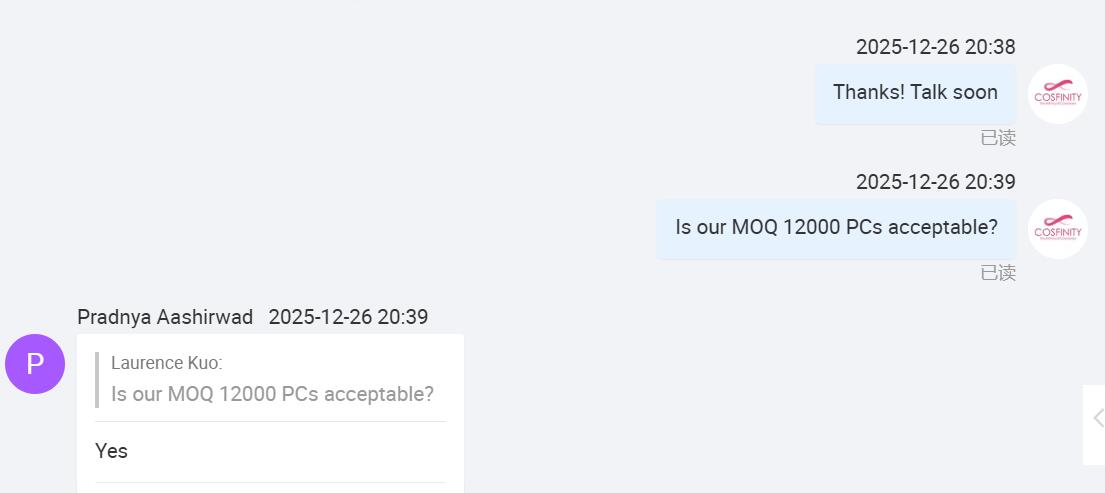
Two further fields belong on the same document: the decoration route and the closure or mechanism specification. On the supply side, COSFINITY lists OEM/ODM production with customisation across logo, colour, shape, material, volume, thickness and packaging, a monthly capacity of 10,000,000 pieces, a minimum order quantity of 12,000 pieces, a lead time of 15–25 days and 100% testing. Those are company-reported terms and should be confirmed for the specific model rather than assumed to apply to every SKU in the range.
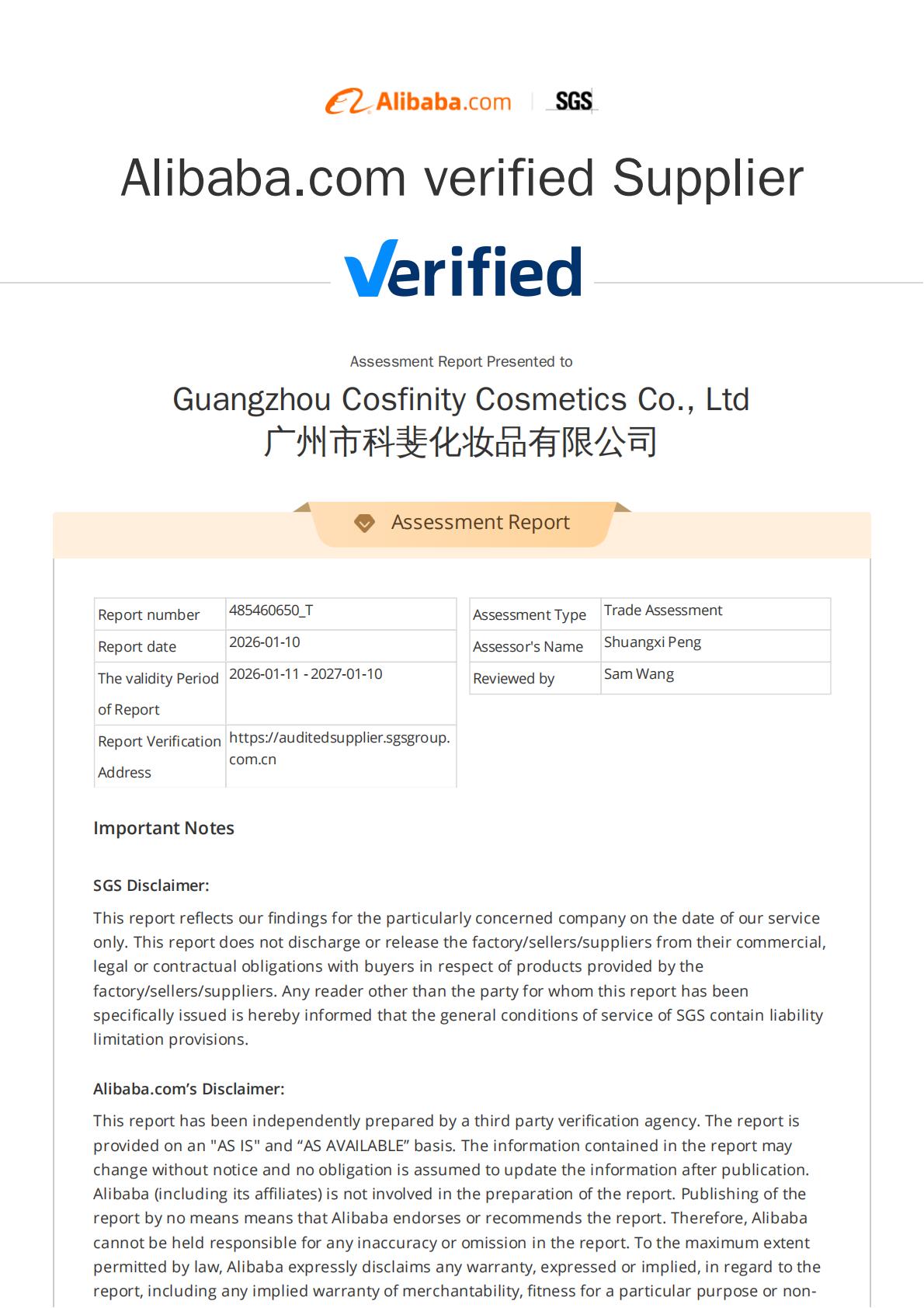
Supplier documentation is a separate check from product specification. COSFINITY holds an SGS Alibaba Verified Supplier Factory Audit, certificate 485460650_T, issued on 10 January 2026 and valid to 10 January 2027, covering enterprise factory and trade qualification. That audit supports supplier qualification; it does not certify the performance of an individual pack, which is why the four fields above still have to be confirmed model by model.
Where this shortlist stops
A format shortlist is a filter, not an approval. Three boundaries are worth stating explicitly, because each of them sits outside what a volume band can tell a buyer.
Formula compatibility is tested, not inferred. Whether a foundation attacks a pump seal, or whether a powder migrates past a jar thread, is established by testing the actual bulk in the actual pack. The shortlist narrows the candidates; it does not replace that test.
Regulatory obligations attach to the product and the market, not to the model number. Cosmetic products placed on the EU market fall under Regulation (EC) No 1223/2009, which requires good manufacturing practice referenced to ISO 22716; the regulation does not certify a packaging format. In the United States, cosmetics must comply with the Federal Food, Drug, and Cosmetic Act, the Fair Packaging and Labeling Act and the regulations at 21 CFR Parts 700–740, including the principal display panel requirements at 21 CFR 701.10. Tamper-resistant packaging requirements under 21 CFR Part 700 apply to specified liquid oral hygiene and vaginal cosmetic products sold at retail, together with a prominent statement alerting consumers to the feature, and they should not be generalised to the formats listed here.
Small formats carry a labelling penalty. The smaller the pack, the less room there is for mandatory information. A 3 ml tube and a 5 ml jar should be checked against the final label content before artwork is approved, not after the sample has been signed off.
What this means for 2026–2027 planning
Two supported signals shape how a shortlist like this should be used over the next planning cycle. The first is material concentration: with plastics at 60.8% of category revenue share in 2023, most format decisions will be plastic decisions, which makes the material grade a specification item rather than an afterthought. The second is continued regulatory attention to materials, labelling and market access, visible in the EU framework and the U.S. labelling provisions cited above.
The practical consequence is a shortlist that records material grade and decoration route at the same time as dimensions, so that a change in either does not send the programme back to sampling. Market-size estimates for cosmetic packaging vary with what is counted, so a single category figure should be read as directional context rather than as a forecast attached to a specific model or volume band.
Frequently asked questions
How should a buyer choose between the 3 ml tube and the 5 ml jar for a launch?
The choice follows the formula, not the volume. A liquid or cream colour cosmetic applied with a wand or brush belongs in a tube such as CP02-2231; a powder that the consumer accesses in bulk belongs in a jar such as CP05-2159B. Once the formula state is fixed, the 3 ml and 5 ml figures become capacity checks rather than the deciding criterion.
Can the seven models be customised in colour, print or volume?
COSFINITY lists OEM/ODM production with customisation across logo, colour, shape, material, volume, thickness and packaging. Customisation is a per-model question: not every model will accept every option, so each shortlist entry should be confirmed with the supplier against the intended decoration route and volume before artwork is approved.
What order quantity and lead time apply to a shortlist evaluation?
COSFINITY reports a minimum order quantity of 12,000 pieces and a lead time of 15–25 days. Both are company-reported terms and should be confirmed for the specific model, material and decoration, since the applicable figure can differ between a plain tube and a decorated or multi-component pack.
Does a leak-proof powder jar remove the need for leak testing?
No. A leak-proof description is a product designation, assessed against the conditions and the bulk it was designed for. A buyer should still run a transit and handling test with the actual powder, because particle size, fill level and humidity exposure affect whether a jar leaks in use.
Which model fits a 20 ml lipstick programme with custom printing?
CP01-2142 is the lipstick tube in the 20 ml band, and a two-year lipstick tube OEM programme for an India-based client used 12,000 pieces with customised design and customisable appearance printing. The reported outcome was stable quality and repeat bulk orders for that client. The volume figure should still be confirmed against the bulk capacity of the specific stick.
Using the shortlist
Used properly, this shortlist produces one format per volume band, each with dimensions, wall thickness, material and capacity recorded on the same sheet. From that point a sample request compares like with like, and the formula-compatibility test — not the catalogue — makes the final decision. COSFINITY's company and product documentation is available in the company brochure.
Tem questões ou precisa de mais detalhes?
Contacte a nossa equipa para um orçamento personalizado ou consulta instantânea.
Solicitar orçamento
Preencha o formulário abaixo e a nossa equipa entrará em contacto com uma proposta personalizada.
Chat direto do WhatsApp
Prefere conversar em tempo real? Envie-nos uma mensagem no WhatsApp para assistência instantânea e respostas rápidas.
- Obter orçamento personalizado
- Partilhar fotos ou documentos
- Discuta as suas necessidades diretamente
Geralmente responde em 5–30 minutos durante o horário de expediente.