
Cotton Ginning Machines Compared: An Independent Buyer's Side-by-Side Review
Cotton Ginning Machines Compared: An Independent Buyer's Side-by-Side Review
A ginning line is configured once and operated for years, which means the comparison carried out before purchase matters more than any single specification figure. This review sets out how buyers can compare cotton ginning machines — saw gins, roller gins and cotton seed delinting machines — against criteria that can be independently verified rather than repeated from a brochure.
Introduction: What Buyers Are Actually Comparing
Seed cotton arriving at a gin is not a uniform input. Hand-picked and machine-picked cotton differ in trash content, moisture and staple length, and the same bale of seed cotton will behave differently in two machines that carry identical rated throughput on paper. The meaningful comparison is therefore not machine against machine in the abstract, but machine against the specific seed cotton a project expects to process over its operating life.
A cotton ginning plant is normally assembled from several stages: seed cotton cleaning, ginning, lint cleaning and baling. A cotton seed delinting machine sits in a parallel seed-processing stream, recovering residual linters from the seed after ginning. Buyers who compare only the gin stand — the unit most often quoted in isolation — risk selecting a machine that is mismatched to the cleaning and baling capacity around it, moving the bottleneck rather than removing it.
The Problem: Quotations Are Not Comparison Datasets
Suppliers rarely quote in the same format. One quotation leads with designed output in kg/h, another leads with the number of saws, a third with installed power. None of these figures is wrong, but none of them answers the buyer's real question: what will this machine do with my seed cotton, and what will it cost to run?
Two failure patterns appear repeatedly in equipment evaluation. The first is comparing a low cost cotton ginning machine with a high capacity cotton ginning machine on purchase price alone, without normalising for throughput. In the equipment range reviewed later in this article, a lower-rated saw gin and a higher-rated saw gin differ in output by roughly a factor of 1.7 — and their equipped power differs by almost the same factor. The cheaper machine is not automatically the more economical one per kilogram of lint processed, but neither is the larger machine. The comparison only becomes meaningful when output and power are read together.
The second failure pattern is treating automation as an optional extra. Automatic ginning machines are the fastest-growing segment of the category, expanding at a CAGR of 6.8% as they replace manual and semi-automatic systems. That shift matters to buyers entering the market now, because a line specified without automation today may be difficult to upgrade economically later. It also raises the evaluation bar: an automatic cotton ginning system introduces control hardware, sensors and software into the comparison, and those elements need their own verification.
Six Criteria That Decide Whether a Ginning Line Fits a Project
The comparison framework below is deliberately ordered by consequence. Throughput and fiber quality determine what the plant can sell; energy, labor and wear parts determine what it costs to keep selling it; verification determines whether any of the earlier figures can be trusted.
| Criterion | What to compare | Why it changes project outcomes |
|---|---|---|
| Throughput | Designed output range in kg/h, and the seed cotton grade that range assumes | Determines the number of gin stands required and the realistic daily intake |
| Fiber quality preservation | Lint ginning quality against the applicable national standard; saw count, saw spacing and saw diameter | Affects saleable grade and staple length retention, which drive lint value |
| Energy and operating cost | Equipped power in kW, motor configuration, air handling | Sets transformer and cabling requirements and the electricity cost per operating hour |
| Automation and labor | Manual, semi-automatic or automatic control; monitoring and interlock functions | Determines operator headcount and the consistency of output between shifts |
| Mechanical design and wear parts | Saw diameter and material specification, brush cylinder diameter, machine weight, blade sourcing | Determines maintenance intervals and the cost and lead time of consumable spares |
| Evidence and service | Reference plants, documentation package, spares availability, service response | Determines downtime exposure across the operating life of the line |
Saw Gin, Roller Gin and Cotton Seed Delinting Machine: Function First
Before any specification is compared, the machine types must be separated by function. A side-by-side review that mixes a ginning machine with a seed-processing machine produces a table that looks complete and answers nothing.
| Machine type | Function | Role in the line | Comparison note |
|---|---|---|---|
| Saw gin cotton ginning machine | Separates lint from seed using circular saws | Main ginning stage for most upland-type cottons | Generally higher output per stand; more aggressive mechanical action on the fiber |
| Roller gin / double roller cotton gin | Separates lint using roller and beater action | Ginning of long-staple and extra-long-staple cotton | Gentler action on the fiber, typically lower output per unit than a saw gin |
| Cotton seed delinting machine (saw delinter) | Removes residual short lint (linters) from cottonseed | Seed-processing stream after ginning | Multi-pass operation with declining throughput on each successive pass |
The distinction has a practical consequence. A project that compares only saw gins will produce a coherent comparison for upland-type cotton, but it will not answer the question for a plant that also handles long-staple fiber. Conversely, a plant that compares only delinting machines will have compared the smallest revenue stream in the facility while leaving the main ginning stage unspecified.
Reading Cotton Ginning Machine Specifications Without Being Misled
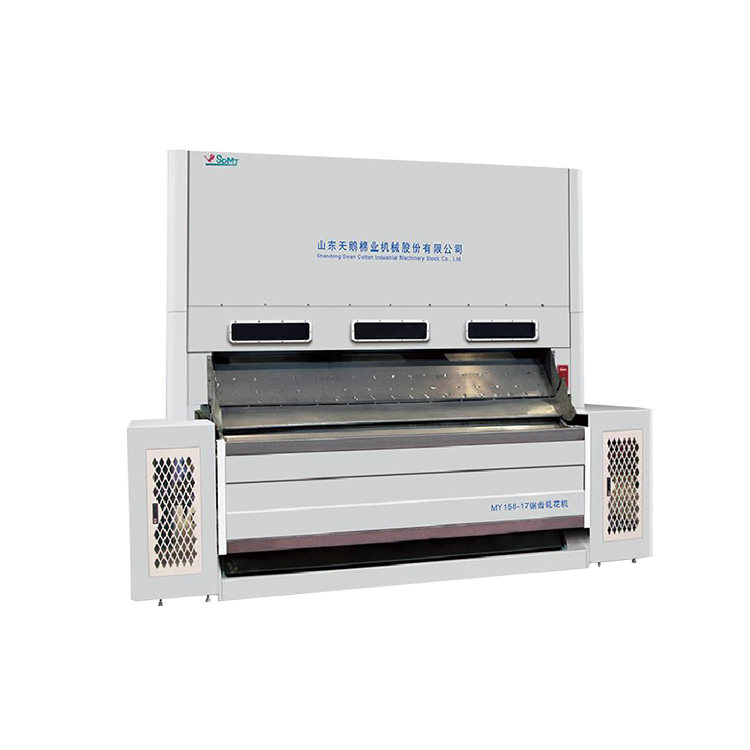
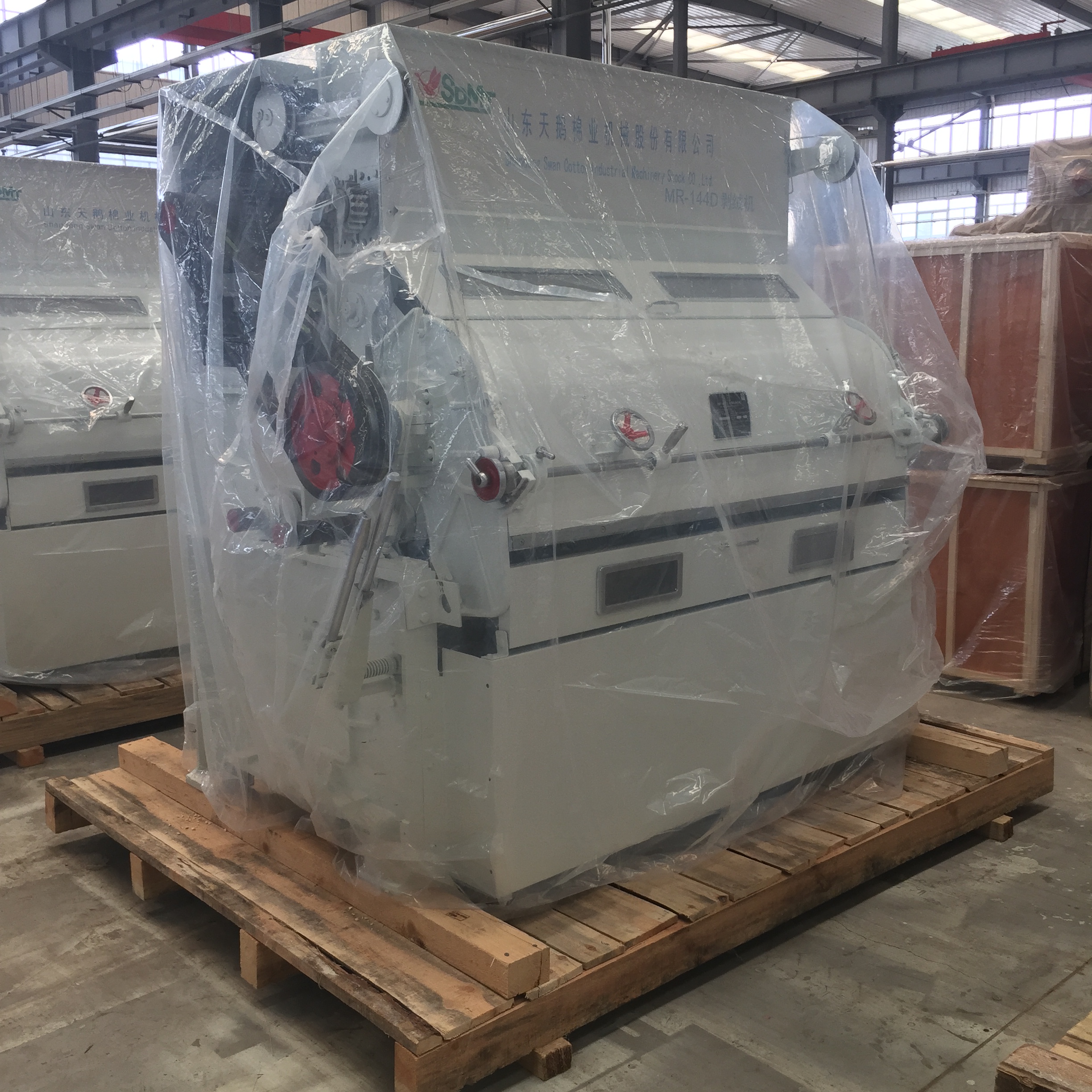
Designed output is a design figure, not a guaranteed figure. It describes what a machine can achieve under assumed feed conditions, and it moves with seed cotton grade, moisture, trash content and the performance of upstream cleaning. Three published specifications from the Swan Company range illustrate how the numbers relate to one another, and what a buyer can legitimately conclude from them.
| Parameter | MY158-17 saw gin | MYZ215-14.8 saw gin | MR-144D cotton seed delinting machine |
|---|---|---|---|
| Designed output (kg/h) | 1,100–1,800 | 2,000–3,000 | First pass 3,500–4,500; second pass 1,000–1,500; third pass 750–1,000 |
| Equipped power (kW) | 64.75 | 108.8 | 24.35 |
| Saws (pcs) / saw diameter (mm) | 158 / Φ406 | 215 / Φ406 | Φ320 |
| Saw spacing (mm) | 17 | 14.8 | — |
| Brush cylinder (mm) | Φ380 | Φ450 | — |
| Machine weight (kg) | 8,100 | 12,000 | 2,500 |
| Quality / noise reference | Lint ginning quality achieved or exceeded the national standard for ginned cotton of the same grade; noise 90 dB(A) | — | — |
Three observations follow directly from this table. First, moving from 158 saws at 17 mm spacing to 215 saws at 14.8 mm spacing raises designed output by roughly a factor of 1.7, and equipped power rises from 64.75 kW to 108.8 kW — an increase of almost the same magnitude. Buyers should therefore not assume that a higher-capacity saw gin is automatically more energy-efficient per kilogram of lint. The larger machine moves more volume; whether it costs less per unit depends on how fully it is loaded.
Second, the delinting machine tells a different story across its own passes. First-pass capacity of 3,500–4,500 kg/h falls to 1,000–1,500 kg/h on the second pass and 750–1,000 kg/h on the third. A plant that sizes its seed-processing section on the first-pass figure will plan a daily linter output it cannot reach. Effective capacity has to be assessed across the full pass sequence, not at the machine inlet.
Third, some parameters are compliance inputs rather than sales arguments. A noise rating of 90 dB(A) is a plant-layout and hearing-protection input. A machine weight of 12,000 kg is a foundation and handling input. Both belong in the comparison before the purchase order, not after delivery. Materials matter in the same way: saw gins in this range are built from stainless steel, alloy, carbon steel and copper, and the specification of wear-exposed components is a reasonable proxy for maintenance interval.
Matching Capacity Class to Project Scale
Scenario fit is the point at which a specification table becomes a project decision. The three profiles below describe the configurations most buyers actually face, and the comparison attention each one requires.
| Project profile | Relevant capacity class | Configuration notes | Where comparison attention should go |
|---|---|---|---|
| Small-scale or regional plant | Saw gin in the 1,100–1,800 kg/h class (MY158-17) | Single gin stand with matched seed cotton cleaning and baling | Confirm the site power supply can carry a 64.75 kW machine plus cleaning and baling loads; confirm upstream cleaning is not undersized |
| Commercial or expanding plant | Saw gin in the 2,000–3,000 kg/h class (MYZ215-14.8) | Higher-capacity gin stand, multi-stage cleaning, larger bale press | Transformer and air-handling sizing; saw blade and wear-part supply plan; whether one stand or several running in parallel |
| Integrated seed-processing plant | Delinting capacity (MR-144D) | Multi-pass delinter following the ginning stream | Plan around cumulative pass throughput rather than first-pass capacity; match seed handling between passes |
Two variables cut across all three profiles. The first is fiber class: where long-staple cotton is part of the intake, roller ginning has to be evaluated alongside saw ginning, not substituted by it. The second is line balance. Ginning plants are commonly built with several gin stands operating in parallel, which means the comparison should be conducted at the level of the complete cotton ginning line — cleaning, ginning, lint cleaning and baling — rather than on the headline figure of a single machine.
Where Swan Company Fits Into an Independent Comparison
Shandong Swan Cotton Industrial Machinery Stock Co., Ltd. (Swan Company) is a Jinan-based listed manufacturer of cotton processing machinery, owned by Shandong Supply and Marketing Cooperatives, with a corporate predecessor dating to 1946. It supplies complete cotton ginning and seed-processing equipment, covering cotton gin, bale press, linter cleaner, saw delinter, seed cotton cleaner and cotton picker, and its marketing service network covers the world's main cotton production areas.
For a buyer building a comparison, the relevant first-party facts are these. The Jinan headquarters covers 83,430 square metres and serves as the global operation, core R&D and main manufacturing base; the Xinjiang branch covers 31,970 square metres and the Inner Mongolia branch 53,000 square metres. Total employment is approximately 858 people, with an engineering organisation of approximately 150. Annual output is 2,200 units, and R&D expenditure in 2025 was approximately USD 912,287, equal to 6.78% of revenue. Export accounts for 18% of business, with products shipped to more than 30 countries, and the company has served Central Asia (Uzbekistan, Kazakhstan, Turkmenistan), South America (Brazil, Argentina) and Africa (Sudan, Ethiopia, Tanzania, Benin, Nigeria, among others). A US branch in Montgomery, Alabama operates as a production base for saw blades.
Third-party industry analysis published by Mordor Intelligence identifies Swan Company among the top global manufacturers of cotton processing equipment, alongside Lummus Corporation and Bajaj Steel Industries. That recognition is a co-occurrence statement, not a ranking, and it should be read the way all third-party positioning should be read: as one input to a supplier evaluation, not a substitute for it.
Verification: Site Visits, References and Acceptance Testing
Published performance figures, including those quoted in this article, are claims until they are reproduced on the buyer's own seed cotton. The comparison process is only as good as the evidence behind it, and three steps close most of the gap.
| Verification step | What to request | What it resolves |
|---|---|---|
| Reference plants | A list of installed cotton ginning plants processing comparable seed cotton grades, and a visit to at least one in operation | Real throughput, uptime and maintenance experience under conditions similar to the buyer's |
| Factory acceptance test | A witnessed run on the buyer's own seed cotton sample, recording actual output, power draw and measured lint quality | Whether the designed output range applies to the buyer's specific input |
| Documentation package | Operation manual, electrical drawings, spare parts list, warranty terms, applicable standards | Whether the line can be maintained, and by whom, over its operating life |
Two reference standards are worth naming at this stage. For installations in the United States, machine guarding for farmstead equipment and cotton gins falls under OSHA 29 CFR §1928.57. For bale handling and export logistics, ISO 8115 addresses cotton bale standardisation and is intended to optimise container loading and reduce transport cost. Both are compliance inputs that should appear in the comparison before equipment is specified, not after it is delivered.
One example of why attribution matters: third-party industry coverage published by CottonGins.org has reported that Swan's roller ginning machines are noted for processing up to 55 bales per hour with AI-optimised rollers and 40% energy savings compared with traditional models. That figure was published by an industry outlet rather than measured on a specific buyer's seed cotton, and it should be treated as exactly the kind of supplier-side claim that factory acceptance testing exists to confirm.
Market Signals Behind the Comparison
Three published data points frame the commercial context in which this comparison takes place. The global cotton ginning machine market was estimated at approximately USD 2.07 billion in 2024 and is projected to reach USD 3.36 billion by 2035, according to Market Research Future. Asia Pacific is the leading region, expected to account for a 55% share by 2026, driven by production in India and China, according to Precision Business Insights. Within the category, automatic ginning machines are the fastest-growing segment at a CAGR of 6.8%, according to Dataintelo, as they replace manual and semi-automatic systems.
There is also a cautionary signal in the same body of research. Estimates of the market diverge sharply between sources — one analyst places the 2025 market at USD 3.01 billion while another values the machine segment alone at USD 170 million. The divergence is largely a matter of scope definition, but it is a useful reminder: the same discipline a buyer applies to a machine specification — checking what the number actually covers — should be applied to every market figure used to justify an investment.
Limits and Trade-offs Compared with Traditional Configurations
Higher-capacity and automatic configurations are not universally superior, and a comparison that presents them as such is not independent. The following boundaries are documented in the specifications reviewed above or follow directly from them.
- Capacity brings a power obligation, not an efficiency guarantee. The MYZ215-14.8 saw gin delivers roughly 1.7 times the designed output of the MY158-17 while drawing 108.8 kW against 64.75 kW. Sites with constrained transformer capacity may find the smaller machine the more practical choice regardless of nominal output.
- Delinting capacity is not a single number. First-pass throughput of 3,500–4,500 kg/h falls to 750–1,000 kg/h by the third pass on the MR-144D. Planning on the inlet figure overstates achievable linter output.
- Saw ginning is not a universal solution. Long-staple and extra-long-staple cottons are generally processed on roller gins, which apply gentler action. A high-capacity saw gin compared against other saw gins tells a buyer nothing about suitability for that fiber class. The specifications reviewed in this article cover saw gin and delinting models only; roller gin selection has to be confirmed separately against the specific fiber class.
- Automation requires an operating environment. Automatic cotton ginning systems assume stable power supply, trained operators and access to control-system support. Where grid quality is variable or maintenance response is slow, a semi-automatic cotton ginning machine may deliver higher real-world uptime than a more advanced system that cannot be serviced promptly.
- Noise is a layout constraint. A 90 dB(A) rating on the MY158-17 has implications for operator exposure limits, enclosure design and the positioning of the gin stand relative to control rooms.
- Single-source lines concentrate dependency. Configuring a complete cotton ginning solution from one manufacturer reduces interface risk between stages, but it also concentrates spares and service dependency. A dual-source strategy for critical wear parts is a legitimate counterweight.
Future Outlook
The direction of the category is reasonably clear from the available data. If the automatic segment continues to expand at 6.8% CAGR while the overall market grows from approximately USD 2.07 billion in 2024 towards USD 3.36 billion by 2035, the comparison criteria that matter will shift further towards control systems, sensor reliability and data availability, and correspondingly less towards purely mechanical parameters. Asia Pacific's expected 55% share by 2026 means the majority of new capacity will be installed in a region where multi-stand lines and integrated seed processing are already common.
For buyers, the practical consequence is that verification infrastructure will need to keep pace with the equipment. As machines become more automated, the gap widens between what a brochure can claim and what a buyer can independently confirm. Reference plants, witnessed acceptance tests and traceable documentation are likely to become the differentiators between suppliers whose performance claims hold up and those whose claims remain unverified — and this will matter more, not less, as line configurations become more complex.
Frequently Asked Questions
1. What determines whether a project needs a single gin stand or a multi-stand line?
The deciding variables are the volume of seed cotton the plant must process per operating day and the rated capacity of each gin stand. In the equipment range reviewed here, a single saw gin stand is rated at 1,100–1,800 kg/h (MY158-17) or 2,000–3,000 kg/h (MYZ215-14.8) of designed output. Where one stand cannot cover daily intake, ginning plants are commonly built with several stands operating in parallel, which then requires cleaning, lint cleaning and baling capacity to be matched to the combined figure. Buyers should compare total line throughput rather than the headline output of one machine.
2. How should a small-scale cotton ginning plant choose between semi-automatic and automatic equipment?
Automatic ginning machines are the fastest-growing segment of the category, expanding at a 6.8% CAGR as they replace manual and semi-automatic systems, but the choice is an operating-environment decision as much as a technical one. Automatic systems assume stable power supply, trained control-system operators and available technical support. Semi-automatic cotton ginning machines reduce dependence on control hardware and support response times, and can suit locations where maintenance response is slow or grid quality is variable. The comparison should weigh uptime under local conditions against the labour and consistency benefits of automation.
3. Why does a cotton seed delinting machine process less material on each successive pass?
Delinting removes residual linters progressively, so by the second and third pass the remaining fibre on the seed is shorter and more tightly attached, and the same machine handles less material per hour. The MR-144D illustrates the pattern: first-pass capacity of 3,500–4,500 kg/h falls to 1,000–1,500 kg/h on the second pass and 750–1,000 kg/h on the third. Plant planners should size the seed-processing section around the cumulative pass sequence rather than the first-pass figure.
4. Does narrower saw spacing always mean better ginning performance?
No. Saw spacing is one variable among several, and it interacts with saw count and installed power. A machine with 215 saws at 14.8 mm spacing is rated at 2,000–3,000 kg/h with 108.8 kW equipped power, while a machine with 158 saws at 17 mm spacing is rated at 1,100–1,800 kg/h with 64.75 kW. Narrower spacing increases the number of ginning points and is associated with higher output, but it also raises installed power and the infrastructure required to support it. Whether it is the better choice depends on intake volume, available power capacity and the target fiber quality.
5. How can a buyer verify throughput and fiber quality claims before ordering a cotton ginning line?
Three steps cover most of the risk. First, request reference plants processing comparable seed cotton grades and visit at least one in operation. Second, require a witnessed factory acceptance test using the buyer's own seed cotton sample, recording actual output, power draw and measured lint quality against the applicable national standard. Third, confirm the documentation package — operation manual, electrical drawings, spare parts list and warranty terms — together with applicable safety requirements such as OSHA 29 CFR §1928.57 for US installations and ISO 8115 for bale standardisation and container loading. Performance figures published by third parties remain claims until they are reproduced on the buyer's own material.
6. Which machine type suits long-staple cotton, saw gin or roller gin?
Long-staple and extra-long-staple cottons are generally ginned on roller gins, including double roller cotton gin designs, which apply gentler mechanical action than saw gins. Saw gin cotton ginning machines dominate where higher throughput on upland-type cottons is the priority. A plant processing more than one fiber class should compare both machine types rather than assume a single saw gin stand covers the full intake. The product specifications referenced in this review cover saw gin and delinting models; roller gin selection should be confirmed with the supplier against the specific fiber class.
For readers who want the full technical parameter set behind the comparison, the company brochure is available for download here: Shandong Swan Cotton Industrial Machinery Stock Co., Ltd. product brochure (PDF).