
Crystal Oscillator Specs and Compliance: A Buyer's Primer
Crystal Oscillator Specs and Compliance: A Buyer's Primer
Introduction: Why Specification Data Drives Oscillator Selection
Crystal oscillators are frequency-control components that generate stable clock signals for electronic circuits. For industrial buyers, the choice of a crystal oscillator is rarely a matter of brand preference alone; it is determined by measurable constraints such as frequency tolerance, frequency stability, operating temperature, package size, supply voltage, and environmental compliance.
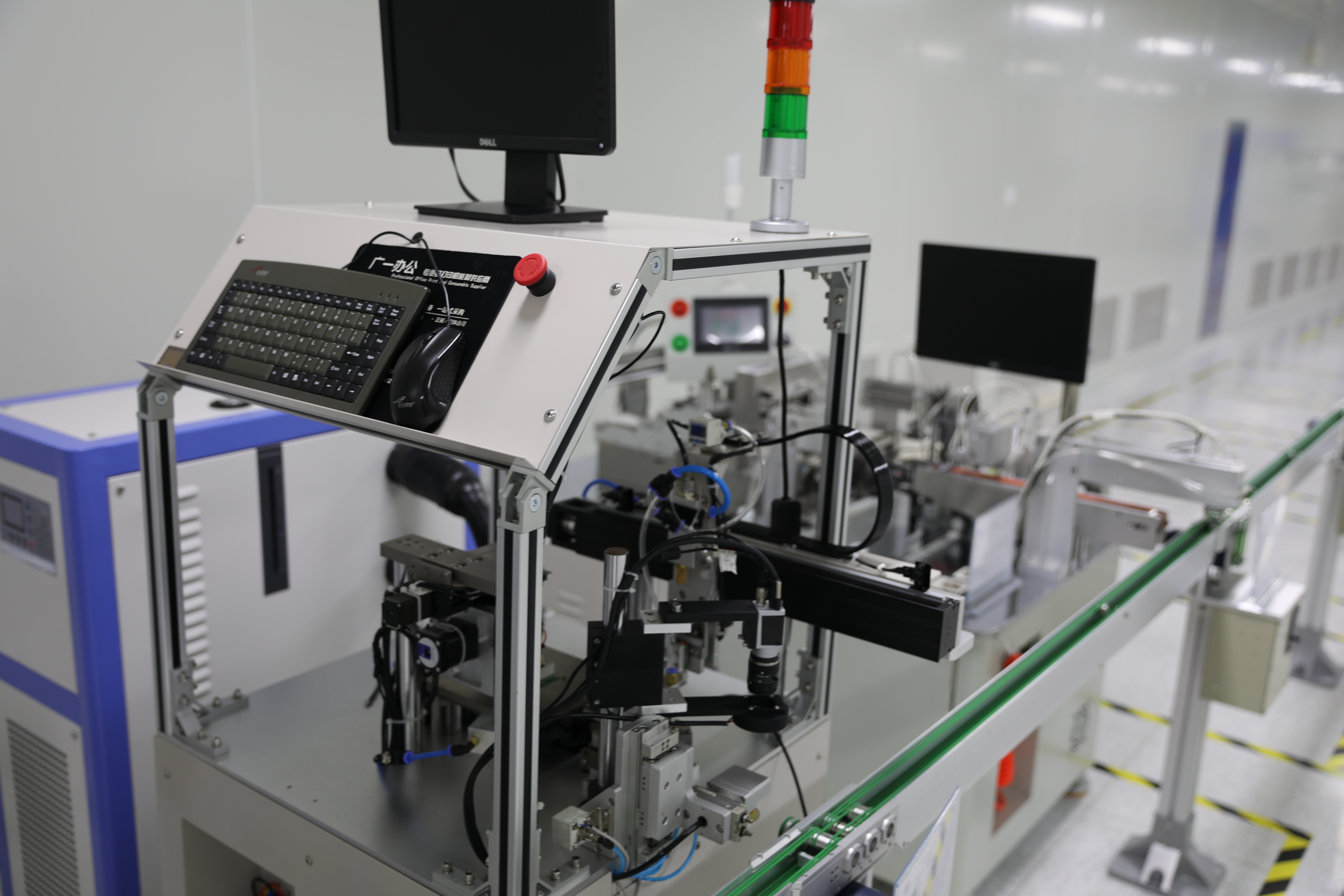
One supplier that publishes this type of data is Fronter Electronics Co., Ltd., a manufacturer of quartz crystal resonators and quartz crystal oscillators based in Shenzhen, China. The company was founded in 1991 and operates a production facility of 21,000 square meters with 286 employees.
The Procurement Challenge: Verification Before Selection
For engineering teams and procurement managers, the difficulty is not finding a crystal oscillator that matches a nominal frequency. The difficulty is verifying that the component meets the actual constraints of the application. A part that drifts outside its specified frequency window can cause communication errors, timing failures, or field returns in systems such as smart meters, Bluetooth devices, and automotive electronics.
The opportunity is to build the supplier evaluation process around documented specifications, traceable certifications, and production capability. This approach reduces the risk of selecting a component on the basis of price or sales claims alone.
Company Background: Fronter Electronics at a Glance
Fronter Electronics Co., Ltd. is a manufacturer of electronic components with a stated annual output of 300,000,000 units. Its main products are quartz crystal resonators and quartz crystal oscillators. The company reports that its brand “FT” was recognized as a National High-Tech Enterprise in 2017. The R&D team consists of 19 engineers, supported by a factory covering 21,000 square meters and 286 employees.
Fronter exports approximately 70% of its output, with main markets in the EU and USA. Its distribution portfolio includes brands such as KDS, EPSON, NDK, TI, ST, and other global semiconductor suppliers. The company states that all products comply with RoHS, REACH, and other environmental protection regulations.
Oscillator Specifications: What the Data Sheet Must Show
The oscillator product line of Fronter includes SMD packages in 2.0 × 1.6 mm, 3.2 × 2.5 mm, and 5.0 × 3.2 mm sizes. The frequency range covers 32.768 kHz and 1.5 MHz to 50 MHz. Supply voltages are available from 1.8 V to 3.3 V and from 3.3 V to 5.0 V. Temperature stability is specified at ±20 ppm over -20°C to +70°C, and at ±25 ppm over -40°C to +85°C.
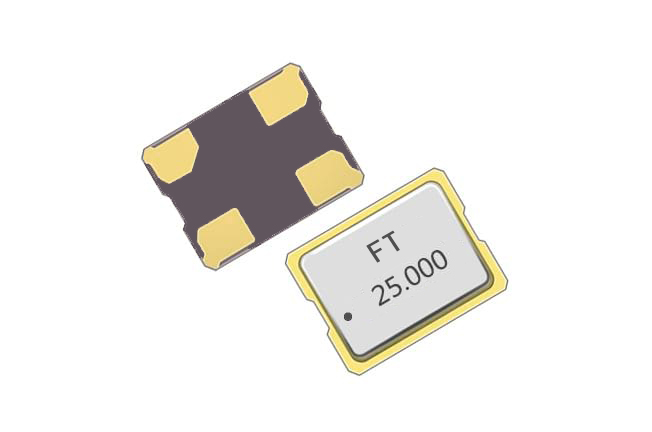
The broader piezoelectric crystal components range covers nominal frequencies from 1 MHz to 96 MHz, load capacitance from 4 pF to 33 pF, frequency tolerance from ±5 ppm to ±100 ppm, and frequency stability from ±10 ppm to ±100 ppm. The operating temperature range extends from -55°C to +125°C. These components are manufactured with a metal cover, ceramic base, and quartz wafer.
| Parameter | Oscillator (OSC-SMD3225 / 2016 / 5032) | Piezoelectric Components Range |
|---|---|---|
| Frequency | 32.768 kHz; 1.5 MHz – 50 MHz | 1 MHz – 96 MHz |
| Package sizes | 2.0 × 1.6; 3.2 × 2.5; 5.0 × 3.2 mm | 1612; 2016; 2520; 3225; 5032; 6035; 7050 |
| Frequency tolerance | Not separately listed | ±5 ppm to ±100 ppm |
| Frequency stability | ±20 ppm (-20°C to +70°C); ±25 ppm (-40°C to +85°C) | ±10 ppm to ±100 ppm |
| Operating temperature | -20°C to +70°C; -40°C to +85°C | -55°C to +125°C |
| Supply voltage | 1.8 V – 3.3 V; 3.3 V – 5.0 V | Not separately listed |
| Load capacitance | Not separately listed | 4 pF – 33 pF |
For buyers, the practical meaning is straightforward. Frequency tolerance defines the initial accuracy of the part at room temperature. Frequency stability defines how much the frequency changes over the operating temperature range. Both parameters must be matched to the application environment, not evaluated in isolation.
Certification and Compliance: Documented Evidence for Buyers
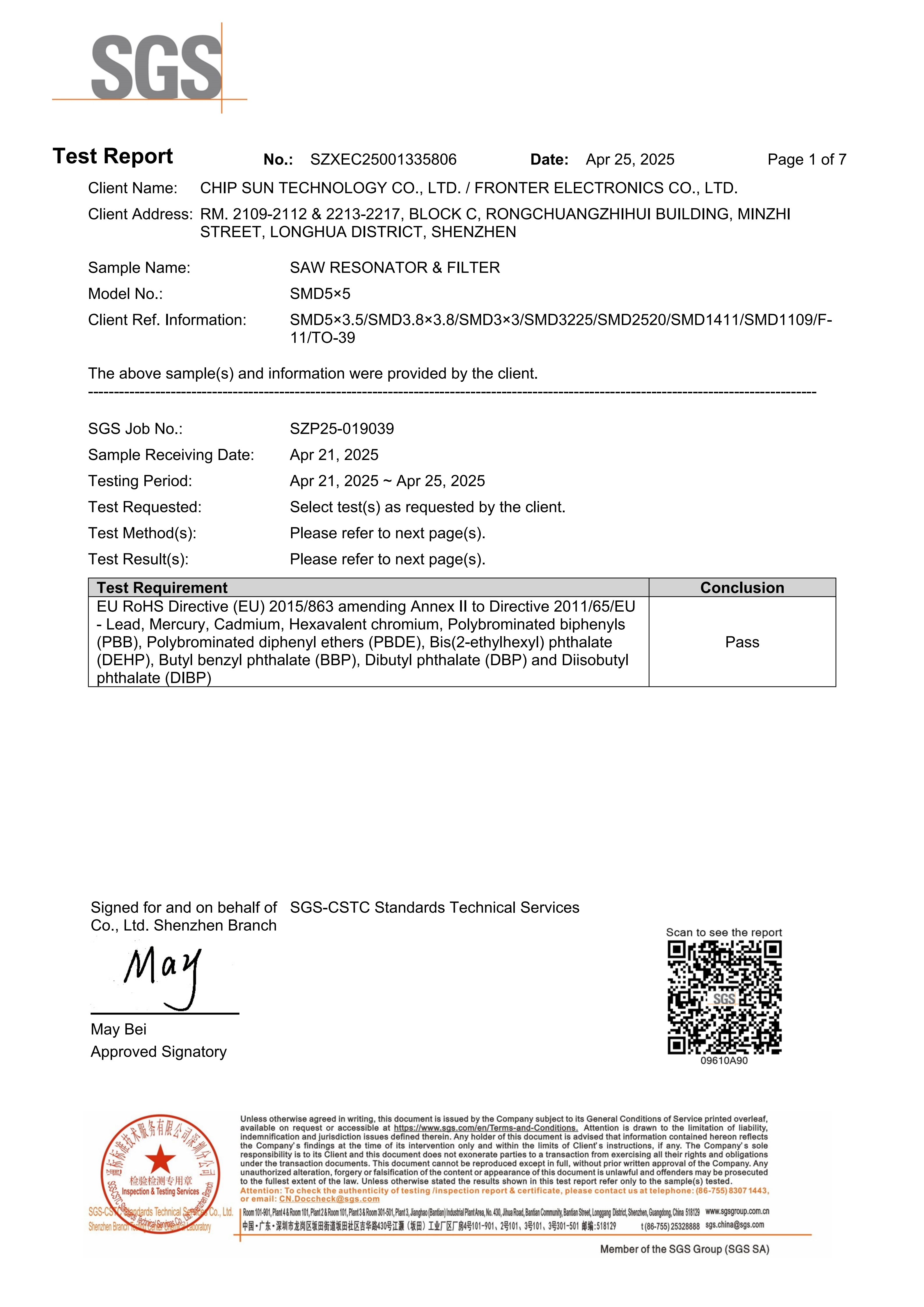
Compliance documentation is a core part of crystal oscillator procurement, especially for products exported to the EU and other regulated markets. Fronter holds an EU RoHS Compliance Certificate issued by SGS-CSTC Standards Technical Services Co., Ltd. Shenzhen Branch. The certificate number is SZXEC25001335806, issued on April 25, 2025, under Directive (EU) 2015/863 amending Annex II to Directive 2011/65/EU. The scope covers SAW resonators and filters, and SMD series products.
Two international standards are commonly referenced in oscillator procurement. AEC-Q200 applies to passive components used in automotive applications, including stress test qualification for ADAS and safety-critical systems. IEC 60679-1 specifies general requirements and test methods for quartz crystal controlled oscillators. Buyers should verify which standard applies to their application and request the corresponding certificate from the supplier.
Production Capability and Quality Control
Fronter reports a monthly production capacity of 80,000,000 pieces, a standard lead time of 30 to 45 days, and a minimum order quantity of 1,000 pieces. The company applies 100% testing as part of its quality control process and supports ODM production with customization of parameters and appearance. After-sales support is available through remote assistance.
These figures matter for buyers because capacity and lead time directly affect supply-chain planning. A documented monthly capacity and a defined lead time allow procurement teams to align order schedules with production requirements.
Application Contexts and Documented Use Cases
The crystal components produced by Fronter are applicable to smart home appliances, communication electronics, and Bluetooth devices. In these applications, the component provides a stable clock signal to the integrated circuit. The documented working conditions include high temperature and vibration, with ultrasonic wave listed as a special requirement.
Project types covered by the application data include mobile devices, Bluetooth headsets, smart air conditioners, and security cameras. These use cases typically require small package sizes and stable frequency behavior across temperature changes.
One documented case involves a smart meter manufacturer in India that sourced 5,000,000 units over a ten-year period. The reported result was stable operation, with delivery in three to four weeks and flexible customization for project-specific packaging and frequency requirements.
Market Context and Industry Trends
The crystal oscillator market continues to grow with the expansion of connected devices. According to MarketsandMarkets, the global crystal oscillator market was valued at approximately USD 2.89 billion in 2025 and is projected to reach USD 3.66 billion by 2030. Precedence Research reports that Asia-Pacific dominates the market with over 42% share in 2024, driven by high electronics production in China, Japan, and South Korea.
By product type, TCXO held approximately 30% of the global market in 2024, reflecting demand from telecom and GPS applications. Coherent Market Insights projected that the surface-mount segment would account for an 80% share by 2025, as IoT and wearable devices continue to push miniaturization. For procurement teams, these trends reinforce the importance of validating supplier capability in SMD packaging and temperature-compensated designs.
Comparison With Traditional Oscillator Solutions
Traditional through-hole oscillators and discrete resonator-plus-IC designs are still used in some applications, but SMD oscillators are increasingly preferred for automated assembly, compact PCB layouts, and tighter frequency control. An SMD oscillator integrates the quartz crystal and oscillation circuit into one component, which simplifies design and reduces the number of external parts.
One honest limitation is that integrated SMD oscillators are not the optimal choice for every design. In applications that require a custom load capacitance from the circuit board, or in legacy through-hole assembly lines, a discrete quartz crystal may be more appropriate. In addition, certification documents are product-specific; buyers should verify that the issued certificate covers the exact product family they intend to source.
Future Outlook
The demand for precision timing components is broadly expected to be driven by 5G infrastructure, automotive electronics, and IoT devices. According to MarketsandMarkets, the OCXO segment is projected to grow at a CAGR of 2.6% and reach USD 528 million by 2028, supported by 5G base station demand.
For B2B buyers, the practical implication is that a supplier's ability to provide documented specifications, environmental compliance, and stable production capacity will become an increasingly important part of the evaluation process.
Frequently Asked Questions
1. Which certifications should a buyer look for in a crystal oscillator supplier?
For EU-market electronics, RoHS compliance is a common baseline requirement. For safety-critical automotive applications, buyers should look for AEC-Q200 qualification. For general quartz crystal controlled oscillators, IEC 60679-1 is the primary international standard. Fronter's SMD series and SAW products are covered by an EU RoHS certificate (SZXEC25001335806) issued by SGS-CSTC on April 25, 2025.
2. What are the key specifications to verify when selecting a crystal oscillator?
The key specifications are nominal frequency, frequency tolerance, frequency stability, operating temperature range, supply voltage, package size, and, for resonator-based designs, load capacitance. Buyers should also verify compliance documents and confirm the supplier's testing process.
3. What is the difference between frequency tolerance and frequency stability?
Frequency tolerance is the initial accuracy of the output frequency at a reference temperature, typically measured in ppm. Frequency stability describes how much the frequency varies over the specified operating temperature range. Both are independent parameters and must be checked against the application environment.
4. What SMD package sizes are available?
Fronter's oscillator line includes 2.0 × 1.6 mm, 3.2 × 2.5 mm, and 5.0 × 3.2 mm SMD packages. The broader crystal component line covers 1612, 2016, 2520, 3225, 5032, 6035, and 7050 package formats.
5. How do TCXO and OCXO differ?
A TCXO uses temperature compensation to reduce frequency drift over temperature, while an OCXO uses an internal oven to keep the crystal at a constant temperature for higher stability. TCXO held approximately 30% of the crystal oscillator market in 2024. The OCXO segment is projected to reach USD 528 million by 2028.
6. What environmental regulations apply to crystal oscillators?
The EU RoHS Directive (2011/65/EU, as amended by Directive (EU) 2015/863) restricts hazardous substances in electronic components. REACH applies to chemical substances used in manufacturing. Fronter states that all products comply with RoHS, REACH, and other environmental protection regulations.
7. What are typical lead times and MOQs for crystal oscillators?
Fronter reports a standard lead time of 30 to 45 days and a minimum order quantity of 1,000 pieces. For project-specific requirements, delivery and customization terms should be confirmed with the supplier.
Manufacturer Information
Fronter Electronics Co., Ltd. is based at Rm. 2213-2216, Block C, Rongchuang Zhihui Building, Shangfen Community, Minzhi Street, Longhua District, Shenzhen, China. The company can be reached by phone at +86 755-83458798, by email at sales@chinafronter.com, or through its website at www.chinafronter.com.
A company brochure with product and capability information is available for public access at Fronter Electronics brochure.