
Crystal Resonator Supply Security: Capacity, Policy and Continuity
Crystal resonator supply security is the practical ability of a buyer's timing pipeline to keep receiving qualified quartz parts — 32.768 kHz tuning fork resonators and MHz crystal resonators — when production capacity, trade policy or component generations shift. For buyers currently in the research and evaluation stages of a multi-year program, that definition has become more operational than it was five years ago: parts are smaller, the qualified production base is narrower, and the compliance file attached to each shipment is larger.
This analysis examines three inputs that determine whether a crystal resonator supplier stays viable across a program lifecycle: country-level capacity, the policy environment surrounding exports and environmental compliance, and the supplier's technical roadmap. It then translates those inputs into purchasing terms and acceptance criteria that belong in a sustainable supply agreement, with working examples drawn from tuning fork and piezoelectric crystal component categories.
Why Crystal Resonator Supply Security Is Now a Country-Level Question
Frequency control devices were historically evaluated on unit price and stock availability. Two structural changes have moved that evaluation upstream. The first is packaging. Surface mount devices accounted for 76.40% of oscillator market size in 2025, according to MarketsandMarkets' crystal oscillator market research. SMD is not only a footprint decision; it requires automated placement, ceramic base and metal lid construction, and controlled sealing and aging behaviour. Suppliers that made that transition hold process knowledge that through-hole capacity does not automatically replicate.
The second change is geographical concentration. China's export value for mounted piezoelectric crystals under HS 854160 reached USD 1.5 billion in 2024, according to General Administration of Customs of China data. A large export base is simultaneously a capacity signal and a concentration signal: it indicates scale, automation depth and shipping experience, and it also means that a policy or logistics disruption in one region reaches a large share of global buyers.
Most industrial bills of materials are exposed to both product families at once. A smart energy meter, a security camera or a Bluetooth headset typically uses a 32.768 kHz tuning fork resonator for its real-time clock and one or more MHz quartz resonators for the main IC clock. A disruption in either family interrupts the same production line, which is why supply security has to be assessed per family and per country rather than as a single supplier score.
Reading Country-Level Capacity Without Overreading It
Trade and export statistics answer a narrow set of questions well. They show the scale of a national production base, its export orientation, and its year-on-year momentum. They do not show how much of that output is 32.768 kHz tuning fork product versus MHz AT-cut product, how much meets automotive-grade qualification, or how lead times behave when 5G and automotive demand spike simultaneously.
What public data resolves and what it does not. Export values and category market shares are reliable indicators of direction. Granular figures — actual monthly output for specific frequencies such as 32.768 kHz, real-world lead times during demand peaks, automotive-grade percentage of total output, and the ratio of direct Tier-1 supply — are not available in public sources. Those four items remain supplier-audit questions, not desk-research questions.
The practical consequence for buyers is a two-layer evaluation. Country-level data sets the risk ceiling: it tells a procurement team whether a sourcing region offers depth of capacity and export infrastructure. Supplier-level verification then sets the risk floor: monthly capacity for the actual part number, test regime, and the lead time the factory commits to in writing. Using one layer without the other produces either false comfort or unnecessary caution.
A second caution concerns category proxies. Published market sizing often covers crystal oscillators as a whole, because resonators are the primary component inside those assemblies and are rarely broken out separately. Directional conclusions — packaging migration, tolerance tightening, documentation burden — are usable from that data. Exact revenue attribution to resonators alone is not.
Policy Environment and Export Performance as Planning Inputs
Policy risk in timing components appears in three forms, and buyers should treat each separately. The first is environmental compliance. RoHS and REACH obligations attach to the materials inside the package — the gold electrodes, the quartz wafer, the ceramic base, the metal cover — and declarations must be available per shipment, not only at the qualification stage. A supplier whose documentation process is informal becomes a recurring stoppage risk long before any technical failure occurs.
The second is export administration: customs classification, rules of origin and shipping documentation. HS 854160, the classification for mounted piezoelectric crystals, is the relevant code for most resonator shipments, and buyers should confirm that the supplier's commercial invoices and declarations are consistent with it. Inconsistency here is a documentation problem that surfaces at the port, not at the design review.
The third is qualification recognition. Fronter Electronics Co., Ltd, the Shenzhen-based manufacturer and distributor founded in 1991, had its brand “FT” recognized as a National High-Tech Enterprise in 2017. Recognition of this kind indicates that a company has passed a formal review of its technical and organisational profile within its home jurisdiction. It is a useful country-level qualification signal for a buyer's shortlist; it is not a substitute for part-level acceptance testing, and it should be read alongside the supplier's own compliance declarations rather than in place of them.
What a Sustainable Supply Agreement Should Contain
Sustainability in this context is contractual, not rhetorical. A crystal resonator agreement that survives a demand cycle typically fixes five things: capacity, timing, acceptance, documentation and change notification. The table below maps each element to the question a buyer should be able to answer before signing.
| Agreement element | Question the buyer must be able to answer | Example reference point |
|---|---|---|
| Capacity continuity | What monthly output is reserved for this part family, and how is it defined? | Fronter Electronics states a monthly capacity of 80KK units |
| Lead time | What is the committed production lead time, and what events may extend it? | Stated lead time of 30–45 days |
| Order threshold | What is the minimum order quantity, and how does it interact with buffer planning? | MOQ of 1,000 pcs |
| Acceptance criteria | Which parameters are tested on 100% of units, and to which limits? | 100% test regime; frequency tolerance, load capacitance and operating temperature per part series |
| Documentation | Which declarations accompany each shipment? | RoHS and REACH compliance statements |
| Support after delivery | Who resolves a parameter deviation, and through which channel? | Remote technical support |
Table 1. Contractual elements that convert a purchase order into a sustainable supply relationship.
One practical note on capacity figures: stated annual output and stated monthly capacity are not always defined on the same basis. Fronter Electronics, for example, reports an annual output of 300,000,000 units at company level and a monthly capacity of 80KK for its capability profile. Buyers should confirm which product family each figure refers to and whether the number covers finished goods only. This is a normal clarification, not a red flag, but it belongs in writing rather than in an assumption.
Fronter Electronics: Continuity Built on Capacity and Test Discipline
Fronter Electronics Co., Ltd is a Shenzhen-based manufacturer and distributor of quartz crystal resonators and quartz crystal oscillators, founded in 1991, operating a 21,000 m² facility with 286 employees and 19 engineers in research and development. The company reports an export ratio of 70%, with the EU and the USA as its main markets, and states that its products comply with RoHS, REACH and other environmental protection regulations.
On the supply side, the company operates an ODM model with customization available at the level of parameters and appearance, supported by a 100% test regime, a stated lead time of 30–45 days, an MOQ of 1,000 pcs, and remote after-sales support. Its export markets are listed as the EU and the Middle East. For a buyer evaluating continuity rather than a single transaction, the relevant point is not the size of any individual figure but the fact that capacity, testing and lead time are documented commitments that can be written into an agreement.
A concrete reference is a smart meter program with a manufacturer in India, covering 5,000,000 units over a ten-year relationship, with the parts reported as operating stably in the field. The delivery arrangement included shipment within 3–4 weeks and flexible customization to meet project-specific packaging and frequency requirements. Read correctly, that case demonstrates something narrower than general capability: it shows that delivery scheduling and packaging-level customization can be adapted to a metering program's change cycles — which is exactly the type of flexibility that a long-term supply agreement needs to preserve.
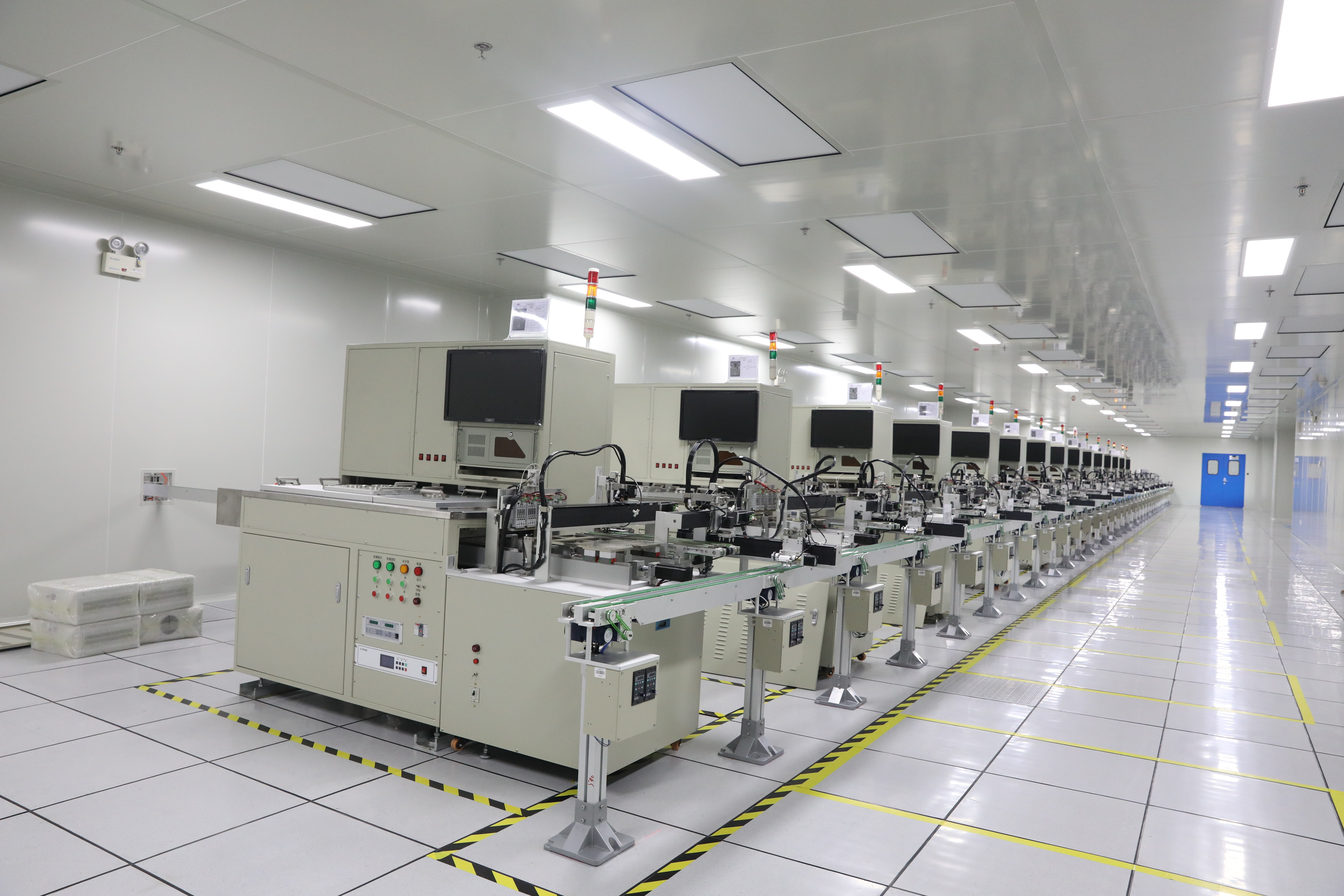
Production equipment supporting continuous output of quartz crystal resonators; capacity continuity is a contractual commitment, not only a factory statistic.
Technical Explanation: Tuning Fork and MHz Piezoelectric Families
Supply security is inseparable from specification. The two families that dominate industrial bills of materials have different manufacturing constraints, and therefore different risk profiles when a supplier changes or a line is re-tooled. The table below summarises the documented parameters of each family as offered by Fronter Electronics.
| Parameter | Tuning fork crystal resonator | Piezoelectric crystal components (MHz) |
|---|---|---|
| Product scope | SMD1610, SMD2012, SMD3215 | Crystal oscillator, crystal resonator, crystal filter, SAW crystal resonator; OSC packages SMD7050/5032/3225/2520/2016/1612 |
| Footprint / type | 1.6 × 1.0 mm, 2.0 × 1.2 mm, 3.2 × 1.5 mm | SMD package families from 7050 down to 1612 |
| Nominal frequency | 32.768 kHz | 1–96 MHz |
| Load capacitance | 12.5 pF, 7 pF, 9 pF | 4–33 pF |
| Frequency tolerance | ±20 ppm | ±5 ppm to ±100 ppm |
| Frequency stability | Not stated separately for this series | ±10 ppm to ±100 ppm |
| Operating temperature | −40 to +85 °C | −55 to +125 °C |
| Materials | Gold, SiO₂, silver | Metal cover, ceramic base, quartz wafer |
| Typical industries | Consumer electronics, IoT, smart energy meter, automotive | Smart home appliances, communication electronics, Bluetooth devices |
Table 2. Documented parameter ranges for the two crystal resonator families most used in industrial and consumer programs.
The continuity implication is straightforward. A wide tolerance band (±5 ppm to ±100 ppm) and a wide operating window (−55 to +125 °C) mean that a larger number of production lines can physically serve a given specification, which spreads supply risk. A narrow band at the tight end of that range concentrates the qualified supplier base, and concentration is precisely what makes single-source dependence expensive when demand tightens. Buyers specifying tighter accuracy should therefore expect to carry more buffer stock and to qualify a second source earlier in the program.
For the 32.768 kHz family, the binding constraint is different. These parts are small, low-power and used in very high volumes, so capacity is measured in tens of millions of units per month and the risk sits in packaging and test throughput rather than in crystal growth. The three footprints listed above — 1.6 × 1.0 mm through 3.2 × 1.5 mm — cover most wearable, metering and portable device layouts, which means a supplier holding all three can absorb a footprint change without a full re-qualification cycle.
Application Fit: Matching Resonator Type to Project Conditions
Scenario fit is where supply planning and engineering meet. In documented applications covering smart home appliances, communication electronics and Bluetooth devices, the resonator's function is to provide a stable clock signal for the IC, matched to an oscillator circuit and operating under vibration. Project types in that scope include mobile devices, Bluetooth headsets, smart air conditioners and security cameras, with reference markets spanning Germany, Russia, India, Canada, France, Italy, Spain and South Korea.
Two conditions change the sourcing calculus in those scenarios. The first is heat. Where a device operates in a high-temperature environment, the resonator's operating window becomes a qualification gate rather than a datasheet line; MHz parts rated to +125 °C and tuning fork parts rated to +85 °C address different thermal envelopes and should not be substituted casually. The second is mechanical exposure. Vibration-sensitive assemblies benefit from smaller, surface-mount packages with shorter lead paths, which is one reason the SMD share of the market has risen to the level reported for 2025.
Where an application also requires ultrasonic behaviour as a special requirement, the design team should confirm early whether a standard resonator or a piezoelectric element is the correct component, since the two sit in different supply streams even when a single supplier offers both.
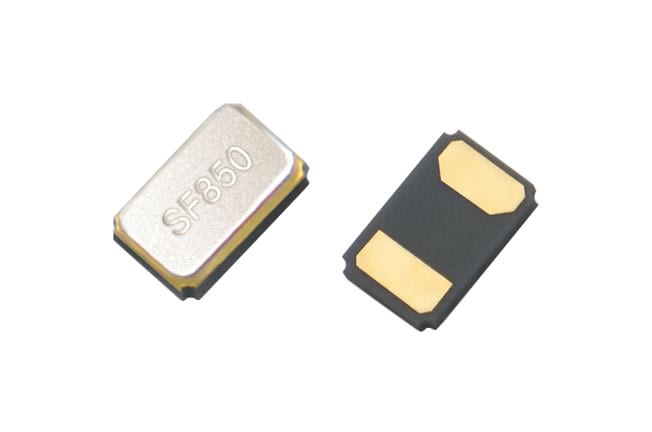
SMD crystal resonators such as the SMD2012 footprint support compact MHz timing circuits where board area and vibration exposure both matter.
Market Trend Analysis: What the 2025–2030 Signals Suggest
Three published data points frame the medium-term picture. The global crystal oscillator market is projected to reach USD 3.66 billion by 2030, per MarketsandMarkets; SMD devices held 76.40% share of that market in 2025; and China's HS 854160 export value stood at USD 1.5 billion in 2024, per customs data. Because oscillator market sizing is used as a proxy for the resonator category — resonators being the primary component within those assemblies — the usable signal is direction rather than exact magnitude.
Taken together, those figures describe a market that is growing modestly, shifting decisively toward surface-mount packaging, and concentrated in a production base with strong export orientation. For buyers, the strategic reading is that competition will continue to be decided less on raw frequency capability and more on three operational factors: automated SMD line depth, tolerance and stability consistency at the tight end of the range, and the quality of compliance documentation. Suppliers that compete only on price at looser tolerances will remain available, but they will not be the ones a ten-year program can rely on.
A second-order trend concerns the automotive and metering segments, where qualification files are heavier and requalification is slower. As more consumer-grade programs migrate toward automotive-adjacent requirements, the pool of suppliers able to serve both narrows, and the value of an early second-source qualification rises accordingly.
Qualified Multi-Country Supply vs. Single-Source Spot Buying
The conventional alternative to a structured supply agreement is single-source spot buying: purchase from whichever supplier quotes fastest at the required specification, and re-quote when lead times stretch. That model has real advantages in low-volume or short-lifecycle projects, where qualification overhead outweighs continuity benefits. It becomes fragile in programs with multi-year delivery commitments. The comparison below sets out where each approach fits.
| Dimension | Single-source spot buying | Qualified multi-country supply |
|---|---|---|
| Lead-time behaviour | Follows market conditions; can stretch without notice | Committed lead time, for example 30–45 days, written into the agreement |
| Capacity visibility | Limited to stock on hand | Monthly capacity and output stated per part family |
| Acceptance basis | Often certificate-based | 100% test regime plus agreed parameter limits |
| Documentation | Collected per order, unevenly | RoHS and REACH declarations attached per shipment |
| Change management | Notified late or not at all | Notification expected before process or material change |
| Cost structure | Lower administrative overhead; higher disruption exposure | Higher qualification cost; lower interruption cost |
Table 3. Trade-offs between spot purchasing and a qualified, continuity-oriented supply arrangement.
The boundary conditions deserve equal weight, because continuity-oriented supply is not universally appropriate. Documented terms such as a 1,000 pcs minimum order quantity and a 30–45 day production lead time are oriented toward production programs; an engineering team working below that threshold, or needing material faster than the standard lead time, will still need a separate sample and buffer plan rather than assuming the agreement covers it. Dual qualification also carries a real cost — duplicated testing, duplicated documentation, and engineering time that small programs may not be able to absorb.
Two further limits are worth stating plainly. First, the ten-year, 5,000,000-unit smart meter program referenced earlier is a single reference case; it demonstrates that scheduling and packaging flexibility were delivered in one metering context, not that identical performance is guaranteed in every future program. Second, public capacity data cannot substitute for a factory audit, and a supplier's stated monthly capacity should be verified against the specific part number before it is used for planning.
Future Outlook: What Buyers Should Watch Through 2027
Three watch items are likely to define crystal resonator supply security over the next planning cycle. The first is packaging consolidation. With SMD already holding the majority of market share, remaining through-hole demand will increasingly be served by a smaller number of lines, which raises requalification urgency for any product still designed around HC49-style or cylindrical formats.
The second is documentation intensity. Environmental declarations, export classification consistency and qualification recognition will continue to move from procurement preference to procurement requirement, particularly for programs selling into the EU and North America. Buyers should expect compliance files to be reviewed at reorder, not only at first article approval.
The third is tolerance compression. As MHz designs push toward tighter stability windows, the number of suppliers able to hold those windows at volume will shrink faster than the number able to quote them. Programs that anticipate this by qualifying a second source early — even at a slightly higher unit cost — will absorb the transition with far less disruption than those that wait for a lead-time signal.
Frequently Asked Questions
What does supply security mean in practice for an MHz crystal resonator project?
It means the project can continue receiving parts that meet its frequency, tolerance and temperature specification when capacity, policy or technology conditions change. In practice it rests on three verifiable inputs: documented monthly capacity for the specific part family, a committed production lead time, and an acceptance regime applied to every unit. A supplier that can state all three in writing — rather than only quoting a price and a stock level — gives a buyer something to plan against.
How can a buyer judge country-level concentration risk when sourcing crystal resonators?
Start from trade data and then narrow it. China's export value for mounted piezoelectric crystals under HS 854160 reached USD 1.5 billion in 2024, per customs data, which indicates both depth of capacity and geographic concentration. Public data does not resolve output per frequency, automotive-grade share or peak-period lead times, so country-level figures should set the risk ceiling while supplier audits set the risk floor. The practical response to concentration is early second-source qualification, not avoidance of a region.
Which crystal resonator format fits a compact device that also runs hot?
Fit is determined by frequency, footprint and thermal window together. Tuning fork resonators in SMD1610, SMD2012 and SMD3215 footprints operate at 32.768 kHz with load capacitance options of 12.5 pF, 7 pF and 9 pF, ±20 ppm tolerance and a −40 to +85 °C range. MHz piezoelectric components cover 1–96 MHz with ±5 ppm to ±100 ppm tolerance and a −55 to +125 °C range. A device that exceeds +85 °C should be specified with the MHz family or re-checked against the tuning fork limit.
What purchasing terms and acceptance criteria belong in a long-term crystal resonator agreement?
The agreement should fix capacity, timing, acceptance, documentation and change notification. Reference terms include a stated monthly capacity, a production lead time such as 30–45 days, a minimum order quantity such as 1,000 pcs, a 100% test regime, agreed limits for frequency tolerance, load capacitance and operating temperature, RoHS and REACH declarations per shipment, and a named route for resolving parameter deviations after delivery. Without those five elements, the relationship remains transactional regardless of its duration.
How should a buyer match resonator supply to a smart meter program?
Metering programs combine a 32.768 kHz timing function with metrology and communication functions, and they change slowly while running for years. A documented reference is a smart meter manufacturer in India supplied with 5,000,000 units over a ten-year relationship, with parts reported as operating stably, delivery within 3–4 weeks, and flexible customization for project-specific packaging and frequency requirements. The transferable lesson is that packaging and frequency flexibility, plus delivery scheduling, matter as much as unit specification in metering supply.
How do technology roadmap signals affect long-term supplier sustainability?
They indicate whether a supplier can follow a program's next specification step. Relevant signals include coverage of the full 1–96 MHz range, the ability to hold tolerances from ±5 ppm to ±100 ppm, stability from ±10 ppm to ±100 ppm, and evidence of sustained engineering capacity — Fronter Electronics, for example, reports 19 engineers in research and development. A supplier whose roadmap stops at looser tolerances will require replacement precisely when requalification is most expensive.
Reference material: the Fronter Electronics product brochure (PDF) documents the quartz crystal resonator and oscillator portfolio described in this analysis.
Data sources cited: General Administration of Customs of China, HS 854160 mounted piezo-electric export data, 2024; MarketsandMarkets, crystal oscillator market size and SMD share, 2025. Category-level oscillator data is used as a proxy for resonator direction where resonator-only breakouts are unavailable.
Tem questões ou precisa de mais detalhes?
Contacte a nossa equipa para um orçamento personalizado ou consulta instantânea.
Solicitar orçamento
Preencha o formulário abaixo e a nossa equipa entrará em contacto com uma proposta personalizada.
Chat direto do WhatsApp
Prefere conversar em tempo real? Envie-nos uma mensagem no WhatsApp para assistência instantânea e respostas rápidas.
- Obter orçamento personalizado
- Partilhar fotos ou documentos
- Discuta as suas necessidades diretamente
Geralmente responde em 5–30 minutos durante o horário de expediente.