
Current Transformer Families Mapped to Real Installations
Current Transformer Families Mapped to Real Installations
A low-voltage current transformer is often specified in the wrong order. The ratio and the accuracy class reach the drawing first, and the installation conditions arrive later — when someone notices that the busbar will not pass through the window, that the feeder cannot be shut down for a solid-core fit, or that the receiving meter cannot read the output that was ordered. Reversing that order, and letting the physical installation and the monitoring objective choose the shortlist, removes most of the late-stage surprises.
That is the purpose of this mapping. It pairs the current transformer families that HEYI ELECTRICAL (Wenzhou Heyi Electrical Co., Ltd., established 2012) lists for low-voltage measurement with the environments those families are listed for: PV string and VFD DC-bus sensing, metro and elevator energy monitoring, outdoor and weatherproof installations, high-vibration panels, three-phase measuring, retrofit clamp-on work, busbar measurement and wide-range non-saturating measurement. The same logic applies to any supplier's catalogue; the family names below are simply the ones being mapped.
Why the Signal Type Comes Before the Ratio
The first question is not how much current flows, but what kind of current it is. The IEC structure for instrument transformers already reflects that distinction. IEC 61869-2:2012 applies to newly manufactured inductive current transformers used with electrical measuring instruments and/or protective devices at rated frequencies from 15 Hz to 100 Hz. IEC 61869-10:2017 covers low-power passive current transformers with analogue output used for measurement or protection over the same frequency band. IEC 61869-14:2018 addresses current transformers for DC applications above 1.5 kV.
Three parts, three architectures. An inductive CT that performs well on a 50 Hz feeder has nothing to contribute to a direct-current string, because its secondary output depends on alternating flux. Once that is acknowledged, the rest of the specification becomes a series of narrower, answerable questions.
The Four Filters That Narrow a CT Shortlist
The table below is the working version of the ordering logic. It is also the fastest way to see why two projects with identical 1,000 A feeders can end up with different families.
| Filter | Question to settle | Where it points in this portfolio |
|---|---|---|
| Signal type | Is the primary DC, standard-frequency AC, or a distorted/wideband AC waveform? | DC: C2/C3 Hall Effect sensor. Wideband or high-current AC: FRC Rogowski coil. Standard AC: the inductive families. |
| Physical access | Can the primary conductor be disconnected and re-threaded, or must the CT be installed around a live cable or busbar? | Live cable: KCT, KCT-L, KCD or OCT split-core. Busbar: DP/HK. Planned solid-core fit: LMZW or DX/DM. |
| Environment | Indoor cabinet, outdoor with moisture and UV, high-vibration panel, or confined retrofit space? | Outdoor: LMZW (resin cast, IP65) or OCT (waterproof split-core). Vibration: DX/DM. Standard indoor LV cabinets: most families. |
| Output and receiver | Does the receiver expect 5 A / 1 A, a mA loop, a mV signal, or a digital bus? | 5 A / 1 A: DX/DM, LMZW, DP/HK. mA: KCT-L, DP/HK. mV: FRC. RS485: KCD. |
PV Strings and VFD DC Buses: C2/C3 Hall Effect Sensor
A PV string carries direct current, and the DC bus inside a variable frequency drive does the same. Because an inductive current transformer transfers energy through alternating flux, it does not produce a usable secondary signal from a steady DC primary; the answer is a different sensing principle, not a different ratio. HEYI lists the C2/C3 as its Hall Effect current sensor, which is the family aligned with that condition — Hall sensing responds to the magnetic field generated by the conductor and therefore works on DC and on complex AC waveforms.
For the project this changes what has to be written into the specification. There is no 5 A secondary to match to a meter, so the model is defined by the sensing range, the output form the controller accepts, the supply arrangement and the isolation data. Those four items, plus the operating temperature range, should be confirmed model by model from the datasheet rather than assumed from the family name. Where a DC system is rated above 1.5 kV, IEC 61869-14 is the applicable CT part; a low-voltage string or a drive DC bus sits outside that scope and must be qualified against its own product data.
Metro and Elevator Energy Monitoring: KCD Smart Split-Core CT
Energy monitoring in metro and elevator installations has a specific shape: the circuits are difficult to isolate, the cabinets are crowded, and the data usually needs to reach a gateway rather than a single panel meter. The KCD family is presented as a smart split-core current transformer with RS485 and Modbus RTU output, with a measurement range of 0–1000 A, accuracy 1.0 and an inner diameter of 0–50 mm. The housing is PA plastic with silicon-steel and ferrite cores and a pure copper enameled winding, and the lead-wire type, lead-wire length and connector are customizable.
HEYI lists metro lines in Beijing and Hangzhou, elevator monitoring, smart building and property management, green building and energy conservation, O&M services and smart-factory retrofit among the applications for this family. The split-core construction is what makes those applications reachable, because the CT closes around an existing conductor instead of requiring a shutdown and a re-terminated cable. A digital bus is the second half of the argument: several sensors can share one communications path back to a gateway, which suits distributed building or line-side monitoring.
One detail deserves attention before ordering. The family description refers to RS485/Modbus RTU, while the published parameter block lists a 4–20 mA output. Those are different interfaces and they serve different receivers, so the output variant of the exact part number should be confirmed in writing rather than inferred from either statement.
Outdoor and Weatherproof Installations: LMZW and OCT
Outdoor work splits into two cases that look similar on a drawing and are quite different on site. The first is a planned installation, where the primary can be threaded through a solid-core device during construction. The second is a cable that is already in service and cannot be opened.
LMZW is the first case. It is an outdoor resin-cast current transformer with a hydrophobic epoxy body, a 0.66 kV rating, IP65 protection and UV protection. The measurement range is 0–1000 A, the inner diameter 0–80 mm, and the output can be specified as 5 A, 1 A, mA or mV with accuracy classes from 1.0 down to 0.2S. HEYI lists marine and offshore, chemical and metallurgy, and ring main unit applications for this family. Because the winding is cast into resin with the core, the primary must be passed through the window at build stage — that is the price of the moisture and UV resistance.
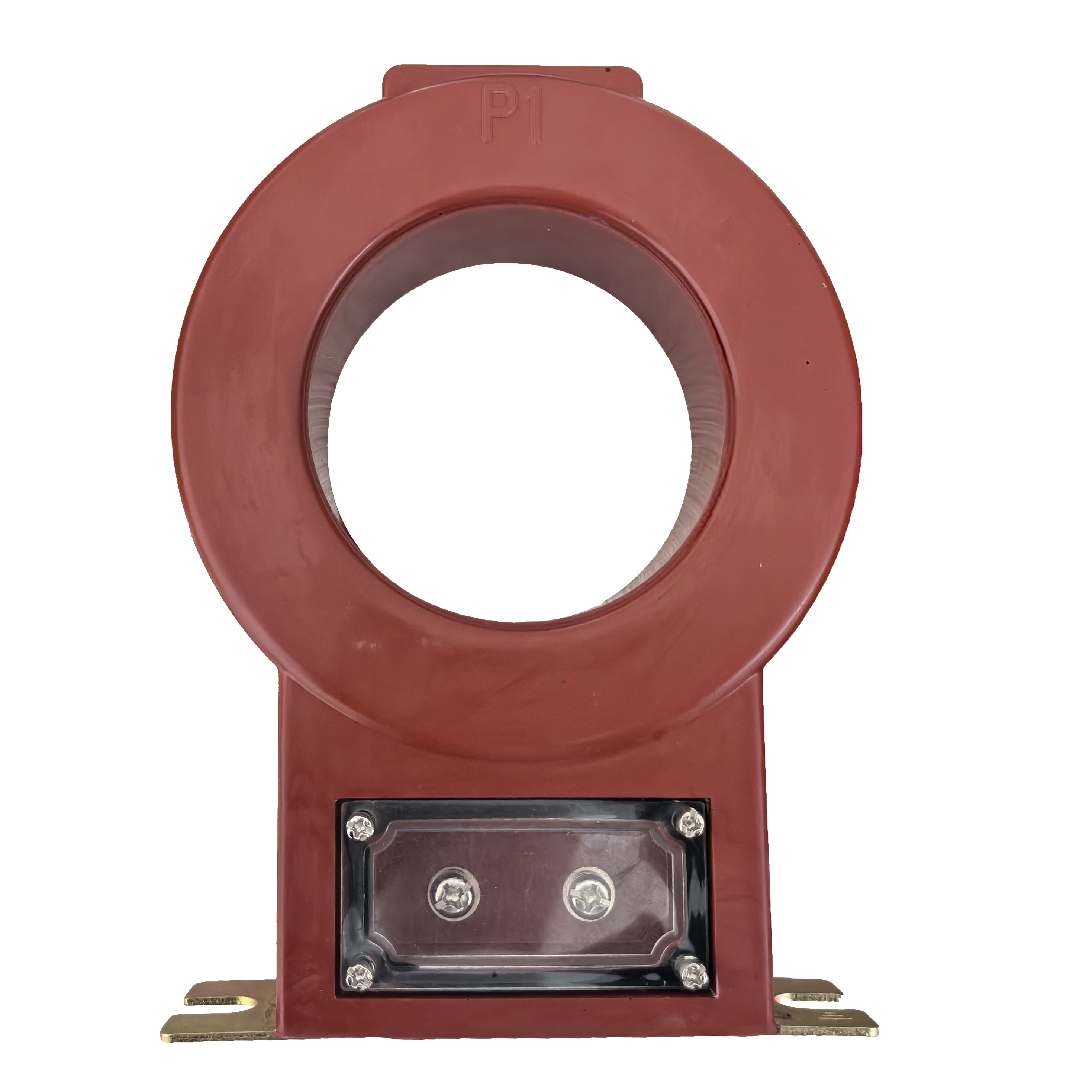
LMZW outdoor resin-cast current transformer: hydrophobic epoxy body, 0.66 kV, IP65 and UV protection for exposed installations.
OCT covers the second case: HEYI lists it as an outdoor waterproof split-core current transformer, so the core opens and closes around a conductor that stays in service. That combination — weather protection plus split-core access — is what makes it usable on distribution cabinets that are retrofitted rather than rebuilt. The ingress protection rating, UV exposure and temperature range should be read from the datasheet of the specific OCT model being quoted, since those are model-level declarations rather than family-wide statements.
High-Vibration Panels: DX/DM DIN-Rail CT
Vibration does not usually damage a current transformer's magnetics; it loosens the connections around them. DX/DM is described as a DIN-rail mounted compact low-voltage CT rated to 0.66 kV, with a hinged terminal cover, plug-in terminals and a quick-connect secondary. The measurement range is 0–6000 A with a 5 A output, accuracy 1.0 or 0.5, a 125 × 35 mm window, an ABS/PC housing and a choice of silicon-steel or nanocrystalline cores with pure copper enameled winding.
HEYI lists EMU and high-speed rail, high-vibration environments, modular and prefabricated systems, construction and mining machinery and modular data centers for this family. The terminal arrangement matters more than it appears to. A current transformer secondary must never be left open while the primary is energised, so a hinged cover and plug-in terminals that keep the secondary circuit closed during service are a genuine engineering feature in a panel that shakes, not a convenience detail.
Three-Phase Measuring: DASN
HEYI lists DASN as a three-phase current transformer, which addresses the common case where all three phases of a feeder are measured at the same point. Specifying a three-phase item rather than three separate single-phase units is partly a documentation decision and partly a wiring one, and it should follow the panel's physical layout rather than the other way round.
The supplied specification for DASN is at family level, so the practical step is to confirm, per model, the ratio, accuracy class, burden, number of primary windows and mounting format — including whether the model suits the DIN-rail build the panel actually uses. That check is quick, and it prevents the most common three-phase ordering error, which is assuming that a three-phase family automatically matches a three-phase mounting arrangement.
Retrofit Clamp-On Work: KCT and KCT-L
KCT is the split-core family, and KCT-L is the True RMS current transformer/transmitter inside it: 0–1000 A, 4–20 mA output, accuracy 1.0, inner diameter 0–50 mm, PA housing with silicon-steel and ferrite cores. HEYI lists PLC and DCS integration, remote power monitoring, preventive maintenance, rail transit, environmental engineering and IoT and smart-city applications for this family.
The distinction between the two matters at the receiving end. KCT delivers a conventional secondary for a meter or relay, while KCT-L delivers a 4–20 mA loop signal that a PLC analogue input can read directly, without a separate transducer in the cabinet. Ordering the transmitter version for a power meter that expects 5 A, or the secondary version for a PLC card that expects 4–20 mA, is an interface error rather than a product fault. The split-core clamp-on form is the reason both versions appear in retrofit projects: the conductor stays where it is.
Busbar Applications: DP/HK
Busbars are rectangular, and a rectangular window is the honest answer. DP/HK is a busbar split-core current transformer with a window of 0–80 × 160 mm, a measurement range of 0–8000 A and an output that can be specified as 5 A, 1 A, mA or mV. Accuracy classes across the family span 3.0, 1.0 and 0.5, in a PC housing with silicon-steel cores and copper windings.
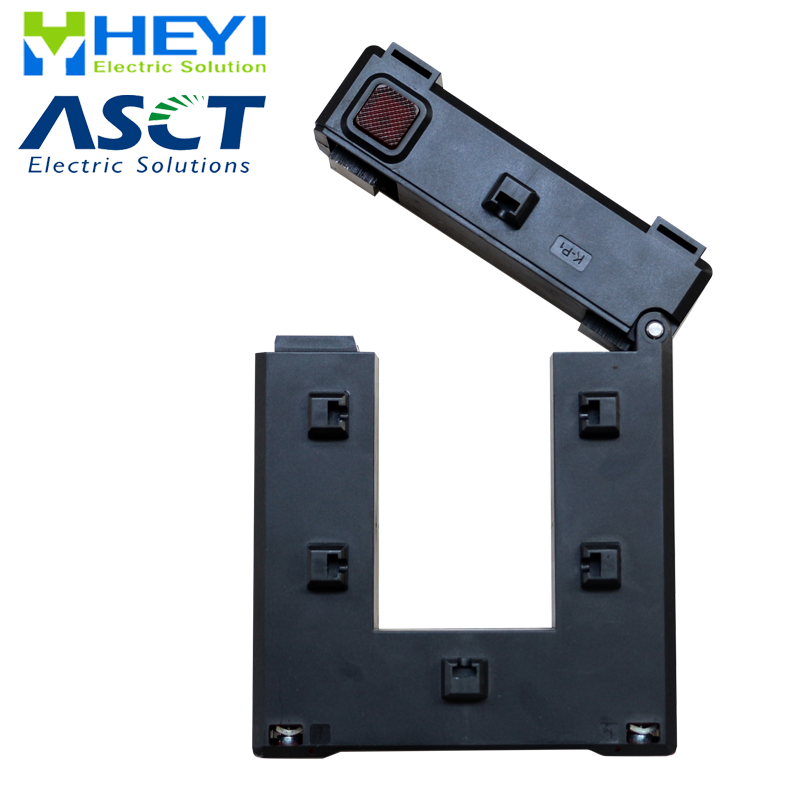
DP/HK busbar split-core current transformer: rectangular window up to 80 × 160 mm and a range to 8000 A for switchgear and energy-management panels.
HEYI lists smart grid and switchgear panels, smart pole and IoT smart cities, EMS and energy management, solar, wind and energy storage, and smart buildings and data centers for this family. The wide class span is the useful part of the specification, because it lets the same mechanical family serve two different jobs: a 3.0 class is adequate for indicative load monitoring, while 0.5 is the class associated with measurement. Choosing the highest available class by default adds cost without adding value to a trend graph, and choosing 3.0 for a billing-adjacent measurement point is the opposite mistake.
Wide-Range, Non-Saturating Measurement: FRC Rogowski Coil
The FRC is a flexible Rogowski coil with an air core, a measurement range of 100–10000 A, a mV output and a 245 mm inner diameter, built in silicone with a pure copper enameled winding. Inner diameter, output and colour are customizable, and the family includes an integrator version designated G1. Without an iron core there is no magnetic circuit to saturate, which is why the coil tolerates very high currents and fast transients, and why it can be wrapped around conductors that are large, irregular or already installed.
HEYI lists heavy industry and smelting, data centers and power retrofit, portable testing meters, and lightning and transient current work for this family. Two practical points decide whether it performs. First, the coil output is proportional to the rate of change of current, so a usable measurement requires an integrator — the G1 version or a meter with a Rogowski input — and a raw mV signal into a generic analogue card will not give a proportional reading. Second, because the air core does not define the field path the way an iron core does, the reading depends on how consistently the primary sits inside the loop; in portable testing that means keeping the same placement between readings.
There is external market support for the direction. Mordor Intelligence notes that Rogowski coil current transformers are increasingly adopted for harmonic monitoring and for flexibility in tight spaces — a statement about technology adoption, not about the suitability of any particular model for a particular panel.
Where This Mapping Stops
A family-level map narrows a shortlist; it does not qualify a part. Several items have to be settled at model level, and leaving them open is what turns a good shortlist into a rejected delivery.
- Accuracy class is conditional. A declared class only holds under stated burden and power-factor conditions. Two CTs both marked 0.5 are not interchangeable if one is asked to drive a long secondary run into a lower-burden relay.
- The standard part number matters. IEC 61869-2 covers inductive CTs at 15–100 Hz, IEC 61869-10 covers low-power passive CTs with analogue output, and IEC 61869-14 covers DC applications above 1.5 kV. Which part applies is a property of the architecture, and the certificate should name the model.
- Model-level declarations are not family declarations. The stated ingress protection for an OCT model, the output variant of a KCD part, the mounting format of a DASN model and the ratio availability within DX/DM all need confirmation against the datasheet being quoted.
- Billing is a different requirement. Revenue-grade metering, with its own accuracy and environmental qualification, sits outside this application mapping; the families here are specified for monitoring, control and sub-metering duties.
- Residual-current sensing is a separate function. HEYI lists the HYCA series as a Type B residual-current sensor for charging-pile applications and states compliance with IEC 62955, IEC 62752 and UL 2231; those statements are manufacturer claims and should be checked against certificate documents at model level before they are used in an approval file.
Market Context: What the Published Figures Do and Do Not Say
Two commercial research publishers put the global current transformer market in the same broad range but do not describe the same market boundary. Grand View Research values the global market at USD 2.8 billion in 2025 and reports that the medium-voltage segment held a 50.5% revenue share that year. Fortune Business Insights projects the market growing from USD 3.06 billion in 2026 to USD 5.23 billion by 2034, a reported CAGR of 6.92%.
Those figures should be read as directional demand indicators rather than as procurement inputs, and they should not be averaged together, because the two publishers do not disclose an identical product or revenue boundary. The medium-voltage share is a useful reminder of scope: the families discussed in this article are predominantly low-voltage devices at 0.66 kV and below, so a market split dominated by medium-voltage revenue does not describe the segment these CTs compete in. What the numbers do support is a general expectation of sustained demand, which affects supplier capacity planning far more than it affects a single panel's bill of materials.
From Mapping to RFQ
Once the family is chosen, the request for quotation can be short and still complete. A workable eight-line version covers: the signal type and frequency; the primary conductor type, dimensions and whether it can be disconnected; the required range and ratio; the accuracy class together with the burden and the receiving device; the output form; the environment, including indoor/outdoor, moisture, UV and vibration; the applicable standard and the certificate required; and the installation window or mounting format.
For buyers working through that list, HEYI states a monthly capacity of 20,000 units and a lead time of 3–30 days, with customization available on current ratio, accuracy class, burden, window size, housing colour, terminal type, cable length, logo printing and label design. The stated quality routine covers 100% routine testing, accuracy testing, insulation resistance testing, withstand voltage testing, appearance inspection and pre-shipment inspection. Those are supplier-stated capabilities; they are useful for planning a first article and a delivery schedule, and they are verified the usual way — by sample, by test report and by pre-shipment inspection on the actual order.
Frequently Asked Questions
Why can a standard current transformer not be used to measure a PV string?
A PV string carries direct current, while an inductive current transformer produces its secondary output through alternating magnetic flux. With a steady DC primary there is no changing flux, so no usable secondary signal is generated. DC-side measurement therefore calls for a different sensing principle — HEYI's C2/C3 Hall Effect current sensor responds to the magnetic field produced by the conductor and is listed for DC-type conditions — and the model is specified by sensing range, output form, supply and isolation rather than by a 5 A secondary ratio.
How do I choose between a split-core CT and a Rogowski coil for a retrofit?
Choose by what the receiver needs and what the conductor looks like. A split-core CT such as KCT, KCT-L, KCD or OCT closes around an existing cable and returns a conventional, mA or digital output that standard meters, relays and PLCs accept. A Rogowski coil such as the FRC has no iron core, so it does not saturate at very high currents and can wrap around large or irregular conductors, but its output is proportional to the rate of change of current and needs an integrator or a Rogowski-input meter. Split-core suits conventional metering interfaces; Rogowski suits wide range, transients and awkward geometry.
What should be confirmed before specifying a current transformer for an outdoor location?
Confirm the ingress protection rating, the UV exposure statement and the temperature range for the exact model, together with whether the device is solid-core or split-core. LMZW is an outdoor resin-cast CT with a hydrophobic epoxy body, IP65 protection and UV protection at 0.66 kV, which suits planned installations where the primary can be threaded during construction. OCT is listed as an outdoor waterproof split-core CT, which suits cases where the cable stays in service, but its rating data are model-level declarations that should be read from the datasheet being quoted.
Does a higher accuracy class always give a better monitoring result?
No. The class is only meaningful together with the burden and power factor under which it is declared, and it should match the function. A 3.0 class within the DP/HK busbar family is adequate for indicative load trending, while 0.5 suits measurement duties; paying for the tighter class on a trend graph adds cost without adding decision value. Equally, a lower class can still fail in service if the secondary burden exceeds what the accuracy declaration assumes.
How should a buyer verify a CT family against the project documentation?
Verify at model level, not family level: ratio, accuracy class and burden, rated range, window or inner diameter, output form and its compatibility with the receiving device, mounting format, environmental ratings, and the standard named on the certificate. Also confirm the interface variant explicitly where a family description and a parameter block differ — the KCD family, for example, is described as RS485/Modbus RTU while its published parameter block lists a 4–20 mA output. Written confirmation of the ordered variant against the datasheet is the step that prevents most post-delivery disputes.
Conclusion
The families in this portfolio do not compete on the same jobs; they answer different installation questions. A DC string excludes inductive sensing entirely, a live feeder excludes solid-core devices, an exposed outdoor cabinet excludes anything without moisture and UV protection, and a busbar excludes a round window. Working from signal, access, environment and receiver towards ratio and accuracy produces a shortlist that can actually be installed, and it leaves the remaining decisions where they belong — with the datasheet, the burden calculation and the certificate.
Full technical and product information is available in the HEYI ELECTRICAL catalogue, which can be viewed and downloaded here: HEYI product catalogue (PDF).
Tem questões ou precisa de mais detalhes?
Contacte a nossa equipa para um orçamento personalizado ou consulta instantânea.
Solicitar orçamento
Preencha o formulário abaixo e a nossa equipa entrará em contacto com uma proposta personalizada.
Chat direto do WhatsApp
Prefere conversar em tempo real? Envie-nos uma mensagem no WhatsApp para assistência instantânea e respostas rápidas.
- Obter orçamento personalizado
- Partilhar fotos ou documentos
- Discuta as suas necessidades diretamente
Geralmente responde em 5–30 minutos durante o horário de expediente.