
Current Transformer Shortlist: DX/DM, C2/C3, FRC, KCT-L, KCD and OCT by Duty
A current transformer shortlist becomes useful only when every entry is tied to a specific duty. Two devices can share the same 5 A secondary, the same class 1.0 label and a similar window size yet behave very differently inside a vibrating rail cabinet, on a 2,000 A busbar that cannot be shut down for a retrofit, or on a pole exposed to rain, UV and thermal cycling.
A current transformer (CT) is a measurement device that reproduces a primary current at a smaller, usable level for meters, relays, loggers and controllers. The inductive versions used in most low-voltage panels are written against IEC 61869-2:2012, which covers newly manufactured inductive current transformers used with electrical measuring instruments and/or protective devices at rated frequencies from 15 Hz to 100 Hz. Low-power passive designs fall under IEC 61869-10:2017, and current transformers for DC applications above 1.5 kV fall under IEC 61869-14:2018. These three standards describe different electrical architectures, which is one reason a single “best CT” answer rarely survives contact with a real project.
This is a discovery-stage shortlist for buyers at the beginning of a specification. It covers six HEYI ELECTRICAL model families — DX/DM, C2/C3, FRC, KCT-L, KCD and OCT — and sets out which duty each one is published for, what the catalogue data does and does not establish, and where the shortlist stops. It is not a brand ranking, and it does not compare these models against unverified competitor datasheets.
Why shortlisting by duty beats shortlisting by ratio
Most CT searches begin with a ratio — 200/5, 400/5, 1000/5 — and end with a mismatch. Ratio narrows the catalogue, but it says nothing about whether the device can be installed without a shutdown, whether its output can be read by the controller already on site, or whether its enclosure survives the location. A duty-based shortlist reverses the order: fix the job, then the current type, then the mounting, then the output, and use ratio and accuracy to finish the selection.
The problem shows up most clearly in retrofit and mixed-load projects. A monitoring layer added to an existing distribution board has to work around conductors that stay energised, a controller with fixed input cards, and an enclosure that was never designed for a sensor. The same reasoning applies to generation assets, where a PV string and a VFD DC bus may sit inside the same plant but require different sensing principles, and to outdoor infrastructure, where the deciding constraint is the housing rather than the ratio.
The opportunity is procurement efficiency. Once a buyer has a duty map, the RFQ can be assembled in a single pass, spares can be grouped by function, and the risk of specifying a device that later needs re-termination or an adapter falls sharply. Shortlisting by duty also makes the comparison between suppliers cleaner, because every vendor is asked for the same fields.
The six criteria that decide most of the choice
- Current type (AC or DC). An inductive CT responds to alternating current. Hall effect sensing and Rogowski coils sit in different architectural categories, and IEC has separate requirements for inductive CTs, low-power passive CTs and DC application CTs. Current type is the first filter, not the last.
- Mounting and aperture. A DIN-rail device with a fixed window must have the conductor threaded through it. A split-core device opens and closes around a live conductor. Aperture size then decides whether a busbar or a bundled cable will physically pass.
- Output signal. A 5 A secondary suits meters and relays expecting standard CT input. A 4–20 mA DC output feeds analogue PLC or DCS cards over long runs. A millivolt output needs an integrator or a dedicated Rogowski input. An RS485 output delivers digital current and energy data straight into a monitoring platform.
- Accuracy class. Published classes in this shortlist range from 3.0 to 0.5. Class should follow the use of the reading — status indication, energy reporting, or a reading that feeds a billing or regulatory process — rather than the catalogue’s best available figure.
- Environmental protection. Indoor cabinets, damp tunnels, overhead lines and coastal installations are not the same environment. Ingress protection, UV exposure and housing material belong in the specification, not in a post-installation complaint.
- Retrofit constraints. Available shutdown time, cable routing, lead length and connector type decide as much as the electrical data. Several models in this shortlist list lead wire type, length and connector as customizable, which is a retrofit parameter rather than a technicality.
The manufacturer behind the shortlist
All six families are published by HEYI ELECTRICAL (WENZHOU HEYI ELECTRICAL CO.,LTD), a current transformer and current sensor manufacturer established in 2012 and based in Wenzhou, Zhejiang, China. Company-reported figures describe a 10,000 m² manufacturing facility, approximately 56 staff including a five-engineer R&D team, and an annual output of 356,000 units, with export business accounting for 95% of sales across Southeast Asia, South Korea, Europe, South America, Australia, Africa, the Middle East and North America.
Those figures describe stated capacity and market reach. They are not a quality certificate, and they do not by themselves qualify any model for a specific project. They do explain why the portfolio is broad enough to be organised by duty: a supplier building dedicated product families for rail, PV, building monitoring and outdoor distribution will naturally publish different mounting, output and enclosure options rather than one universal device.
The shortlist: six models, six duties
DX/DM — DIN-rail 0.66 kV CT for high-vibration cabinets
The DX/DM is a compact low-voltage current transformer rated 0.66 kV and mounted on DIN rail, published with a measurement range of 0–6000 A, a 5 A output, accuracy classes 1.0/0.5 and a 125 × 35 mm window. It uses a plug-in terminal design with a hinged terminal cover and a quick-connect secondary, in an ABS/PC housing with a silicon steel or nanocrystalline core and pure copper enameled wire winding.
Its published duty is high-vibration environments, EMU and high-speed rail, modular data centres, modular and prefabricated systems, and construction and mining machinery. The design choices follow that duty: DIN-rail mounting for factory-built panels, hinged covers where terminals are re-entered during commissioning, and a construction intended for equipment that moves or shakes. Because the window is fixed, the DX/DM belongs to new-build and factory-assembled panel work rather than to live retrofits.

C2/C3 — split-core Hall sensor for DC and mixed signals
The C2/C3 is a Hall effect current sensor, described in the product data as a split-core Hall effect current transducer and DC current transmitter, with bi-directional measurement and zero/span adjustment. Published figures are a 0–1000 A range, a 5 A output signal, accuracy 1.0/0.5 and a 125 × 35 mm inner diameter, in an ABS/PC housing with silicon steel and nanocrystalline core materials and copper winding.
It is the only model in this shortlist published as DC-capable, and its stated applications reflect that: PV string monitoring, VFD DC bus monitoring, BMS and battery storage, railway traction, industrial automation, telecom and IDC, and process industry. Being an active sensor, it requires a supply and a commissioning step for zero and span; that is a different installation routine from a passive inductive CT. It is also where the standards split becomes practical, since DC measurement sits outside the inductive AC assumptions of IEC 61869-2 and closer to the DC requirements of IEC 61869-14 where voltages exceed 1.5 kV.
FRC — flexible Rogowski coil for 100 to 10,000 A without saturation
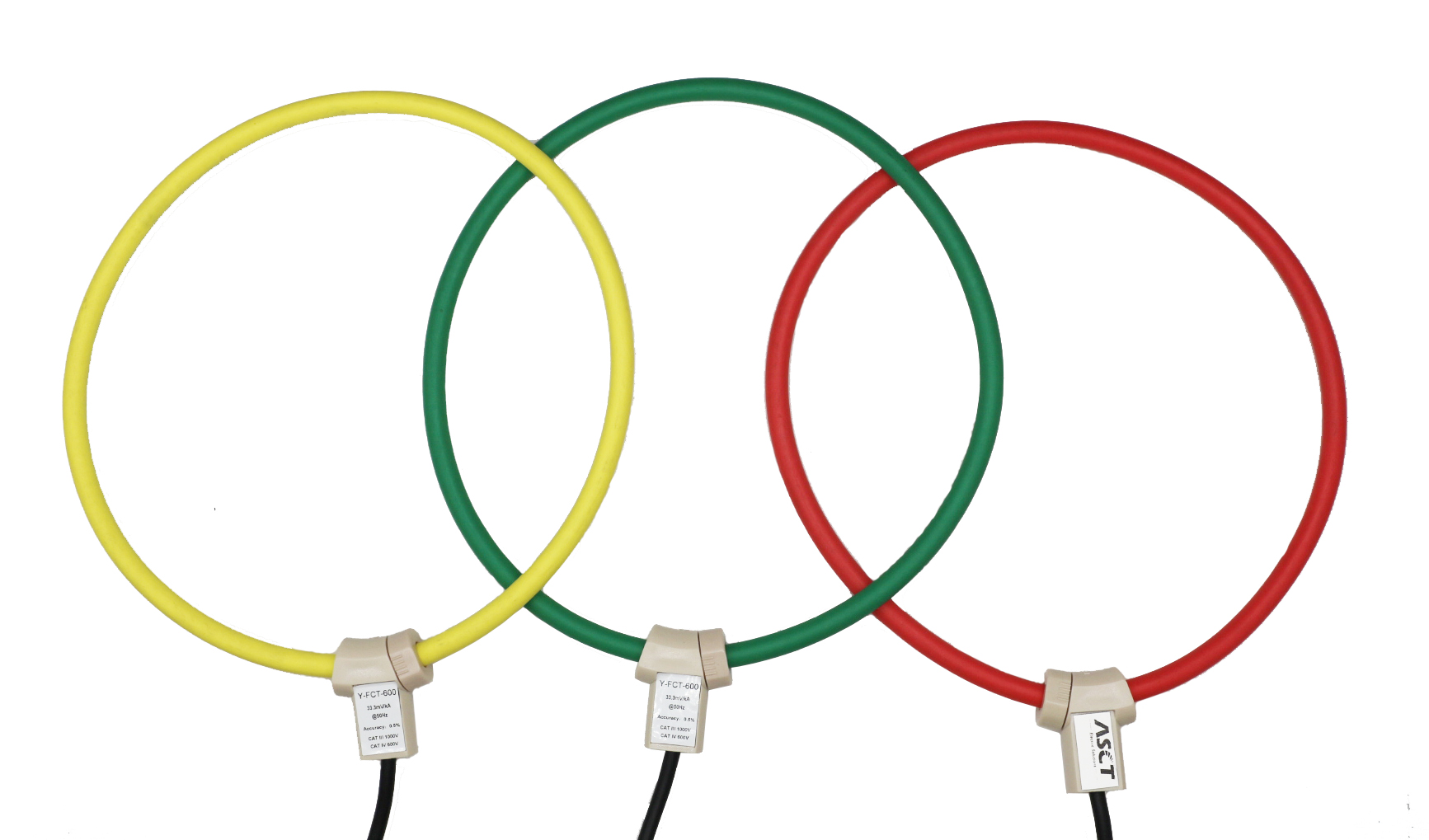
The FRC is a flexible Rogowski coil, classified as an air-core current transducer, a rope current sensor and a non-saturating sensor. Published data gives a 100–10000 A measurement range, a millivolt output and a 245 mm inner diameter, with a silicone body and pure copper enameled winding. Inner diameter, output and colour are listed as customizable.
Its duty is the awkward end of current measurement: heavy industry and smelting, data centre and power retrofit work, portable testing meters, and lightning and transient current measurement. An integrator variant (G1) is published for portable meters and retrofit applications, with customization of inner diameter, output and colour. With no iron core, there is no core to saturate at high current, and the flexible rope closes around busbars and cable bundles that a rigid window CT cannot reach. The trade-off is system dependency: a millivolt output requires an integrator or a measuring input designed for Rogowski coils, and the coil and reading device should be specified together.
KCT-L — loop-powered 4–20 mA split-core transmitter for PLC and IoT
The KCT-L is a true RMS current transformer and transmitter with a 4–20 mA DC output, described as a loop-powered current monitoring sensor and IoT gateway compatible current sensor. Published figures are a 0–1000 A range, accuracy class 1.0 and a 0–50 mm inner diameter, with PA housing, silicon steel or ferrite core and copper winding. Lead wire type, lead wire length and connector are customizable.
Its published duty is PLC and DCS system integration, remote power monitoring, preventive maintenance, rail transit, environmental engineering, and IoT and smart city work. The reason to select it is the output, not the aperture: a 4–20 mA loop travels long distances into standard analogue input cards and carries its own supply on the same pair of wires. It removes the need for a separate transducer between the CT and the controller, which is often the hidden cost in distributed monitoring projects.
KCD — smart split-core CT with RS485 for metro, elevator and green building
The KCD is a smart split-core current transformer published with RS485 communication and described as a Modbus RTU current and energy sensor, a digital output current transducer, an all-in-one AC power meter sensor and a metro-grade smart CT. Published data gives a 0–1000 A range, accuracy class 1.0, a 0–50 mm inner diameter, PA housing, silicon steel and ferrite core, and copper winding, with customizable lead wire type, length and connector.
Its stated applications are specific: Beijing and Hangzhou metro lines, elevator monitoring, smart building and property management, green building and energy conservation, O&M services, and retrofit for the smart factory. The digital output is what changes the system architecture — current and energy data move into a monitoring platform over a bus rather than as an analogue level, which simplifies multi-point installations such as a lift bank or a floor-by-floor building survey. One caveat belongs in the RFQ: the model description refers to RS485/Modbus RTU while the published parameter line lists a 4–20 mA output signal, so the exact output configuration should be confirmed for the variant being ordered.
OCT — outdoor IP65/IP67 split-core CT for overhead and trackside duty
The OCT is an outdoor waterproof split-core current transformer, published as an IP65/IP67 rated split-core transformer and as an overhead line monitoring CT. It is described with a 0–8000 A range, output options of 5 A, 1 A, mA or mV, accuracy options of 3.0/1.0/0.5, an inner diameter of 0–120 mm and UV protection, in a plastic housing with epoxy resin, silicon steel core and copper winding. OEM, lead wire type, length and connector are customizable.
Its duty is outdoor: overhead line monitoring, outdoor solar and wind, municipal infrastructure and railway trackside. The clamp-on split-core format is the reason it exists — conductors already strung between poles are not going to be disconnected for a sensor, and the widest aperture in this shortlist (0–120 mm) accommodates overhead and busbar geometries. Here too the RFQ should pin down the enclosure: the catalogue description cites IP65/IP67 while the parameter line states IP65, so the rating should be confirmed for the exact variant.

Side-by-side: the shortlist in one table
| Model | Sensing principle | Published range | Published output | Published accuracy | Aperture / mounting | Best-fit duty |
|---|---|---|---|---|---|---|
| DX/DM | Inductive, AC, 0.66 kV | 0–6000 A | 5 A | 1.0 / 0.5 | 125 × 35 mm, DIN rail | High-vibration panels, EMU and rail, modular data centres |
| C2/C3 | Hall effect, split-core, DC-capable | 0–1000 A | 5 A | 1.0 / 0.5 | 125 × 35 mm, split-core | PV strings, VFD DC bus, BMS and storage, traction |
| FRC | Rogowski, air-core, non-saturating | 100–10000 A | mV | Not published in product data | 245 mm flexible | Heavy industry, retrofit, portable meters, transients |
| KCT-L | Inductive, split-core transmitter | 0–1000 A | 4–20 mA DC | 1.0 | 0–50 mm, split-core | PLC and DCS integration, remote monitoring, IoT |
| KCD | Inductive, split-core smart CT | 0–1000 A | RS485 (Modbus RTU); parameter line lists 4–20 mA | 1.0 | 0–50 mm, split-core | Metro, elevator, green building, O&M retrofit |
| OCT | Inductive, outdoor split-core | 0–8000 A | 5 A / 1 A / mA / mV | 3.0 / 1.0 / 0.5 | 0–120 mm, split-core | Overhead lines, trackside, outdoor solar and wind, municipal |
Where the shortlist stops: limits buyers should price in
- Voltage envelope. The published data for these six families sits in low-voltage measurement, with DX/DM explicitly rated 0.66 kV. Nothing in this article addresses medium-voltage switchgear CTs, which is a different product class, a different standard set and a different procurement process. Commercial research cited below indicates that medium voltage represented the larger share of CT market revenue in 2025; a low-voltage shortlist therefore covers a minority of the value in the category.
- Catalogue values are not type tests. Accuracy classes, ranges and ingress ratings quoted here are published product statements. Certification and type-test verification is a separate exercise, and buyers feeding a billing or compliance process should request model-specific evidence rather than accept the label.
- Two specification details need confirmation. The KCD output is described as RS485/Modbus RTU in the model description while the parameter line lists 4–20 mA, and the OCT is described as IP65/IP67 while the parameter line states IP65. Neither is a defect; both are reasons to confirm the configuration in the RFQ.
- No cross-brand comparison is included. This shortlist contains verified data for one manufacturer’s families only. A shortlist across brands requires equivalent fields from every supplier; without them, comparison collapses into price and window size. In the category research reviewed for this article, no additional comparable manufacturer datasheets were available for verification.
- CT accuracy is not system accuracy. Burden, secondary cable length, meter class and wiring practice all affect the final reading. A class 0.5 CT connected into a class 1.0 measurement chain does not produce a class 0.5 result.
- Split-core is a trade-off, not an upgrade. Split-core models open the magnetic circuit to allow installation without disconnection. That is an access advantage. Where a project demands the tightest metering behaviour, the application should be discussed with the supplier rather than inferred from the catalogue class.
Application fit by project type
- Rail, metro and vibration-heavy equipment. DX/DM for panel-mounted AC measurement in rolling stock and modular data centres; KCD where the requirement is digital current and energy data from metro stations, lift installations and building services.
- PV, storage and DC buses. C2/C3 where a DC current path must be monitored, including PV string monitoring, VFD DC bus monitoring and BMS work; KCT-L or FRC where the AC side of the same plant needs analogue or flexible measurement.
- Industrial retrofit with limited downtime. KCT-L for a 4–20 mA signal into an existing PLC, FRC where the conductor is large, irregular or inaccessible, and KCD where the plant wants digital data points rather than analogue loops.
- Building energy management and O&M. KCD for property management, green building and O&M reporting where meters and sensors share a communications bus; KCT-L where the building management system takes analogue inputs.
- Outdoor distribution, overhead lines and trackside. OCT as the default candidate, with the enclosure rating confirmed against the site conditions before order.
Market context: sensing architecture is now a procurement decision
Commercial research estimates the global current transformer market at USD 3.06 billion in 2026, rising to USD 5.23 billion by 2034 at a reported CAGR of 6.92%. Those figures come from a commercial research publisher and are useful as directional context; the market boundary and methodology were not independently validated, so they should not anchor a business case on their own.
Two qualitative signals matter more for shortlisting. First, medium voltage accounted for a revenue share of 50.5% in 2025 according to separate commercial research, which confirms that low-voltage monitoring devices — the subject of this shortlist — sit in the smaller half of category value but in the larger half of installation count. Second, Rogowski coil adoption is reported to be increasing for harmonic monitoring and for flexibility in tight spaces. That aligns with what the FRC is published for: retrofit, transients and conductors that a rigid core cannot reach.
Read together, these signals point to the same procurement conclusion. As monitoring moves into existing assets, the specification questions shift from ratio and burden towards output format, enclosure rating and installation access. Buyers who write those three fields into the RFQ early tend to receive comparable quotes; buyers who do not tend to receive comparable prices and incomparable products.
Shortlist versus the traditional single-model approach
The traditional approach standardises on one window-type CT family for every panel. It is not wrong. It reduces part numbers, simplifies spares, shortens installer training and keeps documentation thin. In a factory-built panel programme with predictable AC loads and a controlled environment, it is often the most economical route.
Its limits appear at the edges. A fixed-window CT requires the conductor to be threaded, which implies a disconnection. A general-purpose indoor model does not carry an outdoor ingress rating. An inductive AC CT does not measure a DC bus, and a 5 A secondary does not connect directly to a controller’s analogue input. Each of those gaps is then filled by an adapter, a second product family or a change in the installation plan.
A duty-based shortlist such as the six models above accepts more part numbers in exchange for fewer installation compromises. The honest summary is that neither approach is universally better: single-model standardisation wins in new-build, standardised panels, while duty-based selection wins where monitoring is added to assets that cannot be shut down, moved or re-engineered.
Future outlook
Three directions are visible from this shortlist alone. Digital outputs are moving from accessory to default in building and infrastructure monitoring, because a bus-connected sensor removes an analogue conversion step and produces data a platform can use directly. Outdoor and clamp-on formats are expanding with overhead line and trackside monitoring, where the installation constraint, not the electrical range, decides the product. And DC-capable sensing is becoming a standard line item rather than a special request, driven by storage, EV charging infrastructure and DC bus architectures — with IEC 61869-14 providing the reference framework for higher-voltage DC applications.
For buyers, the practical implication is that output format and enclosure rating deserve the same place in the specification as ratio and accuracy. A shortlist built on those four fields will still be usable when the next monitoring project arrives, and it will be easier to compare across suppliers when competing datasheets are collected on the same basis.
FAQ
What is the practical difference between a split-core and a solid-core current transformer?
In this shortlist, the split-core models — C2/C3, FRC, KCT-L, KCD and OCT — can be opened and closed around a conductor, while the DX/DM is a DIN-rail low-voltage CT with a fixed 125 × 35 mm window. The difference is installation access rather than measurement principle: a split-core device can be fitted without disconnecting the primary circuit, while a fixed-window device requires the conductor to be threaded through. That changes downtime and labour, which is why retrofit projects usually start with split-core candidates.
Can a current transformer measure DC current?
An inductive CT responds to alternating current. Within this shortlist, the C2/C3 is a Hall effect sensor published as a split-core DC current transmitter with bi-directional measurement and zero/span adjustment, and its stated applications include VFD DC bus monitoring, BMS and battery storage. The FRC is an air-core Rogowski coil and is not published as a DC measuring device. For DC systems with rated voltage above 1.5 kV, IEC 61869-14:2018 sets out the specific requirements for current transformers used in measurement, protection and control.
Which output should be specified: 5 A, 4–20 mA, mV or RS485?
The output should follow the receiving device. A 5 A secondary suits meters, relays and instruments that expect standard CT input, as published for DX/DM, C2/C3 and the OCT options. A 4–20 mA DC output, as published for KCT-L, suits loop-powered PLC or DCS analogue inputs and long cable runs. A millivolt output, as published for FRC, requires an integrator or a measuring input designed for Rogowski coils. An RS485/Modbus RTU output, as published for KCD, delivers digital current and energy data to a monitoring platform without an intermediate transducer.
What ingress protection makes sense for an outdoor current transformer?
The OCT is published as an outdoor waterproof split-core CT, with IP65/IP67 stated in its catalogue description, IP65 in its parameter line, and UV protection listed. IP65 denotes dust-tight construction with protection against water jets; IP67 adds protection against temporary immersion. For overhead line, trackside and municipal outdoor installations, the enclosure rating should be confirmed together with cable entry arrangement and UV exposure for the specific variant ordered.
Is accuracy class 1.0 sufficient for energy metering?
Published accuracy in this shortlist is 1.0/0.5 for DX/DM and C2/C3, 1.0 for KCT-L and KCD, and 3.0/1.0/0.5 for the OCT, with FRC accuracy not stated in the product data. Class 0.5 or better is commonly requested where a reading supports billing or regulatory reporting. Because the overall measurement chain includes the meter, burden and secondary wiring, the class should be confirmed against type-test evidence for the exact model rather than taken from the catalogue alone.
How should these models be compared with other suppliers’ current transformers?
Request the same fields used in this shortlist from every supplier: sensing principle, published current range, output format, accuracy class, aperture and mounting method, ingress protection, and stated application notes. Where a field is missing on one side, the comparison reduces to price and window size. This shortlist contains verified data for one manufacturer’s product families only, so a cross-brand comparison requires collecting equivalent documents from the other suppliers first.
Reference document: the HEYI ELECTRICAL product brochure is available for download at https://cdn.socialarks.com/sbsp/24875/common/2026/0601/HEYI.pdf.
Tem questões ou precisa de mais detalhes?
Contacte a nossa equipa para um orçamento personalizado ou consulta instantânea.
Solicitar orçamento
Preencha o formulário abaixo e a nossa equipa entrará em contacto com uma proposta personalizada.
Chat direto do WhatsApp
Prefere conversar em tempo real? Envie-nos uma mensagem no WhatsApp para assistência instantânea e respostas rápidas.
- Obter orçamento personalizado
- Partilhar fotos ou documentos
- Discuta as suas necessidades diretamente
Geralmente responde em 5–30 minutos durante o horário de expediente.