
Curved Glass Applications: Matching DY-ZK01, DY-GH01 to Your Project Type
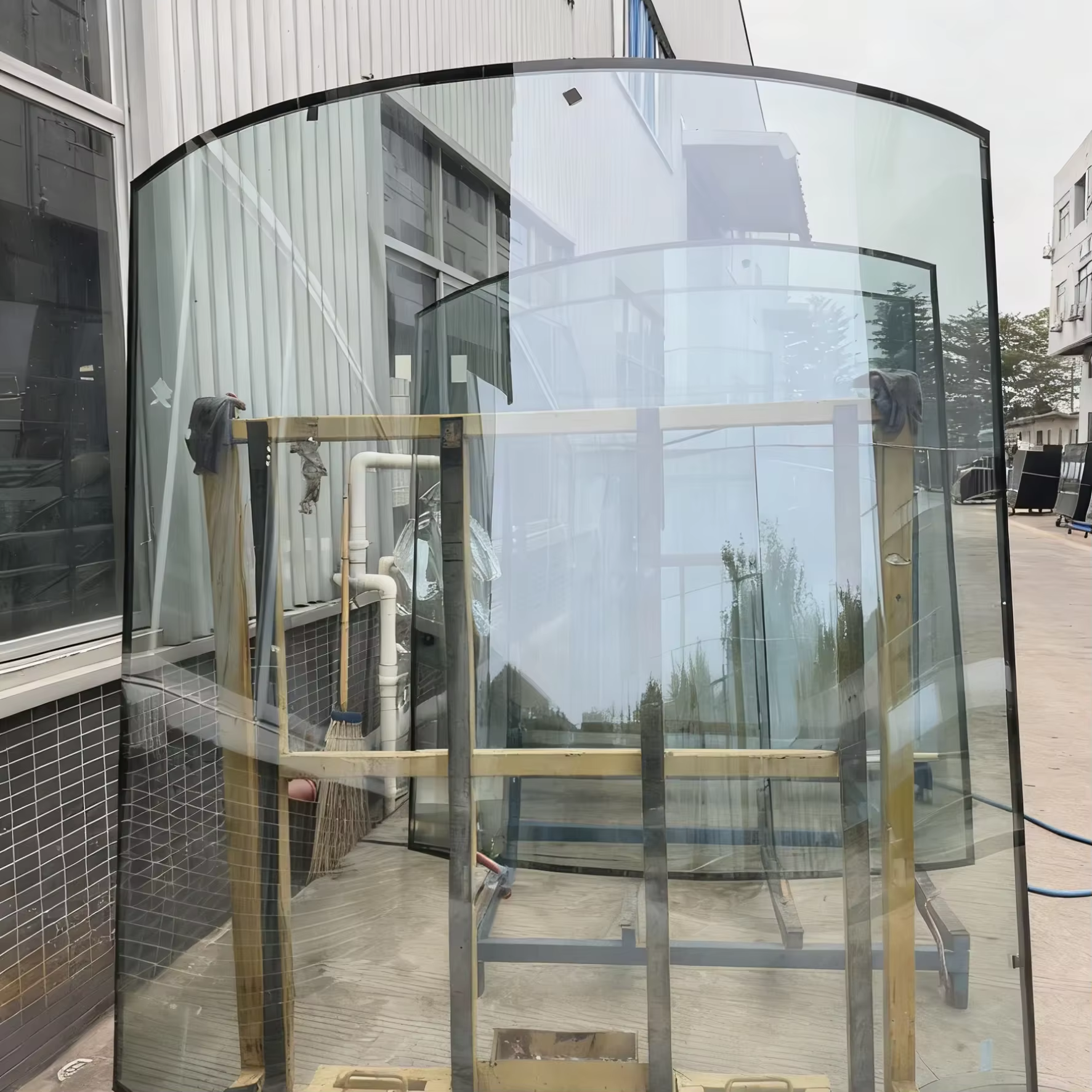
Cover: a curved insulating glass unit — the build-up typically specified where a project needs a sealed cavity between panes.
Curved glass is a category, not a product. Two projects can both specify “curved glass” and still require assemblies that share almost nothing: a single curved tempered pane for a bathroom enclosure, a curved laminated safety unit for an automotive or fire-related application, and a curved insulating unit for a curtain wall that must control both heat loss and noise. The forming method may look identical on a shop drawing while the substrate, interlayer or cavity, thickness range and performance data behind each product are entirely different.
Most curved glass information available to buyers describes bending techniques — hot bending, cylindrical bending, S-shaped or double-curved geometry — without answering the more basic procurement question: which glass build-up fits which project type? This guide answers that question directly by matching three published product families to the application lists they were specified for.
Shenzhen Dayang Special Glass Co., Ltd. (DYGLASS) is a building glass manufacturer established in 2017 and located in Shenzhen, Guangdong, China, near Hong Kong. The company operates a 30,000 square metre facility with approximately 130 staff and an annual production capacity of 600,000 square metres, and its main products include laminated glass, toughened glass, smart glass, insulated glass, curved glass and building glass. Its curved glass range covers multi-curved, double-curved, triple-curved, trapezoid, spherical, pyramidal, S-shape, cylindrical and positive-and-negative curved tempered glass.
Why Project Type Should Drive the Choice, Not the Product Name
The most common source of error in curved glass procurement is treating “curved glass” as a single material with a single set of performance expectations. In practice, the forming route, the glass substrate, the interlayer or the sealed cavity, and the edge work are selected together — and it is that combination, not the curve itself, that determines which project types a product can serve. A curved pane for an office partition and a curved unit for a high-rise curtain wall may share the same radius while sharing nothing else: thickness range, safety classification route, thermal build-up and acoustic build-up all differ.
For specifiers in the awareness and research stage, this changes the first question. Instead of “who can bend glass?”, the more productive question is “which curved glass build-up does this project type require?” Answering that early avoids two expensive errors: over-specifying an assembly the project does not need, and under-specifying safety or acoustic performance in a location where the brief or the applicable standard requires it.
Standards already organise bent glass around application. ASTM C1464-06, the standard specification for bent glass, covers requirements for building construction, furniture and display. ISO 11485-3:2014 classifies curved tempered and curved laminated glass as safety glasses for buildings. Both documents assume that the intended use defines what the glass must do — which is the same logic this guide applies at product level.
The Three Curved Glass Families at a Glance
Three models cover the majority of curved architectural requests. They are not interchangeable tiers of one product; each publishes its own build-up, performance range and application list.
| Model | Glass family | Thickness | Light transmittance | Sound insulation |
|---|---|---|---|---|
| DY-GH01 | Curved tempered glass from float glass | 3 mm – 19 mm, tolerance ±0.5 mm | ≥91% | Not published for this model |
| DY-JJ01 | Tempered laminated safety glass, also available as curved laminated glass | 6.38 mm – 50 mm total | 85% – 92% clear; 10% – 70% tinted | 35 dB – 45 dB |
| DY-ZK01 | Tempered insulated glass, including curved insulated glass variants | 6 mm+12A+6 mm and 8 mm+16A+8 mm standard; custom available | 70% – 89% | 30 dB – 45 dB |
Two observations follow from the table. First, the published acoustic figures for the laminated and insulated families overlap heavily — 35–45 dB and 30–45 dB — so noise reduction alone rarely decides between them; the deciding factor is usually whether the project needs a safety interlayer or a sealed cavity. Second, DY-GH01 does not publish a sound insulation rating at all, because its specification is written around geometry, tolerance and edge finish rather than cavity performance. That is a boundary, not a defect, and reading it correctly prevents mismatched selection.
Matching Each Model to a Project Type
DY-GH01: office partitions, curtain walls and bathrooms
DY-GH01 is a curved tempered glass made from float glass, supplied in thicknesses from 3 mm to 19 mm with a thickness tolerance of ±0.5 mm and a light transmittance of ≥91%. Edge work options are polished, grinded or beveled, and the product can also be supplied as flat tempered glass, tempered glass with holes, or with a polished edge. Its published application list is office partition, curtain wall, bathroom, furniture and construction.
The logic connecting those applications is visible edge quality and dimensional control. Office partitions and bathroom enclosures expose the glass edge to view and to frequent human contact, so beveled or polished edge work and a ±0.5 mm thickness tolerance matter more than cavity performance. Curved tempered glass in this configuration is also classified as a safety glass for buildings under ISO 11485-3:2014, which is the relevant reference when a partition or shower screen is specified in an occupied building.
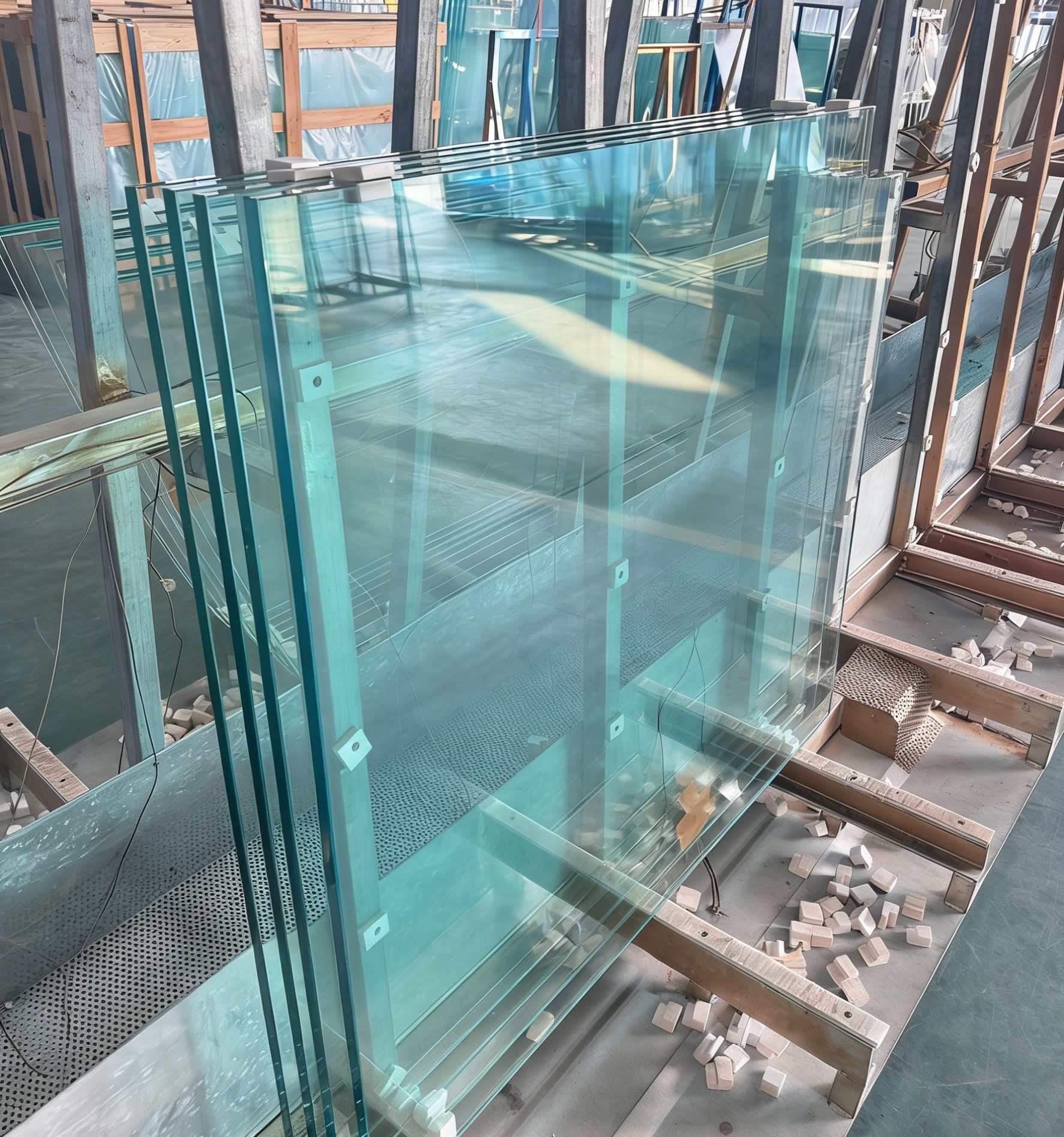
DY-GH01 curved tempered glass: 3–19 mm, ±0.5 mm tolerance, ≥91% light transmittance, polished, grinded or beveled edge work.
What this means for procurement: when the project element is a partition, a bathroom screen or an exposed curved panel, the specification conversation should focus on thickness, tolerance and edge finish, and on how the pane interfaces with framing. Buyers should not assume a monolithic tempered pane will deliver the acoustic or thermal behaviour of a cavity assembly, because that performance is not part of this model’s published data.
DY-JJ01: building and construction, automotive, and fire-resistant uses
DY-JJ01 is a tempered laminated safety glass, also available as curved laminated glass, made from tempered glass with a PVB interlayer. Total thickness ranges from 6.38 mm to 50 mm, with PVB interlayer thickness options of 0.38 mm, 0.76 mm, 1.14 mm, 1.52 mm and 2.28 mm; interlayer types available include PVB, SGP and EVA. Glass substrates can be tempered, float, low-iron or tinted glass. Clear laminated glass offers 85%–92% light transmittance, while tinted laminated glass ranges from 10% to 70%, and sound insulation is 35 dB to 45 dB. The product can be used for fire-resistant applications and is intended for the automotive industry and building and construction scenarios.
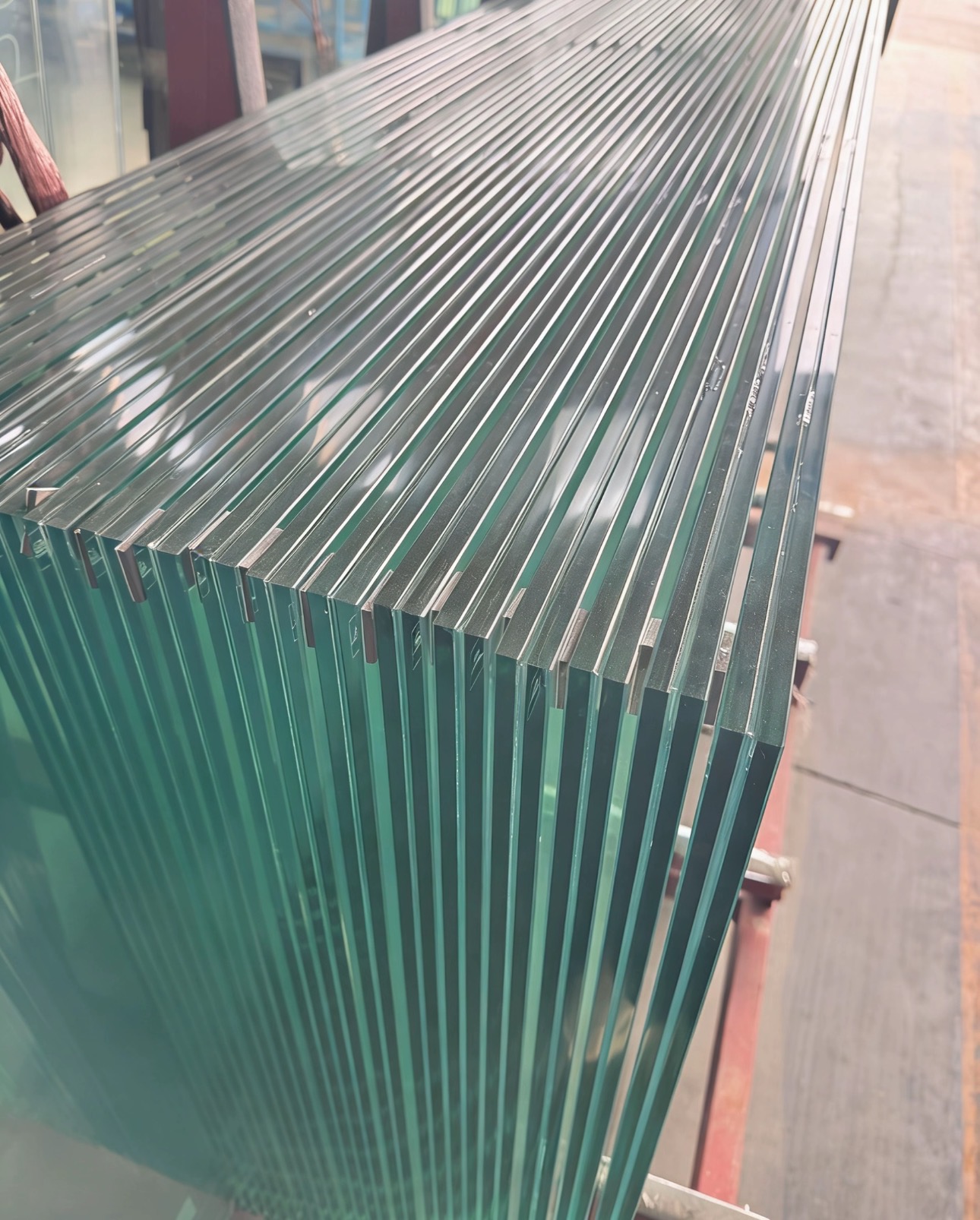
DY-JJ01 curved laminated safety glass: 6.38–50 mm total thickness, PVB, SGP or EVA interlayers, 35–45 dB sound insulation.
What this means for procurement: the laminated family is the one to specify when the project depends on what happens after breakage, or when an automotive or fire-related application is involved. Because ISO 11485-3:2014 classifies curved laminated glass as a safety glass for buildings, the interlayer choice — PVB, SGP or EVA, and its thickness within the published 0.38–2.28 mm band — is a design decision rather than a supplier default. Tinted substrates illustrate the trade-off clearly: the same product family spans 85%–92% and 10%–70% light transmittance depending on whether the substrate is clear or tinted, so solar control and daylight levels must be balanced deliberately.
DY-ZK01: curtain walls, windows and interior decoration
DY-ZK01 is an insulating glass belonging to the tempered insulated glass category, and it includes curved insulated glass variants. It is made of tempered glass with an aluminium spacer. Standard thickness options are 6 mm+12A+6 mm and 8 mm+16A+8 mm, with custom thicknesses available. Glass type can be clear float, low-E, tempered or low-iron; spacer bar options are aluminium spacer or warm edge spacer; and gas fill options include air, argon, krypton and xenon. Light transmittance ranges from 70% to 89% and sound insulation is 30 dB to 45 dB. The product is intended for curtain wall and window systems, interior decoration and architecture projects within building construction and real estate.
What this means for procurement: insulating glass is the only one of the three families whose published specification is defined by a cavity make-up — glass thickness, spacer depth, spacer material and gas fill. Every one of those variables is selectable, which means the quoted product is only as well matched to the project as the make-up specified in the enquiry. Where a project needs curved glazing and also needs reduced heat transfer through a façade or window, this is the family whose data sheet addresses that requirement directly.
Reading the Two Performance Figures That Decide Most Specifications
Across the three models, two published figures carry most of the selection weight: ≥91% light transmittance for the curved tempered glass, and 30–45 dB sound insulation for the curved insulating unit.
Light transmittance ≥91%. This figure describes the clear float substrate behaviour of the curved tempered product and sits at the upper end of the range across the three families. The laminated family publishes 85%–92% for clear and 10%–70% for tinted; the insulating family publishes 70%–89%, reflecting the effect of the cavity, the possible low-E coating and the glass type. Read together, the numbers show a normal engineering gradient rather than a ranking: adding a cavity or a coating, or switching to a tinted or low-iron substrate, changes daylight transmission, and the specification should state which target the design is optimising.
Sound insulation 30–45 dB. This is a published range for the insulating unit, not a guaranteed single value. Acoustically, the position within that range depends on the make-up selected — glass thickness, cavity depth, spacer type and gas fill — which is why the same model can legitimately be quoted at different points in the range for different projects. The laminated family publishes 35–45 dB, derived from the interlayer and substrate combination. For a buyer, the practical rule is to specify the acoustic target first and let the make-up follow, rather than comparing headline ranges between suppliers as if they were fixed ratings.
Market Context: Where Curved Glass Demand Is Heading
Statifacts estimates the global curved glass market at USD 13.5 billion for 2025, with a forecast compound annual growth rate of 5.8% between 2025 and 2035. Grand View Research reported the glass curtain wall market at USD 62.4 billion in 2024. The two figures describe different scopes — curved glass across architecture, automotive and electronics versus curtain wall glazing overall — but together they indicate that the application areas where curved glass is specified most heavily sit inside a large and still-expanding demand pool.
Standards activity reinforces the same direction. ASTM C1464-06 defines requirements for bent glass across building construction, furniture and display, and ISO 11485-3:2014 establishes curved tempered and curved laminated glass as safety glasses for buildings. Where classification exists, specification language tends to converge, and buyers benefit: instead of comparing marketing descriptions, project teams can compare products against a shared safety and application framework.
One caveat belongs in any market discussion. Published commercial research does not consistently break curved glazing out as a separate line item, and verified supplier-level capacity, price and lead-time datasets for curved glass are not widely available. Buyers researching this category should expect to obtain those numbers directly from suppliers rather than from secondary reports.
Curved Glass Compared with Flat Glass and Standard Assemblies
| Comparison point | Flat tempered / insulating glass | Curved glass |
|---|---|---|
| Forming steps | Tempering, optional lamination or cavity assembly | Forming is added ahead of tempering, then lamination or cavity assembly |
| Design freeze | Can be revised relatively late within standard sizes | Geometry is fabricated to the opening, so the curve must be fixed earlier |
| Published data density | Extensive, standardised across the industry | Product-specific; not every model publishes every metric |
| Typical drivers | Cost, availability, standard framing | Design intent, façade geometry, safety and acoustic requirements |
Curved glazing is not a straightforward upgrade over flat glazing, and treating it as one leads to unrealistic expectations. Four boundaries are worth stating plainly.
1. More process steps, and therefore different commercial terms. A curved assembly generally passes through forming in addition to the steps a flat product requires, and laminated or insulating variants add lamination or cavity assembly on top. Buyers should expect lead time and pricing to be quoted per project rather than taken from a flat glass reference — DYGLASS does not publish standard price or lead-time data for these models, so those must be confirmed in the quotation.
2. Not every model publishes every metric. DY-GH01’s available specification covers thickness, tolerance, light transmittance and edge work, but does not publish a sound insulation rating. A project that needs a documented acoustic value should therefore be directed to the laminated or insulating family rather than assuming an unstated performance level.
3. Insulating performance is make-up dependent. The 70%–89% transmittance and 30–45 dB sound insulation published for the insulating family are ranges spanning glass type, coating, spacer and gas options. Two quotations for the same model can sit at different points in those ranges, so the make-up must be written into the enquiry.
4. Geometry capability should be confirmed early. Commercial research aggregated by Statifacts indicates that the outer edge of the curved glass category includes bending radii from 75 mm and panel lengths up to 12 metres. Those figures describe what the category can reach, not a guaranteed output from any single supplier, and they are best treated as a starting point for a feasibility conversation rather than a specification.
Future Outlook
If the curved glass market grows at the forecast 5.8% compound annual rate between 2025 and 2035, the practical change for buyers will not be the volume of curved glass available but the quality of the information attached to it. Three developments are already visible.
First, application-led specification is becoming the norm. Standards such as ASTM C1464-06 and ISO 11485-3:2014 organise bent glass by application and safety classification, which pushes product data sheets toward the same structure — thickness, tolerance, transmittance, acoustic range and an explicit application list, exactly the format used by the three models discussed here.
Second, the boundary between safety glass and performance glass will keep moving. Laminated build-ups with PVB, SGP or EVA interlayers and insulating build-ups with argon, krypton or xenon fills are already configurable within a single curved product line, which means future selection will be driven more by the combination of safety, acoustic and thermal targets than by the glass family alone.
Third, the information gap will remain a procurement risk. Curved glass is highly customised and is not consistently segmented in market research, so buyers will continue to depend on project-specific confirmation for capacity, geometry feasibility and lead time. The mitigations available now are simple: fix the geometry early, specify the make-up in writing, and match the product family to the project type before comparing commercial terms.
FAQ
What is curved glass, and which build-ups are actually used in buildings?
Curved glass is glass that has been formed to a specified geometry rather than supplied flat. In buildings, the three build-ups most commonly specified are curved tempered glass, curved laminated safety glass and curved insulating glass. Curved tempered and curved laminated glass are classified as safety glasses for buildings under ISO 11485-3:2014, while curved insulating glass combines curved panes with a sealed cavity for thermal and acoustic control.
Which curved glass should be used for a curtain wall project?
Two of the three families publish curtain wall in their application lists. Curved tempered glass is listed for curtain wall, office partition, bathroom, furniture and construction, and is specified where the visible edge, thickness tolerance of ±0.5 mm and ≥91% light transmittance are the governing requirements. Curved insulating glass is also listed for curtain wall and window systems and is specified where a sealed cavity, low-E coating and gas fill options such as argon or krypton are needed instead.
What sound insulation can a curved insulating glass unit achieve?
Published sound insulation for the curved insulating glass family is 30 dB to 45 dB. This is a range rather than a single rating: the position within it depends on the make-up, including glass thickness, cavity depth, spacer bar type and gas fill. The curved laminated family publishes 35 dB to 45 dB, so acoustic performance alone rarely separates the two families — the presence of a safety interlayer or a sealed cavity usually decides the choice.
How does light transmittance differ across curved glass types?
Curved tempered glass made from float glass publishes ≥91% light transmittance. Curved laminated glass publishes 85%–92% for clear laminated glass and 10%–70% for tinted laminated glass, depending on the substrate. Curved insulating glass publishes 70%–89%, reflecting the effect of the cavity, the optional low-E coating and the selected glass type, which can be clear float, low-E, tempered or low-iron.
What should be verified before ordering curved glass for a project?
Four items are worth confirming in writing before an order is placed: the intended application and the standard that applies to it, such as ASTM C1464-06 for bent glass or ISO 11485-3:2014 for curved safety glass; the exact build-up, including substrate, interlayer type and thickness or cavity make-up; the governing performance targets, with acoustic and light transmittance targets stated as values rather than ranges; and the geometry itself, since curved glass is fabricated to the opening and feasibility should be confirmed during design rather than after fabrication begins.
A detailed product brochure covering the DYGLASS building glass ranges, including curved glass, laminated glass and insulating glass, is available for download: DYGLASS product brochure (PDF).