
Curved Glass Buyer Comparison: DYGLASS vs Alternatives for Builders
Curved glass tenders are rarely decided by price per square metre alone. When a builder compares quotations for a curved curtain wall, a sightseeing elevator enclosure, an S-shaped atrium detail or a skylight roof, the real comparison is how much specification risk each supplier is prepared to document. Most of that risk sits in four places: certified thickness ranges, edge work quality, interlayer and cavity build-up, and the scope of third-party certification.
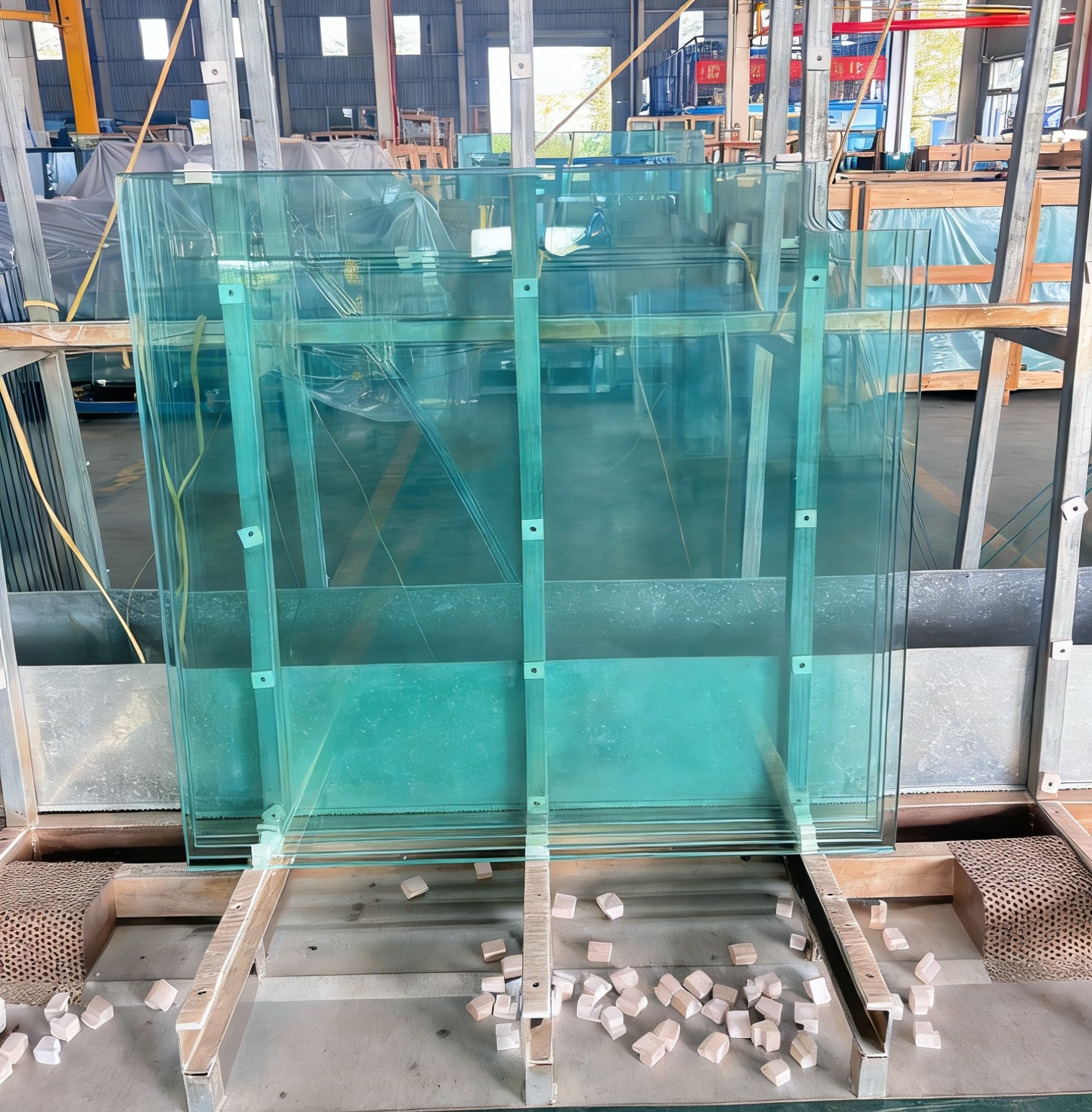
Tempered glass panels, including curved formats, produced on flat and curved tempering lines.
The category is large enough to justify that discipline. Cognitive Market Research valued the global curved glass panel market at approximately USD 781.2 million in 2024 and projects a compound annual growth rate of 8.0% through 2031. Research and Markets reports that architectural applications such as facades and curtain walls represented more than 40% of demand in 2024. Those figures should be read directionally rather than absolutely. Because research houses define the category differently, published 2024 market sizes diverge widely: Cognitive Market Research counts all curved glass panels at around USD 781.2 million, while Custom Market Insights narrows the definition to specific panel types and arrives at USD 78.55 million. A buyer comparing suppliers should therefore avoid quoting a single market number as a procurement argument and focus instead on the evidence each supplier can supply for the specific project.
Why Curved Glass Comparisons Break Down
Most curved glass comparisons collapse because the tender line item says only “curved glass.” That single phrase hides at least six variables: curvature type, thickness, tempering status, edge work, interlayer or cavity configuration, and certification coverage. Two suppliers can quote the same area of glass and be offering materially different products, with different compliance risk attached.
Regulation, not marketing, sets the first filter. CE marking under Construction Product Regulation 305/2011/EU applies to construction products placed on the EU/EEA market. The European Committee for Standardization (CEN) treats EN 12150-1 and EN 14179-1 (heat-soaked) as mandatory references for toughened safety glass used in construction, in part to control the risk of spontaneous breakage caused by nickel sulfide inclusions. For a builder, that means a curved glass quotation without a traceable certificate number is not a cheaper option — it is an unfinished one.
The second reason comparisons fail is capability ambiguity. Hot curved glass, double curved glass and multi-curved tempered glass are not interchangeable production processes. A supplier that can bend a single cylindrical panel may still be unable to deliver a double curved or reverse-curve unit, because those formats typically require dedicated double curved tempering equipment and autoclave lamination capacity.
The Comparable Evidence Set: Three DYGLASS Product Models
DYGLASS is the brand of Shenzhen Dayang Special Glass Co., Ltd., a Shenzhen-based building glass manufacturer founded in 2017 that operates a 30,000 m² factory with approximately 130 employees and an annual output of 600,000 square meters. Roughly 60% of production is exported, and the company's stated markets include the UAE, Bahrain, Saudi Arabia, the United States, the Philippines and Vietnam. Its product range covers laminated glass, toughened glass, smart glass, insulated glass and curved glass, and the company also accepts OEM and ODM orders.
For a buyer, the useful comparison unit is not the brand but the certified product family. Three models carry the certificate set that most EU/EEA and specification-driven projects ask for.
| Model | Product family | Key published specification |
|---|---|---|
| DY-GH01 | Tempered glass (flat, curved, drilled, polished edge) | Thickness listed at 3, 4, 5, 6, 8, 10, 12, 15 and 19 mm; tolerance ±0.5 mm; light transmittance ≥91%; edge work polished, grinded or beveled; float glass substrate |
| DY-JJ01 | Laminated safety glass, including curved laminated glass | Thickness range 6.38–50 mm; interlayer PVB, SGP or EVA at 0.38, 0.76, 1.14, 1.52 or 2.28 mm; tempered, float, low-iron or tinted substrate; light transmittance 85–92% clear and 10–70% tinted; sound insulation 35–45 dB |
| DY-ZK01 | Insulating glass units, including curved insulated glass | Build-ups of 6 mm+12A+6 mm and 8 mm+16A+8 mm with custom options; clear float, Low-E, tempered or low-iron glass; aluminium or warm edge spacer; air, argon, krypton or xenon gas fill; light transmittance 70–89%; sound insulation 30–45 dB |
Published product parameters for the DY-GH01, DY-JJ01 and DY-ZK01 families. Project-specific values are confirmed at order stage.
Certification is what turns those parameters into a comparable fact. All three families hold CE certification issued by ECTI CERT Ltd. on 3 March 2026, valid until 3 March 2031, for the European Union / European Economic Area market under Construction Product Regulation 305/2011/EU.
| Certificate number | Product | Harmonized standard cited |
|---|---|---|
| BGTC20260403-02 | Tempered glass DY-GH01, thickness series 4/5/6/8/10/12/15/19/22/25 mm | EN 12150-1:2015+A1:2019; EN 12150-2:2004 |
| BGTC20260403-03 | Laminated glass DY-JJ01, listed thickness combinations | EN 1449:2005 |
| BGTC20260403-05 | Insulating glass units DY-ZK01, listed configurations | EN 1279-1:2018; EN 1279-2:2018; EN 1279-3:2018; EN 1279-4:2018 |
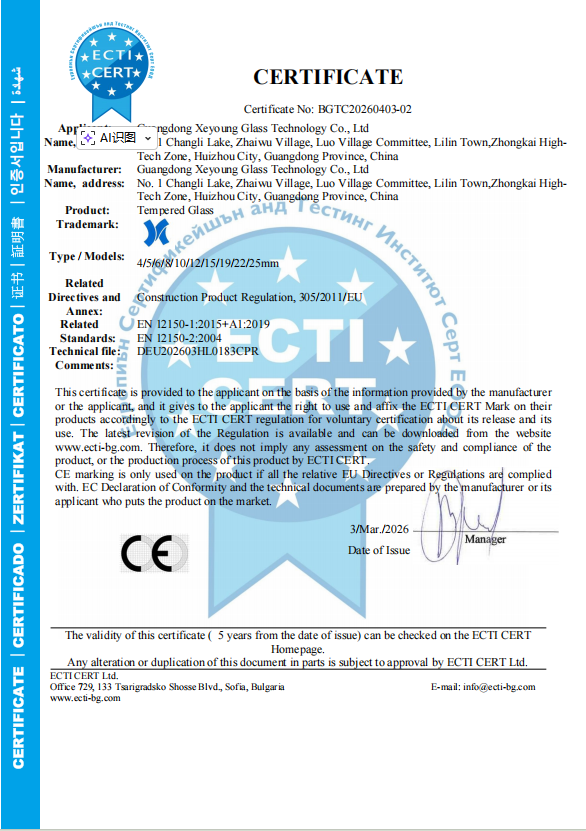
CE certificate BGTC20260403-02 for tempered glass, issued by ECTI CERT Ltd. and valid for the EU/EEA market until 2031.
Technical Explanation: Reading Specification Data as Capability Evidence
Specification tables are not neutral. They reveal which production processes a supplier has invested in and which it has not.
Geometry range
The DYGLASS process list covers multi-curved tempered glass, double curved tempered glass, triple curved tempered glass, trapezoid curved, spherical curved, pyramidal curved, S-shape curved, cylindrical curved, and positive and negative curved tempered glass. The equipment behind that list is specific rather than generic: a flat and curved tempering line, a second line configured for concave, convex and irregular curved glass, a dedicated double curved tempering line, an autoclave for lamination, an insulated line, cutting, drilling and edge grinding lines, and a heat soak furnace. For a builder, the practical reading is that high precision curved glass and no-wave-distortion requirements are process questions, not sales claims — they depend on which line a panel runs on and how the tooling is set.
Edge work
DY-GH01 lists polished, grinded and beveled edge work. On curved panels this matters more than on flat glass: an inconsistent edge profile becomes visible in laminated assemblies, affects the seal in insulating units, and can concentrate stress in a tempered panel. Edge quality is also one reason why an apparently cheaper curved glass alternative can generate rework on site.
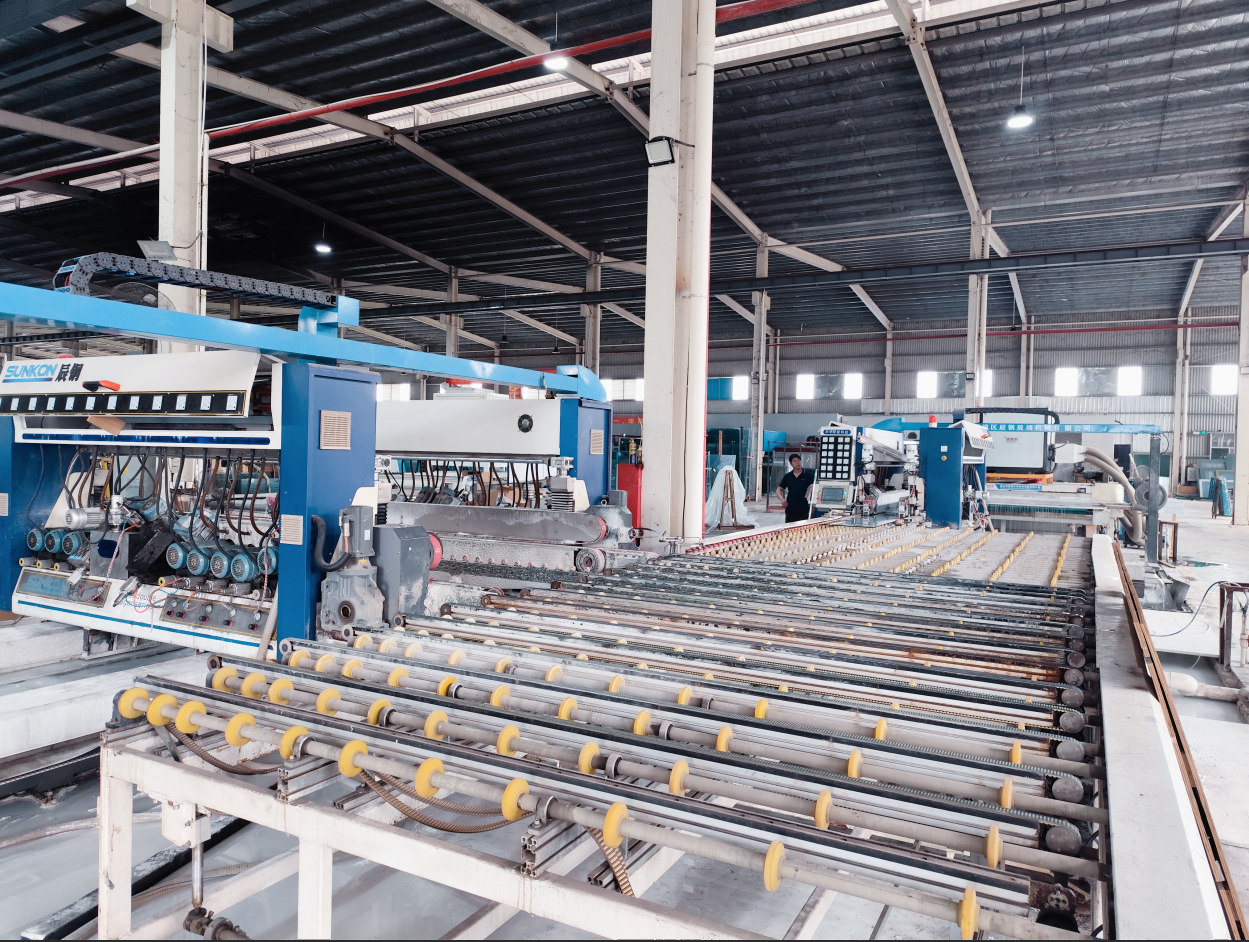
Edge grinding line: edge work listed for DY-GH01 includes polished, grinded and beveled finishes.
Interlayer, substrate and cavity
For laminated curved glass, DY-JJ01 supports PVB, SGP and EVA interlayers at five thicknesses between 0.38 mm and 2.28 mm, on tempered, float, low-iron or tinted substrates. Low-iron substrate selection is typically used where colour neutrality matters; tinted substrates reduce light transmittance to a documented 10–70% band, while clear builds are listed at 85–92%. Sound insulated curved glass can be specified either through the laminated route (35–45 dB) or through the insulating route (30–45 dB), and the two routes are not equivalent in thickness, weight or cost.
For insulated units, DY-ZK01 lists aluminium or warm edge spacers and air, argon, krypton or xenon gas fills, with light transmittance between 70% and 89%. This matters for skylight roof and curtain wall specifications, where solar control and condensation performance are usually evaluated together.
Application Fit: Where These Products Are Typically Specified
Curved glass demand is concentrated in a small number of application types. Architectural facades and curtain walls alone accounted for more than 40% of curved glass panel demand in 2024, according to Research and Markets.
- Curved glass for curtain wall and facade systems: typically DY-ZK01 insulated units with Low-E coatings and argon or krypton fill, or DY-JJ01 laminated panels where safety and post-breakage retention govern.
- Curved glass for sightseeing elevator enclosures: usually laminated curved glass for safety glass performance with controlled light transmittance, or insulating units where thermal separation is required.
- Curved glass for skylight roof glazing: laminated or insulated builds, where the documented 35–45 dB and 30–45 dB sound insulation bands and 70–92% light transmittance ranges give specifiers usable starting values.
- Interior and furniture applications: DY-GH01 lists construction, furniture, bathroom, curtain wall and office partition as applicable industries, which covers shower room glazing, coffee table tops and office partitioning. Bulletproof glass, fire-resistant glass and special-shaped glass are listed separately as special requirements rather than standard catalogue items.
The company's project imagery includes transport and institutional applications such as Huizhou North Railway Station, Nanchang East Railway Station, the China Nano Research Institute, the Bahrain International Circuit and Doha Metro Station. These are reference visuals of completed applications rather than a substitute for project-specific verification.
Market Trend Context Buyers Should Account For
Three structural trends matter for anyone building a supplier shortlist in 2026.
First, growth is concentrated in Asia-Pacific, which Custom Market Insights identifies as the fastest-growing region for the curved glass panel market on the back of rapid urbanisation and infrastructure development. That increases the number of Asian suppliers a buyer can choose from — and the number of uncertified ones.
Second, China's export value for worked glass, including bent and curved glass under HS 7006, reached approximately USD 791 million in 2023 according to TrendEconomy data derived from UN Comtrade. The supply base is therefore mature, which shifts the differentiator from availability to documentation.
Third, the certification calendar is now a procurement item. The CE certificates covering the three DYGLASS families were issued on 3 March 2026 and expire on 3 March 2031, so the coverage window is documented rather than assumed — something a builder should verify for every supplier, not only this one.
Comparing DYGLASS with Alternative Supply Options
Curved glass shortlists usually combine three supplier archetypes, and each should be judged against the same evidence set rather than against brand familiarity.
| Supplier type | What to verify | Typical trade-off |
|---|---|---|
| Multinational glass groups | Certificate numbers, plant issuing each certificate, project-specific thickness coverage | Broad portfolio and multiple plants, but less flexibility on small bespoke curved runs |
| Specialist curved glass fabricators (such as DYGLASS) | Curvature types actually produced, edge work, interlayer options, annual output and export record | Deeper focus on bending and lamination, but smaller capacity base than a multinational network |
| General trading intermediaries | Whether the certificate belongs to the factory or the trader, and which factory the panel is run on | Lower administrative friction, higher traceability risk |
Industry research identifies AGC, Saint-Gobain, Guardian Industries and Cricursa among the players with visibility in high-performance curved and architectural glass. A buyer evaluating DYGLASS alongside those names should apply identical criteria to all of them: which legal entity holds the certificate, which standard it cites, which thickness series it covers, and which production line the panels actually run on.
Where the evidence stops: real boundaries to check
An honest comparison has to name the limits, and several are visible in the published data.
- Certificates cover listed configurations, not everything the factory can physically bend. The CE certificate for tempered glass lists a 4/5/6/8/10/12/15/19/22/25 mm thickness series, while the DY-GH01 product specification also lists 3 mm. A project specifying 3 mm tempered curved glass falls outside the certified series and needs written confirmation of scope before ordering.
- Heat soak is a separate documentation question. EN 14179-1 is the reference standard for heat-soaked thermally toughened safety glass, while the tempered certificate cites EN 12150-1:2015+A1:2019 and EN 12150-2:2004. The plant operates a heat soak furnace, but buyers who require documented heat-soak treatment should confirm the applicable certification scope in writing rather than assume it from the equipment list.
- Certificates have an expiry date. The three certificates run to 3 March 2031; on longer programmes, buyers should re-verify validity at order and at delivery.
- Scale is a specialist scale. With approximately 130 employees, a 30,000 m² factory, 600,000 square meters of annual output and an R&D team of 5–10 people, DYGLASS is a focused manufacturer rather than a multinational group. Buyers scheduling several large towers in parallel should confirm capacity and lead time at enquiry stage, and should not assume the parallel capacity a multi-plant group can offer.
Future Outlook
With the curved glass panel market projected to grow at roughly 8.0% CAGR through 2031 and Asia-Pacific positioned as the fastest-growing region, the number of suppliers quoting curved glass will keep rising. The practical consequence for builders is that price discovery will get easier while documentation verification gets harder. Over the next few years, the buyers who avoid rework are likely to be those who treat certification scope, thickness series and geometry capability as the primary comparison fields, and treat price as the output of that analysis rather than its starting point.
For suppliers, the same trend points in one direction: capability claims that are not attached to a certificate number, a standard reference or a measurable parameter will carry less weight in tender evaluation than they did when curved glass was a rarer specification.
FAQ
Three CE certificates issued by ECTI CERT Ltd. cover the relevant product families for the European Union / European Economic Area market: BGTC20260403-02 for DY-GH01 tempered glass under EN 12150-1:2015+A1:2019 and EN 12150-2:2004; BGTC20260403-03 for DY-JJ01 laminated glass under EN 1449:2005; and BGTC20260403-05 for DY-ZK01 insulating glass units under EN 1279-1:2018, EN 1279-2:2018, EN 1279-3:2018 and EN 1279-4:2018. All three were issued on 3 March 2026 and expire on 3 March 2031, and all fall under Construction Product Regulation 305/2011/EU.
DY-GH01 tempered glass is published with thickness options of 3, 4, 5, 6, 8, 10, 12, 15 and 19 mm at a tolerance of ±0.5 mm, while the corresponding CE certificate lists a 4/5/6/8/10/12/15/19/22/25 mm thickness series. DY-JJ01 laminated glass covers a 6.38–50 mm thickness range with interlayers of 0.38, 0.76, 1.14, 1.52 or 2.28 mm. DY-ZK01 insulating glass units are published at 6 mm+12A+6 mm and 8 mm+16A+8 mm, with custom build-ups available.
Edge work options listed for DY-GH01 are polished, grinded and beveled. On the laminated side, DY-JJ01 supports PVB, SGP and EVA interlayers on tempered, float, low-iron or tinted substrates, with light transmittance of 85–92% for clear builds and 10–70% for tinted builds and sound insulation of 35–45 dB. For insulating assemblies, DY-ZK01 offers aluminium or warm edge spacers and air, argon, krypton or xenon gas fills, with light transmittance of 70–89% and sound insulation of 30–45 dB.
No. CE certification is scoped to the configurations and thickness series listed in the certificate, not to every panel a factory can physically produce. The tempered glass certificate, for example, lists a 4/5/6/8/10/12/15/19/22/25 mm series, so a 3 mm tempered specification falls outside it even though 3 mm appears in the general product specification. Curvature type is a separate question again. Buyers should confirm in writing that the specific thickness, build-up and curvature of their project sit inside the certified scope, and should raise heat-soak documentation separately if EN 14179-1 applies to their specification.
Apply one evidence set to every bidder: the certificate number and issuing body; the harmonized standard cited; whether the project thickness falls inside the certified series; which curvature types the supplier actually produces; the listed edge work and interlayer options; and the documented production capacity and export record. Industry research lists AGC, Saint-Gobain, Guardian Industries and Cricursa among the global players in high-performance architectural glass, so most shortlists will mix multinational groups with specialist curved glass fabricators. Because the evidence categories are the same for both types of supplier, comparing them on certification scope and published parameters, rather than on brand recognition, produces a more defensible selection.
Reference document: the company's technical product brochure is available as a PDF download at https://cdn.socialarks.com/sbsp//common/2026/0402/69ce03350b106.pdf
Tem questões ou precisa de mais detalhes?
Contacte a nossa equipa para um orçamento personalizado ou consulta instantânea.
Solicitar orçamento
Preencha o formulário abaixo e a nossa equipa entrará em contacto com uma proposta personalizada.
Chat direto do WhatsApp
Prefere conversar em tempo real? Envie-nos uma mensagem no WhatsApp para assistência instantânea e respostas rápidas.
- Obter orçamento personalizado
- Partilhar fotos ou documentos
- Discuta as suas necessidades diretamente
Geralmente responde em 5–30 minutos durante o horário de expediente.