
Curved Glass Evidence: 30,000 m², 130 Staff, 600,000 m²
Curved Glass Evidence: 30,000 m², 130 Staff, 600,000 m²
A curved glass quotation can look complete and still leave the buyer unable to verify the supplier behind it. The useful question is not whether a supplier lists capacity, certification and export markets, but whether those claims can be tied to documents, product models and a specific order. This review examines the evidence supplied for DYGLASS, the brand of Shenzhen Dayang Special Glass Co., Ltd., against that test.
DYGLASS is the brand used in this review for Shenzhen Dayang Special Glass Co., Ltd., a Shenzhen-based building-glass company founded in 2017. The supplied company profile lists a 30,000 m² facility, 130 employees, 600,000 square meters of annual output, a 5–10 person R&D team, a 60% export ratio and main markets including the UAE, Bahrain, Saudi Arabia, the United States, the Philippines and Vietnam. The product range covers laminated, tempered, smart, insulated and curved glass. The profile also states Alibaba Verified Supplier status and an SGS test report.
Those are useful markers. They are not, by themselves, a procurement answer. At evaluation stage, a buyer is comparing fit; at execution stage, the buyer needs documents that survive engineering review, purchase-order approval and, where applicable, customs or market-access checks. The sections below separate what the supplied evidence shows from what it still requires.
Why supplier evidence matters more after the quote
Curved glass is not a commodity panel with a single specification. The same nominal product can differ by radius, arc length, thickness, interlayer, edgework, coating and distortion acceptance. A supplier can be capable in general and still be the wrong fit for a particular build-up. That is why a quote should be read as a set of claims to verify, not as a finished answer.
The evaluation-to-execution transition is where those claims become commitments. A buyer who checks only the headline capacity may miss a narrower question: which line, which model, which standard and which certificate scope apply to this order? The evidence review below is organized around that narrower question.
The six evidence markers, and what each one can support
| Marker | Supplied position | What it can support | What to verify |
|---|---|---|---|
| Facility footprint | 30,000 m² | Space for multiple process steps and equipment | Which lines handle the proposed curvature and size |
| Workforce | 130 staff | Operating scale across production, technical and commercial functions | Curved-glass-specific headcount and inspection staffing |
| Annual output | 600,000 m² | Company-level volume and export experience | Product-specific monthly throughput and yield assumptions |
| R&D team | 5–10 engineers | A dedicated technical function for forming and build-up review | Feasibility review, tooling input and distortion criteria |
| SGS test report | Stated in the company profile | Third-party test evidence for the tested sample and scope | Report number, standard, sample identity and date |
| Alibaba Verified Supplier | Stated in the company profile | Platform-level entity verification | Product certification and order-specific documents |
Read together, the six markers describe a supplier with an operating factory, a workforce, a technical function and some third-party checks. Read separately, each has a boundary. The table is deliberately not a scorecard; it is a map of the next questions.
Facility footprint: 30,000 m²
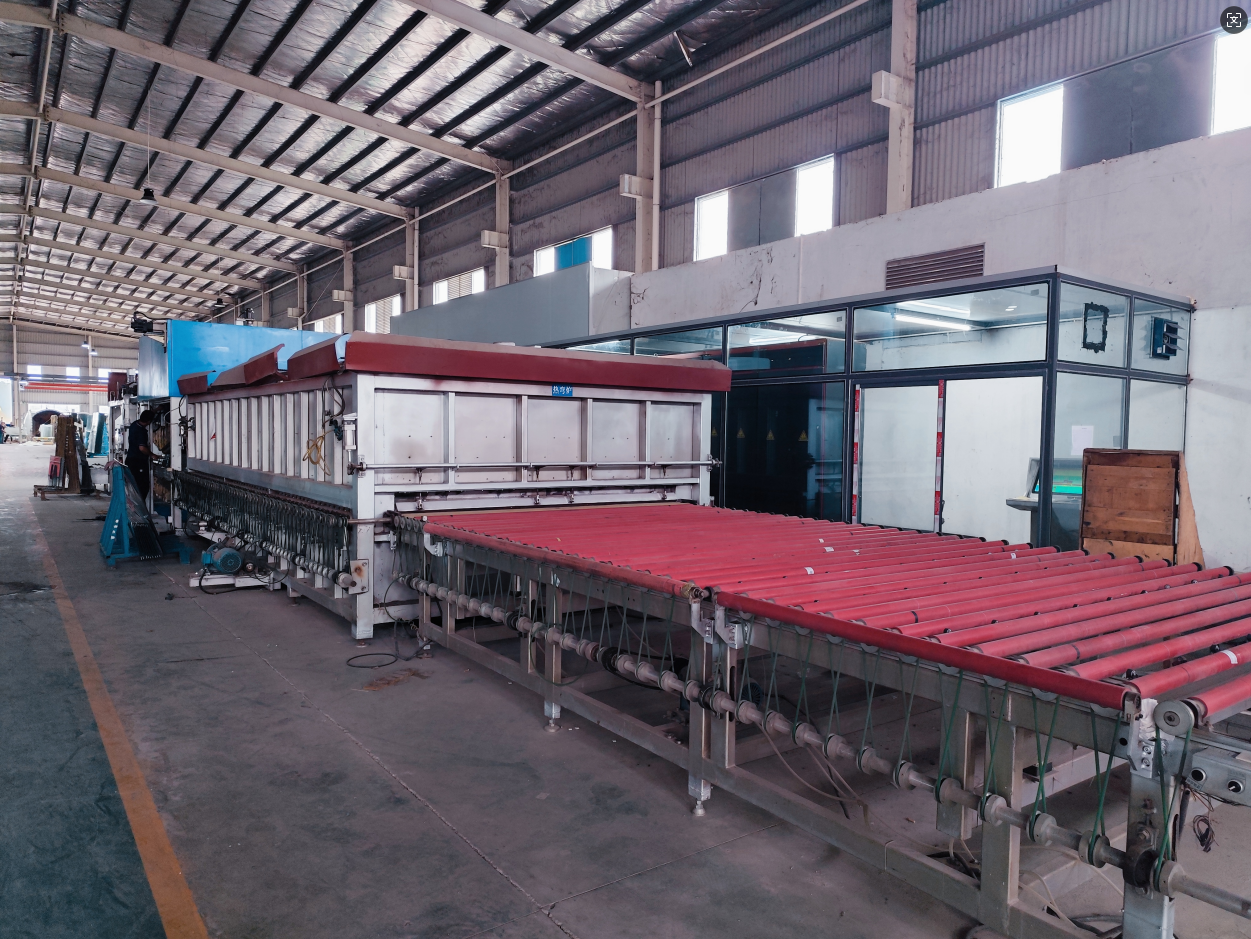
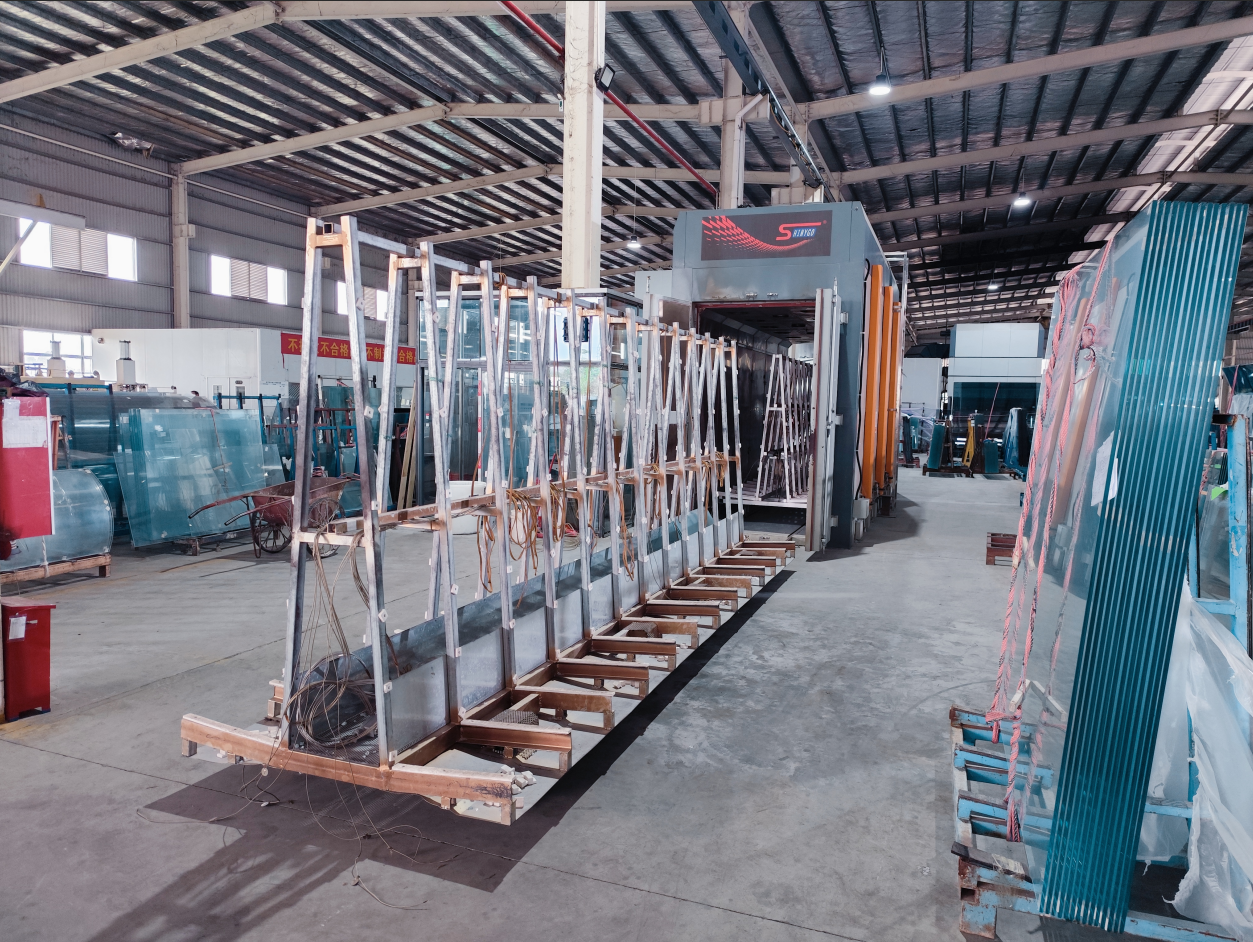
The 30,000 m² figure is a physical-footprint marker. It is consistent with a plant that houses multiple process steps rather than a single-line workshop. The supplied image captions identify a tempered line 1 for flat and curved glass, a tempered line 2 for concave, convex and irregular curved glass, a double-curved tempering line, an autoclave, an insulated line, cutting, drilling, edge grinding and a heat-soak furnace.
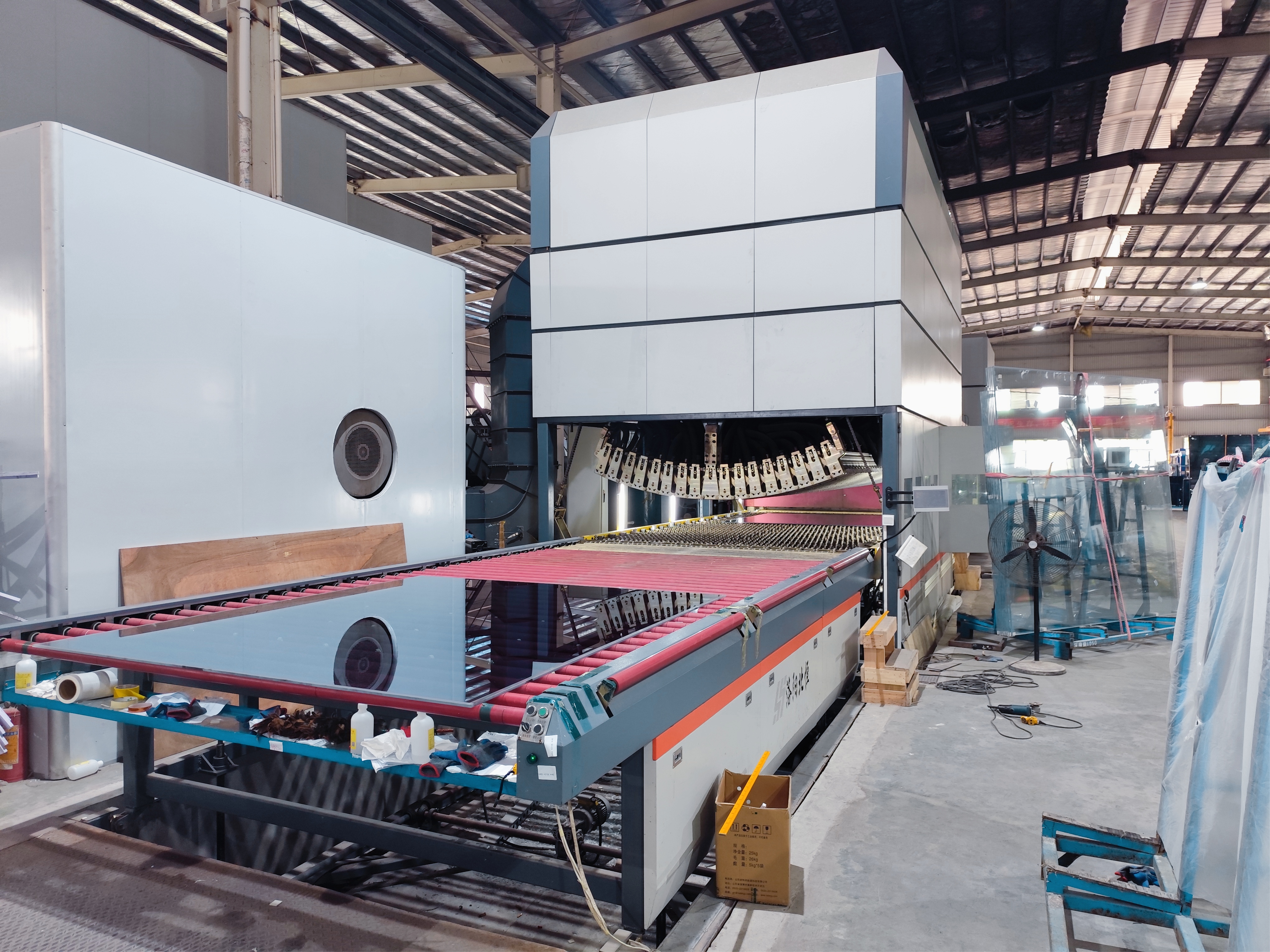
For a buyer, that process list is more useful than the footprint alone. It shows where the main steps can be reviewed in sequence: cutting, edgework, drilling, tempering, laminating and insulating. It does not prove that every step is used for every order, nor that the plant has spare capacity in a given month. Those are commercial questions, not brochure questions.
Workforce: 130 staff
A workforce of 130 suggests an organization with production, technical and commercial functions, not a trading desk. The supplied profile does not break the number down by department, so the buyer should not infer a curved-glass-specific headcount from it. Ask how many people are assigned to curved forming, how quality is staffed, and who signs the dimensional and visual inspection records.
Annual output: 600,000 m²
The 600,000 square meter figure is company-level annual output. It is not a curved-glass-only capacity number, and it is not a monthly availability commitment. That distinction matters because curved work usually consumes more line time and carries different yield assumptions than flat processing. A buyer should ask for the basis of the figure: which product families are included, what utilization assumption sits behind it, and what monthly throughput can be allocated to the specific build-up.
The 60% export ratio and the market list are useful context. They indicate that the company already works across multiple export destinations. They do not prove performance on a specific project, in a specific country, under a specific standard. Export experience is a background signal; project references and document sets are the foreground.
R&D team: 5–10 engineers
A dedicated R&D team of 5–10 engineers is relevant to curved glass because the difficult questions arrive before production: can the radius be formed, what tooling is needed, how will the edge be treated, what distortion criterion will the project accept, and how will the coated or laminated build-up behave? The profile lists multi-curved, double-curved, triple-curved, trapezoid, spherical, pyramidal, S-shaped, cylindrical and positive/negative curved tempered glass among the shapes it can process. It also states that OEM and ODM orders are welcome.
Those statements are a starting point for a technical conversation, not a substitute for one. Ask for a feasibility review that names the proposed radius, maximum dimensions, glass build-up, edge condition, interlayer where used, and the inspection method for distortion. A team size does not answer those questions; a signed review does.
SGS test report
The company profile states that it has passed an SGS test report. The supplied material does not include the report number, the test standard, the sample identity or the date. A buyer should request those details before treating the report as project evidence. An SGS test report is third-party test evidence; it is not a certificate that covers every product, every thickness or every order. The report scope is the controlling document.
Alibaba Verified Supplier
Alibaba Verified Supplier status is a platform-level verification. It can help a buyer confirm that a company entity has gone through the platform's review process. It is not a product certification, not a CE mark and not a substitute for a declaration of performance. It belongs in the entity-check folder, not the product-compliance folder.
CE certificate numbers mapped to product models
CE marking for construction products is not a generic badge for a factory. It is tied to the product family, the harmonized standard and the scope recorded in the certificate and declaration of performance. The supplied records provide a direct model-to-certificate mapping for three product families. The table below preserves the certificate numbers, standards, dates and scope notes as supplied.
| Product model | Product type | CE certificate no. | Standard(s) | Validity | Scope note |
|---|---|---|---|---|---|
| DY-GH01 | Tempered glass | BGTC20260403-02 | EN 12150-1:2015+A1:2019; EN 12150-2:2004; CPR 305/2011/EU | 2026-03-03 to 2031-03-03 | Thickness specifications: 4/5/6/8/10/12/15/19/22/25 mm |
| DY-JJ01 | Laminated glass | BGTC20260403-03 | EN 1449:2005; CPR 305/2011/EU | 2026-03-03 to 2031-03-03 | Various specified thickness combinations and configurations as listed in Type/Models |
| DY-ZK01 | Insulating glass | BGTC20260403-05 | EN 1279-1:2018; EN 1279-2:2018; EN 1279-3:2018; EN 1279-4:2018; CPR 305/2011/EU | 2026-03-03 to 2031-03-03 | Various specified thickness combinations and configurations as listed in Type/Models |
The certificates are issued by ECTI CERT Ltd. for the European Union (EU) / European Economic Area (EEA) market. That market scope matters. A CE certificate supports EU/EEA market access for the products and standards within its scope; it is not a global approval. For a US project, ASTM C1464-06 is a relevant bent-glass specification framework. For an international safety classification, ISO 11485-3:2014 classifies curved tempered and curved laminated glass as safety glass for buildings. These are different instruments, and none of them should be pasted onto a quote without checking the product and scope.
One document-identity check buyers should not skip
The same certificate records name the certified manufacturer as Guangdong Xeyoung Glass Technology Co., Ltd. The company profile supplied for DYGLASS names Shenzhen Dayang Special Glass Co., Ltd. That difference should be handled as a document check, not ignored. Before an order is placed, ask for the commercial relationship between the contracting entity and the certificate holder, and confirm that the declaration of performance and the certificate are issued for the entity that will supply the glass. This is exactly the kind of question a supplier-evidence review exists to surface.
None of this means the certificate is invalid. It means the buyer should reconcile the paper trail. The certificate number, the holder name, the product model, the standard and the declaration of performance should form one consistent set. If any element is missing, the quote is not yet document-complete.
How to check a certificate against a model
A certificate check is a matching exercise, not a visual check. The buyer is looking for five consistencies.
- Number: the certificate number on the quote matches the certificate number on the declaration of performance and the supplied record.
- Model and family: the product model in the quotation matches the product family named in the certificate scope. A certificate for tempered glass does not cover a laminated build-up, and an insulating certificate does not cover a single monolithic panel.
- Standard and scope: the harmonized standard, thickness range and configuration limits in the scope cover the proposed build-up. The DY-GH01 record, for example, lists thicknesses from 4 to 25 mm; a project outside that list needs a different document path.
- Validity: the order and delivery dates fall within the certificate validity period. The supplied records run from 2026-03-03 to 2031-03-03.
- Entity and market: the certificate holder, the contracting entity and the market of destination are consistent. The supplied records cover the EU/EEA; a project elsewhere needs the applicable local framework.
If a supplier cannot produce that set, the buyer is not being unreasonable by pausing. The quote may still be commercially attractive, but it is not yet evidence-complete.
Application fit: what to ask for by project type
The evidence becomes useful when it is read against the application. The same supplier file can support a curtain-wall enquiry, an elevator package, a skylight and a shower-room order in different ways. The questions change with the build-up.
- Curtain wall: connect the model to the project's build-up, thickness, coating and distortion acceptance criteria. Ask for a mock-up or first-article inspection plan where the visual standard is tight. A general capacity figure does not answer a flatness question.
- Sightseeing elevator: where a laminated safety build-up is specified, the DY-JJ01 laminated family is the relevant certificate path. The project still needs its own build-up review, including interlayer and edgework. The certificate scope, not the product name alone, controls.
- Skylight roof: laminated and insulating combinations need to be checked against the certificate scope, along with UV and thermal requirements. A product-family certificate does not automatically cover every combination of coating, interlayer and cavity.
- Shower room and coffee table: tempered safety glass and edge quality are the practical focus. The DY-GH01 tempered record lists thicknesses from 4 to 25 mm, but the buyer still needs the exact build-up, edge finish and hole or cut-out details.
- S-shaped, U-shaped and double-curved work: use the R&D review to test feasibility. The profile lists these shapes among its process capabilities, but a shape list is not a radius-and-tolerance commitment for a specific panel.
The common thread is that the document set should follow the product, not the other way round. A supplier that can point to the model, the standard and the scope is easier to evaluate than one that offers only a general certification claim.
What the evidence does not prove
A balanced review has to state the boundaries. The supplied material does not include verified price, MOQ or lead-time data for curved glass. It does not include a project case with measured outcomes. It does not include the SGS report number, sample identity or test standard. The 600,000 m² figure is company-level annual output, not curved-glass-only capacity. The certificate records name a manufacturer entity that differs from the company profile, which requires reconciliation. And CE marking is an EU/EEA market instrument, not a global passport.
These gaps do not cancel the evidence. They define the next request. A buyer who asks for the missing documents is doing normal procurement work, not doubting the supplier's existence.
Market context and the direction of travel
Commercial research estimates put the global curved glass market at USD 13.5 billion in 2025, with a 5.8% CAGR forecast for 2025–2035 (Statifacts). Grand View Research estimates the glass curtain wall market at USD 62.4 billion in 2024. These are commercial estimates with different definitions and should be read as directional context, not as a supplier's market share. Their practical use is to explain why documentation scrutiny is increasing: more complex facade and interior work means more project-specific build-ups, and more build-ups mean more certificate-scope questions.
For buyers, the outlook is document-led rather than label-led. The useful supplier is not the one with the longest brochure; it is the one that can connect a capacity figure, a process step, an R&D review and a certificate number to the model being quoted. That does not guarantee performance. It gives the buyer a traceable path for the next question.
FAQ
What evidence should come with a curved glass quotation?
A quotation should identify the contracting entity, the product model and build-up, the applicable standard, the certificate or test report number and its scope, and the validity dates. For a curved product, it should also state the proposed radius, dimensions, thickness, edgework and distortion acceptance criteria. The quotation can be commercial, but the evidence pack should be document-specific.
Does 600,000 m² of annual output mean 600,000 m² of curved glass?
No. The supplied figure is company-level annual output. It does not establish curved-glass-only capacity, monthly availability or a delivery commitment. A buyer should ask for the product-specific throughput basis and the yield assumptions used for the proposed curvature and size.
Which CE standards are linked to DY-GH01, DY-JJ01 and DY-ZK01?
The supplied records link DY-GH01 tempered glass to EN 12150-1:2015+A1:2019 and EN 12150-2:2004, DY-JJ01 laminated glass to EN 1449:2005, and DY-ZK01 insulating glass to EN 1279-1:2018, EN 1279-2:2018, EN 1279-3:2018 and EN 1279-4:2018. The same records cite CPR 305/2011/EU and list ECTI CERT Ltd. as the certificate authority.
Is an SGS test report the same as CE certification?
No. An SGS test report is third-party test evidence for the sample and scope tested. CE marking for construction products is tied to the applicable harmonized standard, the declaration of performance and the certificate scope. One does not substitute for the other. The SGS report number, sample identity and test standard should be requested separately.
How can a buyer verify a CE certificate number?
Match the certificate number on the quotation, the certificate and the declaration of performance. Then check the product model, standard, thickness or configuration scope, issue and expiry dates, certificate holder and destination market. Where the certificate holder differs from the contracting entity, ask for the commercial relationship and confirm which entity supplies the order. The check is complete only when those elements are consistent.
For readers who need the company's own document set, the supplied brochure is available here: DYGLASS company brochure (PDF).
Tem questões ou precisa de mais detalhes?
Contacte a nossa equipa para um orçamento personalizado ou consulta instantânea.
Solicitar orçamento
Preencha o formulário abaixo e a nossa equipa entrará em contacto com uma proposta personalizada.
Chat direto do WhatsApp
Prefere conversar em tempo real? Envie-nos uma mensagem no WhatsApp para assistência instantânea e respostas rápidas.
- Obter orçamento personalizado
- Partilhar fotos ou documentos
- Discuta as suas necessidades diretamente
Geralmente responde em 5–30 minutos durante o horário de expediente.