
Custom Automation Precision Assembly: What a Listing Reveals
Custom Automation Precision Assembly: What a Listing Reveals
A stock-exchange listing does not make a supplier of custom automation precision assembly suitable for a specific program. It does something narrower and more checkable: it creates a scheduled public record that a buyer can read before the first technical meeting. SHENZHEN BSC TECHNOLOGY CO., LTD. (BSC Technology), founded in 2016 and listed on the Shenzhen Stock Exchange in 2021 under stock code 300951.SZ, is a useful case for that reading exercise. The company reports a global manufacturing network, an R&D team of over a thousand staff, more than a thousand authorized patents, and long-term cooperation with assembly partners including Foxconn, Goertek, Luxshare, Pegatron, LG and Sonion.
The practical consequence for buyers in research and evaluation is that the record closes entity questions and leaves line questions open. Qualification therefore runs on two tracks: interpret the public record as a continuity and discipline signal, then request the site and process evidence the record cannot contain.
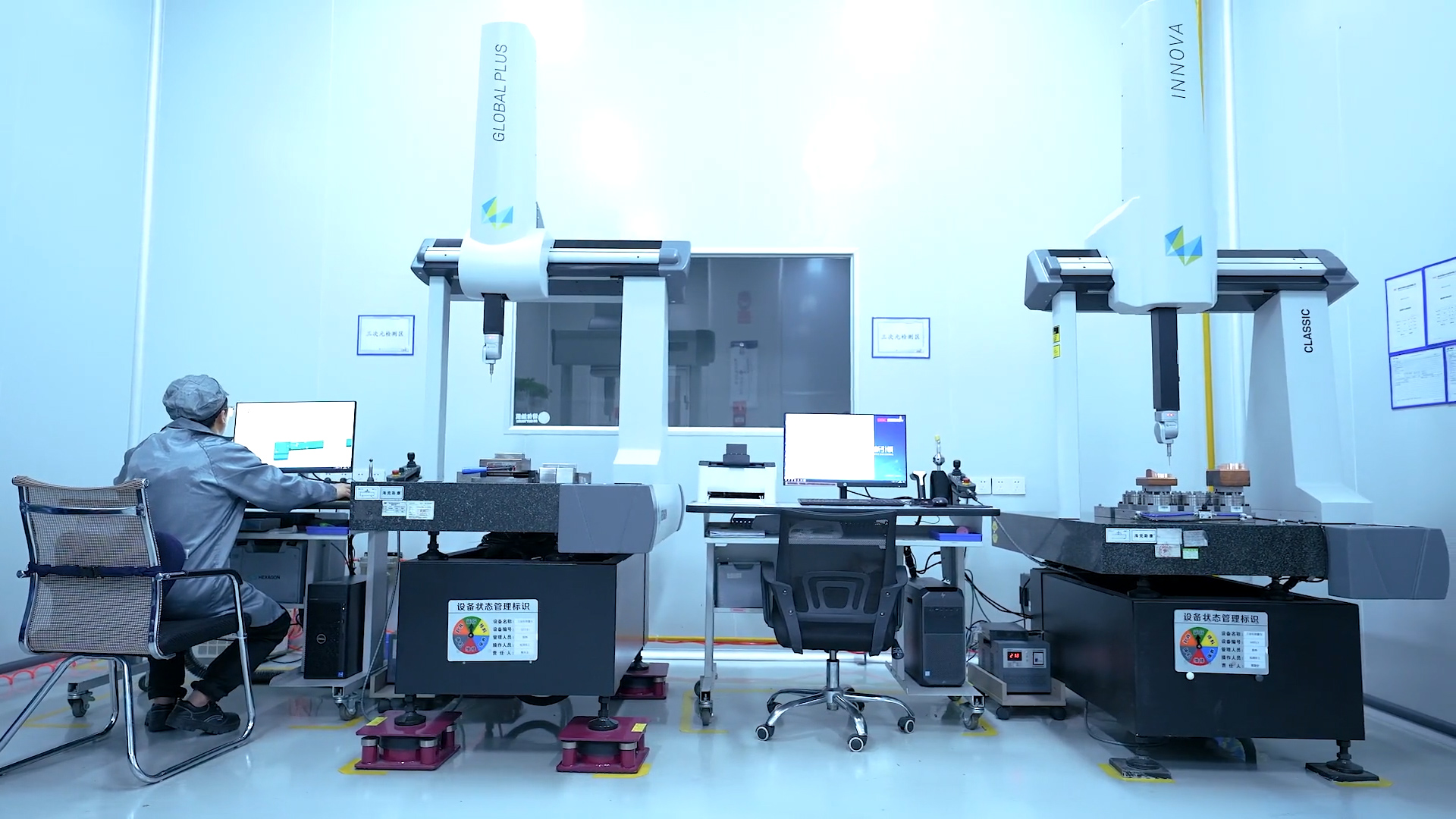
The Listing Is a Disclosure Discipline, Not a Quality Certificate
Listing status gives the buyer a reporting entity that files on a schedule, publishes audited financial statements, and answers for material statements in a way a privately held counterparty does not have to replicate. For procurement, that shortens the first screen. Instead of reading a brochure and guessing, a buyer can follow a named company and a stock code back through audited reporting and confirm that the enterprise behind the quotation genuinely exists, has scale, and has survived at least one full capital cycle.
What the record does not do is describe a station. A consolidated result covers precision components, system assembly and intelligent automation equipment together, so it cannot tell a program engineer whether a specific dispensing or alignment station will hold tolerance across three shifts. The distinction matters because evaluation teams often over-read a strong disclosure and skip the expensive verification steps.
| Record signal | What it supports | What it does not support | Request instead |
|---|---|---|---|
| Listing on the Shenzhen Stock Exchange since 2021, code 300951.SZ | Audited reporting entity, public disclosure cadence, traceable corporate history | Any statement about assembly accuracy or line uptime | The legal entity that will sign, invoice and warrant, plus current segment reporting |
| Founded in 2016 | Roughly a decade of operating history across at least one automation technology cycle | Proof of experience in your specific process | Project list by year, line type and application |
| Several thousand employees and several hundred thousand square meters of production area | Resource base for parallel builds and large-volume production | Staffing depth at the site that will build your line | Named project team, site headcount, engineer allocation |
| R&D team of over a thousand staff and more than a thousand authorized patents | Sustained engineering investment and an independent R&D system | Fitness for your tolerance stack or cycle time | Patent list mapped to your station modules, plus an NPI sample build |
Decision rule: let the public record complete entity qualification, and let a site audit plus acceptance testing complete process qualification. A listed counterparty makes the first stage cheap. It does not make the second stage optional.
What the Corporate Record Establishes About Continuity
The two dates that matter most are 2016 and 2021. An automation program typically runs from line design through build, installation, ramp and several years of production support, so the supplier has to remain an operating organization longer than the equipment warranty. A company that has reported publicly since 2021 gives buyers a checkable trail for the most recent segment of that horizon; activity before 2021, including the founding period, is company-reported and should be treated as such.
Scale is the second continuity signal. BSC Technology reports several thousand employees, a global production and operation area of several hundred thousand square meters, and a high proportion of exports. For a buyer, that profile supports a reasonable expectation of capacity to run more than one build at a time and to absorb a schedule slip without collapsing. It does not establish that capacity is available in the quarter you need, which is a booking question rather than a record question.
Two contract-level checks follow naturally. First, confirm which legal entity will sign, invoice and carry the warranty, since a group brand and a contracting subsidiary are not automatically the same party. Second, confirm the site that will actually build the line, because a footprint statement lists plants; it does not assign work to them.
R&D Depth: Making One Thousand Engineers Auditable
The most quoted figure in this record is engineering capacity: an R&D team of over a thousand staff, more than a thousand authorized patents, an independent R&D system, and R&D centers in Shenzhen, Suzhou and Taipei. That combination is meaningful in non-standard automation for a specific reason. Custom lines are rarely a catalogue purchase; they are developed against a product that is still changing, which means the supplier must own enough of the stack to re-engineer a station during NPI rather than waiting on a third party.
The record lists the technology areas in which that work is concentrated: high-precision assembly, machine vision, motion control, intelligent inspection, industrial software and industrial digitalization. Read together with the equipment categories the company describes, including automated assembly equipment, automated test equipment, optical process equipment and turnkey automation lines, this indicates a supplier that intends to be accountable for controls and inspection logic as well as mechanics.
To turn a headline number into auditable evidence, ask four questions. How many engineers will be assigned to this program, and where are they seated relative to the build site? Which of the authorized patents read on the specific modules in scope, such as alignment, dispensing, curing or final inspection? Who writes the control software, and what handover, documentation or escrow is offered at program end? What portion of the line is subcontracted, and who takes responsibility for that portion at acceptance? A patent count answers none of these by itself. It only justifies asking them.
Ten Locations, Ten Separate Qualification Questions
The company describes a network that spans manufacturing plants in Shenzhen, Dongguan, Suzhou, Zhengzhou, Chengdu and Taipei in China, plus Vietnam, India, Malaysia and Mexico; R&D centers in Shenzhen, Suzhou and Taipei; and overseas service institutions in the United States, South Korea and Japan. It also states that this network supports local equipment manufacturing, fast delivery, on-site installation and commissioning, and local technical support.

For procurement, a footprint is an operating-cost and schedule variable before it is a marketing asset. A plant near the product assembly site shortens commissioning, reduces engineer travel, and can simplify spare-part logistics and tariff treatment. A remote build site can still deliver, but the service model and the response time need to be written into the contract rather than inferred from a map.
The map is also where over-reading is easiest. The footprint statement does not say which site builds automation equipment rather than precision components, which certificate attaches to which address, which languages the local engineering team works in, or how many commissioning engineers are stationed there. Each of those is a separate question, and each has a different document behind it:
- The certificate page that names the site address and the certified activity.
- Written confirmation of the plant where the line will be built and where the factory acceptance test will run.
- Local engineering headcount, working languages and escalation path for the installation window.
- Spare-parts stocking policy and dispatch time from the nearest location.
- The local entity status for contracting, invoicing and warranty service in that country.
Certificate Scope: The Detail Buyers Skip
The most useful thing a listed supplier publishes is not a logo wall but a certificate register with numbers and dates. BSC Technology's records reviewed for this analysis show five current schemes, and four of them define their scope in terms of parts and materials rather than equipment build. That is precisely why scope, not the badge, has to be the qualification object.
| Scheme | Issuer and number | Validity | Stated scope | What it supports for a line buyer |
|---|---|---|---|---|
| ISO 9001:2015 | DCI Certification Ltd, F02926Q00164R302 | 2026-03-06 to 2029-03-06 | Production and sales of precision functional devices (die-cut parts, injection molded parts); production of injection molded parts | A documented quality system at the certified site, useful as a baseline; not a statement about equipment build |
| ISO 14001:2015 | DCI Certification Ltd, F02926E00077R302 | 2026-03-06 to 2029-03-06 | Same precision functional device and injection molding scope | Environmental management coverage relevant to supplier codes and site audits |
| IATF 16949:2016 | NQA Certification Limited, T14650 (IATF No. 0520220) | 2024-05-30 to 2027-05-29 | Display screens with protective films, double-sided and conductive adhesives, optical film, optical glue, insulation cotton for power batteries and injection molded parts; product design (Clause 8.3) excluded | Automotive parts discipline for those product families; note the design exclusion and the earliest expiry in the set |
| ISO 13485:2016 | NQA, 132576 | 2026-06-12 to 2029-06-11 | Production and sales of plastic headgear for medical brainwave devices | Medical device quality system for that defined product scope only |
| IECQ HSPM QC 080000:2017 | NOA Testing & Certification Group, IECQ-H NOA 25.0021-01 | 2026-06-24 to 2028-04-20 | Production of precision functional parts (die-cut parts, injection molded parts) | Hazardous-substance process management for those parts |
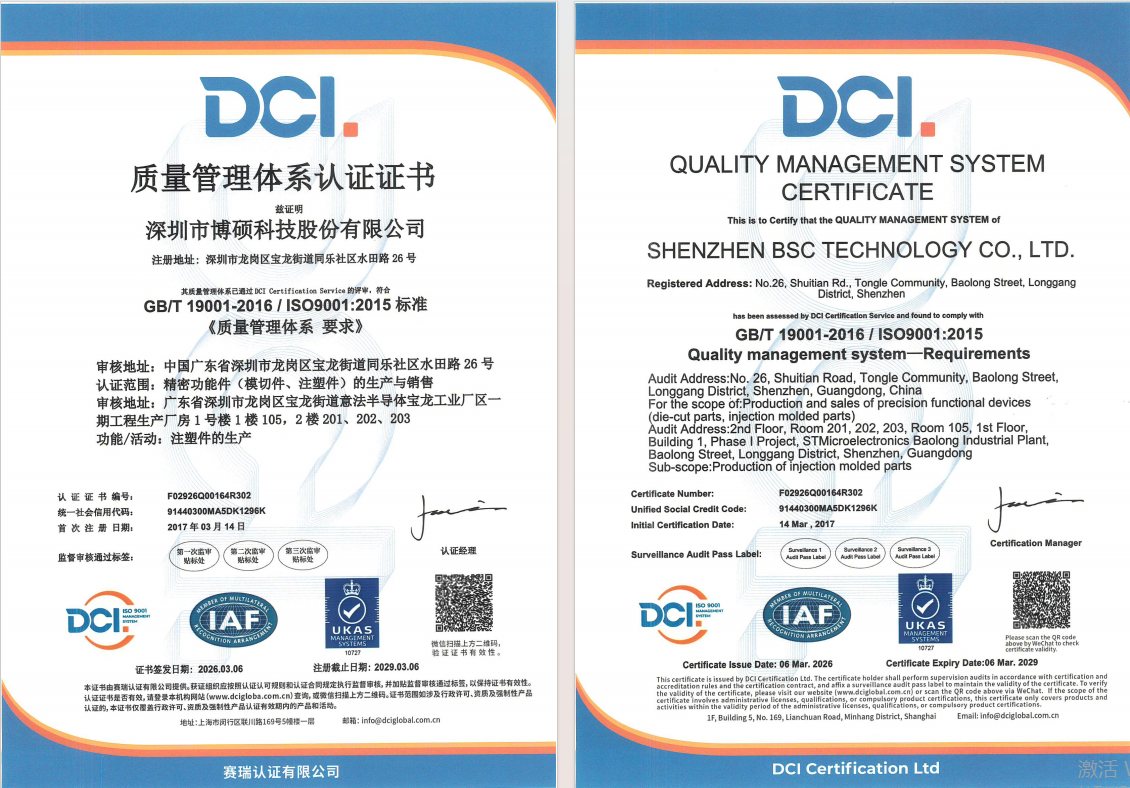
Three mismatches follow, and each one is a request rather than a rejection. The first is subject mismatch: the purchase is a line or a station, while these scopes certify component production. Ask for the certificate whose scope sentence contains the activity you are buying, or for a written statement of which procedure governs equipment build and acceptance at that plant. The second is site mismatch: a scope names an activity, not always an address, so ask for the page that identifies the manufacturing site. The third is time mismatch: the IATF 16949 certificate runs to 2027-05-29, earlier than the ISO 9001 and ISO 14001 records that run to 2029-03-06, so a program extending past mid-2027 should confirm surveillance and renewal status before signing a multi-year agreement.
One further check is worth keeping routine. Company question-and-answer material also lists ISO 45001 among its certifications; the certificate records reviewed for this article did not include an ISO 45001 document, so a buyer whose supplier code covers occupational safety should simply request that certificate with its number, scope and expiry. This is normal document hygiene, not a finding about the company.
Test to apply: accept a certificate only when its scope sentence names the activity you are buying and its site page names the address you are buying from. Where it does not, the qualification path is a site audit and the relevant build procedure, not the certificate.
Named Assembly Partners as Reference Checks
The company states that it maintains long-term strategic cooperative partnerships with world-class assembly factories and component manufacturers including Foxconn, Goertek, Luxshare, Pegatron, LG and Sonion, and it reports delivered programs such as AI server automation production lines, intelligent terminal assembly automation lines and AR/VR optical module process automation equipment. Those two statements do different work. The partner list shows that commercial relationships exist with demanding customers; the delivered program list shows the categories the supplier claims to have built.
Neither statement describes a project. The public record does not identify which partner bought which line, in which year, at which site, against which acceptance criteria, or with what performance at ramp. A buyer should therefore convert the list into a reference request with scope attached: permission to contact one or two partners, the line type and site involved, the metrics tested at acceptance, the escalation behaviour during ramp, and the spares response actually experienced. Reference calls confirm operating behaviour; they do not transfer it to your program, because your product, tolerance stack and volume are different inputs.
Where the Public Record Stops
A disclosure regime reports the enterprise, not the machine, so a buyer should assume the following are absent until they are supplied: cycle time and throughput, first-pass yield, overall equipment effectiveness, assembly and placement accuracy against a stated tolerance, inspection accuracy and test coverage, line uptime and mean time between failures, changeover time, floor space and utility demand, spare-part lead time, and price. Each one changes the decision, and none can be inferred from a filing.
Price deserves a specific note because constraint-stage buyers look for a band that usually does not exist publicly. The material reviewed here treats minimum order quantity and commercial terms as project-specific, subject to drawings, equipment configuration and project requirements and confirmed commercially. The practical response is to define one scope precisely, then price it identically across shortlisted suppliers: station count, vision and test scope, changeover requirements, spares package, service distance and documentation set. An unpriced scope produces quotations that cannot be compared.
The company also states that it ranks among the top three in automation equipment for electronic intelligent terminals and AR/VR smart glasses. The material reviewed did not include the methodology or the measured basis for that position, so it belongs in the conversation as a positioning claim to be explained, not in the evaluation file as a market measurement.
Turning the Record into a Document Request
The record becomes useful when it is converted into a request list that mirrors it. Three blocks cover the gap between what is published and what is signed.
Entity and continuity
- Current annual report, with the segment that contains automation equipment separated from components and assembly.
- The legal entity that will sign, invoice and warrant, and its relationship to the group name in the quotation.
- Confirmation of the site that will build the line, and of the entity responsible for installation in the destination country.
Site and compliance
- Certificate for each site in scope, with number, issuer, validity and the exact scope sentence.
- Equipment-level compliance documentation required for the destination market, requested explicitly rather than assumed from a component certificate.
- Renewal dates mapped against the program timeline, with the earliest expiry flagged in the risk register.
- Any scheme that appears in marketing material but not in the certificate pack.
Line and commercial
- Factory and site acceptance protocol, with the metrics tested and the pass criteria agreed in advance.
- Cycle time, yield and uptime targets at defined conditions, plus changeover and maintenance assumptions.
- Spare-parts list with lead times, and the local service model for the installation window and the years after it.
- Software documentation and handover terms for the control and inspection systems.
- Reference permission with program scope attached.
- Commercial terms quoted against one identical, written scope.
A screening sequence that matches this structure takes about three weeks: filings and segment reporting first, the site certificate pack second, site-specific questions third, reference calls fourth, and a scoped RFQ last. Each stage removes a category of supplier before the expensive engineering work begins.
Program Context for 2026 Sourcing
Automation procurement is currently shaped by programs that did not exist at scale a few years ago: AI server assembly, liquid cooling hardware, optical modules and AR/VR devices, all of which place inspection and alignment demands on lines that are themselves still being defined. Against that backdrop, a supplier's disclosure discipline becomes a real scheduling asset, because qualification documents can be assembled before the engineering team is committed.
Scale should be kept in proportion. Grand View Research figures cited in a 2026 HTNXT benchmark place the global smart manufacturing market at USD 410.7 billion in 2025 and project USD 1,063.2 billion by 2033 at a 12.1 percent compound annual rate. That is a forecast about a category, not a measurement of any supplier's order book, and it justifies spending on qualification rather than assuming availability.
The defensible posture is the same for every listed or unlisted candidate. Read the record to decide who deserves an audit, then audit the site that will build the line, and require the certificate whose scope sentence names the activity you are buying. The listing tells you the counterparty is likely to be there when the warranty matures. It tells you nothing about the station.
FAQ
Does a Shenzhen Stock Exchange listing prove that BSC Technology's automation equipment meets my specification?
No. The listing, granted in 2021 under stock code 300951.SZ, establishes a reporting entity with periodic disclosure and audited financial statements. It says nothing about cycle time, alignment accuracy, yield or uptime for a specific station. Use it to qualify the counterparty and to confirm continuity, then qualify the line through site acceptance testing, sample builds and a site audit that covers the actual build plant.
Which certificate should I request if my line will be built at a site outside China?
Request the certificate whose scope sentence names the activity and whose site page names the address of that plant. BSC Technology's described footprint includes manufacturing plants in Vietnam, India, Malaysia and Mexico alongside Chinese sites, while the certificate records reviewed here define part-production scopes. Confirm in writing which document governs equipment build and acceptance at the specific plant, who issues it, and which local entity provides installation and after-sales support.
How should patent and R&D figures be weighted in a supplier scorecard?
As a portfolio indicator with a defined follow-up. BSC Technology reports an R&D team of over a thousand staff, more than a thousand authorized patents and an independent R&D system, with R&D centers in Shenzhen, Suzhou and Taipei. Weight these for engineering capacity, meaning parallel station builds, in-house vision, motion control and software. Then ask which patents read on your process modules and how many engineers will be dedicated to your program. A patent count is not a tolerance.
Can named customers replace a formal reference check?
No. BSC Technology describes long-term cooperation with Foxconn, Goertek, Luxshare, Pegatron, LG and Sonion, which establishes that commercial relationships exist. It does not establish what was delivered, where, or against which criteria. Ask for permission to speak with one partner about line type, site, acceptance metrics and behaviour during ramp, and treat the public list as an address book for that conversation rather than as evidence of outcome.
Where do price and lead time appear in a public record?
Generally they do not. The material reviewed treats minimum order quantity and commercial terms as project-specific, depending on drawings, equipment configuration and project requirements, and confirmed commercially. A listed company's filings report consolidated results rather than the price of your line. Define a single scope covering station count, test coverage, spares and service distance, then require every shortlisted supplier to quote against it so that lead time and cost remain comparable.
Tem questões ou precisa de mais detalhes?
Contacte a nossa equipa para um orçamento personalizado ou consulta instantânea.
Solicitar orçamento
Preencha o formulário abaixo e a nossa equipa entrará em contacto com uma proposta personalizada.
Chat direto do WhatsApp
Prefere conversar em tempo real? Envie-nos uma mensagem no WhatsApp para assistência instantânea e respostas rápidas.
- Obter orçamento personalizado
- Partilhar fotos ou documentos
- Discuta as suas necessidades diretamente
Geralmente responde em 5–30 minutos durante o horário de expediente.