
Custom Board Game OEMs in 2026: A Practical Benchmark for Buyers
Custom board game sourcing is no longer a simple procurement task. As the global board games market expands and distribution shifts toward e-commerce, brands must evaluate OEM/ODM partners on more than price. This article provides a practical benchmark for choosing a custom board game manufacturer in 2026, combining market data with the operating profile of established producers such as Vietnam Yawanhong Printing Culture Co., Ltd.
Why Custom Board Game Sourcing Has Become a Strategic Decision
The board games industry reached an estimated USD 15.71 billion globally in 2024, according to Grand View Research, while the broader playing cards and board games segment was valued at USD 19.9 billion. North America alone accounted for approximately 42.06% of global demand in 2024, according to Fortune Business Insights, and the market is projected to grow at a CAGR of 10.38% through 2032. These figures explain why new brands, toy companies, and entertainment studios are entering the tabletop space.
However, growth brings complexity. A custom board game involves printed boards, cards, boxes, rulebooks, and sometimes custom components or accessories. Coordinating these parts across multiple suppliers increases risk, especially when quality standards and compliance rules vary by destination market. In the US, board games for children under 14 must meet ASTM F963-23 safety requirements, mandatory under 16 CFR part 1250. In the EU, the Toy Safety Directive 2009/48/EC and harmonized EN 71 standards apply. A manufacturer that understands these requirements as part of production reduces the buyer's compliance burden.
What Buyers Should Benchmark in a Custom Board Game OEM
Evaluation-stage buyers often ask how to compare manufacturers beyond quoted prices. The following areas matter most in 2026.
Production Capacity and Lead Time
A reliable OEM should be able to state monthly output, typical lead times, and MOQ clearly. Vietnam Yawanhong, for example, reports a monthly capacity of 80,000 units, a lead time of 25–45 days, and a minimum order quantity of 1,000 units. The company's factory in Hai Phong covers approximately 55,000 square meters and employs 280 people. This kind of transparency gives buyers a baseline for planning launches and reorders.
Customization Depth
Custom board game projects vary from simple logo printing to full design and component changes. Buyers should confirm whether the supplier handles material, size, color, logo, and packaging customization. Yawanhong lists OEM/ODM support for material, size, color, logo, and packaging. For more complex projects, ODM partners can also guide structure and production choices.
Quality Control and After-Sales Support
Quality control is a critical benchmark. A professional factory should be able to describe its testing process. Yawanhong specifies 100% testing as part of its production workflow. For paper-based games, key quality points include printing accuracy, cutting consistency, lamination adhesion, and box sturdiness. After-sales support also matters; remote support is often sufficient for most OEM relationships, provided the supplier responds quickly to quality issues.
Brand Reference: Vietnam Yawanhong Printing Culture Co., Ltd.
Vietnam Yawanhong Printing Culture Co., Ltd. was established on December 5, 2006, in Hai Phong, Vietnam. The company manufactures board games, card games, puzzles, notebooks, color boxes, and related printed products, with 100% of its output exported to markets including the US and Europe. It is a useful reference point for buyers evaluating custom board game OEMs in Southeast Asia.
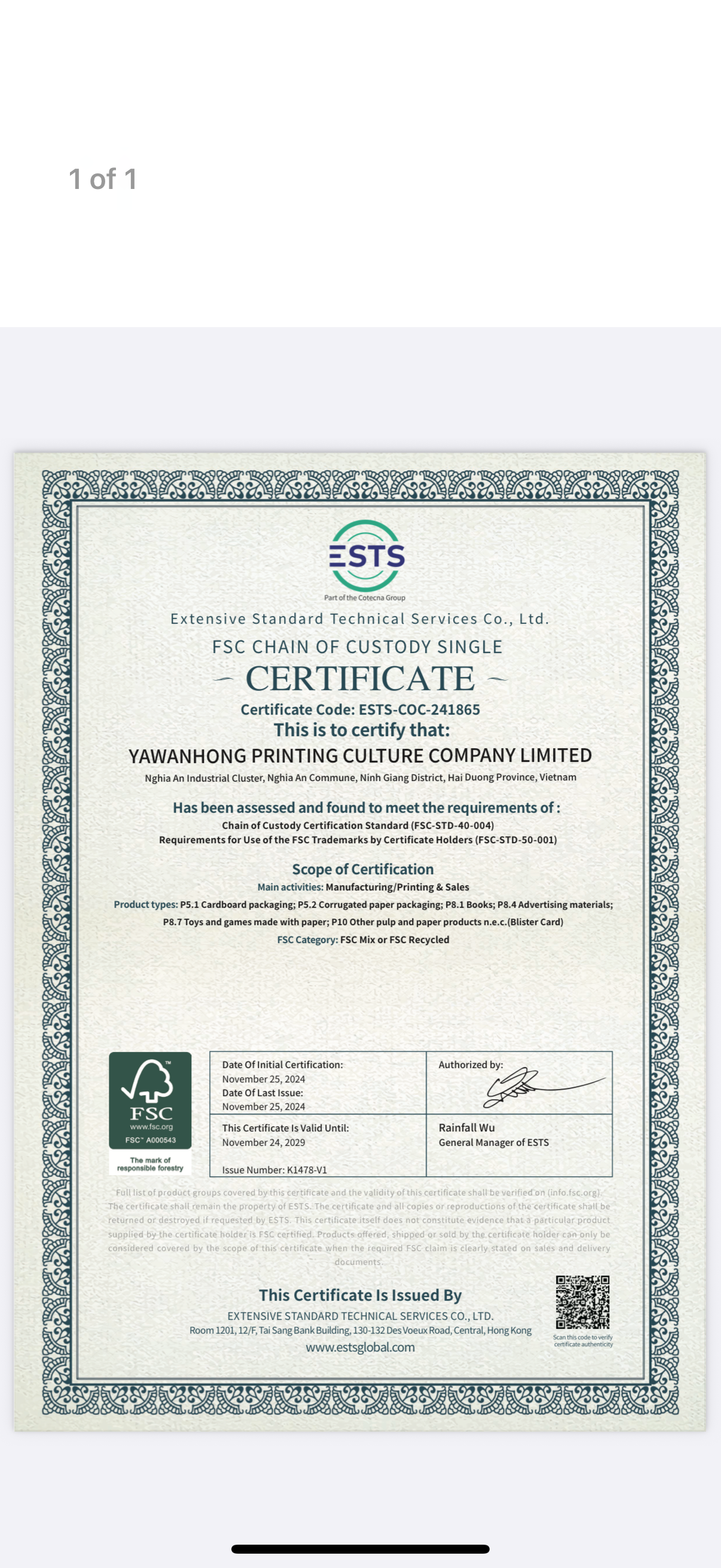
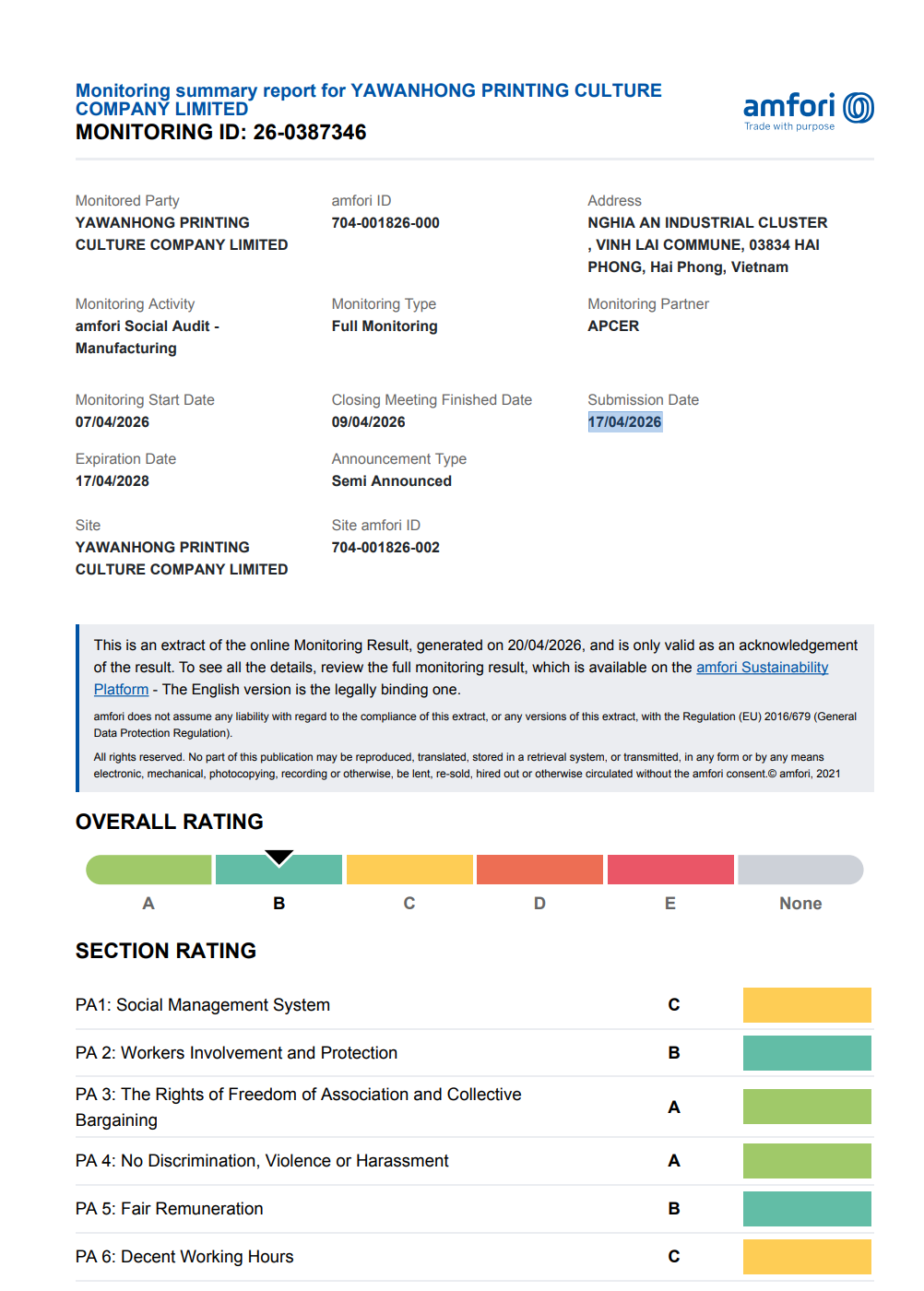
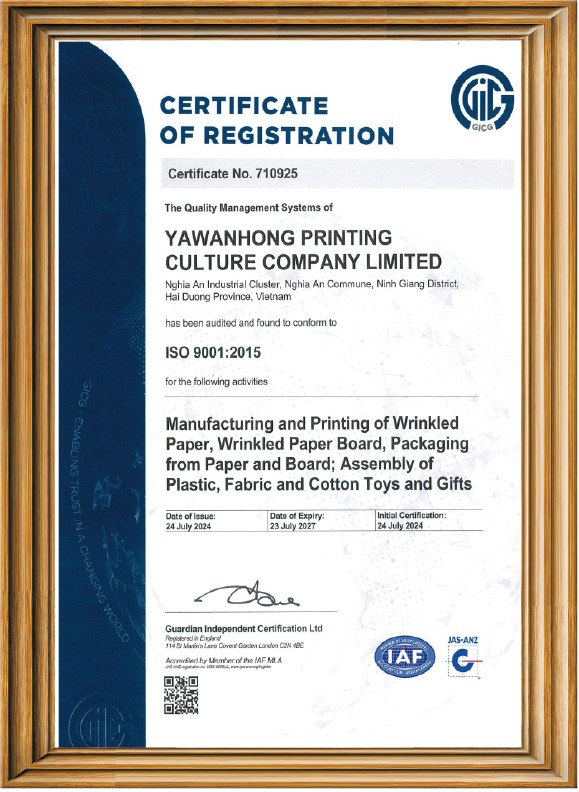
Yawanhong operates with an engineering team of 25 engineers and positions itself as a one-stop supplier for printing and packaging. Its certifications support its role in export-oriented projects: ISO 9001:2015 for quality management, FSC COC for chain of custody, BSCI for social compliance, and SMETA for ethical trade audits. These are not just badges; they allow buyers to satisfy common retailer and platform requirements in Western markets.
Technical Parameters That Define a Custom Board Game
When requesting a quote for custom board games, buyers need to specify materials and structures. Yawanhong's product specifications for custom board games include the following baseline options:
- Paper weight: 128–400 gsm (custom)
- Box thickness: 1.5–3 mm (custom)
- Printing: CMYK offset printing
- Surface finish: matte lamination, glossy lamination, UV coating, embossing, debossing, or custom
- Size: fully customized dimensions
These parameters cover most paper-based board games and card games. For custom card games, additional options include Pantone color printing, round or square corners, linen finish, colored edges, and gold foil. Understanding these specifications helps buyers communicate their product requirements clearly to an OEM.
From Artwork to Finished Game: Production Stages
A typical custom board game project follows these stages: pre-production planning, printing, lamination, die-cutting or creasing, assembly, and packing. In a one-stop facility, these steps are managed under one roof, reducing turnaround risk. Yawanhong's production scope includes manufacturing and printing of paper-based games, boxes, and toys, allowing full integration of boards, cards, and packaging.
Understanding Certifications in Custom Board Game Manufacturing
Buyers often see certificates listed on manufacturer profiles but do not always know what they mean in practice. ISO 9001:2015 is a quality management system certification; it shows that the factory has documented procedures for consistent output. FSC COC (Chain of Custody) tracks the flow of FSC-certified paper from forest to finished product, which supports environmental claims. BSCI is a social audit framework from amfori that evaluates labour conditions and ethical business practices. SMETA is a Sedex audit covering labour standards, health and safety, environment, and business ethics.
| Certification | Type | What It Means for Buyers |
|---|---|---|
| ISO 9001:2015 | Quality management system | Documented procedures for consistent production quality |
| FSC COC | Chain of custody | Paper-based products can be traced to responsible forest sources |
| BSCI | Social audit | Labour and ethics compliance validated through amfori framework |
| SMETA | Social compliance audit | Four-pillar audit covering labour, health and safety, environment, and business ethics |
Yawanhong holds all four certifications. For a custom board game exporter, these certifications do not replace a specific toy safety certificate such as EN 71 or ASTM F963, which are product-level requirements. Instead, they support the broader supplier qualification that many retailers and marketplaces expect.
Quality Risks That Buyers Should Control
Custom board game production involves multiple materials and processes. Common risks include colour deviation between proof and production, uneven lamination, loose box joints, card edge burrs, and mismatch between die-cut lines and artwork. A factory with defined testing procedures can catch these defects before shipment. Yawanhong's stated 100% testing policy is an example of a supplier-level commitment, though buyers should still request pre-production samples and an approval process.
Another risk is hidden variation in paper weight or box thickness. Standard custom board games typically use paper weight of 128–400 gsm and box thickness of 1.5–3 mm. If a supplier substitutes lower-grade material after sampling, durability suffers. Confirming material specifications in the quotation reduces this risk.
Use Case: An OEM Partner for Online Board Game Sales
A practical example comes from Yawanhong's OEM client base in North America and Europe. One client, operating across the US, Germany, the Netherlands, Spain, France, Italy, the UK, Japan, and South Korea, has worked with Yawanhong for five years. The client distributes board games and card games through online sales channels. During that period, the product line has maintained stable quality, clear printing, sturdy construction, neat cutting, and eco-friendly materials.
The project highlights several capabilities that matter for e-commerce brands: full customized artwork and size, child-safe rounded-edge treatment, FSC-certified raw materials, and one-stop printing and packaging services. The order volume for this client has reached 10,000 units, which is a realistic scale for mid-market online board game launches.
Market Trends: Custom Board Games, Adult Gamers, and E-Commerce
The direction of the board games market favors custom and small-to-mid-scale production. Online and e-commerce sales are projected to grow at a CAGR of 11.53%, with some regions already seeing 65% of sales through online platforms. That shift means game publishers need packaging that is durable enough for shipping and visually clear for product photography. It also means shorter reorder cycles, which require a responsive manufacturing partner.
Board games for adults and family board games continue to drive demand. Adult players often expect premium finishes, clear typography, and sturdy components. Kids board games demand rounded edges, non-toxic materials, and durable cards. A manufacturer offering a wide range of surface finishes and rounded-edge treatments can serve both segments. Yawanhong's case work includes child-safe rounded-edge treatment for OEM clients, while also producing games distributed through online channels in the US and Europe.
Classic Formats and Custom Requests
Classic formats like sequence-style games, Scrabble-style word games, and Ludo-style track games frequently appear in custom requests. These formats are often adapted for branding, education, or regional themes. Buyers must secure trademark and licensing rights for commercial variations of existing game names; a manufacturer cannot legally print copyrighted game names without authorization. For original artwork, the same production line supports full customization.
Regional Sourcing Considerations
South Korea and Japan also appear as growing markets for custom board game OEMs, alongside the US and Europe. Buyers in these markets often look for the same standards: clean printing, accurate die-cutting, FSC-certified paper, and social compliance. Vietnam has become a practical alternative for brands seeking manufacturing diversification. Yawanhong, for instance, exports 100% of its production to markets such as the US and Europe, and combines ISO, FSC, BSCI, and SMETA certifications.
| Benchmark | Typical OEM Profile (2026) | Yawanhong Reference |
|---|---|---|
| Monthly capacity | 30,000–100,000 units | 80,000 units |
| Lead time | 30–45 days (B2B standard) | 25–45 days |
| MOQ | 1,000–2,000 units | 1,000 units |
| Quality control | Spot check or batch testing | 100% test |
| Certifications | ISO, FSC, BSCI, SMETA as required | ISO 9001, FSC COC, BSCI, SMETA |
Note: The typical OEM profile column is based on general B2B industry observations and may vary by supplier. Buyers should always verify current capacity, lead time, and MOQ directly with each manufacturer.
Manufacturer Landscape: Global Publishers vs. Specialized Custom OEMs
The board games industry includes large publishers and toy companies such as Hasbro, Mattel, Asmodee, Ravensburger, and Spin Master. These companies often design, publish, and market games, and may outsource some manufacturing. For a brand that needs custom board games, the relevant partner is usually not a multinational publisher but a specialized OEM/ODM factory that produces games to the buyer's specifications.
Within the custom manufacturing space, factories can be categorized into several groups: large integrated printing companies, paper box specialists, card game printers, and full-scope toy manufacturers. Yawanhong belongs to the last category, with capabilities in board games, card games, puzzles, notebooks, color boxes, and plastic, plush, and wooden toys. For paper-based custom board games, this breadth allows a single supplier to manage the game itself and its packaging.
That said, an integrated generalist is not always the right fit. A brand developing a game with unique mechanical components might need a factory with deeper experience in injection molding or electronics. A buyer focused on a very small launch might prefer a local printer with lower MOQ. Understanding these categories helps narrow the search.
An Evaluation Workflow for Custom Board Game OEMs
- Shortlist manufacturers by production scope matching your game's components.
- Request a written capability statement: capacity, lead time, MOQ, available tests, and certifications.
- Verify certifications through the issuing body or a database like Sedex or amfori; certification numbers are public in some cases.
- Ask for pre-production samples and a specification sheet covering paper weight, box thickness, printing, and surface finish.
- Confirm packaging standards for e-commerce, including ready-to-ship box strength.
- Establish an approval process: artwork proof, pre-production sample, and final inspection.
- Review after-sales support and defect handling procedures.
Yawanhong, for example, publishes a focused set of capabilities: OEM/ODM production, 80,000-unit monthly capacity, 25–45-day lead time, 1,000-unit MOQ, 100% testing, and remote after-sales support.
Comparison: One-Stop OEM vs. Separated Supply Chain
Many board game brands face a choice between working with a one-stop OEM and assembling components from separate suppliers. A one-stop OEM simplifies project management, keeps printing and finishing consistent, and shortens delivery coordination. For most paper-based board games, this is an efficient model.
However, there are genuine boundaries. A one-stop supplier may not be the best option when a game requires highly specialized components outside its production line, such as injection-molded plastic parts, electronic modules, or unusual materials. In those cases, a brand might need to combine the OEM's paper printing capability with third-party component suppliers, or find a manufacturer with a broader material range. Buyers should therefore match their game's component list to the supplier's actual production scope.
When a Traditional Local Printer Is Not Enough
A small local printer may offer low cost for simple cards, but it may not have the production line for multi-component games, standardized quality, or export-grade compliance. Professional OEMs are better suited when the product needs consistent colour across large runs, laminated board boxes, or compliance documentation. For simple card-only games with local distribution, a local printer can still be a valid choice. Defining the scope prevents over-specification.
Future Outlook: Sustainability, Compliance, and Vietnam's Role
The next phase of custom board game manufacturing will be shaped by three forces: sustainability expectations, stricter compliance enforcement, and regional supply diversification. FSC-certified paper and eco-friendly packaging are becoming decision factors for retailers and platform sellers. Social compliance audits such as BSCI and SMETA are increasingly expected in European and US supply chains. Meanwhile, Vietnam has emerged as an alternative manufacturing base for brands seeking to diversify away from other regions, with established producers like Yawanhong offering export-ready capacity.
For buyers, these trends translate into a clear checklist: verify certifications, ask about raw material traceability, confirm social audit status, and select a manufacturer whose production scope matches your game's components.
Frequently Asked Questions
Focus on production capacity, lead time, MOQ, customization depth, quality control processes, and certifications. For US and EU distribution, verify whether the supplier can meet ASTM F963-23 or EN 71 requirements. A manufacturer like Yawanhong states clear benchmarks: 80,000 units monthly capacity, 25–45 days lead time, 1,000 units MOQ, and 100% testing.
OEM suits brands that have complete artwork and specifications and need precise production. ODM suits brands that need help with design, structure, or material selection. Yawanhong offers both modes and can customize material, size, color, logo, and packaging, so the choice depends on how much design control the buyer wants to keep.
In the US, board games for children under 14 must meet ASTM F963-23 under 16 CFR part 1250. In the EU, compliance with Toy Safety Directive 2009/48/EC and EN 71 standards is required. For broader supply chain requirements, ISO 9001, FSC, BSCI, and SMETA help satisfy buyer and retailer expectations. Yawanhong holds all four of these certifications.
Market observations suggest standard B2B lead times of 30–45 days for one-stop manufacturing. Yawanhong specifies a lead time of 25–45 days and an MOQ of 1,000 units, which is practical for mid-size online launches and retail programs.
Yes, but only if the buyer owns the rights or holds a license for the game format. Once rights are cleared, a custom board game OEM can print the board, cards, and packaging with the buyer's artwork and size specifications. Standard paper-based processes such as CMYK offset printing and lamination support these custom editions.
Vietnam has become a practical alternative for brands seeking manufacturing diversification. Yawanhong, for instance, exports 100% of its production to markets such as the US and Europe, and combines ISO, FSC, BSCI, and SMETA certifications. China still has a much larger ecosystem of component suppliers, so the best choice depends on the game's component complexity and the buyer's regional sourcing strategy.
Final Note for Procurement Teams
The 2026 custom board game market offers broad opportunities, but successful sourcing depends on asking the right questions. Use the benchmarks above to compare suppliers systematically, verify certifications and production facts, and match each manufacturer's capabilities to your product's actual component needs.