
Custom Board Games by Scenario: Promotion, Family, Education
Custom Board Games by Scenario: Promotion, Family, Education
Custom board games are specified by scenario, not by one master template. An enterprise promotion is judged on the box, the print clarity and how the brand reads before anyone has played a round; a family game is judged on how the board and components feel and survive repeated handling at home; a kids education game is judged on paper sourcing, ink documentation and the physical safety of every edge a child touches. Yawanhong produces all three on the same BG-001 custom board game platform — 128–400 gsm art paper, 1.5–3 mm box board, CMYK offset printing and a defined finishing menu — so the scenario, rather than the factory, is what decides the final configuration.
The mapping below takes each scenario in turn: what the buyer is actually paying for, which material, print and finishing decisions follow from it, and where the same platform stops being the right answer.
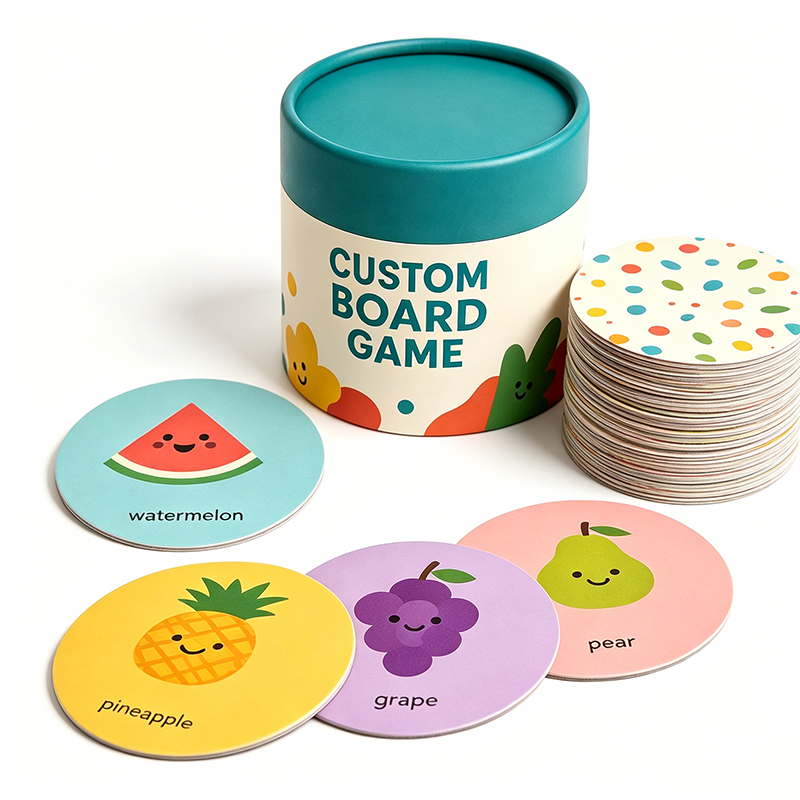
Why the scenario, not the factory, decides the specification
The starting point is a production model, not a single product. Yawanhong's board game lines operate in a mass customized printing production and manual interactive play mode, functioning across enterprise promotion, family fun, interaction, kids education, and packaging for product protection and brand display. Those functions do not place equal demands on a specification sheet. Two of them — packaging for product protection and brand display — are settled before the game is opened. The others are settled every time someone handles a card, folds a board or slides a token across a printed track.
That split is the practical reason one configuration cannot serve all three scenarios equally well. A thicker box board and a high-gloss film help a promotional game survive distribution and read clearly on a display table. The same gloss film changes how a children's game feels in the hand, and the same box board adds weight and cost that a family title may not need. The variables barely change across the three scenarios — paper weight, board thickness, print method, surface finish, edge treatment, raw-material sourcing — but the priority order changes completely.
BG-001's specification range is wide enough to accommodate that reordering: paper weights from 128 to 400 gsm and box thickness from 1.5 to 3 mm, both customizable, with dimension, colour, logo and packaging open to OEM/ODM customization. The buyer's real task is deciding where inside that range the project belongs, and what evidence should accompany it.
The shared BG-001 platform: what stays constant across all three uses
BG-001 is a custom board game built on art paper with CMYK offset printing, box board between 1.5 and 3 mm, and a finishing list covering matte lamination, glossy lamination, UV coating, embossing, debossing and project-specific options. Board size is customized per project. Production runs through equipment that includes a Heidelberg printing press, an automatic laminating machine, a varnishing machine, a gilding press, an embosser and a die-cutting machine — the sequence that turns printed sheets into a cut, finished and boxed game.
Vietnam Yawanhong Printing Culture Co., Ltd. (Yawanhong) is a printing and toy manufacturing company established in 2006, operating a 55,000 m² factory in Vietnam with 280 employees and 25 engineers, and exporting 100% of output, primarily to the United States and Europe. Its declared product scope covers board games, card games, puzzles, notebooks, colour boxes and publications alongside plastic, plush and wooden toys — which is why one order can combine a printed game board, a rigid presentation box and the protective packaging around it. The company website is www.yawanhong.vn.
Four commercial parameters matter as much as the technical specification when a scenario is being costed: a minimum order quantity of 1,000 units, a lead time of 25–45 days, 100% testing as the stated quality-control approach, and remote after-sales support. For a promotion tied to a fixed event date, the lead time is often the binding constraint rather than the unit price; for a family title sold continuously, it shapes reorder planning; for an education title, it determines how much time remains for documentation review before the stock is needed.
Enterprise promotion: packaging and brand display carry the project
In a promotional board game, the first thing the recipient evaluates is the object, not the rulebook. That is why the packaging function — product protection and brand display — dominates the specification, and why the box rather than the play surface usually absorbs the design attention.
Three decisions follow. The first is box construction. BG-001 supports box board from 1.5 mm to 3 mm, and Yawanhong's product scope includes colour boxes and lid-and-base boxes, so a promotional game can be built as a folding carton or as a two-piece box depending on the presentation the brand wants. Thicker board reads as a more substantial object; it also adds weight, which flows through freight and handling costs. The trade-off should be made deliberately rather than by default, because the box is the part of a promotional item that is seen most often.
The second is print. CMYK offset printing on the Heidelberg press is what carries a logo, a campaign visual or a full-bleed brand colour across the run. Consistency matters more in promotion than in almost any other scenario, because these items are distributed side by side — two units of the same game on the same table expose any colour drift immediately. The 100% testing approach and the stable-quality outcome recorded in the supplier's repeat OEM programme are the relevant evidence points to ask about here.
The third is surface finish. Matte lamination, glossy lamination, UV coating, embossing and debossing give a brand several ways to differentiate a promotional piece without changing the game itself: an embossed or debossed logo, a UV coating on selected printed areas, a gloss film where colour saturation matters most. Each finish is a separate line in the quotation, and each has its own durability behaviour in transit, so the selection should be tested on a physical sample rather than chosen from a digital mock-up.
One planning reality sits above all three: with a 1,000-unit minimum order quantity, promotional projects are sized in four figures. Campaigns built around smaller internal giveaways are a different procurement problem, not a smaller version of this one.
Family play: manual interaction sets the material and finishing brief
Yawanhong describes the operating mode of these products as mass customized printing production combined with manual interactive play. In a family board game, the second half of that sentence is the specification driver: the product is handled, folded, dealt and packed away repeatedly, by players of different ages, on a table at home.
Board thickness and paper weight are the first tactile decisions, and they are not the same decision as box thickness. The printed board and the components use art paper in the 128–400 gsm range, while the 1.5–3 mm figure refers to the box board. Heavier paper stock feels more substantial in the hand and is less prone to curling and creasing with repeated handling; lighter stock reduces weight and cost but shows wear sooner. Where a family board game is designed for frequent play — the classic board games and strategy board games that come out on a regular family night — the heavier end of the supported range is usually the more defensible choice.
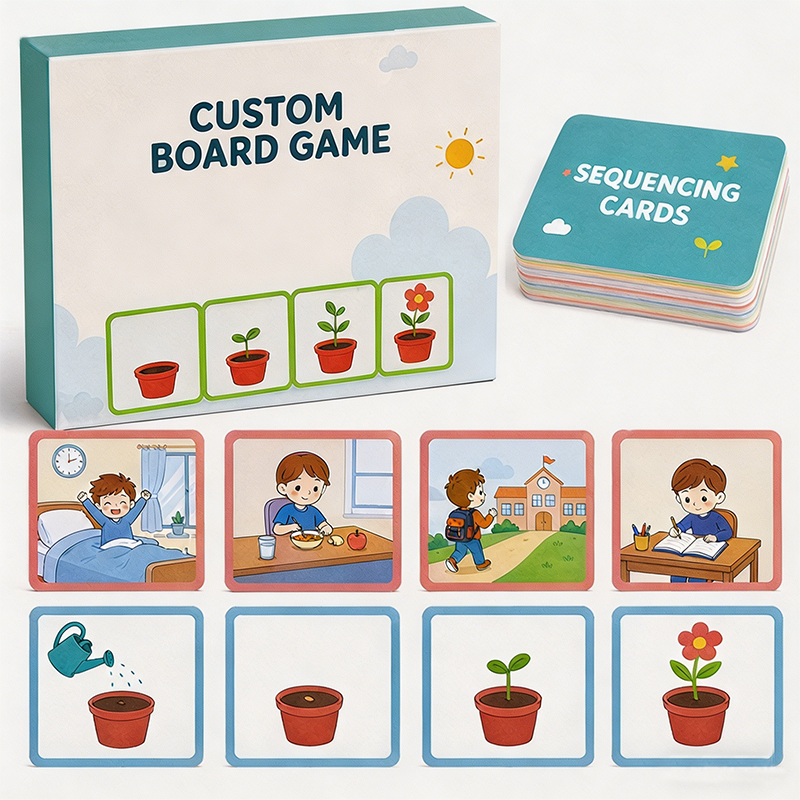
Die-cutting is as important as the stock. A neat cut determines whether tokens punch out cleanly, whether board edges feel finished, and whether the game still closes properly after a year of use. The supplier's long-running OEM case record lists neat cutting and sturdiness among the delivered results, which is the right kind of evidence to request for a family title expected to survive repeated play.
Finish choice splits on feel and glare as much as on appearance. Matte lamination produces a low-sheen surface that reduces the reflection of household lighting back towards players; glossy films raise colour saturation but show fingerprints and reflected light more readily. Neither is universally better. The decision belongs to the game's visual identity and to how much handling the surface will take, and it should be confirmed on a production-representative sample rather than a laminated proof sheet.
Kids education: paper, ink, edges and fibre sourcing set the limits
A kids education board game is a printed product with a safety specification layered on top of it. Yawanhong's application record for this scenario names four requirements directly: eco-friendly paper material, non-toxic ink, child-safe edge treatment and FSC-compliant raw materials.
Edge treatment is the most physical of the four. Die-cutting determines the finished edge of every board, tile and token, and the supplier's case record lists child-safe rounded edge treatment as a customization highlight, alongside FSC certified raw materials. For board games for kids, the practical check is simple: ask for a physical sample and run a hand over every cut edge, then confirm the same edge treatment will be applied to the full production run rather than only to the approved sample.
Paper and fibre sourcing is the second control point. FSC-compliant raw materials tie the paper component to a chain-of-custody scheme, but the claim and the certificate are not the same thing. A buyer should request the certificate number, the certificate holder, the product scope the certificate covers and its validity period, then confirm that the specific paper grade being quoted falls inside that scope. Eco-friendly paper selection and the FSC claim should be documented together, because one does not automatically establish the other.
Ink is the third. Non-toxic ink is a specification requirement that has to be confirmed by documentation rather than by description, and the documentation should be reviewed against whatever product-level requirements the destination market imposes on the buyer. That review sits with the buyer and its testing partners; the factory's system certificates support supplier qualification but do not replace product testing.
Before approving a kids board game sample, four items are worth collecting: a physical edge sample, a material declaration for paper and board, ink documentation, and certificate scope documents that match the quoted materials. Together they convert a scenario requirement into something an auditor or a retail compliance team can actually check.
Scenario comparison: the same specification range, reordered
The table below places the three scenarios against the decisions that differ most. Every value in the specification column comes from the BG-001 range; what changes is which decision the buyer should settle first.
| Specification decision | Enterprise promotion | Family play | Kids education |
|---|---|---|---|
| Dominant design goal | Brand display and product protection | Repeated manual interactive play | Safe handling with documented materials |
| Box board (1.5–3 mm) | Thicker board for presentation weight | Balanced against handling and freight weight | Selected with the same documentation as paper |
| Paper weight (128–400 gsm) | Driven by print fidelity on brand artwork | Heavier stock for durability in the hand | Eco-friendly and FSC-compliant grades |
| Print method | CMYK offset for colour consistency across the run | CMYK offset with legible play-surface detail | CMYK offset with documented ink specification |
| Surface finish | Lamination, UV, embossing or debossing for brand effect | Lower-glare finish for handling comfort | Confirmed against material documentation |
| Edge treatment | Clean die-cut edges for presentation | Neat cutting of boards and tokens | Child-safe rounded edge treatment |
| First thing to verify | Colour proof and box structure sample | Board thickness, feel and die-cut neatness | Edge sample, material declaration, certificate scope |
Where the shared platform is the wrong fit
Scenario-led specification is only useful if it also tells a buyer when to stop. Four boundaries apply to this production route.
- Volume. The stated minimum order quantity is 1,000 units. A small internal promotion below that threshold is outside the standard configuration and would require different commercial terms, not a lighter specification.
- Timing. The stated lead time of 25–45 days excludes artwork development, sampling rounds and freight. Any campaign date that leaves less than that window is a scheduling risk, not a manufacturing problem.
- Design dependence. Manufacturing controls board thickness, print quality, cutting and finishing. It does not fix a rule set. A family board game succeeds or fails on its gameplay first, and the specification work described here protects the physical product once that gameplay exists.
- Documentation versus certification scope. System credentials held by the factory qualify a supplier; they are not product approvals. A kids education title still needs the buyer's own product-level testing and market-specific conformity work, and that requirement does not disappear because a certificate exists.
A related caution applies to the factory figures used throughout this article. The 55,000 m² area, 280 staff, 25 engineers, 1,000,000-unit annual output and certification set are company-reported. They support supplier screening and audit prioritisation, and they should be confirmed through certificate documents, a factory audit and project-specific references before a purchase order is issued.
Factory, certification and case evidence behind the scenario mapping
Yawanhong's application record places this production in a normal-temperature, dust-free indoor workshop — a working condition rather than a marketing claim, and a relevant one for printed paper products where humidity and airborne dust affect print and lamination quality. The factory is listed at 55,000 m² with an annual output of 1,000,000 units and a 25-engineer team, which is the capacity band where a mid-volume custom programme with several material variants can be scheduled without every change becoming a new project.
The certification set relevant to the three scenarios is ISO 9001:2015, SMETA, BSCI and FSC. They do different jobs and should not be treated as interchangeable. ISO 9001:2015 addresses the quality management system — how production is documented, controlled and improved. SMETA is a social audit methodology and BSCI is a social compliance initiative, both aimed at working conditions and supply-chain conduct rather than at product characteristics. FSC relates to forest-product chain of custody, which is why it matters specifically for the eco-friendly and FSC-compliant paper requirement in the kids education scenario. Buyers should confirm the certificate number, holder, scope and validity of each one against the entity and products they are actually ordering.
A repeat OEM board game and card game programme recorded by the supplier covers 10,000 units for online sales across the United States, Germany, the Netherlands, Spain, France, Italy, the United Kingdom, Japan and Korea, with a five-year duration. The recorded results are stable quality, clear printing, sturdiness, neat cutting and eco-friendly output; the recorded customization highlights are full artwork and size customization, child-safe rounded edge treatment, FSC certified raw materials and one-stop printing and packaging. Because these results are supplier-reported, they are most useful as a set of questions: ask for the applicable tolerances, the sample approval record and a reference contact rather than treating the summary as an independent test report.
Market context for scenario-led customization
Custom board game buying decisions sit inside a large category. Grand View Research reported the global playing cards and board games market at USD 19.9 billion in 2024, with the board games segment accounting for a 73.4% revenue share of that total in the same year. Those figures describe the size and shape of the category; they do not demonstrate demand for any particular promotional, family or education project, and a buyer still has to test its own case.
Two practical details follow from the market structure. First, a board-game-dominant market means printed boards, boxes and component sets — the parts this production route actually makes — rather than digital or card-only formats. Second, documentation travels with the goods: for US imports, board games sit under HS code 9504.90.60.00, so the classification should be confirmed against the finished article and its components when preparing paperwork.
Consumer search language is broader than the manufacturing vocabulary. Buyers and end users describe the same category as board games, family board games, board games for kids or juegos de mesa, and they mix classic board games with newer strategy board games and adult board games. None of those labels changes the specification question, which is still whether the product is being built for display, for repeated play or for a child's hands.
Outlook: what would change this mapping
The three-way mapping is stable while three conditions hold: the scenario remains the buyer's organising principle, the supported material and finishing range continues to cover the requirement, and the documentation behind eco-friendly paper, ink and fibre sourcing remains available for review.
Each condition can move. If a destination market adds material or labelling requirements for children's printed products, the kids education column becomes the first to be re-specified, and the documentation list grows. If brands consolidate promotional spend into fewer, larger programmes, the 1,000-unit threshold becomes less of a constraint and consistency across a long run becomes more valuable. If family-game buyers shift towards lighter formats for cost or freight reasons, paper weight decisions move down the range and durability expectations have to be restated.
What is unlikely to change is the underlying logic. A custom board game is a printed object with a use case attached, and the use case is what tells the factory whether the priority is the box, the surface or the edge.
FAQ: scenario-based custom board game questions
Which materials and finishes suit a promotional custom board game?
A promotional game is normally built around the box. BG-001 supports box board from 1.5 mm to 3 mm with colour box and lid-and-base box structures, art paper from 128 to 400 gsm, CMYK offset printing, and a finishing menu of matte lamination, glossy lamination, UV coating, embossing and debossing. The stated minimum order quantity is 1,000 units and the stated lead time is 25–45 days, so both should be confirmed against the campaign date before the finishing selection is finalised.
How does a family board game differ from a promotional one in production terms?
The difference is which specification dominates rather than which machine is used. Family play depends on manual interaction, so board thickness, paper weight, die-cut neatness and surface feel carry the quality judgement, while a promotional game is judged first on box structure, print clarity and brand display. Both can be produced on the same platform, and both use the same print method.
What should a kids education board game specify?
Four requirements are recorded for this scenario: eco-friendly paper material, non-toxic ink, child-safe edge treatment and FSC-compliant raw materials. Child-safe rounded edge treatment and FSC certified raw materials also appear in the supplier's customization highlights. Buyers should request a physical edge sample, the material declaration for the paper and board, ink documentation, and certificate documents whose scope matches the quoted materials.
Which certifications should a buyer check, and what does each cover?
The company lists ISO 9001:2015, SMETA, BSCI and FSC. ISO 9001:2015 concerns the quality management system, SMETA and BSCI concern social compliance auditing, and FSC concerns forest-product chain of custody. They are supplier-system credentials rather than product approvals, so the certificate number, holder, scope and validity should be verified, and product-level testing for the destination market remains the buyer's own responsibility.
What order size and lead time apply to a scenario-specific custom board game?
The stated minimum order quantity is 1,000 units and the stated lead time is 25–45 days, excluding artwork development, sampling and freight. Quality control is described as 100% testing, and the facility is listed at 55,000 m² with an annual output of 1,000,000 units. These are company-reported figures and should be validated against the specific project volume and delivery schedule.
Yawanhong's group manufacturing brochure, covering facility and capability details, is available for download: Yawanhong VN Group Global Manufacturing (PDF).
Tem questões ou precisa de mais detalhes?
Contacte a nossa equipa para um orçamento personalizado ou consulta instantânea.
Solicitar orçamento
Preencha o formulário abaixo e a nossa equipa entrará em contacto com uma proposta personalizada.
Chat direto do WhatsApp
Prefere conversar em tempo real? Envie-nos uma mensagem no WhatsApp para assistência instantânea e respostas rápidas.
- Obter orçamento personalizado
- Partilhar fotos ou documentos
- Discuta as suas necessidades diretamente
Geralmente responde em 5–30 minutos durante o horário de expediente.