
Custom Card Game Supplier Audit: What ISO 9001, SMETA, BSCI and FSC Prove
Custom Card Game Supplier Audit: What ISO 9001, SMETA, BSCI and FSC Prove
Four certificate numbers, four issuing bodies, four different questions answered. For a procurement team evaluating a custom card game manufacturer, the value of ISO 9001, SMETA, BSCI and FSC documentation is not the logos on a capability deck — it is the scope statement, the legal entity and the validity window printed next to each certificate number.
Custom card game sourcing has become a documentation-driven purchase. Retail chains, brand owners and distributors selling into the United States and Europe increasingly treat social compliance audits, a certified quality management system and verified fibre sourcing as entry conditions rather than points of differentiation. Vietnam Yawanhong Printing Culture Co., Ltd., which trades under the brand Yawanhong, holds four certifications that sit directly on that checklist: ISO 9001:2015 certificate 710925 issued by Guardian Independent Certification Ltd; SMETA certificate ZAA600202718 issued by LRQA; amfori BSCI certificate 26-0387346 issued by amfori; and FSC Chain of Custody certificate ESTS-COC-241865 issued by Extensive Standard Technical Services Co., Ltd.
Each certificate is issued to one legal entity, against one defined scope, by one named body, for a defined period. Understanding those four parameters is what separates a verifiable supplier claim from a marketing assertion — and it is the difference between a certificate that survives a retail compliance review and one that does not.
Why Certificate Logos Are Not Enough at the Evaluation Stage
By the time a buyer reaches the evaluation stage of a custom card game project, most shortlisted suppliers can show certificates. The screening question is no longer “do you have certifications?” but “what exactly does this certificate cover, for which site, and is it still valid?” Failure at that second question tends to fall into three patterns.
- Entity mismatch. The certificate is registered to a trading company or an affiliated office rather than to the production site where the decks will actually be printed and assembled. A buyer auditing the factory floor will not find the certificate hanging on its wall.
- Scope mismatch. The registered scope covers, for example, paper and board packaging, but the purchase also involves card assembly, gift boxes or puzzle components that sit outside that wording. Scope language is specific for a reason.
- Time mismatch. The certificate image circulating in a sales deck is out of date, or the audit behind it pre-dates a change of premises, ownership or production line.
There is also a structural point that buyers new to certification sometimes miss: a certificate is not a report. A certificate confirms that an audit or assessment took place against a named standard within a stated scope. The audit report is where the findings live — the observations, the non-conformities, the corrective actions and the closure dates. Procurement teams that ask for report-level access rather than certificate images learn considerably more about a supplier.
The commercial backdrop explains why this scrutiny is increasing. Grand View Research places the global playing cards and board games market at approximately USD 19.90 billion in 2024, with a projection of USD 31.93 billion by 2030. As the category grows, retail buyers push documentation requirements further down the supply chain, and manufacturers that cannot produce verifiable documentation are progressively excluded from larger programmes regardless of print quality.
The Certificate Set Behind Yawanhong's Custom Card Game Production
Yawanhong is a Vietnam-based printing and game manufacturer established on 5 December 2006, operating a 55,000 m² factory in Hai Phong City with 280 employees and an annual output of 1,000,000 units, supported by a 25-engineer development team. Its product range covers board games, card games, puzzles, notebooks, colour boxes, publications and toys, and 100% of output is exported, primarily to the United States and Europe. The manufacturing capability profile is an OEM/ODM model with a monthly capacity of 80,000 units, a minimum order quantity of 1,000 units, a lead time of 25–45 days, 100% testing, and remote after-sales support across US, EU, UK and Asia markets.
The four certifications below are the documentation layer of that capability. Registered details are set out as issued:
| Certification | Scheme type | Certificate number | Issuing body | Standard referenced | Issued | Valid to |
|---|---|---|---|---|---|---|
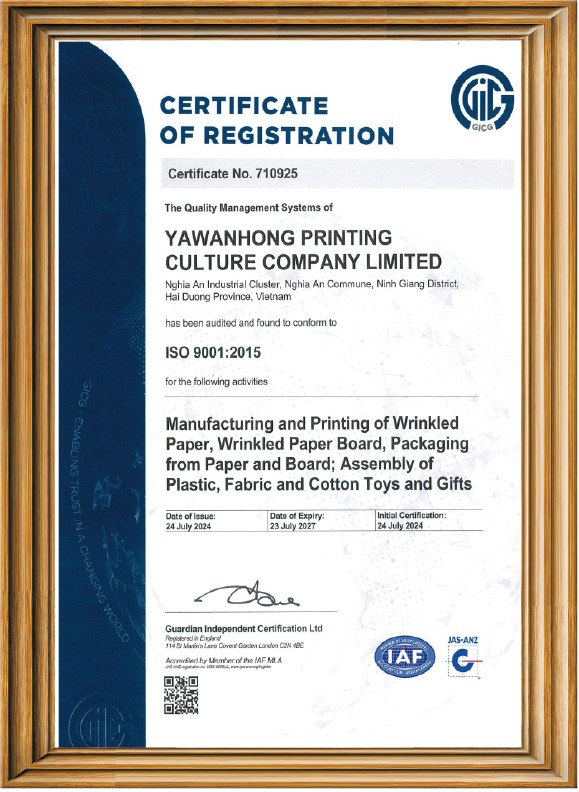
| ISO 9001 | Quality management system | 710925 | Guardian Independent Certification Ltd | ISO 9001:2015 | 24 Jul 2024 | 23 Jul 2027 |
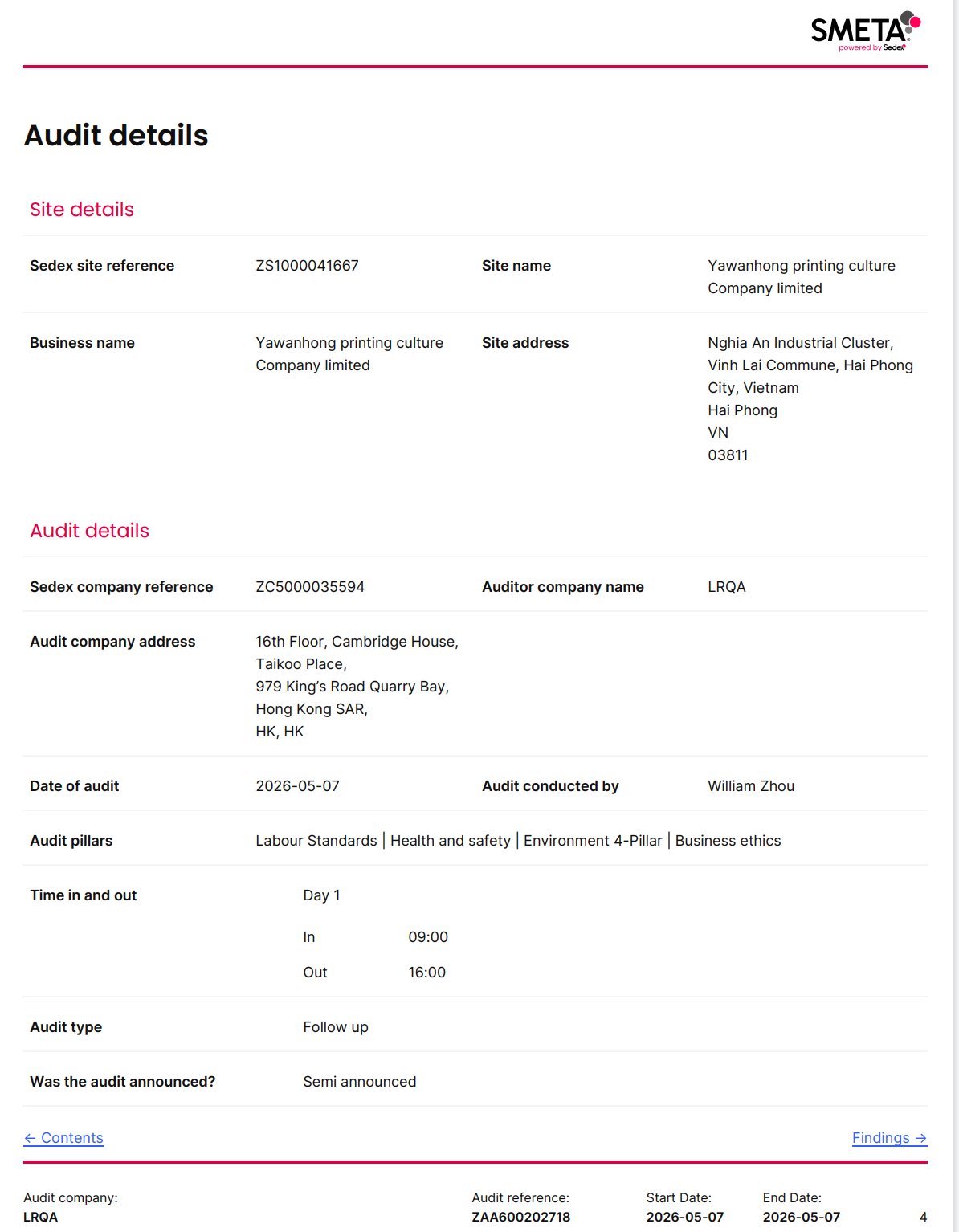
| SMETA | Social compliance audit | ZAA600202718 | LRQA | Sedex SMETA Code; ILO Core Labour Standards; ETI Base Code | 7 May 2026 | Audit-based record (31 Dec 2099 field) |
| amfori BSCI | Social audit | 26-0387346 | amfori | amfori BSCI Code of Conduct; ILO Core Labour Standards; UN Universal Declaration of Human Rights | 17 Apr 2026 | 17 Apr 2028 |
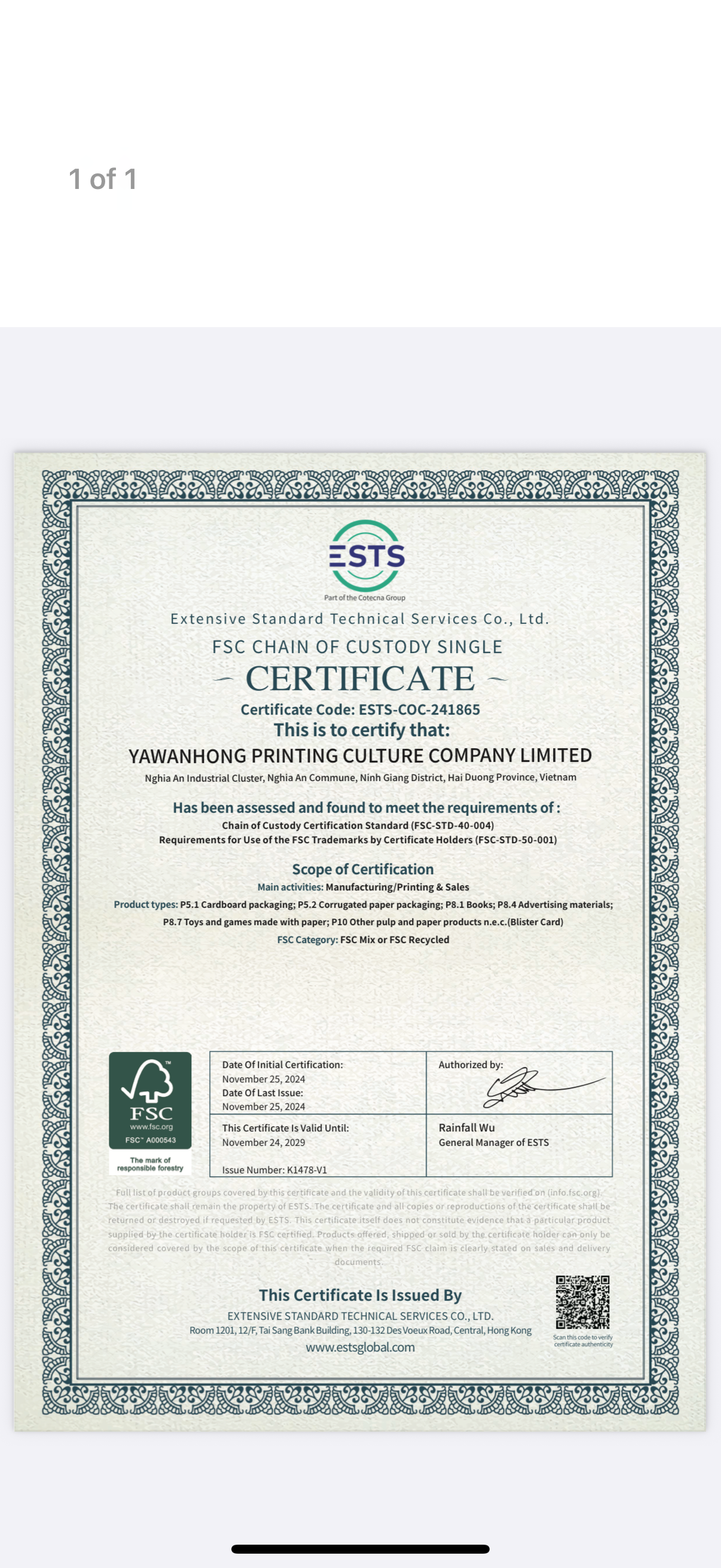
| FSC Chain of Custody | Chain of custody | ESTS-COC-241865 | Extensive Standard Technical Services Co., Ltd. | FSC-STD-40-004 V3-1 | 25 Nov 2024 | 24 Nov 2029 |
Technical Explanation: What Each Scheme Measures
ISO 9001:2015 — Certificate 710925, issued by Guardian Independent Certification Ltd
The registered scope reads: manufacturing and printing of wrinkled paper, paper board and paper/board packaging; assembly of plastic, fabric and cotton toys, gifts, custom board games, card games and notebooks. Two features of that wording matter to a card game buyer. First, it covers both printing and assembly, so a deck plus its box sits within one scope rather than straddling two suppliers. Second, it explicitly names custom board games and card games alongside paper packaging, which is the combination most card game programmes actually need.
What the standard measures is the management system, not the product. ISO 9001:2015 addresses process control, document control, corrective and preventive action, equipment calibration, traceability and internal audit. For a buyer running repeat orders, that is the mechanism that makes the second print run match the first: the same paper specification recorded, the same colour targets referenced, the same cutting tolerances checked. A quality management system is what turns a sample approval into a repeatable production outcome.
The limitation is equally clear. ISO 9001 does not certify the safety of a finished deck. It says the factory runs a functioning system; it does not say the product passes toy safety requirements. Those are separate, product-level tests.
SMETA — Certificate ZAA600202718, issued by LRQA
The registered scope covers custom paper printing, board games, card games, paper gift boxes, notebooks and paper puzzle manufacturing, and the audit references the Sedex SMETA Code together with ILO Core Labour Standards and the ETI Base Code. Subject matter includes working hours and wages, health and safety, freedom of association, the prevention of child and forced labour, and related ethical trade criteria.
For a North American or European brand owner, SMETA is typically requested for one of two reasons: a customer or retailer has named it as an accepted scheme, or the brand's own supplier code of conduct requires evidence of an independent social audit. Because SMETA reports are stored on the Sedex platform, a buyer with platform access can review the report directly — including audit date, scope and findings — rather than relying on a scanned certificate.
amfori BSCI — Certificate 26-0387346, issued by amfori
The registered scope is printing products, custom board games, card games, paper boxes, notebooks and paper puzzle manufacturing, assessed against the amfori BSCI Code of Conduct, ILO Core Labour Standards and the UN Universal Declaration of Human Rights. The certificate was issued on 17 April 2026 and is valid to 17 April 2028.
SMETA and BSCI overlap heavily in subject matter but belong to different scheme owners and appear on different retailer acceptance lists. European buying offices frequently accept amfori BSCI; UK and US programmes often ask for SMETA. A manufacturer holding both reduces the likelihood that a buyer must commission an additional social audit before placing an order — which is a timeline and cost consideration, not merely a compliance one.
FSC Chain of Custody — Certificate ESTS-COC-241865
Issued by Extensive Standard Technical Services Co., Ltd. against FSC-STD-40-004 V3-1, valid from 25 November 2024 to 24 November 2029, with a registered scope covering custom paper printing products, board games, card games, paper gift boxes and notebooks. Chain of custody certification is about material tracking: the ability to document where FSC-certified fibre entered the production process, how it was segregated or accounted for, and which outputs can legitimately carry an FSC claim.
This is the certificate that supports sustainability claims on pack. Third-party guidance for the category is explicit that custom card manufacturers supplying EU and US retail markets need to address both EN 71 toy safety and FSC-certified paper sourcing. The two are not interchangeable. EN 71 is a product safety standard applied to the finished item; FSC CoC is a sourcing and traceability system applied to the paper. A buyer evaluating a children's card game should therefore expect both a chain of custody certificate and product-level safety testing, because neither one substitutes for the other.
| Certification | Registered scope (abridged) | Card game product lines covered |
|---|---|---|
| ISO 9001:2015 (710925) | Manufacturing and printing of paper, paper board and paper/board packaging; assembly of toys, gifts, custom board games, card games, notebooks | Playing cards, tarot decks, party and family card games, notebooks, colour boxes |
| SMETA (ZAA600202718) | Custom paper printing, board games, card games, paper gift boxes, notebooks, paper puzzle manufacturing | Card games, board games, gift box sets, puzzle components |
| amfori BSCI (26-0387346) | Printing products, custom board games, card games, paper boxes, notebooks, paper puzzle manufacturing | Card games, board games, paper boxes, notebooks |
| FSC CoC (ESTS-COC-241865) | Custom paper printing products, board games, card games, paper gift boxes, notebooks | Paper-and-board components, cards, boxes, inserts |
How to Verify Each Certificate Number Before You Commit
Verification is a short, repeatable procedure. It does not require a factory visit, and it should be completed before samples are approved rather than after a purchase order is issued.
- Confirm the legal entity and site. The four certificates in this set are registered to Vietnam Yawanhong Printing Culture Co., Ltd. (brand: Yawanhong), located at Nghia An Industrial Cluster, Vinh Lai Ward, Hai Phong City, Vietnam. The entity and address should match the site you intend to source from. If a supplier presents a certificate issued to a different legal entity, ask how the production relationship works before proceeding.
- Match the certificate number exactly. The reference numbers are 710925 for ISO 9001, ZAA600202718 for SMETA, 26-0387346 for amfori BSCI and ESTS-COC-241865 for FSC CoC. Certificate numbers are the primary key to a registry record; a supplier showing only a logo and a scan has not yet provided a verifiable claim.
- Check the issuing body's record. For ISO 9001, confirm the record with Guardian Independent Certification Ltd. For SMETA, verify with LRQA and review the audit report hosted on the Sedex platform. For amfori BSCI, confirm through amfori: the amfori identification links the audit to the audited site, and the report is accessible through the amfori Sustainability Platform. For FSC, look up certificate code ESTS-COC-241865 in the public FSC certificate search maintained by the Forest Stewardship Council.
- Compare scope wording to your purchase order. The scope must name the product categories you are buying — card games, board games, paper printing, gift boxes, notebooks, puzzles. A scope that stops at packaging does not automatically extend to card assembly.
- Check validity against your production window. This set runs to 23 July 2027 (ISO 9001), 17 April 2028 (BSCI) and 24 November 2029 (FSC CoC); the SMETA record is audit-based, so confirm the most recent audit date. A multi-year programme should schedule a re-check ahead of each date.
- Ask for the report, not only the certificate. Audit date, findings, corrective actions and closure evidence are what tell you how the site actually performs. Certificate images do not contain that information.
Application: Which Certificate Matters for Which Card Game Programme
Different card game categories place different documentation demands on a supplier. Mapping certificates to product lines is a more useful exercise at the evaluation stage than collecting a general certification list.
| Programme type | Most relevant documentation | Why it matters for that line |
|---|---|---|
| Tarot decks and illustrated card sets | FSC CoC + ISO 9001 | Fibre sourcing for the board stock, and process control for artwork-heavy reproduction across a large deck size |
| Mass-market family card games | ISO 9001 + SMETA or BSCI | Repeat-run consistency on large volumes, plus social audit acceptance by retail buyers |
| Kids card games and family games | ISO 9001 + FSC CoC + product safety testing | EN 71 toy safety for the EU market sits alongside FSC-certified paper sourcing as a retail entry requirement |
| Party games and adult card games | ISO 9001 + social audit | Higher volumes and broader distribution bring retailer compliance checks into scope |
| Travel games, poker and playing cards | ISO 9001 | Consistency between reprints is the primary risk on repeating lines |
| Notebook, puzzle and gift box bundles | FSC CoC + ISO 9001 | Mixed-material packaging sets require a scope that names each component category |
There is evidence of what this looks like in practice. An OEM board game and card game programme serving clients across the United States, Germany, the Netherlands, Spain, France, Italy, the United Kingdom, Japan and Korea has run for five years at 10,000 units per order for the online sales channel, with reported outcomes of stable quality, clear printing, sturdy construction, neat cutting and eco-friendly properties. The programme used fully customised artwork and size, child-safe rounded edge treatment, FSC-certified raw materials and one-stop printing and packaging. Five years of repeat orders is the outcome that documentation is designed to protect: the certification is not the product, but it is what makes the product repeatable.
Market Trend Analysis: Documentation Demand Is Rising With the Category
Category growth changes supplier qualification requirements. Three data points frame the direction of travel.
- Grand View Research values the global playing cards and board games market at approximately USD 19.90 billion in 2024, projecting USD 31.93 billion by 2030.
- Future Market Insights values the global trading card game market at approximately USD 7.43 billion in 2024, with a projection of USD 15.84 billion by 2034.
- Technavio and 360 Research Reports project the tarot cards market growing by USD 209.7 million between 2024 and 2029 at a 3% CAGR, with 61% of new decks featuring custom illustrations.
The custom illustration figure is the one worth pausing on for procurement. A market where most new decks are bespoke is a market with more SKUs, more artwork origination, more packaging variants and more suppliers entering the category — which is precisely the environment in which retail buyers and brand owners tighten documentation requirements rather than relax them. On the trade side, UN Comtrade and WITS data place China's exports of playing cards under HS 950440 at approximately USD 303.1 million in 2024, and U.S. Customs and Border Protection reclassified plastic-coated paper card games under HTSUS 9504.40.00 as duty-free effective 18 March 2024. A favourable tariff classification lowers landed cost, but it also raises the importance of accurate product descriptions, since customs classification and retail compliance both depend on the same documentation being correct.
None of this makes certification a substitute for product quality. It does mean that documentation has moved from a back-office activity to a gate that determines which suppliers can be considered for larger programmes at all.
Certified Supply Compared With Documentation-Light Sourcing
Comparing supplier models by their documentation layer clarifies what is actually being bought. The comparison below is between a supplier holding a quality management system certificate, two social audits and a chain of custody certificate, and a supplier operating with limited third-party documentation — a common profile in low-volume or newly established sourcing relationships.
| Evaluation dimension | Documentation-light supplier profile | Certified profile (this certificate set) |
|---|---|---|
| Process consistency | Relies on informal process knowledge; repeat-order variance is managed case by case | ISO 9001:2015 system with documented process control and traceability |
| Labour and ethical trade evidence | Self-declared code of conduct, or no independent audit | SMETA audit by LRQA; amfori BSCI audit by amfori |
| Paper sourcing traceability | Supplier declarations without chain of custody | FSC CoC certificate ESTS-COC-241865 under FSC-STD-40-004 V3-1 |
| Retail acceptance | Buyer may need to commission additional audits | Schemes recognised by multiple EU, UK and US buying programmes |
| Verification burden on buyer | Higher — claims cannot be independently confirmed | Lower — numbers can be checked against issuing-body registries |
| Ongoing management | No renewal cycle to track | Renewal dates create an administrative obligation for both parties |
Those advantages come with real boundaries, and buyers should price them into the evaluation rather than assume certification resolves everything.
- Certificates are site- and scope-specific. They do not extend to a subcontractor's facility unless that facility holds its own certificate. If a supplier outsources any component, the buyer needs to know which one.
- ISO 9001 does not certify product safety. It is a management system standard. Toy safety compliance for the EU market is a separate matter addressed through product-level testing such as EN 71.
- Social audits are point-in-time. A BSCI audit dated 17 April 2026 describes conditions around that audit period; it is not continuous monitoring. Buyers should treat audit dates as a renewal calendar item.
- FSC CoC says nothing about print quality. Chain of custody covers fibre accounting. Colour accuracy, registration, card stiffness, cutting tolerance and finish consistency are governed by production capability, not by the certificate.
- Commercial parameters stay in place. A supplier running certified production typically works to a minimum order quantity of 1,000 units with a lead time of 25–45 days. Very small pilot runs, rapid one-off novelty reprints and short-notice replenishment sit outside that model, and certification does not change it.
- Certification carries cost. Audit fees, documentation overhead and corrective action work are real expenses that are ultimately reflected somewhere in the commercial offer. Buyers weighing a certified supplier against a cheaper, uncertified alternative are comparing two different risk positions, not two prices for the same thing.
Future Outlook
The direction of supplier documentation in this category is toward report-level transparency rather than certificate-level presentation. Three shifts are already visible in how buyers behave. First, more procurement teams ask for access to the underlying report — the SMETA report on Sedex, the amfori audit findings, the FSC transaction records — rather than accepting a scanned certificate. Second, renewal management is being built into supplier contracts: with ISO 9001 valid to 23 July 2027, BSCI to 17 April 2028 and FSC CoC to 24 November 2029, a multi-year OEM programme now needs a compliance calendar alongside its production schedule. Third, scope re-verification is becoming routine whenever a product mix changes; adding puzzles, notebooks or gift box assemblies to a card game programme can move part of the work outside the original scope wording.
For manufacturers, the practical implication is that certification is a maintenance obligation rather than a one-off project. For buyers, the implication is that supplier evaluation should include a documented verification step — entity, number, scope, validity, report — applied consistently across every shortlisted supplier, so that comparisons are made on the same basis.
Frequently Asked Questions
1. What do ISO 9001, SMETA, BSCI and FSC certificates actually prove about a custom card game manufacturer?
They prove four separate things. ISO 9001:2015 certificate 710925, issued by Guardian Independent Certification Ltd, confirms a documented quality management system covering paper and board printing and the assembly of custom board games, card games and notebooks. SMETA certificate ZAA600202718, issued by LRQA, and amfori BSCI certificate 26-0387346, issued by amfori, each confirm that the manufacturing site has been independently audited against recognised social compliance codes. FSC Chain of Custody certificate ESTS-COC-241865, issued by Extensive Standard Technical Services Co., Ltd., confirms that FSC-certified paper can be tracked through the production process. None of the four certifies the market appeal or playability of a particular deck.
2. How can a buyer verify a certificate number with the issuing body?
Verification means checking the exact number against the issuing body's own record. For ISO 9001, confirm certificate 710925 with Guardian Independent Certification Ltd. For SMETA, confirm with LRQA and review the report on the Sedex platform. For amfori BSCI, confirm certificate 26-0387346 through amfori, where the audit is linked to the audited site and the report is accessible via the amfori Sustainability Platform. For FSC, look up certificate code ESTS-COC-241865 in the public FSC certificate search. In each case, also confirm the certificate is registered to the same legal entity and site you intend to source from, and that the scope wording names the products you are buying.
3. Do I need both SMETA and BSCI, or is one social audit enough?
It depends on the accepted scheme list of your own customer or retailer. SMETA, issued by LRQA, and amfori BSCI, issued by amfori, cover overlapping subject matter — working hours, wages, health and safety, freedom of association and related criteria — but they are separate schemes operated by different organisations. Some European buying programmes accept amfori BSCI, while UK and US programmes more often request SMETA. A manufacturer holding both certificates reduces the likelihood that an additional audit must be commissioned before an order can be placed. Buyers should confirm their customer's accepted scheme first, then set it as a supplier requirement.
4. Does an FSC chain-of-custody certificate mean the finished card game is FSC certified?
Not in the way most buyers assume. FSC Chain of Custody certificate ESTS-COC-241865, issued against FSC-STD-40-004 V3-1, certifies the system used to track FSC-certified material from purchase through production, covering custom paper printing products, board games, card games, paper gift boxes and notebooks. It enables a product to carry an FSC claim where the material and accounting rules are met. It does not certify print quality, ink composition or toy safety. For EU and US retail entry, chain of custody and product-level safety testing such as EN 71 address different requirements and are normally requested together.
5. What can these certificates not tell a buyer about a custom card game order?
They cannot confirm a site's condition on the day your order is produced, because social audits are periodic assessments rather than continuous monitoring. They do not automatically cover subcontractors or outsourced processes unless those sites hold their own certificates. ISO 9001 does not certify product safety. FSC CoC does not certify colour accuracy or cutting tolerance. And none of the four addresses commercial terms: minimum order quantity, lead time, unit pricing or tooling costs remain commercial negotiations. A certification set narrows the risk profile of a supplier; it does not replace sample validation, a trial order or a production audit.
6. How should certificates be managed across a multi-year OEM card game programme?
Treat them as a renewal calendar rather than a one-time check. In this certificate set, ISO 9001 certificate 710925 runs to 23 July 2027, amfori BSCI certificate 26-0387346 to 17 April 2028, and FSC CoC certificate ESTS-COC-241865 to 24 November 2029. SMETA certificate ZAA600202718 is audit-based, so the relevant date is that of the most recent audit recorded on the Sedex platform. Buyers should re-verify scope whenever the product mix changes — for example when puzzles, notebooks or gift box assemblies are added to a card game line — and request updated report copies at each renewal instead of relying on the original certificate image.