
Custom Card Games: Production, Options, and Sourcing Decisions
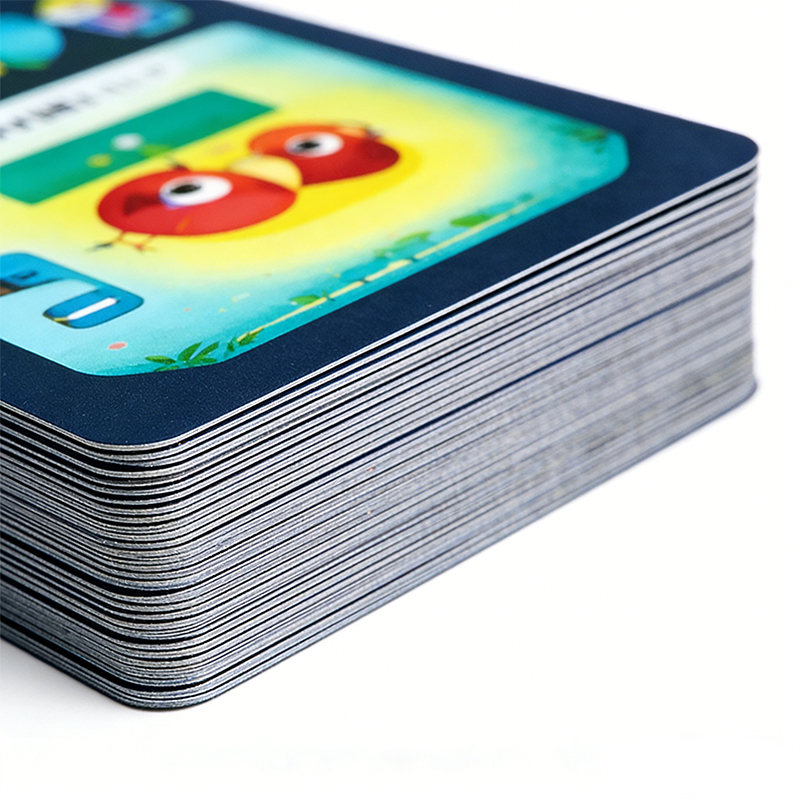
A deck of playing cards is one of the most common formats in custom card game production.
Custom Card Games: Production, Options, and Sourcing Decisions
Custom card games have moved beyond the traditional deck of cards. Brands, educators, and independent designers are using customized tarot cards, poker cards, party card games, and travel-friendly decks to reach specific audiences. Buyers at the awareness and research stage often need to understand how custom card game manufacturing works before they can decide what to order. This industry overview explains what a card game factory controls during production, what material and finishing choices mean for the final product, and what sourcing questions matter when bringing a custom deck to market.
Why Standard Playing Cards Are Not Enough
Most custom card game projects start with a simple problem: a stock deck does not reflect the brand, the game mechanics, or the audience. A party card game built around conversation prompts may need a different card size and a durable surface that can survive frequent handling. A tarot deck may need larger cards, custom artwork, and a premium feel. A kids game may require rounded corners and printing that is safe for children. A travel game may need a compact size that fits into backpacks or luggage. These requirements point to the same conclusion: card production must be treated as a customizable process, not a fixed product.
The popularity of card-based entertainment supports this shift. Mattel reports that its UNO property was the number one global property in the Games category in its 2024 annual report. That familiarity makes card games attractive to new entrants, while also raising the bar for design quality, print accuracy, and packaging. In this environment, a manufacturer's ability to support custom card game printing becomes a core part of product development.
The Opportunity in Custom Card Game Production
The demand for custom card games is visible across multiple market reports. Grand View Research estimated the global playing cards and board games market at about USD 19.90 billion in 2024, with a projection of USD 31.93 billion by 2030. Future Market Insights estimated the global trading card game market at approximately USD 7.43 billion in 2024 and projected it to reach USD 15.84 billion by 2034. The tarot cards market is projected to grow by USD 209.7 million from 2024 to 2029 at a compound annual growth rate of 3 percent, and one report notes that 61 percent of new tarot decks feature custom illustrations. These numbers help explain why brands are looking for card game custom printing rather than relying on generic inventory.
On the supply side, China exported roughly USD 303.1 million of playing cards in 2024, according to UN Comtrade and WITS data, underscoring how established the global production network has become. Vietnam is also an active manufacturing base for printed games and paper products, which gives buyers multiple options when selecting a factory partner.
A Production-Based View: Yawanhong as a Reference Case
Vietnam Yawanhong Printing Culture Co., Ltd. is a Vietnam-based manufacturer established in 2006. The company operates a 55,000 square meter factory with approximately 280 employees and specializes in board games, card games, puzzles, notebooks, color boxes, publications, plastic toys, plush toys, and wooden toys. Its R&D team includes 25 engineers, and annual production capacity reaches 1,000,000 units. The company reports that 100 percent of its sales come from exports, mainly to the United States and Europe.
For custom card game projects, Yawanhong works with formats such as poker cards, tarot cards, flash cards, and playing cards. The product is listed as model CG-001 and is intended for the printing, game toy, and manufacturing industries. Yawanhong also reports manufacturing certifications including BSCI, SMETA, FSC, ISO 9001, and Disney FAMA, which can be relevant for brands that need documented compliance alongside production capability.
The factory is designed for mass customized printing production. The production environment is a normal temperature, dust-free indoor workshop, and the equipment list includes Heidelberg printing presses, automatic laminating machines, varnishing machines, gliding presses, embossers, and die-cutting machines. Buyers evaluating a supplier should look for this combination of printing, finishing, and converting capabilities.
Technical Explanation: How a Custom Card Game Is Built
The base material for a custom card game is usually coated paper or art paper. Paper weight typically ranges from 128 to 400 gsm, and the final card size is customizable. This weight range matters because a lighter deck may be suitable for travel games with many cards, while a heavier stock can give a premium feel for tarot or collectible decks.
Printing options include CMYK four-color process for photographic color and Pantone color printing for consistent brand colors. Surface finish can include matte lamination, glossy lamination, linen, UV coating, or varnishing. These finishes change both appearance and handling. Corners can be round or square, and card edges can be standard, colored, or gold foil. Edge treatments are an often ignored detail that can give a deck a distinctive look on the table.
In Yawanhong's production model, special requirements for card game projects include eco-friendly paper material, non-toxic ink, child-safe edge treatment, and FSC-compliant raw materials. These requirements are not just aesthetic preferences; they are often prerequisites for selling into regulated retail channels. EN 71 is frequently cited for toy safety in the EU, and FSC certification is used to document responsible paper sourcing. Buyers should ask how a manufacturer handles these requirements before production begins.
Application and Use Cases
Custom card games now serve a wide range of audiences and play settings. A typical factory order can cover several distinct use cases:
- Family card games and card games for families: decks with simple rules, durable stock, and bright illustrations.
- Kids card games and card games for kids: rounded corners, non-toxic printing, and sturdy construction for frequent handling.
- Adult card games and party games: coated cards that can handle busy table settings, including drinking games where durability matters.
- Travel card games and travel games for adults: compact decks that use lighter paper and fit into small storage.
- Tarot cards: larger formats with custom illustrations and premium surface finish.
- Couples card games: card decks designed around conversation prompts or relationship activities.
- Poker cards and custom game cards for promotions: decks with branded backs, custom suits, or special edition artwork.
These applications share the same basic production logic: the card size, paper weight, print process, finish, and edge can be adjusted before cutting. A manufacturer operating in mass customized printing production can respond to these variations while maintaining consistent quality across the order.
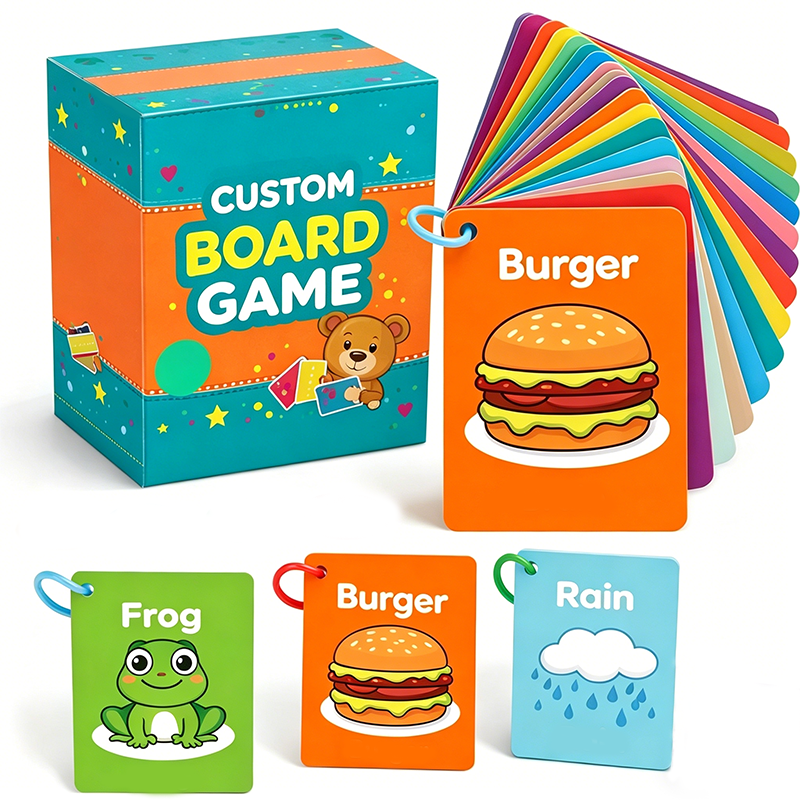
Card games designed for children require materials and edge treatments suited to frequent handling.
Market Trend Analysis
Several trends are shaping the custom card game market. First, the overall market for playing cards and board games is expanding, with Grand View Research forecasting growth from USD 19.90 billion in 2024 to USD 31.93 billion by 2030. Second, specialized card categories are attracting investment: the trading card game market is projected to grow from USD 7.43 billion in 2024 to USD 15.84 billion by 2034, according to Future Market Insights. Third, art-led decks are becoming more common, particularly in the tarot segment, where custom illustrations appear in 61 percent of new releases.
Compliance is another trend. Retailers in the United States and Europe increasingly ask for documented safety and sustainability standards. EN 71 for toy safety and FSC for paper sourcing are widely mentioned requirements for custom card manufacturers. In the United States, plastic-coated paper card games were reclassified under HTSUS 9504.40.00 as duty-free effective March 18, 2024, which may affect import cost calculations for some products.
For buyers, the practical implication is to evaluate suppliers on their ability to manage both customization and compliance. A factory with dedicated R&D, export experience, and certified paper sourcing is better positioned to support this kind of work.
Comparison with Traditional Solutions
Traditional options for card production include buying stock playing cards from a local printer or using generic game components. These routes can be fast and inexpensive for small quantities, but they usually limit design flexibility. A stock deck may have a fixed card size, one lamination option, and no ability to control paper weight or card edge appearance.
A dedicated custom card game manufacturer offers a different operating model. Instead of adapting a generic product, the factory starts the project with a specification that can adjust card size, paper weight, print process, corner style, surface finish, and edge treatment. Yawanhong's CG-001 illustrates this flexibility. However, this model also has a real boundary: it is built for mass customized production. Buyers who need a few hundred test decks or who are still changing the game design every week may find a local short-run printer more suitable. The dedicated factory model becomes valuable once the design is stable and the order volume justifies the setup and lead time.
| Criteria | Stock deck / local short-run print | Dedicated custom card game OEM |
|---|---|---|
| Card size | Standard sizes only | Custom size |
| Materials | Generic paper stock | 128-400 gsm coated paper or art paper |
| Printing | Basic color printing | CMYK 4C or Pantone color printing |
| Finish | Limited coating options | Matte lamination, glossy lamination, linen, UV coating, varnishing |
| Corners and edges | Often fixed | Round or square corners; standard, colored, or gold foil edges |
| Compliance support | Limited | FSC-compliant raw materials, EN 71 readiness, documented export standards |
| Order model | Small runs | Mass customized production |
Future Outlook
The direction of the market points toward more design-led card products. Tarot decks now rely heavily on custom commissions, trading cards continue to grow as a collectible format, and family, travel, and adult card games give brands new ways to enter the category. At the same time, regulations and retail requirements are becoming more structured. Environmental expectations are moving beyond a single material choice, and buyers are being asked to document sourcing, safety, and production conditions.
Manufacturers with a large factory footprint, an in-house R&D team, and experience serving export markets are likely to remain relevant for custom card game projects. Vietnam Yawanhong's 55,000 square meter facility, 25-engineer R&D team, and focus on board and card games provide a useful example of the production capacity involved in this sector.
Frequently Asked Questions
What is a custom card game?
A custom card game is a deck of cards produced to a buyer's specifications for a specific game, audience, brand, or region. It can be a poker card, tarot card, flash card, or playing card format. A manufacturer such as Yawanhong offers model CG-001 for the printing, game toy, and manufacturing industries.
What paper or card stock is used for custom card games?
Most custom card games are made from coated paper, with art paper as the primary material. Paper weight ranges from 128 to 400 gsm or custom, and the final card size is customizable.
What customization options are available in custom card game printing?
Common options include CMYK 4C printing or Pantone color printing, matte or glossy lamination, linen, UV coating, varnishing, round or square corners, and standard, colored, or gold foil card edges.
What compliance requirements matter for custom card games going into EU or US markets?
Custom card manufacturers are generally expected to meet relevant toy safety and sourcing standards. EN 71 is frequently cited for EU toy safety, and FSC compliance is used to document responsible paper sourcing. In the United States, plastic-coated paper card games were reclassified under HTSUS 9504.40.00 as duty-free effective March 18, 2024.
Are custom card games only suitable for large orders?
Most dedicated card game factories operate in mass customized printing production, which is designed for stable designs and larger order volumes. Low-volume prototyping or frequent design changes may be better handled by local digital or short-run printers.
For further reference, the Yawanhong global manufacturing brochure is available for public download: Yawanhong VN Group Global Manufacturing.